
An immersion blender for meal prep can simplify soups, sauces, purees, and small-batch food preparation without requiring a full-size countertop blender. However, blade design, shaft length, speed control, attachments, and safe handling matter more than appearance alone. This guide explains how to choose a practical hand blender that fits your cooking habits and kitchen equipment.
- Quick Answer: What Should You Look For?
- Understanding Immersion Blenders
- Choosing the Right Motor and Speed Control
- Blending Shaft Design and Material
- Essential Features for Meal Prep
- Which Attachments Are Worth Having?
- Practical Meal Prep Applications
- Safe Operation During Meal Prep
- Cleaning and Long-Term Maintenance
- Choosing an Immersion Blender for Different Households
- Common Buying Mistakes
- Frequently Asked Questions
- Conclusion
Quick Answer: What Should You Look For?
For most home cooks, a corded immersion blender with a detachable blending shaft, comfortable handle, and useful speed control is a sensible starting point.
Choose a model that matches your typical cookware, ingredient quantities, and cleaning preferences.
Prioritize these features:
-
A detachable blending shaft for convenient cleaning.
-
A suitable blending head design for your usual cookware.
-
Comfortable grip and easily controlled activation.
-
Appropriate speed settings for soups, sauces, and purees.
-
Sufficient shaft length for the intended container.
-
Clear hot-food operating instructions.
-
Manufacturer-supported attachments when genuinely useful.
-
Available replacement parts and understandable care guidance.
An immersion blender should improve preparation efficiency without introducing unnecessary complexity or unsafe handling.
Understanding Immersion Blenders
What Is an Immersion Blender?
An immersion blender, also called a hand blender or stick blender, is a handheld appliance with a rotating blade assembly near the end of a blending shaft.
The user places the blending head into ingredients inside a suitable container and operates the motor to process them.
Unlike a conventional countertop blender, an immersion blender does not normally require transferring the entire mixture into a separate blending jar.
This makes it particularly useful for certain soups, sauces, dressings, and purees.
However, its capabilities depend on motor design, blade configuration, container shape, and ingredient consistency.
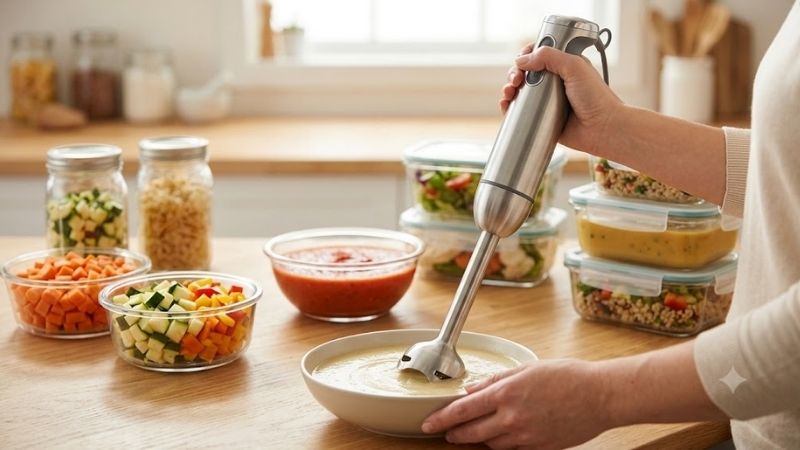
How Does an Immersion Blender Work?
An electric motor rotates blades inside a protective blending head.
The blade movement creates circulation that draws nearby ingredients into the cutting area.
As food passes through the blade zone, it is broken into smaller particles.
The resulting texture depends on ingredient softness, liquid quantity, blending time, and equipment capability.
Immersion blenders are effective for many liquid-rich mixtures, but they are not automatically suitable for every thick or dry preparation.
Always check the permitted ingredients and operating restrictions of the exact model.
Immersion Blender vs. Countertop Blender
Both appliances can puree suitable foods, but their workflows differ.
| Feature | Immersion Blender | Countertop Blender |
|---|---|---|
| Typical preparation | Blending directly in suitable containers | Processing inside a dedicated jar |
| Storage | Often compact and easy to store | Usually requires more space |
| Batch size | Depends on shaft length and container | Depends on jar capacity |
| Soups | Convenient for appropriate in-pot pureeing | May require transferring portions |
| Smoothies | Possible with suitable ingredients and containers | Often better suited to mixed frozen ingredients |
| Cleaning | Shaft and blending head require careful washing | Jar, lid, seals, and blades require cleaning |
| Additional tasks | Depends on included attachments | Depends on blender design and accessories |
For cooks who frequently prepare pureed soups or sauces, an immersion blender may reduce transfers and cleanup.
For dense smoothies or mixtures containing substantial frozen ingredients, a suitable countertop blender may be more appropriate.
Choosing the Right Motor and Speed Control
How Important Is Motor Wattage?
Motor wattage is one specification manufacturers commonly advertise.
However, it does not provide a complete measure of blending performance.
Blade geometry, torque delivery, motor control, and the design of the blending head also influence how effectively food moves through the blades.
A higher advertised wattage does not guarantee smoother results or better durability.
Compare credible published performance evidence using ingredients similar to those you prepare.
For example, blending cooked vegetables into soup is a different workload from processing dense chickpeas into a thick puree.
Variable Speed vs. Fixed Speed
Some immersion blenders use a simple fixed-speed design, while others offer multiple settings or variable-speed triggers.
Variable speed can be useful when beginning with delicate or relatively thin mixtures.
Starting at a lower suitable setting may help limit splashing, depending on the appliance and container.
Higher settings may be appropriate for processing softer solids once the blending head is properly submerged.
However, more speed settings do not necessarily make an appliance better.
For everyday meal prep, predictable control and comfortable operation are more valuable than a large number of advertised speed levels.
Is a Turbo Button Necessary?
Some immersion blenders include a turbo or temporary high-speed function.
This can be useful for certain mixtures when the manufacturer approves the workload.
However, high-speed operation may increase splashing if the blending head is positioned incorrectly.
It can also make a thick mixture harder to control.
Treat turbo settings as optional rather than essential.
An appliance that handles your usual recipes consistently at ordinary settings may be entirely sufficient.
Blending Shaft Design and Material
Stainless Steel vs. Plastic Shafts
Immersion blenders may use stainless steel, plastic, or combinations of different materials around the blending shaft and guard.
Stainless steel shafts are common in models intended for a variety of kitchen tasks.
However, the material alone does not establish suitability for hot food, nonstick cookware, or dishwasher cleaning.
Plastic components may be lighter or serve particular protective functions, but material characteristics and temperature restrictions are model-specific.
Review the manufacturer’s instructions for food-contact suitability, heat exposure, and cleaning.
Do not assume that every stainless steel shaft can be used without restriction in a hot cooking pot.
Choosing the Right Shaft Length
Shaft length affects how comfortably the blending head reaches food inside a container.
For shallow bowls, measuring cups, and small saucepans, a relatively short shaft may be convenient.
For deeper stockpots, a longer shaft can improve reach.
However, a long shaft may be awkward when processing small portions in narrow containers.
Consider the cookware you use most frequently.
A blender intended mainly for two-person meals may not require the same reach as one used for large batches of soup.
Blending Head Shape and Splash Control
The blending head surrounds the blades and influences how ingredients enter the cutting area.
Different guard shapes can affect circulation, suction against the bottom of a container, and splashing behavior.
Some designs include features intended to reduce splashing or prevent the head from sticking to the vessel.
These features may help, but their effectiveness depends on ingredients and operating technique.
A wider guard may also require more room inside small blending cups.
Choose a head shape appropriate for the containers you normally use.
Can an Immersion Blender Scratch Nonstick Cookware?
Contact between a metal blending head and a delicate cookware surface can cause damage.
Some immersion blenders include protective features, but these do not necessarily make every model suitable for every nonstick coating.
Check both the immersion blender’s instructions and the cookware manufacturer’s care requirements.
When compatibility is uncertain, transfer ingredients to a suitable separate container before blending.
Do not assume that avoiding obvious scraping completely eliminates the risk of surface damage.
Essential Features for Meal Prep
Detachable Blending Shaft
A detachable shaft can simplify cleaning and storage.
It also makes it easier to handle the blade assembly separately from the motor housing.
Check how the attachment locks into place and whether the release mechanism is accessible without touching sharp edges.
The shaft should remain securely attached during normal operation.
For frequent meal preparation, a straightforward attachment system is preferable to complicated components that are difficult to reassemble.
Comfortable Handle and Weight
Immersion blenders are handheld appliances, so ergonomics matter.
A comfortable grip can reduce strain when processing multiple batches.
Consider the location of the activation button and whether it can be operated naturally while maintaining control of the appliance.
A heavier model may feel stable to some users but tiring during longer preparation sessions.
A lighter model may be easier to maneuver, but weight alone does not establish build quality or performance.
Choose a design that suits your hand size, grip strength, and typical blending duration.
Power Cord Length and Placement
Corded immersion blenders require safe access to an electrical outlet.
Consider the distance between your main food preparation area and the available outlets.
A cord that is too short may create an inconvenient working position.
However, an excessively long cord can also become an obstacle near cookware and water.
Keep the cord away from hot burners, pot edges, sharp utensils, and sinks.
Follow the manufacturer’s instructions on electrical connections and whether extension cords are permitted.
Storage and Accessories
An immersion blender may be easier to store than a full-size blender, but attachments can increase the space required.
Before choosing a bundle, consider which accessories you would actually use.
A basic immersion blender may be enough for soups and sauces.
A larger package with multiple attachments may make sense if it replaces other appliances in your kitchen.
Avoid buying accessories that duplicate equipment you already own.
Which Attachments Are Worth Having?
Whisk Attachment
Some immersion blender sets include a whisk attachment for suitable light mixtures.
It may be useful for whipping cream, beating eggs, or combining certain batters when the manufacturer approves the task.
However, an attachment whisk is not automatically suitable for heavy dough or prolonged high-resistance mixing.
For people who regularly prepare simple dressings and occasional whipped ingredients, the whisk may add worthwhile versatility.
For cooks who already own an effective handheld mixer, it may provide little additional value.
Chopper Attachment
A chopper accessory can help process appropriately sized ingredients such as herbs, onions, or certain nuts, depending on the model’s instructions.
This can make meal prep more convenient when preparing small quantities.
However, chopping attachments often have limited capacities.
They should not automatically be treated as replacements for full-size food processors.
Check maximum fill levels, approved ingredients, and whether the accessory can handle your intended workload.
Blending Beaker
A narrow blending beaker can be particularly useful for small portions.
It provides a controlled container for dressings, sauces, and other suitable mixtures.
Some recipes benefit from container geometry that keeps ingredients close to the blending head.
However, the beaker must have sufficient capacity and be approved for the intended ingredients and temperatures.
A tall, narrow cup should not be assumed suitable for hot liquids merely because it is included with the blender.
Food Processor Accessories
Some immersion blender systems offer larger food-processing attachments.
These can expand their usefulness but may also increase cost, cleaning effort, and storage requirements.
Compare the supported functions with your actual preparation needs.
If you frequently chop substantial quantities of vegetables or work with dense mixtures, a dedicated food processor may be more practical.
Practical Meal Prep Applications
Pureeing Vegetable Soups
Immersion blenders are especially useful for soups made with softened vegetables.
For example, cooked carrots, squash, potatoes, or cauliflower can be blended with suitable liquid to create a smoother consistency.
However, the ingredients must be cooked and prepared appropriately for the intended recipe.
The blender should not be used to compensate for insufficient cooking or unusually hard ingredients outside its approved capabilities.
When working with hot soup, follow the manufacturer’s temperature and operating instructions.
Reduce burn and splashing risks by controlling the container, blending head position, and operating speed.
Making Smooth Sauces
An immersion blender can help combine cooked or softened ingredients into sauces.
This may be useful for vegetable-based pasta sauces, suitable tomato preparations, and certain pan sauces.
However, sauce consistency depends on ingredients and technique.
Some mixtures require sufficient liquid for circulation, while others may become overly processed.
Begin with short blending periods and assess the texture.
Use an appropriate container to avoid splashing and damage to cookware.
Preparing Salad Dressings
Immersion blenders can combine oils, acids, and other ingredients into dressings.
The blending action may help disperse ingredients and create emulsions when the recipe and technique are suitable.
A narrow container can be useful for smaller batches, provided it is compatible with the blending head.
However, not all emulsions remain stable indefinitely.
Ingredient ratios, temperature, and preparation technique all affect the final result.
Store prepared dressings according to their ingredients and applicable food-safety guidance.
Preparing Homemade Mayonnaise
An immersion blender can be used for certain mayonnaise recipes because it can rapidly disperse oil into other ingredients.
However, homemade mayonnaise requires careful attention to food safety, especially when recipes use raw or undercooked eggs.
For preparations that will not be thoroughly cooked, using pasteurized eggs or pasteurized egg products is a safer approach.
Follow established food-safety instructions, use clean equipment, and refrigerate the finished product promptly.
Blending does not eliminate foodborne pathogens.
Making Baby Food Purees
An immersion blender can puree appropriately cooked foods for infants when used with suitable containers.
However, texture, ingredients, choking risks, and food introduction practices must be appropriate for the child’s developmental stage.
Follow guidance from the child’s health professional and established infant-feeding recommendations.
Cook and store ingredients safely, and avoid assuming that a smooth appearance guarantees the absence of lumps or other hazards.
An immersion blender is a food preparation tool, not a substitute for age-appropriate feeding and food-safety practices.
Safe Operation During Meal Prep
Handle Hot Foods Carefully
Hot liquids and steam can cause burns.
Immersion blenders may splash if the blade assembly is operated too close to the surface or lifted while rotating.
Follow the model’s instructions for permissible temperatures and hot-food use.
Where appropriate, remove a pot from active heat and allow the mixture to cool to a safer working temperature before blending.
Keep the blending head properly positioned within the mixture, use suitable control settings, and maintain a secure grip on the container.
Never touch the blade area or lift a running blade assembly toward your body.
Never Operate the Blades During Assembly
Disconnect a corded appliance from power before attaching, removing, or cleaning blade components.
For cordless models, follow the manufacturer’s procedure for preventing unintended activation.
Do not rely solely on releasing the operating button when handling exposed blades.
Never reach into the blending guard while the appliance could start.
Avoid Overheating the Motor
Thick mixtures and prolonged operation can impose substantial loads on a small motor.
Manufacturers may specify maximum continuous operating times and required cooling intervals.
Follow those limits.
If the appliance slows unusually, stalls, overheats, or produces abnormal smells, stop using it and follow the troubleshooting instructions.
Do not repeatedly force the blades through a mixture they cannot process.
Choose the Right Container
The container must accommodate the blending head and allow suitable ingredient movement.
Very narrow containers can restrict operation, while excessively shallow containers may increase splashing.
Use stable vessels that can withstand the intended ingredients and temperatures.
For delicate cookware or uncertain material compatibility, use a separate approved blending container.
Cleaning and Long-Term Maintenance
Clean the Shaft After Each Use
Food residue can accumulate around the blending head, especially after preparing thick sauces or dairy-based mixtures.
Follow the manufacturer’s instructions for detaching and cleaning the shaft.
Some shafts are dishwasher safe, while others require handwashing.
Even when a component is dishwasher safe, manufacturer guidance may recommend particular placement or cleaning conditions.
Never immerse the motor housing unless the manufacturer explicitly permits it.
Remove Trapped Food Residue
The underside of the blending guard can retain food particles.
Pay attention to areas around the blades and protective housing.
Disconnect the appliance before cleaning, and use an appropriate brush or cleaning method recommended by the manufacturer.
Avoid touching sharp edges directly.
If residue cannot be removed safely, consult the instructions rather than attempting unauthorized disassembly.
Inspect Seals and Attachments
Regularly check for damage, loose components, cracked housings, or unusual movement in attachment connections.
A damaged blending head or coupling can affect safe operation.
Use only manufacturer-approved replacement components.
Do not continue operating an appliance with electrical damage, unusual vibration, or a loose blade assembly.
Store the Blender Safely
Allow cleaned components to dry as instructed before storage.
Store the shaft and attachments where the blades are protected from accidental contact.
Avoid wrapping the power cord tightly around sharp or hot components.
A wall mount or dedicated storage container may be useful when supported by the manufacturer.
Choosing an Immersion Blender for Different Households
Best for Busy Home Cooks
A straightforward corded model with a detachable shaft and comfortable controls is often sufficient.
Prioritize convenient cleaning and reliable handling of cooked vegetables, sauces, and other common preparations.
A complicated accessory system is unnecessary unless it replaces tasks you already perform.
Best for Batch Soup Preparation
Choose a suitable shaft length for your preferred pots and confirm that the appliance supports your intended hot-food use.
Comfortable grip and predictable speed control become especially important when preparing larger quantities.
For substantial or repeated batches, follow the manufacturer’s duty-cycle limits.
Best for Small Apartments
Compact storage and minimal accessories should be priorities.
A basic hand blender can handle certain pureeing and mixing tasks without occupying the permanent counter space required by a larger blender.
However, it may not be the best choice for daily frozen smoothies.
Best for Versatile Meal Preparation
An immersion blender package with a whisk and chopper may help cover several small kitchen tasks.
Choose this configuration when you regularly prepare sauces, dressings, whipped ingredients, and chopped vegetables.
Verify the approved capabilities of each attachment rather than assuming the system can replace every specialized appliance.
Common Buying Mistakes
Selecting the Highest Wattage Automatically
Motor wattage alone does not establish blending effectiveness.
Pay attention to design, controlled performance evidence, and the manufacturer’s stated operating limits.
Ignoring Shaft Length
A short shaft may be inconvenient for deep pots, while a long shaft may be awkward for small containers.
Choose according to your normal cookware.
Buying Too Many Attachments
Extra accessories can increase storage and cleaning requirements.
A simpler model may provide better everyday convenience if most of your cooking involves soups and sauces.
Assuming Every Model Is Safe for Hot Soup
Hot-food suitability depends on the appliance’s materials, construction, and instructions.
Do not assume that every immersion blender can be placed directly into boiling liquids.
Overlooking Cookware Compatibility
Metal blending guards can damage some cookware surfaces if used carelessly or incompatibly.
Check both the appliance and cookware instructions before blending directly inside a pot.
Frequently Asked Questions
Is an Immersion Blender Worth Buying for Meal Prep?
Yes, it can be a useful purchase for home cooks who frequently prepare pureed soups, sauces, dressings, and other liquid-rich foods.
It is less compelling if your main tasks involve thick dough, large-volume chopping, or demanding frozen smoothies.
Can an Immersion Blender Replace a Food Processor?
Not completely.
Some models include chopping accessories suitable for limited tasks, but full-size food processors typically support a different range of preparation workloads and batch sizes.
Can I Use an Immersion Blender in a Nonstick Pot?
Only when the blender and cookware manufacturers permit the combination.
If compatibility is uncertain, use a separate suitable blending container to avoid damaging the cooking surface.
Can an Immersion Blender Crush Ice?
Some models or attachments may support limited ice processing, but many do not.
Never assume that an immersion blender can safely crush ice without explicit manufacturer approval.
Are Immersion Blenders Dishwasher Safe?
Certain removable shafts and accessories are dishwasher safe, depending on the model.
Motor housings usually require different cleaning methods. Follow the exact manufacturer’s instructions.
Is a Corded or Cordless Immersion Blender Better?
Corded models avoid battery charging and may be convenient for regular kitchen use near an outlet.
Cordless models offer greater freedom of movement but introduce battery capacity, charging, weight, and storage considerations.
Choose the configuration that best matches your working environment and food preparation routine.
Conclusion
The right immersion blender for meal prep should provide comfortable control, suitable shaft length, easy cleaning, and dependable performance for the foods you prepare most often. A corded model with a detachable blending shaft is a practical starting point for many home cooks. Choose additional attachments only when they solve genuine preparation needs, and always prioritize safe operation, cookware compatibility, and manufacturer-approved use over impressive technical claims.




Write Your Review
No reviews yet. Be the first to share your experience!