
A food processor for families can reduce repetitive chopping, slicing, shredding, and mixing during everyday meal preparation. However, bowl capacity alone does not determine whether a machine can handle family-sized recipes. This guide explains how to evaluate processing performance, attachments, cleaning requirements, safety features, and kitchen space before choosing the right appliance.
- Quick Verdict: What Should Families Buy?
- Understanding Food Processor Sizes
- Blades and Attachments That Matter for Families
- Motor Capability and Processing Performance
- Family Meal Prep Applications
- Cleaning and Maintenance for Busy Families
- Choosing for Different Family Sizes
- Common Buying Mistakes
- Frequently Asked Questions
- Conclusion
Quick Verdict: What Should Families Buy?
For households that regularly cook for several people, a full-size food processor with a practical work-bowl capacity, dependable safety interlocks, and useful slicing and shredding discs is often the best starting category.
A medium-to-large bowl provides greater flexibility than a small chopper when preparing vegetables, grated cheese, or ingredients for multiple meals.
However, the best machine is not necessarily the one with the largest advertised capacity.
A useful family food processor should offer:
-
Enough usable capacity for common batch sizes.
-
A chopping blade suitable for everyday food preparation.
-
Slicing and shredding attachments appropriate for family meals.
-
A feed tube that accommodates regularly used ingredients.
-
Clearly documented liquid and dough limits.
-
A secure bowl and lid locking mechanism.
-
Easy access for washing and drying.
-
Manageable storage requirements.
Choose the smallest model that comfortably handles your largest recurring preparation task.
Understanding Food Processor Sizes
Mini vs. Mid-Size vs. Full-Size Food Processors
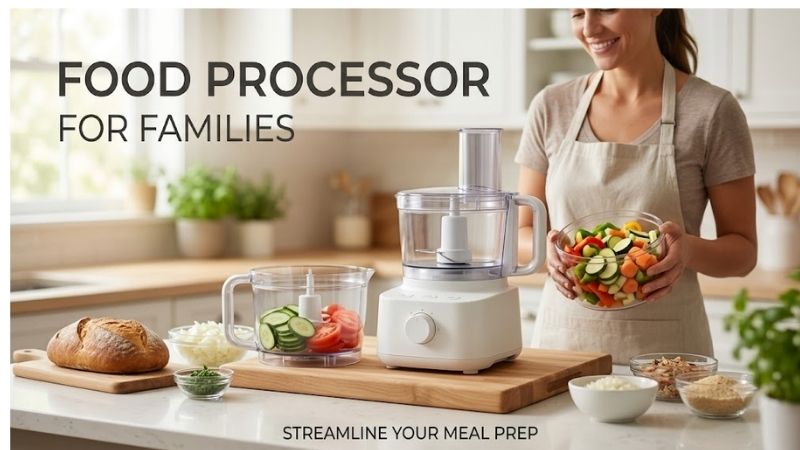
Food processors vary widely in size and configuration.
Smaller machines are convenient for sauces, herbs, and modest quantities of vegetables.
Larger machines generally provide more room for bulk chopping, slicing, shredding, and certain dough preparations.
| Processor Type | Typical Use | Main Advantage | Main Limitation |
|---|---|---|---|
| Mini processor | Herbs, small sauces, limited chopping | Compact and easy to store | Limited batch size and attachments |
| Mid-size processor | Everyday household preparation | Balanced capacity and footprint | May require multiple batches |
| Full-size processor | Larger recipes and family meal prep | More processing room and accessory options | Greater storage and cleaning needs |
Exact capacities vary by manufacturer.
A model advertised as holding a particular number of cups may have lower limits for liquids or certain ingredients.
What Bowl Capacity Does a Family Need?
Start with the amount of food you prepare in a normal cooking session.
A couple preparing occasional meals may not need the same equipment as a household that regularly cooks for five or six people.
Consider these recurring tasks:
-
Chopping onions, carrots, and celery for several recipes.
-
Shredding vegetables for salads and slaws.
-
Slicing potatoes for casseroles.
-
Processing ingredients for family-sized sauces.
-
Preparing mixtures for multiple servings.
-
Making suitable doughs in approved quantities.
If you frequently process substantial quantities, a larger bowl may reduce the number of batches.
However, buying an oversized machine for small daily tasks can make preparation and cleanup less convenient.
Usable Capacity vs. Advertised Capacity
A processor’s advertised work-bowl volume does not necessarily equal its usable capacity for every recipe.
Dry chopped ingredients, liquids, and doughs behave differently.
For example, a mixture containing significant liquid may have a lower maximum fill level than chopped vegetables.
Dough capacity may also depend on flour weight, hydration, motor capability, and the approved processing time.
Always check the model’s operating instructions for each intended workload.
Blades and Attachments That Matter for Families
The Multipurpose Chopping Blade
The multipurpose blade is one of the most frequently used food processor attachments.
Depending on the model, it can chop vegetables, process suitable mixtures, and combine ingredients.
It is particularly useful for preparing aromatic vegetables for soups, stews, and casseroles.
However, processing time affects texture.
A few short pulses may produce coarse pieces, while longer processing can result in smaller, less uniform particles or eventually a puree.
For recipes requiring precise knife cuts, manual chopping may still be preferable.
Slicing Disc
A slicing disc can produce relatively consistent slices of suitable vegetables and other approved foods.
This is useful for potato dishes, salads, gratins, and meal preparation involving repeated slices.
Some processors offer adjustable slicing thickness, while others require separate discs.
An adjustable disc may reduce the need to store multiple accessories.
However, the actual thickness range and adjustment method vary by model.
Shredding Disc
Shredding attachments can save time when preparing cabbage, carrots, cheese, and other ingredients approved by the manufacturer.
This is particularly useful for family meals involving slaws, salads, and baked dishes.
Check whether the processor includes a reversible disc with different shredding sizes or requires separate accessories.
Very soft or sticky ingredients may not shred as neatly as firmer foods.
Follow the recommended preparation and feeding methods.
Dough Blade
Some full-size food processors include a dough blade or support dough preparation using another approved attachment.
However, a dough blade does not guarantee that the machine can knead every bread recipe.
Dough places substantial resistance on the motor.
Compare manufacturer-specified flour capacity, processing duration, and recommended dough types.
If you frequently prepare large batches of heavy bread dough, a suitable stand mixer may be a better investment.
Motor Capability and Processing Performance
Is Higher Wattage Always Better?
No. Electrical wattage alone does not establish how effectively a food processor handles food.
Motor design, gearing, blade construction, bowl geometry, and operating controls all influence performance.
A higher advertised wattage may indicate different power requirements, but it does not prove greater durability or better results.
Look for performance evidence involving the tasks you care about.
Chopping onions, slicing potatoes, and processing dense dough are different workloads and should not be treated as interchangeable tests.
Pulse Control vs. Continuous Processing
Pulse control is especially useful when texture matters.
Brief pulses allow you to inspect progress and reduce the risk of excessive processing.
Continuous operation is useful for tasks that require longer mixing or repeated contact with the blade.
For family cooking, both functions can be valuable.
Choose a processor with controls that are easy to use while safely operating the feed tube and food pusher.
Feed Tube Design
The feed tube determines how food enters the processor when using slicing or shredding discs.
A wider feed tube may reduce the need to cut certain vegetables into smaller pieces beforehand.
However, a large feed tube does not automatically produce more uniform results.
Proper positioning, suitable food size, and use of the supplied pusher remain important.
Never place your fingers inside an operating feed tube.
Family Meal Prep Applications
Chopping Vegetables for Weekly Cooking
A food processor can help prepare vegetables for soups, casseroles, fillings, and other meals.
For consistent results, cut oversized ingredients into suitable pieces and avoid overloading the bowl.
Use short pulses when you want chopped rather than pureed vegetables.
For mixed ingredients, consider processing foods with similar firmness together.
This reduces the chance that soft vegetables become excessively fine while harder pieces remain large.
Slicing Potatoes and Other Vegetables
A slicing disc is useful when a recipe requires many similar slices.
However, processor slicing is not always appropriate for delicate ingredients or very specific cuts.
Choose the disc thickness according to the recipe.
After slicing, check the pieces before cooking rather than assuming every slice is identical.
For dishes where even cooking is important, sorting noticeably irregular pieces can improve consistency.
Shredding Cheese and Vegetables
A processor can simplify preparation of shredded ingredients.
For cheese, firmness and temperature may influence how cleanly it shreds.
Very soft cheese may smear or collect on the disc rather than producing distinct shreds.
Use only ingredients approved for the attachment.
For large family meals, shredding several portions in succession can reduce repetitive manual work.
Mixing Sauces and Dips
Food processors can combine ingredients for pesto, hummus, dips, and certain sauces.
However, some machines are less suitable for thin liquids because of their bowl construction and fill limits.
Check liquid capacity and leakage precautions.
If your household mainly prepares smoothies or pourable beverages, a blender may be more appropriate.
Cleaning and Maintenance for Busy Families
Dishwasher-Safe Components
Some processor bowls, lids, pushers, and accessories are dishwasher safe.
Others require handwashing or specific rack placement.
Follow the exact manufacturer’s instructions.
Keep the motor base away from water immersion and clean it using approved methods.
Sharp blades and discs should be handled individually to reduce injury risk.
Cleaning the Feed Tube and Lid
Food residue can accumulate around feed tube corners, lid locking mechanisms, and accessory connections.
These areas should be inspected after each use.
A processor that has many narrow channels may require more attention than one with simpler construction.
Consider cleaning access before buying, especially if the appliance will be used daily.
Storage of Sharp Accessories
Food processor blades and discs should be stored safely.
Some models include dedicated accessory cases or internal storage systems.
These can be useful in family kitchens where loose sharp components create unnecessary hazards.
Avoid storing exposed blades in crowded drawers.
Choosing for Different Family Sizes
Small Families
A mid-size processor may be sufficient for a household preparing modest recipes.
Focus on chopping capability, simple controls, and manageable cleanup.
A full collection of specialized attachments may be unnecessary.
Larger Families
A full-size processor becomes more useful when regularly preparing larger quantities of vegetables, grated ingredients, or multi-serving recipes.
Prioritize capacity, feed tube convenience, and reliable accessory availability.
Check both bowl volume and workload-specific limits.
Families That Batch Cook
If you prepare ingredients for several meals at once, sufficient capacity and useful slicing and shredding discs can significantly reduce repetitive preparation.
Choose a model whose components are convenient to clean between ingredients.
Avoid assuming the same processor can safely handle every dough, liquid, and frozen food task.
Families With Limited Storage
A mid-size food processor with a compact accessory set may be preferable to an oversized machine.
Measure cabinet depth and shelf height, including the bowl, lid, and accessory storage.
A processor that is difficult to retrieve may be used less frequently despite its capabilities.
Common Buying Mistakes
Buying Based Only on Bowl Size
A large work bowl does not guarantee that the machine handles dough, liquids, and small portions equally well.
Evaluate the specific tasks your household performs.
Ignoring Attachment Compatibility
Not every food processor includes every slicing, shredding, or dough attachment.
Check the exact included components and available compatible accessories.
Expecting Perfectly Uniform Chopping
Food processors provide speed, but chopping results depend on ingredient preparation and pulse control.
They do not always replace careful knife work.
Underestimating Cleaning Time
Large bowls, multiple discs, and elaborate lids create additional washing and storage work.
Choose an appliance whose maintenance matches your routine.
Frequently Asked Questions
What Size Food Processor Is Best for a Family of Four?
A mid-size or full-size processor may be appropriate, depending on recipe quantities and preparation habits. Bowl volume alone is not enough; evaluate the usable capacity for your main tasks.
Can a Food Processor Make Bread Dough?
Some models can process approved dough recipes. Check flour limits, dough types, processing duration, and manufacturer instructions.
Can a Food Processor Replace a Blender?
It can handle certain purees and sauces, but it may be less appropriate for thin liquids and smoothies. The best choice depends on the food and the appliance’s design.
Are Food Processor Blades Dishwasher Safe?
Some are, but cleaning requirements vary. Follow the manufacturer’s instructions and keep sharp components secured during washing.
Can I Chop Raw Meat in a Food Processor?
Only when the manufacturer permits it. Use appropriate food-handling practices, keep ingredients at safe temperatures, and thoroughly clean and sanitize food-contact components after processing raw meat.
Is a Food Processor Worth Buying for Weekly Meal Prep?
It can be worthwhile when you regularly chop, slice, or shred substantial quantities. For occasional small tasks, manual tools or a mini processor may be sufficient.
Conclusion
The best food processor for families should match normal batch sizes, include useful attachments, and remain convenient to clean and store. A full-size processor is a practical choice for households preparing substantial quantities of vegetables and other ingredients, while a mid-size model may suit smaller families. Prioritize usable capacity, safe operation, and real preparation needs rather than choosing the largest or most powerful machine available.
Write Your Review
No reviews yet. Be the first to share your experience!