
A stand mixer for limited counter space should support everyday baking without overwhelming a small kitchen. Compact models can help with cookie dough, cake batter, frosting, and certain bread recipes, but dimensions, bowl capacity, and mixer weight create important trade-offs. This guide explains how to choose a machine that fits your workspace while handling the recipes you prepare most frequently.
- Quick Answer: Which Stand Mixer Is Best for a Small Kitchen?
- Understanding Stand Mixer Types
- Measuring Your Counter Space
- Choosing the Right Bowl Capacity
- Motor Performance and Mixing Capability
- Essential Attachments
- Weight, Stability, and Storage
- Choosing for Different Baking Habits
- Common Buying Mistakes
- Frequently Asked Questions
- Conclusion
Quick Answer: Which Stand Mixer Is Best for a Small Kitchen?
For many home bakers with limited counter space, a compact tilt-head stand mixer is a practical starting point.
These models often provide useful mixing and whipping functions in a smaller overall design than larger heavy-duty machines.
However, a compact mixer still needs enough room for the bowl, head movement, attachments, and safe operation.
Prioritize:
-
A footprint that fits your actual working area.
-
Enough vertical clearance to access the bowl and attachments.
-
Bowl capacity matched to typical recipes.
-
Suitable capability for the doughs and batters you prepare.
-
A stable base that remains secure during operation.
-
Manageable weight for occasional storage.
-
Easy-to-clean bowl and attachments.
-
Available compatible replacement parts.
Do not choose the smallest model solely because it fits under a cabinet. It must also have enough working clearance and capacity for your recipes.
Understanding Stand Mixer Types
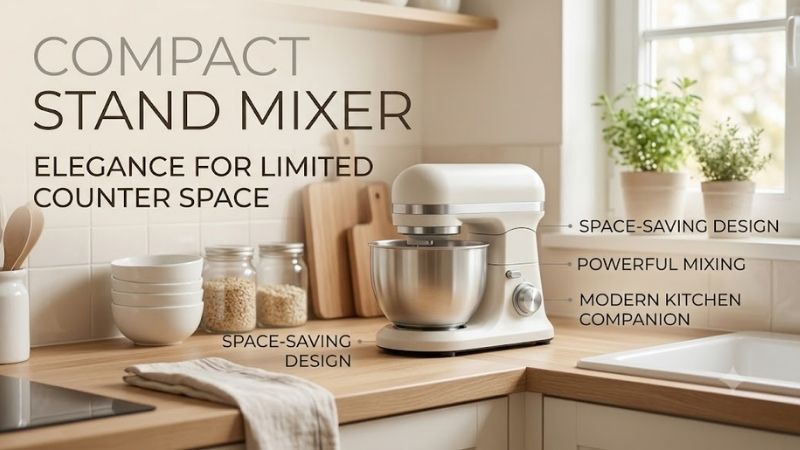
Compact Tilt-Head Stand Mixers
Tilt-head stand mixers allow the motor head to pivot upward for bowl access.
This can make it convenient to change attachments, add ingredients, and remove the bowl.
Compact tilt-head models are often suitable for cookies, cakes, frosting, and other common home baking tasks.
However, the head requires additional clearance when raised.
If the appliance is positioned beneath low cabinets, you may need to slide it forward before changing attachments.
Check both the closed and open dimensions.
Bowl-Lift Stand Mixers
Bowl-lift mixers use a mechanism that raises and lowers the bowl relative to the mixing attachment.
This design is common in larger machines intended for substantial mixing workloads.
Because the head typically remains fixed, some bowl-lift models may offer different overhead clearance requirements than tilt-head machines.
However, larger bowl-lift designs can be heavier and occupy more space overall.
For a small kitchen, a bowl-lift mixer makes sense only when its actual dimensions, bowl access, and workload capabilities justify the footprint.
Stand Mixer vs. Hand Mixer
| Feature | Compact Stand Mixer | Hand Mixer |
|---|---|---|
| Operation | Mixes in a supported bowl | Held and guided manually |
| Counter space | Requires a dedicated operating area | Generally uses less storage space |
| Bowl | Often a dedicated compatible bowl | Works with suitable separate bowls |
| Dough handling | Depends on model and attachments | Usually more limited for demanding dough |
| Weight | Generally heavier | Generally lighter |
| Storage | May require a cabinet or counter location | Often fits in a drawer or small cabinet |
| Hands-free mixing | Common advantage | Requires active handling |
A hand mixer may be the better choice for occasional light baking.
A stand mixer becomes more compelling when you regularly prepare substantial recipes that benefit from supported, hands-free mixing.
Measuring Your Counter Space
Measure Width, Depth, and Height
Before buying, measure the exact location where the mixer will operate.
Check the available width and depth, allowing room for handling the bowl and nearby kitchen activities.
Record the vertical distance between the countertop and overhead cabinets.
Then compare these measurements with manufacturer-listed dimensions.
Do not assume that a mixer will fit comfortably simply because its base occupies a small area.
The working envelope matters more than the closed footprint alone.
Account for Tilt-Head Clearance
A tilt-head mixer may fit under cabinets when closed but be difficult to operate if the head cannot be raised.
Check the full height required to lift the head and remove attachments.
If the mixer must be pulled forward before every use, consider whether its weight makes that practical.
Repeatedly lifting or dragging a heavy appliance can become inconvenient.
Choose a location that provides safe access without placing the mixer dangerously close to the counter edge.
Check Bowl and Attachment Access
Even when a mixer fits physically, the bowl may be difficult to remove in a crowded location.
Make sure you can reach the bowl handle, release mechanism, and attachment connection.
Consider whether there is enough room for adding flour, liquids, or other ingredients.
A mixer that consumes nearly all available preparation space may create more problems than it solves.
Measure Cabinet Storage Separately
If you plan to store the mixer after each use, measure the cabinet opening rather than relying only on the internal shelf dimensions.
A heavy appliance that fits inside a cabinet may still be difficult to lift through a narrow opening.
Check the load capacity of the shelf and whether the mixer can be retrieved without awkward movements.
For frequent baking, accessible storage may matter more than a slightly smaller exterior size.
Choosing the Right Bowl Capacity
Small Bowls for Everyday Baking
A smaller mixing bowl can be useful for households preparing modest recipes.
It may be appropriate for smaller cookie batches, cake batters, frosting, or other suitable mixtures.
However, advertised bowl volume does not automatically describe maximum dough capacity.
Different recipes impose different loads on the motor.
Always compare the manufacturer’s approved capacities for the tasks you perform.
Medium Bowls for Flexible Use
A medium-capacity stand mixer may provide more flexibility for families or home cooks who bake regularly.
It can reduce the need to divide some recipes into separate batches.
However, a larger bowl may be less efficient for very small ingredient quantities, depending on attachment reach and mixer geometry.
Consider your smallest and largest recurring recipes.
The most useful bowl is one that works well across your normal baking range.
Large Bowls and Small Kitchens
Large bowls are useful for substantial batches, but they can increase appliance dimensions and storage requirements.
A large mixer may also be unnecessarily heavy for occasional baking.
If you rarely prepare large recipes, a compact or medium model may offer better everyday convenience.
Do not purchase capacity that you are unlikely to use.
Motor Performance and Mixing Capability
Why Wattage Is Not Enough
Stand mixer manufacturers may advertise electrical wattage, motor type, or other technical specifications.
These figures do not independently establish mixing strength or dough capability.
Gear design, torque characteristics, motor control, attachment geometry, and operating limits all affect performance.
A mixer with a higher advertised wattage is not automatically better for every recipe.
Review manufacturer-supported batch capacities and credible performance information.
Mixing Cake Batter
Cake batters often require controlled incorporation of ingredients.
A stand mixer with useful speed settings and a suitable flat beater can simplify many recipes.
However, overmixing may negatively affect certain batters.
Follow recipe guidance and stop the machine when scraping the bowl.
Do not assume that longer mixing improves results.
Preparing Cookie Dough
Cookie dough can range from relatively soft mixtures to dense batters containing chocolate chips, nuts, or other additions.
Choose a mixer approved for the workload.
For heavy doughs, check the manufacturer’s batch limits and recommended speeds.
A compact mixer may handle modest recipes but struggle with large or unusually dense quantities.
Kneading Bread Dough
Bread dough can place substantial resistance on the mixing mechanism.
Not every compact stand mixer is intended for prolonged kneading or heavy bread doughs.
Check the exact model’s instructions regarding dough capacity, recommended attachment, speed, and operating duration.
If bread making is your main purpose, prioritize verified dough-handling capability rather than compact dimensions alone.
Essential Attachments
Flat Beater
The flat beater is commonly used for cake batter, cookie dough, frosting, and similar mixtures.
Its effectiveness depends on bowl geometry and proper attachment clearance.
Some designs offer flexible scraping features, but compatibility and care requirements vary.
Choose attachments that are supported by the exact mixer model.
Wire Whisk
A wire whisk is commonly used to incorporate air into suitable mixtures, including whipped cream and certain egg preparations.
A stable speed range can help control the process.
Very small quantities may not be reached effectively by every bowl and whisk combination.
Check manufacturer guidance on minimum practical quantities.
Dough Hook
A dough hook is used for approved kneading tasks.
However, the presence of a hook does not mean the mixer is suitable for every bread dough.
Follow recommended speeds, capacities, and duty cycles.
Using the wrong speed or excessive dough quantity can strain the machine.
Optional Accessories
Some stand mixers support specialized accessories for tasks such as pasta preparation, grinding, or food processing.
These can increase versatility, but they also require storage and cleaning.
Attachment compatibility may differ between models, sizes, and generations.
Buy accessories only after confirming that they match the exact mixer and serve a real cooking need.
Weight, Stability, and Storage
Why Mixer Weight Matters
A heavier stand mixer may provide useful stability during operation, but it is more difficult to move.
A lighter model may be convenient for cabinet storage yet require careful evaluation of stability under load.
Weight alone does not prove performance or construction quality.
For a small kitchen, decide whether the mixer will remain on the counter or be stored between uses.
This decision should influence the size and weight you choose.
Moving a Mixer Safely
Lift or reposition the machine according to the manufacturer’s instructions.
Avoid pulling it by the power cord, attachments, or unstable parts.
If a heavy mixer is difficult to move comfortably, consider a more accessible permanent location.
A stable, level countertop is important for safe operation.
Managing Attachments in Small Cabinets
Attachments can consume significant storage space.
Keep compatible beaters, hooks, and whisks together in a safe, dry location.
Avoid placing loose metal accessories where they may damage other items or become difficult to locate.
A smaller mixer with fewer useful attachments may offer a more practical setup than a larger package containing accessories you rarely use.
Choosing for Different Baking Habits
Best for Occasional Bakers
A compact tilt-head mixer may be suitable for occasional cakes, cookies, and frosting.
However, a hand mixer may be enough if you rarely bake and storage is extremely limited.
Best for Frequent Home Baking
A compact or medium stand mixer with sufficient bowl capacity and reliable everyday mixing functions is worth considering.
Prioritize comfortable bowl access, cleaning, and appropriate workload support.
Best for Small Apartments
Look for a model that fits available cabinet and counter dimensions without requiring difficult lifting.
Avoid buying a larger machine simply for occasional recipes that a smaller appliance could handle.
Best for Bread Bakers
Choose based on documented dough-handling capability.
If heavy dough is a regular task, the smallest available mixer may not be appropriate.
A larger, more capable machine may justify its footprint when baking bread is a major household activity.
Common Buying Mistakes
Measuring Only the Closed Height
Tilt-head mixers require additional room to raise the motor head.
Measure operating clearance before buying.
Choosing Based Only on Bowl Capacity
Bowl volume does not guarantee that the machine can safely knead a particular amount of dough.
Check workload-specific limits.
Ignoring Weight
A heavy mixer may become inconvenient if it must be moved for every use.
Consider storage access before purchasing.
Buying Too Many Accessories
Optional attachments can increase clutter.
Prioritize the tools needed for your normal recipes.
Frequently Asked Questions
Can a Stand Mixer Fit Under Standard Kitchen Cabinets?
Some compact models may fit under common cabinet arrangements, but dimensions vary. Check actual clearance, including the space required to lift the head or access the bowl.
Is a Tilt-Head Mixer Better for Small Kitchens?
Often, but not always. Compact tilt-head designs can be convenient, while individual bowl-lift models may offer different clearance advantages. Compare exact dimensions and access requirements.
What Bowl Size Is Best for a Small Household?
Choose based on recurring recipe quantities. A smaller bowl may suit modest batches, while a medium bowl offers greater flexibility for frequent baking.
Can a Compact Stand Mixer Knead Bread?
Some can handle approved bread recipes, but capabilities vary. Check flour capacity, dough consistency limits, attachment requirements, and permitted operating time.
Should I Buy a Hand Mixer Instead?
A hand mixer is often better for occasional light mixing and extremely limited storage. A stand mixer becomes more useful when hands-free operation or approved dough handling is important.
Can I Store a Stand Mixer in a Cabinet?
Yes, provided the cabinet supports its weight, the appliance fits safely, and it can be retrieved without awkward lifting. Follow the manufacturer’s storage guidance.
Conclusion
The right stand mixer for limited counter space should fit your kitchen in both storage and operating positions while supporting the recipes you prepare regularly. A compact tilt-head model is a strong starting category for everyday cakes, cookies, and frosting, but bread bakers may need greater capability. Measure working clearance, consider mixer weight, and prioritize realistic bowl and dough capacities before choosing.


Write Your Review
No reviews yet. Be the first to share your experience!