
A rice cooker for entertaining can make hosting easier by preparing rice while you focus on other dishes. However, serving a group requires more than choosing a machine with a large bowl. Cooking capacity, rice variety, preparation time, keep-warm performance, and food safety all matter. This guide explains how to select a rice cooker that supports gatherings without creating unnecessary work.
- Quick Verdict: What Rice Cooker Is Best for Entertaining?
- Understanding Rice Cooker Capacity
- Choosing Between Rice Cooker Technologies
- Essential Features for Hosting Guests
- Planning Rice for a Dinner Party
- Food Safety When Serving Rice
- Choosing by Gathering Size
- Cleaning and Maintenance
- Common Buying Mistakes
- Frequently Asked Questions
- Conclusion
Quick Verdict: What Rice Cooker Is Best for Entertaining?
For households that regularly host dinners or family gatherings, a larger-capacity rice cooker with a reliable cooking program, appropriate keep-warm function, and removable cooking pot is a practical choice.
A 10-cup uncooked-rice capacity is one category worth evaluating for larger households, while a 5.5-cup model may be sufficient for smaller gatherings. These are common rice cooker capacity classes, not fixed serving guarantees.
Your ideal capacity depends on portions, rice type, menu, and whether rice is the primary dish or a side.
Prioritize:
-
Clearly stated uncooked-rice capacity.
-
Suitable programs for the rice varieties you serve.
-
A keep-warm function with documented operating limits.
-
A removable, easy-to-clean inner pot.
-
Accessible steam vent and lid components.
-
Convenient serving and stable placement.
-
Appropriate electrical requirements.
-
A practical storage footprint.
The best rice cooker is one that produces enough rice for your normal guest count without requiring repeated cooking cycles.
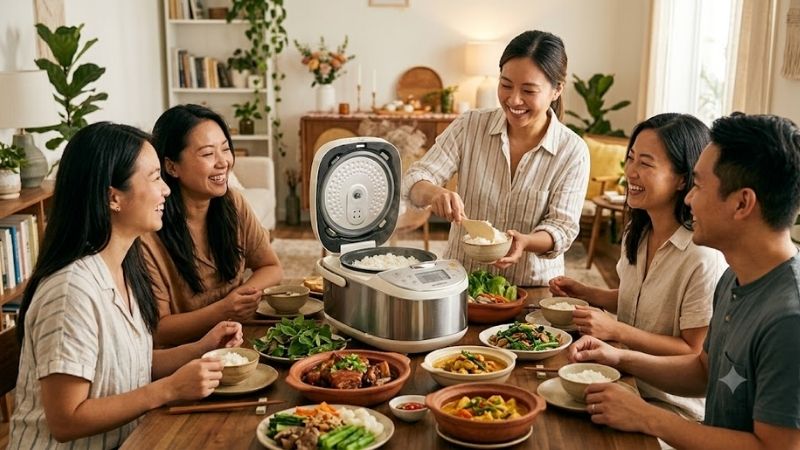
Understanding Rice Cooker Capacity
Uncooked Rice Capacity vs. Cooked Rice Volume
Rice cooker capacities are often expressed in measuring cups of uncooked rice.
Many Asian-style rice cookers use a dedicated measuring cup of approximately 180 mL, which is about three-quarters of a standard US measuring cup.
This distinction matters.
A rice cooker advertised as having a 10-cup capacity may mean 10 included rice-cooker cups of uncooked rice, not 10 standard US cups of finished food.
Rice typically expands during cooking, but the final yield varies with grain type, water absorption, and preparation.
Always check how the manufacturer defines capacity.
How Many Guests Can a Rice Cooker Serve?
The number of servings depends on how much rice each guest will eat.
A small side portion requires less rice than a meal built primarily around a rice bowl.
For example, a dinner with multiple side dishes may require less rice per person than a gathering featuring rice as the main starch.
Use a consistent planning method:
-
Estimate the desired cooked-rice portion per guest.
-
Multiply that amount by the number of guests.
-
Convert the total cooked quantity into the uncooked amount needed for the chosen rice variety.
-
Confirm that the quantity falls within the cooker’s specified operating capacity.
Use the recipe’s yield or manufacturer guidance rather than assuming all rice varieties expand identically.
Is a Larger Rice Cooker Always Better?
No.
A larger appliance can be useful for gatherings but may be less convenient for everyday small batches.
Some models specify a minimum rice quantity.
If you normally cook for two people and host a large gathering only occasionally, an oversized appliance may consume unnecessary storage space.
Consider whether purchasing a moderately sized cooker and preparing another batch before serving would better suit your routine.
For frequent entertaining, though, sufficient single-batch capacity usually provides greater convenience.
Choosing Between Rice Cooker Technologies
Conventional Rice Cookers
Conventional rice cookers typically use a heating system and temperature-sensitive control mechanism to cook rice.
They often provide straightforward operation.
For households that mainly prepare standard white rice, a simple cooker may be sufficient.
However, cooking programs and temperature management are generally more limited than on advanced models.
Micom Rice Cookers
Micom rice cookers use microcomputer-controlled programs to regulate the cooking process.
Depending on the model, they may include settings for white rice, brown rice, mixed rice, porridge, and other preparations.
This flexibility can be useful when entertaining guests with different menu preferences.
However, a greater number of settings does not automatically mean better rice.
Evaluate whether the programs match the grains you use.
Induction Heating Rice Cookers
Some rice cookers use induction heating to heat a compatible inner pot.
These appliances operate using their own electrical heating system and should not be confused with ordinary stovetop cookware.
Induction heating may support different temperature-control approaches, but actual cooking results depend on the complete appliance design.
A higher purchase price does not guarantee that every guest will notice an improvement.
For entertaining, capacity, timing, and dependable operation may matter more.
Essential Features for Hosting Guests
Keep-Warm Function
A keep-warm setting is especially useful when rice finishes before other dishes.
It allows the cooker to maintain cooked rice at an appropriate holding temperature when used according to the manufacturer’s instructions.
However, keep-warm performance varies.
Some models may dry out rice or change its texture during extended holding.
The recommended maximum duration also varies.
A keep-warm function does not mean cooked rice can be stored indefinitely.
Cooking Timers and Scheduling
Some rice cookers include scheduling functions that allow preparation to finish around a chosen time.
These can help coordinate meals.
However, delayed cooking requires attention to ingredients and food safety.
Do not leave perishable ingredients sitting unrefrigerated in a cooker before a delayed cooking cycle.
Follow the manufacturer’s recommendations for approved ingredients and timer use.
Multiple Rice Programs
A household that regularly prepares both white and brown rice may benefit from dedicated programs.
Different grains may require different cooking conditions and durations.
A rice cooker designed for these variations can simplify preparation.
However, do not assume that every grain or mixed-rice recipe is suitable for every program.
Check manufacturer instructions.
Detachable Inner Lid
Large gatherings often result in substantial cooking and cleanup.
A removable inner lid can make it easier to clean condensation and starchy residue.
However, the removal and reinstallation mechanism must be straightforward.
Check whether steam vent components, gaskets, and other food-contact parts are accessible.
A machine with difficult-to-clean components may become inconvenient after frequent use.
Planning Rice for a Dinner Party
Estimate Rice Before Choosing the Menu
Begin by deciding how rice will be served.
For a meal with several vegetable dishes, protein dishes, and other starches, rice may be a secondary component.
For rice bowls or rice-centered dishes, portions may be larger.
Planning portions before selecting a capacity helps prevent shortages and unnecessary leftovers.
Account for Different Rice Varieties
White rice, brown rice, and other grains may have different cooking programs and water requirements.
A cooker that handles one variety efficiently may require different settings for another.
If your gatherings frequently feature several rice varieties, consider whether two cooking appliances or advance preparation would be more practical than a single cooker.
Do not combine grains with incompatible cooking requirements without an approved recipe.
Schedule the Cooking Cycle
A rice cooker frees you from active stovetop monitoring, but preparation still requires planning.
Rinsing, soaking when appropriate, cooking, and resting can all affect timing.
Some machines include soaking and resting stages automatically.
Follow the exact program instructions rather than assuming that all cookers finish in the same amount of time.
Start early enough to accommodate the intended serving schedule.
Serve Without Repeatedly Opening the Lid
Repeatedly opening the cooker during active cooking may interfere with the process.
Wait until the machine indicates completion.
When the rice is ready, follow the manufacturer’s resting and fluffing instructions.
Use a suitable serving utensil and avoid damaging the inner-pot coating.
Food Safety When Serving Rice
Keep Cooked Rice at a Safe Temperature
Cooked rice requires appropriate food handling.
Rice can be associated with Bacillus cereus, a bacterium whose spores may survive cooking and become a concern when rice is held at unsafe temperatures.
For hot holding, use equipment that maintains food at 135°F or above as required under the FDA Food Code for covered food-service settings; a household can use the more conservative target of at least 140°F.
Do not assume that every keep-warm setting consistently maintains a suitable temperature under all conditions.
Follow the manufacturer’s instructions and use a food thermometer when needed.
Refrigerate Leftovers Promptly
Rice that will not be served or safely kept hot should be cooled and refrigerated promptly.
A practical general rule is to refrigerate perishable cooked food within two hours, or within one hour when the surrounding temperature is above 90°F.
Divide large quantities into smaller, shallow containers to promote faster cooling.
Store refrigerated leftovers at 40°F or below.
Do not leave cooked rice sitting in an unheated cooker overnight.
Avoid Treating Reheating as a Complete Safety Fix
Improperly stored rice may develop hazards that reheating cannot reliably eliminate.
The safest approach is to prevent unsafe temperature exposure in the first place.
Discard rice when its storage history makes it unsafe rather than attempting to restore safety through extended reheating.
Choosing by Gathering Size
Small Dinner Parties
A moderately sized rice cooker may be enough when serving a handful of guests.
Prioritize reliable cooking and convenient serving.
If the gathering is occasional, a familiar machine may be preferable to purchasing a much larger appliance.
Family Celebrations
For larger family meals, greater single-batch capacity can reduce preparation pressure.
Pay attention to the usable rice capacity, preparation time, and keep-warm instructions.
Buffet-Style Entertaining
Buffets require additional temperature management because food may remain available over an extended period.
A rice cooker can support hot holding only when its actual performance and instructions make it suitable.
Keep serving utensils clean and minimize unnecessary handling.
Potlucks and Shared Meals
Consider the cooker’s transportability and electrical requirements.
Do not assume the appliance is safe to operate while being transported.
Use appropriate food transportation and temperature-control practices.
At the destination, confirm a suitable outlet and stable operating surface.
Cleaning and Maintenance
Clean the Inner Pot Carefully
Many rice cookers use nonstick-coated inner pots.
Use the utensils and cleaning methods approved by the manufacturer.
Abrasive pads or metal tools can damage certain surfaces.
Do not assume all inner pots are dishwasher safe.
Maintain the Steam Vent
Starchy residue may accumulate around steam vents and inner lid components.
Clean them according to the manual.
Never block steam outlets or operate the cooker with incorrectly installed components.
Inspect Seals and Heating Surfaces
Check removable seals for cleanliness and correct installation.
Keep the exterior of the inner pot and the heating contact area clean and dry as directed.
Food residue between these surfaces can interfere with proper operation.
Common Buying Mistakes
Confusing Rice Cooker Cups With US Cups
A traditional rice-cooker measuring cup is often smaller than a standard US cup.
Check the exact capacity definition before estimating servings.
Choosing Only by Maximum Capacity
A large cooker may not work equally well for small daily quantities.
Check minimum capacity and your normal cooking habits.
Assuming Keep-Warm Means Unlimited Storage
Keep-warm duration and temperature performance vary.
Follow manufacturer limits and safe food-handling practices.
Ignoring Cleaning Access
A large cooker with complicated steam vent and lid components may require substantial cleaning after gatherings.
Inspect the maintenance design before buying.
Frequently Asked Questions
What Size Rice Cooker Do I Need for Entertaining?
Choose based on the number of guests, intended portion size, and whether rice is the main dish or a side. Confirm whether capacity is expressed in uncooked rice-cooker cups.
Is a 10-Cup Rice Cooker Too Big for Everyday Use?
It may be excessive for a small household. Check the minimum cooking quantity and whether you have enough storage space.
Can I Keep Rice Warm During a Party?
Yes, if the machine’s keep-warm function is designed for that purpose and the rice remains safely hot. Follow its time and temperature instructions.
Can I Cook Brown and White Rice Together?
Only when the manufacturer or an appropriate recipe provides a compatible method. Different grains may require different cooking conditions.
Are Rice Cooker Inner Pots Dishwasher Safe?
Some are, but others require handwashing. Follow the exact model’s care instructions.
Is an Induction Rice Cooker Better for Entertaining?
Not automatically. Induction models may offer advanced temperature control, but capacity, workflow, cooking programs, and dependable hot holding are usually more important purchasing factors.
Conclusion
The right rice cooker for entertaining should produce enough rice for your typical gathering, offer suitable cooking programs, and support safe serving. A larger-capacity model is useful for frequent hosting, but the correct size depends on portions and menu planning. Prioritize clearly defined uncooked-rice capacity, convenient cleaning, practical keep-warm operation, and safe food handling over unnecessary settings.



Write Your Review
No reviews yet. Be the first to share your experience!