
A hand mixer for busy mornings can simplify pancake batter, waffle mixtures, eggs, whipped ingredients, and other quick breakfast preparations. However, the best model should be comfortable to control, easy to clean, and simple to store. This guide explains which features support everyday breakfast cooking and when a hand mixer is more practical than a whisk or stand mixer.
- Quick Answer: What Hand Mixer Should You Buy?
- Understanding Hand Mixers
- Speed Control for Quick Breakfast Preparation
- Choosing the Right Beaters and Attachments
- Comfort and Ergonomics
- Corded vs. Cordless Hand Mixers
- Everyday Breakfast Applications
- Cleaning and Storage
- Choosing for Different Household Routines
- Common Buying Mistakes
- Frequently Asked Questions
- Conclusion
Quick Answer: What Hand Mixer Should You Buy?
For everyday breakfast preparation, choose a lightweight hand mixer with a controllable low-speed setting, comfortable grip, easy beater release, and straightforward storage.
A simple corded model may be sufficient if you regularly mix batter at the kitchen counter.
Cordless models can offer greater freedom of movement but require battery charging and careful attention to operating time.
Look for:
-
A low-speed setting that starts gently.
-
Several usable speed levels.
-
Standard beaters suited to your recipes.
-
Comfortable handling and balanced weight.
-
An easy-to-operate attachment release mechanism.
-
Beaters that can be cleaned thoroughly.
-
Convenient cord or accessory storage.
-
Clear operating and safety instructions.
For most households, predictable control and easy cleanup matter more than a large number of speed settings.
Understanding Hand Mixers
What Is a Hand Mixer?
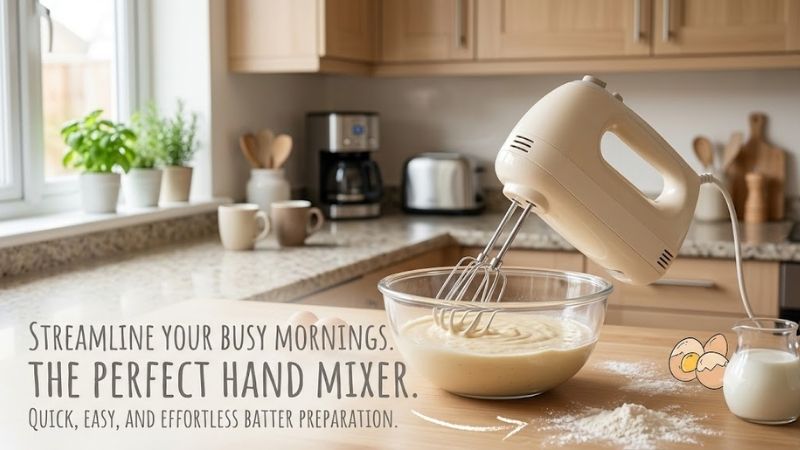
A hand mixer is a handheld electric appliance that drives one or more removable mixing attachments.
It is commonly used for cake batter, pancake mixtures, whipped cream, eggs, frosting, and other appropriate foods.
Unlike a stand mixer, it requires the user to hold and guide the appliance during operation.
This provides flexibility when working with different suitable bowls, but it also requires active control.
Hand mixers are generally smaller and easier to store than stand mixers.
Hand Mixer vs. Manual Whisk
A manual whisk is simple, inexpensive, and convenient for light tasks.
It requires no electricity and may be quicker to clean.
An electric hand mixer becomes useful when recipes require prolonged whisking, more intensive mixing, or repeated preparation.
| Task | Manual Whisk | Hand Mixer |
|---|---|---|
| Beating a few eggs | Often sufficient | Useful but may be unnecessary |
| Pancake batter | Good for simple mixtures | Convenient for controlled mixing |
| Whipped cream | Requires more manual effort | Often more convenient |
| Cake batter | Possible for certain recipes | Usually easier for sustained mixing |
| Small dressing | Often sufficient | May create unnecessary cleanup |
| Dense bread dough | Generally unsuitable | Depends on model and approved attachments |
For a household that only beats eggs occasionally, a whisk may be enough.
For frequent baking or whipping, a hand mixer can reduce repetitive manual effort.
Hand Mixer vs. Stand Mixer
Stand mixers support hands-free mixing inside a dedicated bowl.
Hand mixers require active handling but usually occupy less space.
A stand mixer may be better for substantial batches or demanding approved dough recipes.
A hand mixer may be better for occasional breakfast batter, whipped ingredients, and kitchens with limited storage.
Choose according to the workload rather than assuming that a larger appliance is automatically superior.
Speed Control for Quick Breakfast Preparation
Why Low-Speed Control Matters
A controllable low-speed setting is useful when combining dry and liquid ingredients.
Starting too aggressively can scatter flour or cause splashing.
A gentle initial speed helps incorporate ingredients before increasing mixing intensity when appropriate.
However, the actual low-speed behavior varies by model.
Some mixers may start more abruptly than expected even at their lowest setting.
Look for credible information about startup control when available.
How Many Speeds Do You Need?
More speed settings do not necessarily make a hand mixer better.
For common breakfast recipes, a useful range of controllable settings is generally more important than the total number.
Different speeds may help with:
-
Combining dry and wet ingredients.
-
Mixing soft batters.
-
Whipping cream.
-
Beating suitable egg preparations.
-
Preparing certain frostings or fillings.
Choose a mixer with intuitive controls that can be adjusted comfortably while holding the appliance.
Is a Turbo Button Useful?
Some hand mixers provide a temporary high-speed function.
This may help with certain approved mixing tasks, but it is not essential for basic breakfast preparation.
High speed can create splashing or overmix ingredients if used unnecessarily.
Treat turbo functions as optional.
For pancake batter and many other breakfast mixtures, controlled mixing is more valuable than maximum speed.
Choosing the Right Beaters and Attachments
Standard Beaters
Standard beaters are commonly included with electric hand mixers.
They can be useful for cake batter, pancake mixtures, frosting, and other suitable recipes.
Beater design influences how ingredients move through the bowl.
Some beaters have relatively open wire structures, while others use more substantial metal shapes.
Neither design is automatically superior for every recipe.
Consider cleaning convenience and the foods you prepare most frequently.
Whisk Attachments
Certain hand mixers include a whisk attachment intended for aerating appropriate mixtures.
This can be useful for whipped cream or other light preparations.
However, included accessories vary between models.
A whisk attachment is worthwhile when you frequently prepare foods that benefit from aeration.
For basic pancake batter, standard beaters may be sufficient.
Dough Hooks
Some hand mixers include dough hooks.
However, dough hooks do not mean the appliance can process every bread dough safely.
Dense doughs can place substantial strain on the motor and attachments.
Follow the manufacturer’s restrictions on dough type, quantity, speed, and operating duration.
If you regularly knead substantial bread batches, a suitable stand mixer may be preferable.
Easy Beater Ejection
A convenient attachment release mechanism can simplify cleanup.
Look for a design that allows beaters to be removed without touching food-covered components unnecessarily.
Always switch off and disconnect the appliance before removing attachments, following the manufacturer’s instructions.
Never eject beaters while they are rotating.
Comfort and Ergonomics
Why Weight Matters
A hand mixer must be supported during operation.
A lighter machine may be easier to use for extended periods, while a heavier design may feel more stable to certain users.
Weight alone does not establish quality.
Consider handle shape, grip comfort, and control placement.
For short breakfast tasks, comfort and maneuverability can be more important than maximum motor specifications.
Handle Design and Balance
A comfortable handle should allow you to maintain control without excessive wrist strain.
The mixer should feel balanced when held above a suitable mixing bowl.
Controls should be reachable without compromising grip.
If possible, evaluate the overall dimensions and handle arrangement before purchasing.
A compact appliance with poorly positioned controls may be less convenient than a slightly larger model.
Managing the Power Cord
Cord placement can affect how comfortably the mixer moves around a bowl.
Some mixers provide swiveling cord arrangements or other cable-management features.
These may be useful in crowded kitchens.
Keep the cord away from hot burners, sharp utensils, sinks, and the edges of cookware.
Do not use an extension cord unless the manufacturer’s instructions permit it.
Corded vs. Cordless Hand Mixers
Corded Hand Mixers
Corded models operate using a compatible electrical outlet.
They avoid battery charging and may be convenient for households that consistently mix ingredients in the same kitchen area.
However, cord length and outlet position matter.
A cord that crosses a busy preparation surface can create an inconvenience or hazard.
Cordless Hand Mixers
Cordless models use rechargeable batteries.
Their main advantage is freedom from a power cord during operation.
This can be useful in kitchens with limited outlets or crowded preparation surfaces.
However, battery capacity, charging requirements, appliance weight, and operating time vary.
Do not assume that every cordless mixer can perform all the tasks supported by a corded alternative.
Which Is Better for Busy Mornings?
A corded hand mixer is often a practical choice when a suitable outlet is readily available.
A cordless mixer becomes more attractive when cable-free operation solves a genuine workspace problem.
For occasional short mixing tasks, either configuration may work well.
Choose based on charging convenience, approved workloads, and kitchen layout.
Everyday Breakfast Applications
Mixing Pancake Batter
A hand mixer can combine pancake ingredients, but the goal is not necessarily to create the smoothest possible batter.
Overmixing wheat-flour pancake batter can develop gluten and produce a tougher texture.
Use a low setting when appropriate and stop once ingredients are sufficiently combined according to the recipe.
Some small lumps may be acceptable.
A manual whisk is often adequate for simple pancake recipes, so an electric mixer should be viewed as a convenience rather than a requirement.
Preparing Waffle Batter
A hand mixer can be useful for certain waffle recipes.
However, preparation methods vary.
Some recipes require gently combining wet and dry ingredients, while others involve separately whipping egg whites.
Use suitable attachments and speeds for the particular method.
Avoid assuming that vigorous mixing benefits every waffle batter.
Beating Eggs
For a few scrambled eggs, a fork or whisk is usually sufficient.
An electric mixer may be more useful when preparing larger quantities or recipes requiring additional aeration.
However, excessive beating may not be desirable for every egg preparation.
Choose the method according to the intended texture and recipe.
Whipping Cream
Whipped cream is a task where an electric hand mixer can offer a meaningful convenience advantage.
Use appropriate cream, a suitable bowl, and the speed recommended by the recipe and appliance manufacturer.
Monitor the texture closely because cream can progress from soft peaks to stiff peaks and eventually overwhipping.
Stop when the desired consistency is reached.
Preparing Breakfast Muffin Batter
A hand mixer may be useful for some muffin recipes, particularly when creaming butter and sugar.
However, many muffin recipes use a quick-mix method that benefits from limited stirring.
Once flour is added, excessive mixing may affect tenderness.
Follow the recipe’s mixing method rather than using the mixer simply because it is available.
Mixing Cream Cheese Spreads
A hand mixer can help soften and combine suitable cream cheese mixtures with herbs, seasonings, or other ingredients.
Allow ingredients to reach a recipe-appropriate consistency before mixing.
Do not force very hard or frozen ingredients through the beaters.
Use a bowl that provides enough depth to contain the mixture and limit splashing.
Cleaning and Storage
Choosing Easy-to-Clean Beaters
Beaters should be easy to remove, wash, and dry.
Some are dishwasher safe, while others require handwashing.
Check manufacturer instructions for the specific attachments.
Food may collect around connection points or wire intersections, so inspect these areas after use.
Cleaning the Mixer Body
The motor housing should generally be wiped using a manufacturer-approved method.
Never immerse the housing or expose electrical components to running water unless the appliance is specifically designed and approved for that cleaning method.
Disconnect the mixer before cleaning.
Avoid allowing liquids to enter ventilation openings.
Storage Cases and Attachment Organization
Some mixers include accessory storage cases or integrated storage arrangements.
These can be convenient in small kitchens.
However, extra storage features may increase the appliance’s overall dimensions.
Choose a configuration that fits your actual cabinets or drawers.
Keep attachments clean and dry before storage.
Preventing Long-Term Wear
Follow maximum operating times and cooling instructions.
Avoid mixing ingredients beyond the appliance’s approved capabilities.
If the mixer develops unusual noises, overheating, damaged attachments, or electrical problems, discontinue use and follow the manufacturer’s service guidance.
Choosing for Different Household Routines
Best for Quick Pancake and Waffle Preparation
Choose a lightweight model with predictable low-speed control and straightforward beaters.
A complicated set of accessories is unnecessary for simple batters.
Best for Frequent Baking
A mixer with comfortable ergonomics, appropriate speed control, and useful whisk attachments may be more versatile.
Check whether it supports your usual recipes and batch sizes.
Best for Small Apartment Kitchens
Prioritize compact storage, manageable weight, and convenient cord organization.
A hand mixer often makes more sense than a stand mixer when baking is occasional.
Best for Families With Busy Schedules
A model with easy beater release and simple cleaning may reduce preparation time.
Consider whether multiple servings require larger bowls or more sustained mixing.
Do not overload a small mixer to avoid preparing ingredients in batches.
Common Buying Mistakes
Choosing Based Only on Motor Wattage
Wattage does not fully describe mixing performance.
Consider beater construction, speed control, approved workloads, and ergonomics.
Ignoring Low-Speed Performance
A mixer that starts too aggressively may scatter dry ingredients.
Controlled startup is particularly useful for batter preparation.
Paying for Unnecessary Attachments
Specialized accessories have little value if they do not match your cooking habits.
Focus on features used regularly.
Expecting a Hand Mixer to Knead Heavy Dough
Some models support limited dough preparation, but heavy kneading may exceed their capabilities.
Follow the manufacturer’s operating limits.
Overlooking Cleaning Convenience
An appliance used every morning should be easy to clean and put away.
Simple beater construction and accessible attachment release can matter more than cosmetic features.
Frequently Asked Questions
Is a Hand Mixer Worth Buying for Breakfast?
It can be useful if you frequently make batters, whipped ingredients, or breakfast recipes requiring sustained mixing. For occasional eggs and simple pancakes, a whisk may be sufficient.
Can I Use a Hand Mixer for Pancake Batter?
Yes, when the appliance is suitable for the recipe. Use controlled mixing and avoid excessive beating, which can make some pancake batters tougher.
Is a Cordless Hand Mixer Better Than a Corded One?
Cordless models offer movement without a cable, while corded models avoid battery charging. The better option depends on kitchen layout and mixing needs.
How Many Speeds Should a Hand Mixer Have?
There is no universally ideal number. A useful low-speed setting and a suitable range of controllable speeds matter more than the total count.
Can I Use a Hand Mixer for Bread Dough?
Only if the manufacturer approves the dough type, quantity, attachments, and operating duration. Heavy bread dough may require a more capable mixer or manual kneading.
Are Hand Mixer Beaters Dishwasher Safe?
Some are, but compatibility varies by model and attachment. Always check the manufacturer’s cleaning instructions.
Conclusion
The right hand mixer for busy mornings should be lightweight, easy to control, simple to clean, and capable of handling everyday breakfast recipes without unnecessary complexity. A corded model with reliable low-speed control and removable beaters is a practical choice for many households, while cordless designs suit kitchens where cable-free operation matters. Prioritize comfortable handling and suitable mixing capability over extra speeds or accessories you are unlikely to use.


Write Your Review
No reviews yet. Be the first to share your experience!