
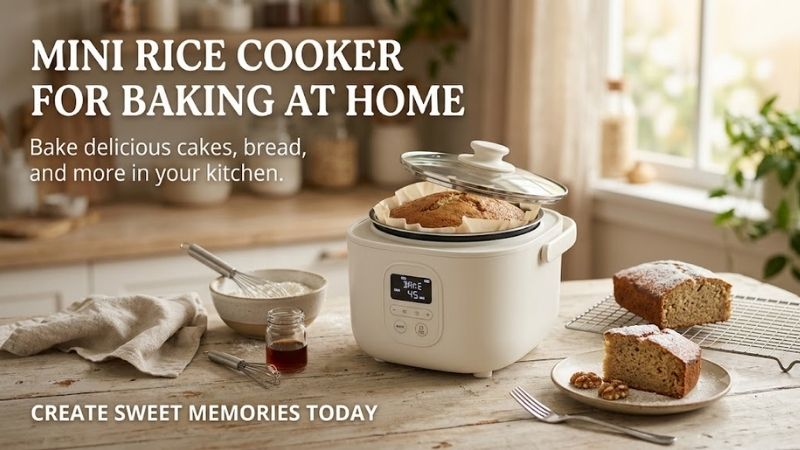
A mini rice cooker for baking at home can be useful when you want to prepare small cakes without using a full-size oven. However, not every rice cooker supports baking, and a standard rice-cooking function is not the same as a dedicated cake program. This guide explains what features matter, how rice-cooker baking differs from oven baking, and how to avoid common cooking and safety mistakes.
- Quick Verdict: Can You Bake With a Mini Rice Cooker?
- Understanding Rice Cooker Baking
- Choosing a Suitable Mini Rice Cooker
- What Types of Cakes Can Be Made?
- Important Baking Features
- How to Bake Safely With a Mini Rice Cooker
- Baking Limitations to Understand
- Choosing for Different Households
- Common Buying Mistakes
- Frequently Asked Questions
- Conclusion
Quick Verdict: Can You Bake With a Mini Rice Cooker?
Yes, certain mini rice cookers can prepare cakes and other approved baked-style recipes.
However, you should choose a model that explicitly supports cake baking or provides manufacturer-approved baking instructions.
A standard one-switch rice cooker may automatically stop or change modes when its temperature sensor detects the conditions associated with finished rice.
This behavior can make cake preparation unreliable.
For baking-focused use, prioritize:
-
A dedicated cake or bake program.
-
Manufacturer-approved baking recipes.
-
Suitable inner-pot capacity.
-
Clearly documented maximum batter levels.
-
A removable cooking pot.
-
Appropriate nonstick surface care.
-
Accessible lid and steam vent components.
-
Safe electrical and thermal design.
A compact rice cooker with a documented cake function is a more appropriate purchase than a basic model whose baking capability is based only on unverified online experiments.
Understanding Rice Cooker Baking
How Does a Rice Cooker Bake a Cake?
A rice cooker heats ingredients inside its removable inner pot.
For cake preparation, the appliance must provide a suitable heating program and operating cycle for batter rather than uncooked rice.
Some models include dedicated cake programs with controls designed for this purpose.
The precise temperature profile varies by manufacturer.
Because heat is often concentrated around the cooking pot rather than distributed through an oven cavity, finished cakes may have different textures and surface appearances from oven-baked cakes.
Why Ordinary Rice Cookers May Not Work
Traditional rice cookers commonly rely on temperature changes associated with water absorption.
Once the rice has absorbed sufficient water and the pot temperature rises, the cooker may switch from cooking to warming.
Cake batter behaves differently from rice and water.
A basic rice cooker may therefore stop heating before a cake is properly cooked.
Repeatedly restarting a cooking cycle may be prohibited by the manufacturer and can create overheating or food-quality problems.
Do not attempt to defeat safety controls or force a basic cooker to operate as an oven.
Rice Cooker Baking vs. Oven Baking
| Factor | Mini Rice Cooker | Conventional Oven |
|---|---|---|
| Heating method | Model-specific heating through an inner pot | Heated oven chamber |
| Recipe quantity | Generally small | Wide range of pan sizes |
| Cake settings | Only on supported models | Baking temperature controls |
| Top browning | Often limited | Can provide more conventional surface browning |
| Shape | Determined by inner-pot geometry | Determined by baking pan |
| Baking flexibility | Limited to approved recipes | Suitable for broader baked goods |
| Equipment footprint | Usually compact | Generally larger |
A mini rice cooker may be convenient for occasional small cakes, but it is not a universal replacement for an oven.
Choosing a Suitable Mini Rice Cooker
Look for a Dedicated Cake Program
This is the most important feature for baking-focused buyers.
A cake program indicates that the manufacturer has designed an operating mode intended for certain cake preparations.
However, the program name alone does not guarantee suitability for every recipe.
Check the owner’s manual for approved ingredients, batter quantity, preparation method, and operating instructions.
A rice cooker advertised as multifunctional may still lack a genuine baking mode.
Check Manufacturer Recipe Support
A useful baking-capable rice cooker should provide clear recipe guidance.
This matters because cake recipes designed for conventional ovens may not work correctly in a rice cooker.
An approved recipe helps establish appropriate ingredient quantities, batter consistency, cooking mode, and doneness checks.
Look for documentation that matches the exact model.
Avoid relying on generic recipes that assume all small rice cookers heat identically.
Choose the Right Inner-Pot Capacity
Mini rice cookers are designed for relatively small quantities.
However, the capacity advertised for uncooked rice does not determine how much cake batter can be safely used.
Batter rises as it cooks.
An overloaded pot may overflow, interfere with steam outlets, or produce unevenly cooked results.
Always follow the specified cake batter limit.
If you need large cakes or several servings, a conventional oven or appropriately designed countertop baking appliance may be more practical.
Consider Pot Shape and Depth
The inner pot determines the finished cake’s basic shape.
A deep, narrow pot may produce a relatively tall cake when the recipe is suitable.
However, thicker mixtures may require more time for heat to reach the center.
A wider pot may produce a shallower cake.
Neither shape is universally superior.
Use recipes intended for the cooker and verify doneness rather than relying on appearance alone.
What Types of Cakes Can Be Made?
Simple Sponge Cakes
Certain rice cookers with cake programs support sponge-style recipes.
These often rely on appropriate egg preparation, flour incorporation, and controlled heating.
However, mixing technique matters.
Overmixing or improperly incorporating ingredients may affect the cake’s texture.
Use a recipe approved for the appliance.
Moist Cakes
Some recipes produce relatively moist cakes because of the covered cooking environment.
However, this is not guaranteed for every machine or recipe.
Ingredient ratios and cooking conditions remain important.
A cake that appears moist should still be checked for complete cooking.
Chocolate Cakes
Chocolate cake recipes may be suitable for certain baking-capable rice cookers.
However, cocoa, melted chocolate, sugar, and fat affect batter consistency.
Do not assume a conventional oven recipe can be transferred directly without adjustment.
Use an appropriate tested recipe that matches the machine’s capabilities.
Cheesecake-Style Desserts
Certain compact cooking appliances may support cheesecake-style recipes.
These preparations involve dairy and potentially eggs, making correct cooking and storage especially important.
Follow an approved recipe with suitable food-safety guidance.
Do not assume that a finished-looking exterior guarantees the center has reached an appropriate temperature.
Important Baking Features
Heating Controls
Some mini rice cookers provide a basic cook-and-warm system, while others include programmable cooking modes.
For baking, controlled operation is important.
A dedicated cake program is generally more useful than a large number of unrelated cooking settings.
However, actual performance depends on the appliance design and recipe.
Nonstick Inner Pot
Many rice cookers use nonstick-coated inner pots.
These may simplify cake removal when used correctly.
However, coatings vary in composition and care requirements.
Use only approved utensils and cleaning methods.
Do not use metal knives to cut a cake directly inside a nonstick pot unless the manufacturer explicitly permits the practice.
Lid and Steam Vent Design
A rice cooker releases steam during operation.
Never block steam vents in an attempt to create a different baking environment.
Do not cover the cooker with towels, foil, or other materials unless specifically required by the manufacturer’s approved recipe.
Blocking steam outlets can create unsafe pressure or heat conditions.
Cleaning Accessibility
Batter can leave residue around the lid, pot rim, and steam components.
A removable inner lid can make cleaning more convenient.
However, removable components must be reinstalled correctly before the next use.
Prioritize accessible cleaning over decorative features.
How to Bake Safely With a Mini Rice Cooker
Step 1: Confirm Baking Compatibility
Read the exact model’s instructions.
Verify that it supports cake preparation and identify the approved program.
Do not proceed with an unsupported recipe merely because another model has similar external dimensions.
Step 2: Select an Approved Recipe
Use a manufacturer-provided recipe or one specifically developed and reliably tested for your cooker.
Confirm ingredient quantities and the permitted batter volume.
Traditional oven temperatures and bake times should not be treated as directly interchangeable with rice cooker programs.
Step 3: Prepare the Inner Pot
Follow the recipe’s instructions for preparing the pot.
Some recipes may specify a suitable coating of fat or another preparation method.
Do not insert an ordinary oven baking pan into the rice cooker unless the manufacturer approves it.
Step 4: Add the Batter
Pour the prepared batter into the inner pot without exceeding the documented limit.
Keep the exterior of the inner pot clean and dry as required.
Seat it properly inside the appliance.
Avoid leaving batter on the heating contact surface or lid sealing areas.
Step 5: Select the Cake Program
Close the appliance according to its operating instructions.
Choose the approved baking setting.
Do not modify the machine, hold down mechanical switches, or bypass temperature controls.
Allow the approved program to operate as directed.
Step 6: Check Doneness
When the program finishes, follow the recipe’s instructions for checking doneness.
A clean skewer may be useful for certain cakes, but it is not a complete food-safety measure for every preparation.
Egg-rich or other potentially hazardous batters may require verified internal temperatures according to an appropriate tested recipe.
If additional cooking is needed, use only a manufacturer-approved procedure.
Step 7: Remove and Cool Safely
The inner pot and steam may be hot.
Use appropriate heat protection and follow the instructions for removing the pot.
Allow the finished cake to cool as the recipe directs.
Do not invert a hot pot or handle hot components without suitable precautions.
Baking Limitations to Understand
Limited Surface Browning
A rice cooker may produce less conventional top browning than an oven.
This is not necessarily a defect.
Many designs heat primarily through the cooking pot and do not include an exposed upper baking element.
If you want a browned crust or decorative top, a conventional oven may be more appropriate.
Small Batch Size
A mini rice cooker may be useful for one or two people but inconvenient for larger households.
Producing several cakes in succession can take more time than baking a larger batch in an oven.
Consider serving needs before buying.
Limited Recipe Flexibility
Cake programs are not universally interchangeable.
Dense breads, pastries, cookies, and high-rising batters may not be supported.
Check the exact permitted recipes and ingredients.
Inconsistent Results With Unadapted Recipes
A recipe designed for an oven may have a different cooking time, texture, and rise when prepared in a rice cooker.
Do not assume that changing only the cooking duration will produce equivalent results.
Choosing for Different Households
Best for Small Apartments
A compact model with a genuine cake program may suit apartment dwellers who have limited access to conventional baking equipment.
However, it still requires a suitable electrical outlet and adequate operating clearance.
Best for Occasional Home Baking
A small baking-capable rice cooker can be useful if you also regularly cook rice.
This dual-purpose use may justify the appliance more than buying it exclusively for occasional cakes.
Best for Beginners
Prioritize clear instructions and manufacturer-approved recipes.
Simple controls are more valuable than a long list of poorly documented functions.
Best for Frequent Bakers
If baking is a major part of your cooking routine, a conventional oven or appropriately designed countertop oven may offer greater recipe flexibility.
A mini rice cooker is best treated as a specialized alternative for supported small-batch preparations.
Common Buying Mistakes
Assuming Every Rice Cooker Can Bake
Many basic rice cookers lack a cake program.
Do not treat the rice cooking cycle as an equivalent substitute.
Overfilling the Inner Pot
Cake batter can expand.
Exceeding the permitted quantity can cause overflow or poor cooking results.
Repeatedly Restarting an Unsupported Cooking Cycle
Forcing a basic rice cooker to continue heating may damage the appliance or create safety hazards.
Use only approved programs.
Using Conventional Oven Recipes Without Adjustment
Rice cooker heating differs from oven heating.
Choose recipes designed for the exact appliance.
Ignoring Food Safety
A cake can look finished while containing undercooked ingredients.
Use appropriate doneness methods and follow safe storage practices, particularly for dairy- or egg-containing preparations.
Frequently Asked Questions
Can You Bake a Cake in a Mini Rice Cooker?
Yes, some mini rice cookers include cake programs or manufacturer-approved baking instructions. Not every rice cooker is suitable.
Do I Need a Special Rice Cooker for Baking?
Choose a model that explicitly supports baking. A standard automatic rice cooker may not provide an appropriate heating cycle.
Can I Use Cake Mix in a Rice Cooker?
Only if the model and a suitable recipe permit it. Ordinary packaged cake mix instructions generally assume conventional oven baking.
Why Is My Rice Cooker Cake Not Brown on Top?
Many rice cookers lack the upper heating arrangement of a conventional oven. Reduced top browning can be a normal result of the heating design.
Can I Put a Cake Pan Inside a Rice Cooker?
Do not insert additional baking pans unless the manufacturer approves their use with the exact model.
Is a Mini Rice Cooker Better Than a Toaster Oven for Baking?
A rice cooker may be convenient for a limited selection of approved cake recipes. A suitable toaster oven generally offers broader conventional baking flexibility.
Conclusion
A mini rice cooker for baking at home is worth considering when you want to prepare small, simple cakes using an appliance that also cooks rice. Choose a model with an explicit cake program, reliable manufacturer instructions, and suitable batter capacity. Never assume that ordinary rice-cooking settings can safely replace baking programs, and treat recipe compatibility and complete cooking as essential purchasing considerations.




Write Your Review
No reviews yet. Be the first to share your experience!