
An automatic espresso machine for easy cleaning should simplify coffee preparation without replacing manual brewing work with complicated maintenance. While bean-to-cup machines automate grinding, dosing, and extraction, they still collect coffee oils, wet grounds, milk residue, and mineral deposits. This guide explains which cleaning features genuinely matter, how machine designs differ, and how to choose an appliance that remains convenient after months of everyday use.
- Quick Verdict: Which Automatic Espresso Machine Is Easiest to Clean?
- Understanding Automatic Espresso Machine Cleaning
- Removable vs. Fixed Brew Groups
- Automatic Rinse Cycles
- Descaling and Water Quality
- Grounds Container Design
- Drip Tray Maintenance
- Milk Systems: Often the Hardest Part to Clean
- Grinder Cleaning and Bean Storage
- Comparing Cleaning Workloads
- Choosing the Right Cleaning Interface
- Cleaning Frequency: What Should Buyers Expect?
- Evaluating Maintenance Costs
- Choosing for Different Households
- Common Buying Mistakes
- Frequently Asked Questions
- Conclusion
Quick Verdict: Which Automatic Espresso Machine Is Easiest to Clean?
For most households, a fully automatic bean-to-cup espresso machine with an accessible grounds container, removable drip tray, straightforward cleaning programs, and a well-documented brew-group maintenance system is the strongest category to consider.
If you regularly make milk beverages, the milk system deserves equal attention.
A machine that automatically rinses coffee pathways but has complicated milk tubing may require more cleaning work than expected.
| Cleaning Feature | Why It Matters | Buying Priority |
|---|---|---|
| Accessible brew group | Allows maintenance where supported | High |
| Automatic rinse programs | Helps flush certain coffee residues | High |
| Removable grounds container | Simplifies daily waste disposal | Essential |
| Removable drip tray | Handles rinse water and spills | Essential |
| Clearly guided descaling | Reduces maintenance confusion | High |
| Easy-clean milk system | Important for cappuccino and latte drinkers | Essential when applicable |
| Accessible grinder maintenance | Helps manage coffee oils and particles | Useful |
| Replaceable seals and components | Supports long-term serviceability | High |
| Cleaning reminders | Helps track required procedures | Useful |
The easiest-cleaning machine is not necessarily the one with the most automatic cleaning programs. The best design combines effective automated routines with components that are easy to inspect, wash, dry, and reassemble.
Understanding Automatic Espresso Machine Cleaning
What Does Fully Automatic Mean?
A fully automatic bean-to-cup machine generally handles grinding, coffee dosing, extraction, and spent-ground disposal with limited user involvement.
Some models also automatically prepare milk beverages.
However, fully automatic does not mean self-maintaining.
The machine still contains parts that contact coffee, water, and possibly milk.
These areas require regular attention.
The amount of manual cleaning depends on how the appliance is built.
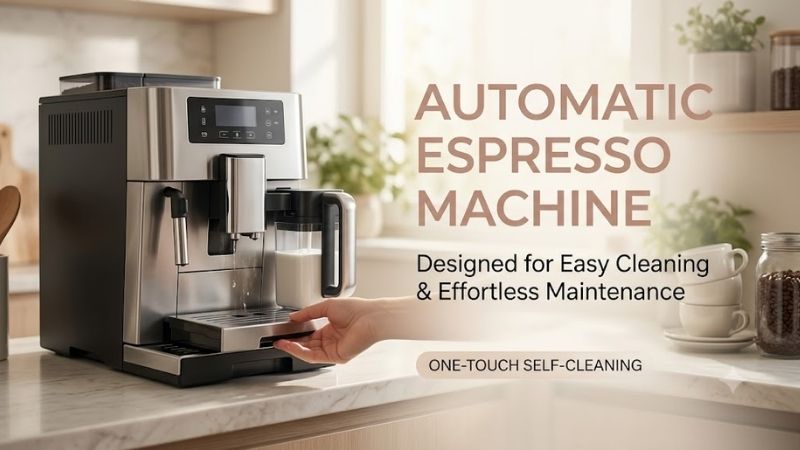
Automatic Brewing vs. Automatic Cleaning
These are separate functions.
A machine may prepare espresso at the touch of a button but still require manual rinsing of its brew group.
Another machine may run automated coffee-circuit cleaning programs while requiring careful daily milk-system washing.
Do not assume that beverage automation predicts maintenance convenience.
When shopping, evaluate the maintenance system independently from the drink menu.
Why Coffee Machines Get Dirty
Coffee contains oils and fine particles.
During extraction, these can accumulate in the brew chamber, coffee outlet, and other components.
Spent grounds contain moisture and can develop unpleasant odors if left inside the machine.
Water minerals may accumulate in heated internal passages.
Milk introduces additional proteins, fats, and sugars that can leave residue in tubing and frothing systems.
Each type of buildup requires an appropriate cleaning approach.
Removable vs. Fixed Brew Groups
What Is a Brew Group?
The brew group is the mechanism that holds and extracts ground coffee within many bean-to-cup machines.
It compresses the coffee, directs brewing water through it, and helps discharge the spent puck.
This component operates repeatedly during normal use.
Its design can strongly influence maintenance.
Removable Brew Groups
Some automatic machines allow users to remove the brew group through a service door.
This may provide direct access for rinsing and inspection.
However, the manufacturer may specify how frequently the unit should be cleaned, how it should dry, and whether lubrication or other maintenance is required.
Removal is useful only when the mechanism is reasonably accessible and the procedure is straightforward.
A removable brew group should never be forced out of position.
Fixed Brew Groups
Other machines have internal brew groups that are not intended for normal user removal.
These may rely on automatic cleaning cycles and manufacturer-approved cleaning tablets.
A fixed brew group is not automatically inferior.
Its maintenance convenience depends on the effectiveness of the cleaning system and the service requirements.
However, some internal areas may be harder for the owner to inspect directly.
Which Is Better?
There is no universal answer.
A removable brew group may appeal to people who prefer hands-on access and periodic rinsing.
A fixed system may suit buyers who prefer guided cleaning routines and are comfortable following the manufacturer’s maintenance procedures.
Compare total owner effort, approved cleaning products, access points, and service costs.
Do not assume that a machine with a removable brew group requires no cleaning tablets or that a fixed group is maintenance-free.
Automatic Rinse Cycles
Startup Rinsing
Some automatic espresso machines rinse internal coffee pathways during startup.
This can help clear residual coffee and condition the brewing pathway.
However, the cycle produces wastewater.
The machine may need a cup or container beneath the outlets, depending on the design.
For a small kitchen, frequent rinse-water disposal can become part of the daily routine.
Shutdown Rinsing
Certain machines also rinse when switched off.
This can help manage coffee residue, but it uses additional water and contributes to drip-tray filling.
Before buying, check how the machine handles rinse water and whether the tray is easy to empty.
Automatic Cleaning Programs
A programmed cleaning cycle may guide the user through adding an approved cleaning tablet, confirming a rinse stage, and disposing of wastewater.
The exact steps vary.
A cleaning cycle does not necessarily remove mineral scale.
This distinction is important when interpreting machine maintenance alerts.
When Automatic Rinsing Is Not Enough
Rinsing with water may remove loose residue, but coffee oils can require a dedicated cleaning product.
Milk systems may need separate procedures.
A machine’s automatic rinse feature should therefore be viewed as one part of maintenance rather than proof that the appliance cleans itself completely.
Descaling and Water Quality
What Is Descaling?
Descaling removes mineral deposits that accumulate in the machine’s water system.
The rate of buildup depends on water mineral content and machine use.
Excessive scale can interfere with heating and water flow.
However, descaling intervals should be based on the manufacturer’s instructions and the conditions of use.
Cleaning vs. Descaling
Cleaning removes coffee oils, grounds, and other residues.
Descaling addresses mineral buildup.
The processes may require different products and programs.
Using a coffee-cleaning tablet does not replace descaling unless the manufacturer explicitly says otherwise.
Likewise, running descaling solution through an inappropriate coffee pathway can damage equipment.
Water Filters
Some automatic machines use replaceable water filters.
These can be useful for controlling certain water characteristics, depending on the filter design.
However, a filter does not guarantee that scale will never form.
Water filtration requirements and compatibility vary.
Use only approved filters or alternatives explicitly supported by the manufacturer.
Water Hardness Settings
Certain machines allow users to configure water hardness.
This can influence maintenance reminders.
However, entering an arbitrary hardness value may produce an inappropriate descaling schedule.
Follow the manufacturer’s testing or setup procedure.
Can You Use Vinegar to Descale?
Do not assume vinegar is safe for every machine.
Some manufacturers approve particular vinegar-based procedures for specific products, while others require proprietary or approved descaling solutions.
Follow the exact appliance instructions.
Using an unauthorized chemical may damage seals, internal components, or warranty coverage.
Grounds Container Design
Why the Container Matters
Automatic machines discharge used coffee grounds into an internal container.
The grounds are wet after brewing.
If left for too long, they may develop odors or support microbial growth.
A convenient grounds container should be easy to remove, empty, wash, and dry.
Grounds Capacity
Manufacturers sometimes advertise how many coffee pucks a container holds.
However, the useful capacity can depend on puck size and machine behavior.
A larger container reduces emptying frequency but does not justify leaving wet grounds inside indefinitely.
Daily attention may still be appropriate.
Cleaning Access
Look for a container that slides out without awkward movements.
If the grounds container is hidden behind the drip tray, check whether both components must be removed together.
A design that requires several steps can become frustrating during busy mornings.
Emptying Alerts
Some machines count brewing cycles to estimate when the grounds container is full.
Others may use different systems.
An emptying alert is not necessarily a direct measurement of the container’s contents.
Follow the instructions for emptying and resetting the indicator.
Drip Tray Maintenance
Why Drip Trays Fill Quickly
Automatic espresso machines may discharge water during startup rinses, shutdown rinses, brewing cycles, and maintenance programs.
A small tray can fill faster than expected.
This is especially relevant when several people use the machine daily.
Removable Components
A practical drip tray should be easy to remove without spilling water.
Check how the cup platform, internal tray, and indicator assemble.
Some designs contain several nested parts.
A simple arrangement may be easier to wash.
Dishwasher Compatibility
Certain tray components may be dishwasher safe.
Others require handwashing.
Follow exact manufacturer instructions.
Do not assume that a removable tray can be washed in a dishwasher.
Preventing Odors
Empty and clean the tray regularly.
Coffee residue and stagnant water can develop unpleasant odors.
Dry components according to the manual before reassembly when appropriate.
Milk Systems: Often the Hardest Part to Clean
Automatic Milk Carafes
Some machines use removable milk carafes that attach to the brewing system.
These can simplify drink preparation.
However, the carafe, lid, frothing components, and milk pathways need cleaning.
Check whether the carafe can be placed in the refrigerator between uses and what the manufacturer requires for rinsing and washing.
Refrigeration does not replace cleaning.
Milk Tubes
Tube-based systems draw milk from a separate container.
This can reduce the number of bulky attached components.
However, milk contacts the tube and other internal surfaces.
These need appropriate cleaning.
A narrow tube can be difficult to inspect.
Choose a system with clear cleaning instructions and available replacement parts.
Traditional Steam Wands
A manual steam wand has fewer milk-contact components than some automatic milk systems.
However, it requires immediate cleaning after each use.
Wipe and purge the wand according to the manual.
Steam and metal components can be extremely hot.
A steam wand may be a practical choice if you prefer simple accessible maintenance and do not mind manually preparing milk.
Automatic Milk Rinsing
Some machines rinse their milk pathways automatically.
This can reduce residue accumulation.
However, an automatic rinse is not necessarily equivalent to the complete cleaning procedure required after milk preparation.
Check whether the machine also needs periodic disassembly or detergent cleaning.
Choosing Based on Your Drinks
If you drink only black espresso, a machine without a complex milk system may be easier to maintain.
If you prepare several lattes daily, a well-designed automatic milk system may justify the additional cleaning.
Choose according to the features you actually use.
Grinder Cleaning and Bean Storage
Built-In Grinder Maintenance
Bean-to-cup machines usually include a grinder.
Coffee oils and particles can accumulate around burrs and the grounds pathway.
However, some grinders are not intended for user disassembly.
Follow the maintenance instructions.
Do not pour water into the bean hopper or grind unapproved cleaning materials.
Oily Coffee Beans
Some dark-roasted coffees have substantial surface oil.
These oils can contribute to residue in certain grinder systems.
However, compatibility varies.
Some manufacturers provide explicit guidance regarding oily beans.
Check the model’s recommendations rather than assuming every automatic grinder handles all roast types equally.
Bean Hopper Cleaning
A bean hopper should be kept clean and dry.
However, removal and washing procedures vary.
Do not expose internal grinder components to moisture.
Switching Coffee Beans
If you frequently change between regular and decaf beans, consider how easily the hopper and grinder can be emptied.
Some machines retain coffee in the grinding pathway.
A single-hopper system may be inconvenient for households with different preferences.
Comparing Cleaning Workloads
| Machine Type | Daily Cleaning | Periodic Maintenance | Main Trade-Off |
|---|---|---|---|
| Automatic espresso, black coffee only | Grounds container, drip tray, accessible surfaces | Brew group, cleaning cycle, descaling | Convenient drinks, internal mechanisms |
| Automatic espresso with milk carafe | Coffee components plus milk system | Deeper milk cleaning, brew group, descaling | Greater beverage convenience, more sanitation |
| Semi-automatic with steam wand | Portafilter, basket, wand, tray | Group cleaning, descaling, seals | More hands-on brewing, accessible parts |
| Capsule machine without milk system | Capsule disposal, tray, outlet | Descaling and model-specific cleaning | Fewer grounds-handling tasks, capsule costs |
A machine requiring fewer manual brewing steps may still have more internal parts needing maintenance.
Choosing the Right Cleaning Interface
Maintenance Reminders
A clear notification system can help users complete cleaning tasks on time.
However, reminders may be based on usage counts or configured water hardness rather than direct measurement.
They are useful prompts, not perfect assessments of machine condition.
Guided Cleaning Programs
An on-screen procedure can reduce confusion.
However, it should be evaluated against the full maintenance requirements.
A simple machine with a well-written manual may be easier to maintain than a complicated touchscreen device.
Removable Water Tanks
Water tanks should be accessible for rinsing and refilling.
Narrow openings may make cleaning difficult.
Check whether the tank can be removed without moving the machine.
Accessible Coffee Outlets
Coffee oils can accumulate around dispensing spouts.
Choose a design that allows appropriate cleaning access.
However, do not attempt to dismantle outlets unless the manufacturer provides an approved procedure.
Cleaning Frequency: What Should Buyers Expect?
After Every Use
Remove obvious spills and residue.
Clean milk-contact components according to the machine’s instructions.
Some machines automatically rinse coffee outlets.
Daily or Frequent Routine
Empty wet grounds and drip-tray water when necessary.
Clean the relevant containers.
Refresh reservoir water as directed.
Weekly or Periodic Maintenance
Some removable brew groups require rinsing or other maintenance at defined intervals.
Follow the model’s manual.
A fixed brew group may have different procedures.
Cleaning Cycles
Run manufacturer-approved cleaning programs when prompted or scheduled.
Use the correct cleaning products.
Descaling
Descale according to water conditions and machine instructions.
Do not impose a universal monthly schedule on every product.
Evaluating Maintenance Costs
Cleaning Tablets
Some machines require specific cleaning tablets.
Check cost and availability before purchase.
A machine that seems inexpensive initially may have substantial recurring maintenance expenses.
Descaling Products
Descaling solutions vary.
Use only approved formulations.
Water Filters
Filters may need regular replacement.
Consider both expense and availability.
Milk Tubes and Seals
Some milk components and seals wear over time.
Check whether replacements are available.
Professional Service
Certain maintenance tasks may require authorized service.
A machine with a complex internal system can become expensive to repair.
Review warranty coverage and service availability.
Choosing for Different Households
Espresso-Only Drinkers
A machine without automatic milk handling may offer a simpler maintenance routine.
Prioritize easy grounds disposal and brew-group care.
Daily Latte Drinkers
Milk cleaning is essential.
Evaluate the complete milk-system procedure before buying.
Families With Several Coffee Drinkers
A larger grounds container and convenient drip tray can reduce interruptions.
However, wet residue still needs regular disposal.
Small Apartments
Choose a machine whose maintenance components are accessible without moving the entire appliance.
Side service doors and top hoppers require clearance.
Users Who Dislike Cleaning
A machine with automatic rinse programs may help.
However, no bean-to-cup machine is completely maintenance-free.
If you want the fewest daily cleaning tasks, compare a simple capsule machine without a milk system as an alternative.
Common Buying Mistakes
Believing Self-Cleaning Means No Maintenance
Automated cycles do not eliminate every manual cleaning task.
Ignoring Milk-System Complexity
Automatic cappuccino functions can create substantial cleaning requirements.
Choosing a Machine With Inaccessible Parts
A removable brew group is useful only if you can reach it easily.
Forgetting Ongoing Consumable Costs
Cleaning tablets, filters, and descaling products affect ownership expenses.
Using the Wrong Cleaning Product
Cleaning and descaling are different processes.
Letting Wet Grounds Accumulate
A large grounds container does not make prolonged storage hygienic.
Frequently Asked Questions
Are Fully Automatic Espresso Machines Easy to Clean?
They can be convenient, but cleaning effort varies with brew-group design, milk systems, and maintenance programs.
Is a Removable Brew Group Better?
It provides direct cleaning access where supported. Fixed brew groups may also be maintained effectively through approved cleaning programs. The better design depends on the model and user preference.
Do Automatic Espresso Machines Clean Their Milk Systems?
Some include automatic milk-rinse routines, but complete cleaning may still require disassembly or additional procedures.
How Often Should I Descale an Automatic Espresso Machine?
Follow the manufacturer’s schedule, water-hardness settings, and maintenance alerts. There is no universal interval appropriate for every machine.
Can I Use Vinegar to Clean My Espresso Machine?
Only if the exact manufacturer approves it for the relevant maintenance procedure.
What Is the Lowest-Maintenance Coffee Machine?
A simple capsule machine without a milk system may involve fewer daily grounds-handling tasks. Among bean-to-cup machines, look for accessible waste containers and well-designed automated maintenance.
Conclusion
The best automatic espresso machine for easy cleaning balances convenient brewing with an accessible, understandable maintenance system. Prioritize grounds disposal, drip-tray access, brew-group care, approved cleaning programs, and manageable descaling. If milk beverages are part of your daily routine, evaluate milk-system cleaning before anything else. A machine that makes excellent coffee but is frustrating to maintain may not be the right long-term purchase.








Write Your Review
No reviews yet. Be the first to share your experience!