
Choosing a roasting pan for small spaces requires balancing useful cooking capacity with limited oven clearance, cabinet depth, and cleaning space. A compact roaster can prepare chicken, vegetables, and smaller cuts of meat without occupying an entire kitchen cabinet. This guide explains how to compare dimensions, materials, rack designs, and storage features.
- What makes a roasting pan suitable for a small kitchen?
- Choosing the right roasting pan size
- How to measure your oven before buying
- Best roasting pan materials for compact kitchens
- Features that improve small-space usability
- Roasting pan versus sheet pan for small kitchens
- How to roast successfully in a smaller pan
- Storage strategies for compact cookware
- Frequently Asked Questions
- Conclusion
What makes a roasting pan suitable for a small kitchen?
A small-space roasting pan should fit inside the available oven, hold the foods you regularly prepare, and remain convenient to wash and store. Overall dimensions matter more than advertised capacity alone because extended handles, tall sidewalls, and oversized racks can make an otherwise manageable pan difficult to use.
An apartment with a conventional oven may still have limited cabinet and sink space.
Likewise, a countertop oven may have significantly less usable space than a standard wall oven.
These differences influence whether a rectangular stainless steel roaster, a compact baking dish, or a shallow oven-safe skillet is the most practical purchase.
A pan that comfortably handles a whole chicken and vegetables can serve many households without needing the capacity for a large Thanksgiving turkey.
The goal is to purchase enough cooking space for normal meals rather than the largest pan the oven could theoretically accommodate.
Choosing the right roasting pan size
Roasting pan dimensions affect food capacity, browning, oven airflow, and safe handling. Buyers should compare the interior cooking area with the overall outside dimensions, especially when a product has large side handles. The ideal fit also depends on whether the oven has multiple racks and how much clearance is available above the food.
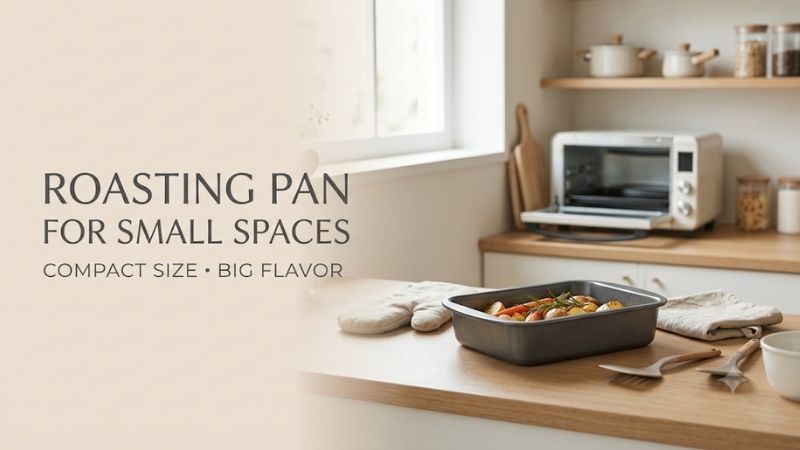
Compact 11-by-14-inch roasting pans
An approximately 11-by-14-inch roasting pan can be a practical option for small households preparing chicken, pork, vegetables, or smaller cuts of beef. Its footprint is substantially more manageable than that of large holiday roasters, making it easier to position in cabinets and wash in a relatively small sink.
The All-Clad Small Stainless Steel Roaster with Nonstick Rack illustrates this size category.
Its removable rack provides flexibility for roasting foods above accumulated drippings.
Without the rack, the cooking vessel can accommodate suitable vegetables or baked dishes.
However, the usable cooking area is smaller than its outside dimensions, and buyers should confirm overall measurements before purchasing.
A compact roaster also has limited capacity for large poultry.
It is better suited to ordinary family meals than substantial holiday gatherings.
Medium 13-by-16-inch roasting pans
A 13-by-16-inch roasting area provides more room for whole poultry, larger meat cuts, and vegetables. This format is common among full-size roasting pans, but it can be challenging in apartments where ovens, sinks, and cabinets have limited dimensions.
The All-Clad Large Stainless Steel Roaster and D3 Large Flared Roaster use this general size.
The additional length provides room for bigger foods.
However, handles may extend beyond the stated cooking dimensions.
A medium-to-large roaster can be worthwhile when it replaces multiple other baking dishes, but it should not be purchased without measuring the available space.
Shallow roasting pans for multipurpose use
A shallow roasting pan can be convenient when cooking vegetables, chicken pieces, and smaller portions that do not require the deep sides of a traditional turkey roaster. Lower sidewalls may improve access to the food and make the pan easier to stack or store.
A heavy-duty rimmed baking sheet can sometimes perform similar tasks.
For vegetables and chicken pieces, a sheet pan may be more versatile than a deep roasting vessel.
However, it provides less containment for substantial cooking juices.
Choose a deeper roaster when collecting liquids, handling larger meats, or using a raised rack is important.
How to measure your oven before buying
Measuring available oven space is essential because manufacturers often describe roasting pans using nominal interior dimensions rather than the complete space occupied by handles and rims. An oven that appears wide enough for a particular pan may still lack the clearance required to insert, remove, or safely handle it when hot.
Measure usable oven width and depth
Begin by measuring the interior space at the rack level where the roaster will be used. Account for the oven walls, door, rack supports, and any fixed structures that reduce usable space.
Do not assume the oven’s advertised capacity provides enough information.
Compare your measurements with the roaster’s complete outside dimensions.
Leave sufficient space around the pan for the oven to operate according to its manufacturer’s instructions.
Also consider whether the door closes without contacting the cookware.
Check handle clearance
Side handles can substantially increase a roasting pan’s total width. Large upright handles may be convenient for lifting but can prevent the vessel from fitting inside a narrow oven.
Look for models with relatively compact handle profiles when space is restricted.
However, avoid designs that are difficult to grip while wearing protective mitts.
A smaller pan with usable handles is preferable to a large pan that barely fits but becomes hazardous to remove.
Consider food height and rack placement
Pan depth is only one part of the clearance requirement. A whole chicken or large roast can extend significantly above the rim, while a raised rack increases the height of the food inside the oven.
Measure the usable vertical space between racks and heating elements.
Allow sufficient clearance for the intended food.
Avoid placing roasting pans where food could contact heating elements.
Follow oven instructions for rack positioning and safe cooking.
Best roasting pan materials for compact kitchens
Material selection influences weight, cleaning, durability, and whether the pan can serve multiple cooking purposes. For small kitchens, multipurpose cookware can reduce the number of items stored. However, features that improve stovetop versatility may come with additional cost or weight.
Stainless steel roasting pans
Stainless steel roasting pans are practical for households that want durable cookware without a conventional nonstick coating. They can handle a broad range of suitable roasting recipes, and many designs include removable racks for poultry or meat.
The Cuisinart Chef’s Classic 16-Inch Roasting Pan is an example.
Its stainless steel body and rack allow the cook to roast meat above accumulated juices.
However, stainless steel can develop stubborn browned residue during long roasting sessions.
Cleaning may require soaking or manufacturer-approved products.
For a small kitchen, consider whether the pan’s overall dimensions are manageable rather than assuming stainless steel durability justifies a large size.
Nonstick roasting pans
Nonstick roasting pans can simplify cleanup when food residue and grease accumulate during cooking. This may be attractive in apartments with small sinks or limited washing space.
However, coatings require appropriate utensils and temperature management.
The All-Clad Nonstick Large Roaster has specific temperature limits for both the pan and rack.
Those limits must be considered separately.
A coated pan is not automatically a better purchase when the household frequently cooks at higher temperatures or wants to develop browned residues for sauces.
Choose nonstick primarily when convenient cleaning aligns with normal cooking methods.
Fully clad roasting pans
Fully clad roasting pans use bonded metal layers that can support heat distribution when the vessel is used in compatible stovetop applications. This may be valuable when preparing gravy from drippings after roasting.
The Cuisinart MultiClad Pro 16-Inch Roasting Pan is an example.
Its tri-ply construction and included rack provide multiple cooking options.
However, it is relatively heavy.
For households with limited lifting ability or very small storage spaces, simpler cookware may be easier to manage.
Enameled roasting dishes
Enameled cast iron and other enameled roasting dishes can be useful for roasting and serving, depending on their construction. Their protective finishes simplify some maintenance requirements, but material weight and thermal-shock precautions remain relevant.
A compact enameled baking dish may also serve casseroles and other oven recipes.
However, not all enameled cookware is suitable for stovetop heating.
Check the exact product specifications.
For small kitchens, the ability to serve directly from the cooking vessel can reduce the number of dishes needed.
Features that improve small-space usability
Space-saving cookware should be evaluated by how easily it moves between storage, oven, sink, and table. Removable racks, compact handles, stackable profiles, and multipurpose cooking surfaces can provide meaningful advantages without requiring complicated mechanisms.
Removable roasting racks
A removable rack allows one roasting vessel to handle different foods. With the rack installed, poultry and some meat cuts sit above accumulated juices. Without it, the pan can accommodate vegetables or recipes that benefit from direct contact with the cooking surface.
This flexibility can reduce the need for separate cookware.
However, the rack must be stored somewhere when it is not in use.
Check whether it nests securely inside the pan.
Protect coated racks from scratching or pressure damage during storage.
Handles that are practical with oven mitts
Compact handles can save space, but they should still allow safe lifting. A loaded roasting pan may contain several pounds of food and hot liquid, making secure control important.
Choose sturdy side handles.
Check whether there is enough room for protective mitts.
Avoid lifting hot cookware by the rack alone.
Use both hands when removing substantial roasts.
Multipurpose cooking surfaces
A roasting pan that also handles vegetables, baked pasta, or suitable casseroles may justify its storage footprint more effectively than cookware reserved exclusively for annual holiday meals.
Consider whether the same vessel can replace a deep baking dish.
However, avoid using non-oven-safe lids or accessories.
Also confirm that any stovetop use is approved for the specific model.
Cleaning convenience
Small sinks can make washing large roasters awkward. Choose a size that can be handled comfortably without hitting surrounding countertops or fixtures.
Dishwasher compatibility may be useful, but the pan must physically fit the appliance.
Check manufacturer care guidance.
Do not assume all stainless steel or nonstick roasting pans share the same cleaning requirements.
Roasting pan versus sheet pan for small kitchens
A roasting pan and a rimmed baking sheet can both prepare oven-cooked meals, but they serve different purposes. Roasters have deeper sidewalls for containing juices and supporting larger foods, while sheet pans provide broad, accessible cooking surfaces for vegetables, chicken pieces, and many baked foods.
| Feature | Compact roasting pan | Rimmed sheet pan |
|---|---|---|
| Sidewall height | Usually deeper | Usually shallow |
| Best for | Roasts and juicy foods | Vegetables and smaller pieces |
| Rack compatibility | Often includes a rack | May require separate rack |
| Storage | Bulkier | Often easier to stack |
| Pan juices | Better containment | Lower capacity |
| Everyday versatility | Roasting and some baking | Roasting and general baking |
For an apartment household cooking mostly vegetables and chicken pieces, a sturdy rimmed sheet pan may be the more useful first purchase.
A dedicated roasting pan becomes more valuable when cooking whole poultry, large meat cuts, or recipes that produce substantial drippings.
How to roast successfully in a smaller pan
Compact roasting requires careful food placement and temperature control because limited surface area can become crowded quickly. A small pan can deliver excellent results when the food fits comfortably, but overloading it may trap moisture and reduce browning.
Choose foods that fit without crowding
A compact roaster should provide sufficient space for the main food while allowing the oven’s hot air to circulate.
Avoid pressing large pieces tightly against the pan walls.
When roasting vegetables, spread them with enough space to encourage browning.
If the pan becomes crowded, prepare the vegetables separately.
Use the rack when appropriate
A rack is useful when the goal is to elevate the food above cooking juices.
It may support more exposed browning on poultry and some meat cuts.
However, vegetables often benefit from direct pan contact.
Choose the arrangement according to the recipe.
Monitor internal temperature
Small pans do not eliminate the need to check food safety.
Use a reliable food thermometer for meat and poultry.
Whole poultry should reach a safe internal temperature of 165°F.
Follow appropriate guidance for other meats and cuts.
Do not judge doneness solely by exterior color.
Transfer hot food carefully
A small roasting pan may be easier to lift than a large one, but hot drippings still create a burn hazard.
Prepare a stable heat-safe surface before removing the food.
Use appropriate protective mitts.
Avoid tilting the pan unexpectedly.
Allow the contents to settle before transferring liquids.
Storage strategies for compact cookware
Roasting pans are often among the bulkiest kitchen items because their handles and sidewalls prevent conventional stacking. An efficient storage arrangement should protect the cookware and permit easy removal without creating unstable piles or damaging delicate finishes.
Store the rack inside the pan
When the rack fits safely inside the roasting pan, keeping both components together can reduce storage clutter.
Ensure the surfaces are clean and dry.
Use suitable protection if the rack has a coating.
Avoid placing sharp tools directly against nonstick finishes.
Use vertical storage when appropriate
Some roasting pans can fit in vertical cabinet organizers when their shape and weight permit secure support.
The arrangement should be stable.
Heavy cookware must not be stored where it could fall onto someone.
Check whether handles interfere with adjacent cabinet doors.
Avoid unnecessary duplicate cookware
Before buying a roasting pan, review what you already own.
A heavy baking dish or suitable oven-safe skillet may handle many smaller roasting tasks.
A dedicated roaster is most worthwhile when it provides capacity or rack functionality unavailable from existing equipment.
Frequently Asked Questions
Small-kitchen cooks often need to decide whether a dedicated roaster is necessary and how much oven space it will consume. The following questions address the practical relationship between pan size, cooking capacity, cleaning, and storage.
What size roasting pan is best for a small oven?
A compact roasting pan around 11 by 14 inches may be suitable, but the correct choice depends on usable oven dimensions, handle clearance, and the intended food.
Measure your oven before purchasing.
Can I roast a chicken in a small roasting pan?
Yes, provided the chicken fits comfortably and the oven maintains sufficient clearance. Use an appropriate rack when needed and verify doneness with a food thermometer.
Do I need a rack for vegetables?
Not usually. Many vegetables benefit from direct contact with the roasting surface, which encourages browning.
A removable rack remains useful for meat and poultry.
Is a roasting pan better than a baking dish?
A roasting pan is useful for larger foods and collecting drippings. A baking dish may be more convenient for casseroles and smaller meals.
Choose according to normal recipes.
Can I store a roasting pan in the oven?
Some households use an unused oven for cookware storage, but all stored items must be removed before preheating or operating the oven. This arrangement can be inconvenient and creates risks if items are forgotten.
A dedicated cabinet or stable storage area is preferable when available.
Conclusion
The right roasting pan for small spaces should fit your oven comfortably, hold normal meal portions, and remain practical to wash and store. A compact 11-by-14-inch stainless steel roaster is a useful option for smaller poultry and everyday meals, while a larger 16-inch pan makes sense when substantial roasts are prepared regularly. Prioritize overall dimensions, handle clearance, removable racks, and multipurpose usefulness rather than purchasing maximum capacity. In especially small kitchens, a quality rimmed sheet pan may cover most ordinary roasting tasks without the storage demands of a dedicated deep roaster.


Write Your Review
No reviews yet. Be the first to share your experience!