
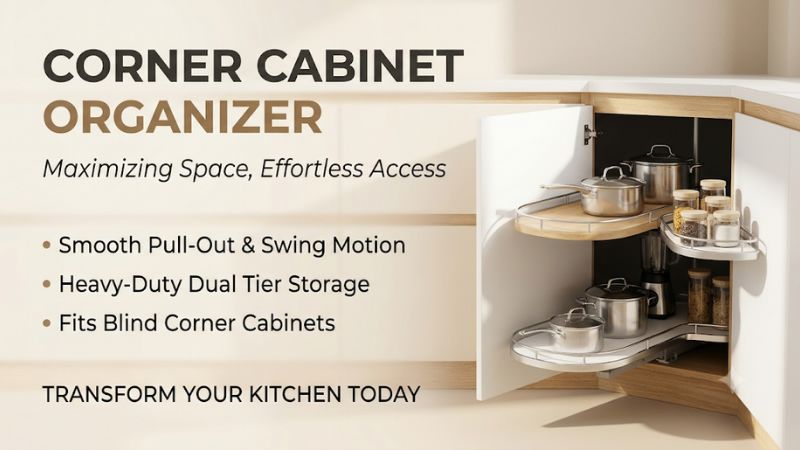
A corner cabinet organizer can turn an awkward kitchen compartment into storage that is easier to reach and maintain. However, blind corners, diagonal cabinets, and L-shaped openings require different hardware. This guide compares six identifiable systems and explains how their mechanisms, mounting needs, and storage limitations affect everyday use.
- Quick Verdict: Which Corner Cabinet Organizer Is Best?
- Quick Comparison Table
- How We Selected These Corner Organizers
- Six Corner Cabinet Organizers Compared in Detail
- Buying Guide: How to Choose the Right Corner Cabinet Organizer
- Installation, Maintenance, and Everyday Use
- Frequently Asked Questions
- Conclusion
Quick Verdict: Which Corner Cabinet Organizer Is Best?
The best organizer depends primarily on the cabinet’s shape and opening dimensions. A blind corner with a narrow entrance usually needs a specialized pull-out or swing mechanism, while a traditional corner base cabinet may work better with a rotating Lazy Susan. These recommendations are based on product design and documented manufacturer features rather than original detailed research.
Our six selections:
- Best for premium swing-out access: Kesseböhmer LeMans II Corner Cabinet System.
- Best for coordinated moving baskets: Häfele Magic Corner.
- Best for wire pull-out storage: Rev-A-Shelf 5PSP Blind Corner Optimizer.
- Best for solid-bottom pull-out shelves: Rev-A-Shelf 53PSP Blind Corner Optimizer.
- Best for traditional rotating storage: Rev-A-Shelf 5472 Chrome Kidney-Shaped Lazy Susan.
- Best for an alternative swing-tray layout: VADANIA Two-Tier Swing Tray Blind Corner Organizer.
None of these should be ordered based on cabinet width alone. Internal depth, clear door opening, corner orientation, hinges, frame construction, and the travel path of the shelves all determine whether installation will work.
For kitchens that already have functional rotating shelves, replacing them with an expensive pull-out system may not provide enough benefit to justify the project.
Quick Comparison Table
These six products address different corner-cabinet conditions and purchasing priorities. Their specifications and design descriptions come from identifiable manufacturer or supplier information, but exact measurements and available configurations vary by model. The comparison therefore focuses on important differences rather than presenting one configuration’s dimensions as universal to the entire product family.
| Product | Best For | Main Design | Key Advantage | Main Trade-Off |
|---|---|---|---|---|
| Kesseböhmer LeMans II | Premium corner access | Independently moving curved swing-out trays | Shelves move toward the user | More complicated fitting and installation |
| Häfele Magic Corner | Coordinated blind-corner access | Front and rear basket mechanisms | Brings hidden rear storage toward the opening | Requires precise cabinet compatibility |
| Rev-A-Shelf 5PSP | Blind corners needing baskets | Multi-basket pull-slide-pull system | Access to front and rear baskets | Wire surfaces may not suit small loose items |
| Rev-A-Shelf 53PSP | Bottles and irregular items | Solid-bottom blind-corner optimizer | Continuous shelf support | Large mechanism requires clearance |
| Rev-A-Shelf 5472 | Traditional corner base cabinets | Two kidney-shaped rotating chrome shelves | Familiar rotation and accessible compartments | Not suitable for every blind-corner layout |
| VADANIA Two-Tier Swing Tray | Swing-out corner storage | Two curved trays with soft-close variants | Different access path from basket systems | Cabinet handing and size must be checked |
The main practical distinction is how each system exposes items near the back of a deep corner. A rotating shelf keeps storage inside the cabinet while bringing items around to the opening. A pull-out system moves baskets forward, sometimes requiring a sideways transition. Swing-out trays follow a curved path and may project into the kitchen aisle.
How We Selected These Corner Organizers
The six products were selected for recognizable product identities, documented corner-storage mechanisms, and meaningful differences in use. We prioritized systems with clear design descriptions rather than generic organizers whose dimensions or assembly method cannot be established. The analysis focuses on cabinet compatibility, accessibility, support surfaces, installation demands, and the types of kitchen objects each design can accommodate.
Evaluation factors:
- Cabinet compatibility: Blind corner, corner base, door opening, and available clearance.
- Access mechanism: Rotation, swing-out movement, or staged pull-out operation.
- Storage support: Wire baskets, solid-bottom trays, and continuous shelves.
- Practical usability: Whether items can be reached without unloading the cabinet.
- Installation: Mounting requirements, moving parts, and potential need for professional fitting.
- Maintenance: Cleaning, adjustment, and access to moving hardware.
No original product testing, load measurement, installation trial, or independently measured durability comparison was conducted for this article.
Manufacturer specifications should be verified for the exact selected model before purchase. In particular, dimensions, handing, weight limits, and mounting requirements can differ within a single series.
Six Corner Cabinet Organizers Compared in Detail
A corner organizer is a more significant purchasing decision than a simple countertop tray because it needs to interact with the cabinet’s physical structure. Each product below serves a specific kind of layout or storage problem. Understanding the movement pattern is essential: a mechanism that looks ideal in an installation photograph may not clear the door, sink plumbing, or adjacent appliance in your kitchen.
Kesseböhmer LeMans II Corner Cabinet System
The Kesseböhmer LeMans system uses distinctive curved trays designed to swing out from a corner cabinet, bringing stored cookware or kitchen supplies closer to the user. Its independently moving shelf arrangement is especially relevant where traditional deep-corner storage requires substantial reaching. This is a premium hardware solution that should be selected according to the cabinet’s exact opening and installation requirements.
Best For: Homeowners who want accessible corner storage with a swing-out mechanism.
Why We Picked It: The LeMans design addresses hidden corner access through shaped trays that travel toward the cabinet opening.
Key Specifications:
- Configuration: Curved corner-cabinet swing-out shelves.
- Storage levels: Product configurations include multiple moving trays.
- Cabinet compatibility: Model-specific opening and handing requirements.
- Installation: Permanent cabinet hardware installation.
Features & Benefits:
- Curved trays support accessible storage.
- Moving shelves reduce the need to reach deeply.
- Separate shelf movement can improve organization.
- The mechanism accommodates various cookware layouts when correctly sized.
Pros:
- Strong emphasis on accessibility.
- Suitable for many common cookware shapes.
- Independently accessible storage levels.
- Designed specifically for corner cabinets.
Cons:
- Higher installation complexity than freestanding storage.
- Requires substantial swing clearance.
- Not appropriate for every cabinet opening.
Buy If: You have a compatible corner base cabinet and prioritize reaching cookware comfortably.
Skip If: You rent, cannot modify cabinetry, or have a very restricted opening.
Performance & Practical Use
The curved platform offers a useful compromise between storage space and retrieval. Instead of rotating objects deep within the cabinet, the shelf can bring them toward a position where the cook can lift them more comfortably. That is valuable for medium-size pots and serving dishes that are inconvenient to retrieve from a conventional deep shelf.
The movement path is the important limitation. A tray that swings outward requires enough clear space beyond the cabinet opening, so nearby drawer fronts, appliances, and people using the kitchen must be considered.
What Makes It Different
Unlike a traditional rotating Lazy Susan, the LeMans concept prioritizes moving shaped shelves outside the cabinet. This can create more direct access to items, but it also makes precise measurement and correct installation essential.
The right buyer is someone undertaking a deliberate kitchen storage upgrade, not someone seeking a quick no-tool organizer.
Häfele Magic Corner
The Häfele Magic Corner is a specialized blind-corner storage system that uses linked or coordinated basket movement to improve access to the hidden section of a cabinet. Product descriptions explain how front and rear storage sections can move toward the accessible opening during operation. This makes it a relevant option for kitchens where a deep blind corner cannot be reached comfortably through a narrow door.
Best For: Blind-corner base cabinets where coordinated basket movement is desirable.
Why We Picked It: Its mechanism is designed to expose storage that normally remains concealed behind an adjacent cabinet section.
Key Specifications:
- Design: Blind-corner moving basket system.
- Movement: Coordinated front and rear basket access.
- Mounting: Permanent cabinet installation.
- Orientation: Configuration-specific; verify handing and door requirements.
Features & Benefits:
- Brings rear storage closer to the opening.
- Separates contents into basket groups.
- Can reduce the need to unload front items.
- Provides dedicated storage inside deep corners.
Pros:
- Designed for difficult blind corners.
- Front and rear storage areas become more accessible.
- Distinct basket sections support categorization.
Cons:
- Cabinet geometry must match the mechanism.
- Multiple moving components increase installation demands.
- Storage baskets may not accommodate every bulky appliance.
Buy If: Your kitchen has a compatible blind corner and the rear section is currently difficult to use.
Skip If: You have a simple diagonal corner cabinet that would work with an ordinary rotating shelf.
Performance & Practical Use
The Magic Corner approach solves a specific access problem: the front storage area is not the only useful part of the cabinet. As the mechanism operates, the rear baskets become available through the same opening, allowing items stored in the otherwise hidden section to be selected.
This can be especially valuable for medium-size pantry packages, serving accessories, and other objects that fit comfortably inside the baskets.
However, the moving geometry means that loose objects should not protrude beyond the basket boundaries. Oversized cookware can interfere with neighboring components.
What Makes It Different
Compared with a curved swing shelf, the Magic Corner uses coordinated basket movement rather than a single broad platform. This may be convenient for smaller, organized groups of items, although a buyer with large stockpots may prefer a solid tray.
Installation compatibility matters more than visual preference. Verify the exact product variant with the cabinet’s dimensions.
Rev-A-Shelf 5PSP Blind Corner Optimizer
The Rev-A-Shelf 5PSP series is a blind-corner storage system using chrome wire baskets and a staged pull-out arrangement. Its front storage sections move outward to permit access to the rear sections. This design is intended to make difficult-to-reach cabinet space usable without relying on a simple rotating platform that might not suit the opening.
Best For: Homeowners who prefer wire baskets for pantry items and smaller kitchen equipment.
Why We Picked It: The identified 5PSP series offers a recognizable pull-slide-pull mechanism for accessing multiple basket groups.
Key Specifications:
- Series: Rev-A-Shelf 5PSP.
- Shelf design: Chrome wire baskets.
- Movement: Pull-out access with staged basket repositioning.
- Variants: Different opening sizes and soft-close configurations are available.
- Installation: Cabinet-mounted sliding mechanism.
Features & Benefits:
- Wire baskets offer clear visibility.
- Front and rear storage can be accessed.
- Multiple basket positions support categorization.
- Sliding hardware reduces deep reaching when properly installed.
Pros:
- Dedicated blind-corner design.
- Good visibility around stored items.
- Clear separation between baskets.
- Useful for many pantry and kitchen supplies.
Cons:
- Small packets can be awkward on wire surfaces.
- The frame and movement mechanism occupy internal space.
- Installation requires accurate alignment.
Buy If: You need access to a deep blind corner and primarily store objects that sit securely in wire baskets.
Skip If: You want a continuous support surface for small containers or loose kitchen accessories.
Performance & Practical Use
Wire baskets are practical for medium-size bottles, packages, and containers with stable bases. Because users can see through the metal sides, the system can make identifying rear items easier than a conventional fixed shelf.
The trade-off is the wire construction. Narrow spice jars, small lids, or awkward packets may not sit as securely as they would on a solid-bottom shelf.
Use manufacturer-approved liners or internal bins where appropriate, and make sure additions do not interfere with the mechanism.
What Makes It Different
The 5PSP’s defining feature is its multi-basket pull-out approach. It is more specialized than an ordinary Lazy Susan and offers a different storage pattern from a single curved swing tray.
For buyers with many medium-size pantry supplies, this separation may be useful. For heavy and irregular cookware, a solid shelf or different corner mechanism deserves consideration.
Rev-A-Shelf 53PSP Solid Bottom Blind Corner Optimizer
The Rev-A-Shelf 53PSP series develops the blind-corner pull-out concept with solid-bottom storage trays. It is particularly relevant for households storing containers that may not sit comfortably on wire shelves, including smaller pantry packages, cookware accessories, and certain serving items. The design retains the specialized corner movement while changing the support surface beneath the contents.
Best For: Blind-corner cabinets where continuous shelves are more useful than wire baskets.
Why We Picked It: The solid-bottom construction addresses a meaningful limitation of open wire storage.
Key Specifications:
- Series: Rev-A-Shelf 53PSP.
- Shelf design: Solid-bottom trays.
- Configurations: Multiple shelf and opening options within the series.
- Movement: Blind-corner pull-out mechanism.
- Slides: Soft-close configurations are available.
Features & Benefits:
- Continuous shelf surfaces support small containers.
- Multiple trays separate storage categories.
- Rear items become more accessible.
- Selected configurations provide controlled closing movement.
Pros:
- More suitable for small or irregular items than open wire.
- Dedicated blind-corner access.
- Organized storage across multiple trays.
- Designed for permanent kitchen installations.
Cons:
- More complicated to install than a rotating tray.
- Solid shelves may collect spills and crumbs.
- Compatibility depends on the exact cabinet geometry.
Buy If: You store mixed kitchen accessories, pantry containers, or cookware that benefits from a solid platform.
Skip If: You want a quick, inexpensive solution with no cabinet modifications.
Performance & Practical Use
Solid-bottom shelves provide predictable support for containers with narrow bases. A jar is less likely to become unstable because of gaps between wires, and small kitchen accessories can be grouped without requiring additional containers.
The trade-off is cleaning. Spilled powder or cooking oil remains on the shelf rather than passing through it, so the trays need occasional wiping.
The full system should also be assessed for load distribution. A substantial amount of cookware can place meaningful demands on slides and mounting hardware.
What Makes It Different
The most important distinction between the 53PSP and 5PSP families is the shelf surface rather than a claim of universally superior performance.
Choose the solid-bottom format when continuous support materially improves storage for your actual items.
Do not assume that shelf count, dimensions, and load limits are identical across all 53PSP configurations.
Rev-A-Shelf 5472 Chrome Kidney-Shaped Lazy Susan
The Rev-A-Shelf 5472 series uses kidney-shaped rotating wire shelves intended for appropriate corner cabinet configurations. The manufacturer describes two-shelf versions with independently rotating hardware and a central shaft. Instead of pulling baskets outward into the kitchen, the system brings stored objects toward the opening through circular movement within the cabinet.
Best For: Traditional corner base cabinets where a rotating shelf arrangement fits the opening.
Why We Picked It: Its kidney-shaped rotating shelves provide a fundamentally different solution from blind-corner pull-out mechanisms.
Key Specifications:
- Series: Rev-A-Shelf 5472.
- Shelf shape: Kidney-shaped.
- Construction: Chrome wire shelves.
- Configuration: Two rotating shelf levels.
- Variants: Manufacturer-listed diameter options include 28 and 32 inches.
Features & Benefits:
- Rotating shelves improve visibility.
- Two levels organize different storage groups.
- Wire construction offers visibility around contents.
- Familiar operation without staged basket movement.
Pros:
- Simple rotational access after installation.
- Suitable for common corner-cabinet layouts.
- Independently moving shelves.
- Multiple diameter configurations.
Cons:
- Curved shelves may leave some irregular unused space.
- Wire construction is less suitable for loose small objects.
- Incorrect shelf shape will not work with every door configuration.
Buy If: Your cabinet shape is appropriate for kidney-shaped shelves and you prefer rotation to complex pull-out movement.
Skip If: Your kitchen has a blind corner requiring shelves to move sideways through a narrow opening.
Performance & Practical Use
A rotating Lazy Susan provides a convenient way to bring rear objects toward the accessible opening without removing everything on the shelf. This is especially useful for cookware and pantry containers that can sit securely on a rotating platform.
However, the circular path means that users must account for the shape of stored objects. Large rectangular boxes can waste space or interfere with rotation.
Do not overload one section of the shelf or allow handles to protrude into the rotation path.
What Makes It Different
Unlike a blind-corner optimizer, the 5472 system is designed around rotation. It can be easier to use when cabinet geometry already supports a Lazy Susan, but it is not a direct substitute for every narrow-opening blind-corner unit.
Its value lies in matching the correct cabinet shape, not in claiming the highest theoretical storage capacity.
VADANIA Two-Tier Swing Tray Blind Corner Organizer
VADANIA offers two-tier swing-tray organizers intended for blind-corner cabinets, including configurations marketed for 32-inch and 36-inch cabinet sizes. These systems use curved trays that move out of the hidden storage area to improve access. Soft-close configurations are described in the product range, but buyers must verify the exact dimensions, orientation, and components of the selected variant.
Best For: Homeowners seeking a swing-out corner storage alternative with defined tray levels.
Why We Picked It: The identifiable two-tier swing-tray design provides a different purchasing option from staged rectangular basket systems.
Key Specifications:
- Brand: VADANIA.
- Design: Two-tier swing-out storage trays.
- Cabinet options: Variants marketed for different nominal cabinet widths.
- Movement: Curved tray access.
- Closing: Soft-close options are marketed.
Features & Benefits:
- Moves concealed items toward the user.
- Curved trays accommodate mixed kitchen supplies.
- Separate levels improve organization.
- Swing-out access reduces the need to reach deeply.
Pros:
- Practical corner-specific design.
- Dedicated upper and lower storage.
- Alternative to large wire basket mechanisms.
- Suitable for some retrofit projects.
Cons:
- Product variants may have different opening requirements.
- Installation and adjustment require attention.
- Tray movement needs clear space beyond the cabinet.
Buy If: Your cabinet meets the exact dimensions and orientation requirements for the selected swing-tray model.
Skip If: You cannot confirm the product variant or want a completely freestanding solution.
Performance & Practical Use
The main appeal is the accessible movement of the trays. Instead of placing pots or pantry items deep inside the cabinet and then reaching around obstacles, the user can bring the storage area outward.
However, swinging trays also require careful spacing of contents. Handles, tall bottles, and irregular objects can interfere with the surrounding cabinet as the mechanism moves.
Check vertical clearance on both levels and leave enough room to lift items comfortably.
What Makes It Different
VADANIA’s product family offers a swing-tray alternative to established corner hardware systems. It may be worth considering when cabinet measurements match a published configuration and the user prefers a two-level tray arrangement.
Avoid assuming that a product labeled for a 36-inch cabinet fits every cabinet with that nominal exterior dimension.
Buying Guide: How to Choose the Right Corner Cabinet Organizer
Buying a corner cabinet organizer is fundamentally a cabinet-fit decision. Even high-quality hardware cannot compensate for the wrong opening width, incorrect door handing, or a tray that collides with hinges. Before considering finishes or accessories, identify the cabinet shape and determine how the storage mechanism will move from its resting position to the point where items can be retrieved.
Identify Your Cabinet Type First
Corner cabinets are not interchangeable. A blind corner hides storage behind an adjacent cabinet section, while a typical corner base cabinet may have two doors or a shaped opening that permits rotating shelves. Diagonal cabinets and specialized sink-base corners introduce additional geometry that can affect storage options.
Common cabinet types:
- Blind corner: Deep hidden space accessed through a relatively narrow opening.
- L-shaped corner: A corner opening that may suit shaped rotating shelves.
- Diagonal corner: A front face positioned across the corner.
- Corner wall cabinet: Elevated storage with different height and loading considerations.
- Corner sink cabinet: Plumbing may restrict mechanisms and access.
Photograph the empty cabinet and record the opening, depth, height, hinges, and interior obstacles.
If the cabinet already contains a rotating mechanism, determine its shape and mounting method before selecting a replacement.
Do not assume that a generic organizer labeled “corner” will work in a blind corner.
Measure the Opening and Movement Path
A corner organizer must fit inside the cabinet and travel through its opening without contacting the door or surrounding structure. Measurements should therefore include both the stationary footprint and the entire operating path. Pull-out and swing-out mechanisms often require additional clearance that is not obvious from their folded dimensions.
Measurement checklist:
- Clear door opening width.
- Internal cabinet width and depth.
- Available vertical height.
- Face-frame dimensions.
- Door and hinge interference.
- Left- or right-hand configuration.
- Required movement clearance.
- Mounting surface suitability.
Use the exact manufacturer’s template and minimum dimensions for the selected model.
If the cabinet opening is close to the minimum, seek confirmation from the manufacturer or an experienced installer before purchasing.
A few inches of mismatch can make the entire mechanism unusable.
Compare Wire Baskets, Solid Trays, and Rotating Shelves
Storage surfaces influence what the organizer can comfortably hold. Wire baskets make items easy to see but may require additional containers for small packets. Solid trays support irregular objects and are easier to use with narrow containers. Rotating shelves are convenient for bringing items around the corner but may be less suitable for large rectangular cookware.
Choose wire baskets for:
- Medium-size pantry bottles.
- Stable food containers.
- Individually grouped supplies.
- Items that benefit from visible separation.
Choose solid trays for:
- Small jars.
- Cooking accessories.
- Mixed-size containers.
- Irregular cookware.
Choose rotating shelves for:
- Cabinets built for circular movement.
- Everyday cookware.
- Accessible pantry containers.
- Storage where outward swing clearance is limited.
The support surface should be chosen around actual contents, not decorative preference.
Consider Installation Complexity and Total Cost
Corner mechanisms can require substantially more work than ordinary pull-out shelves. Installation may involve precise positioning, drilling, frame adjustment, door alignment, and testing the complete movement path. Some systems are appropriate for skilled DIY installation, while others are better handled by cabinet professionals.
Potential expenses:
- Organizer hardware.
- Installation labor.
- Additional mounting materials.
- Cabinet modifications.
- Replacement panels or door adjustments.
- Accessories such as tray liners.
Avoid choosing the least expensive mechanism without confirming complete compatibility.
Likewise, a premium system is not automatically justified if the cabinet stores items used only once a month.
Prioritize the access improvement relative to the total project cost.
Installation, Maintenance, and Everyday Use
A properly selected corner organizer still needs appropriate installation and routine maintenance to remain useful. Multiple moving parts can place forces on cabinet mounting points, and heavy cookware creates additional loading demands. Before the first use, the mechanism should operate smoothly through its complete travel path, with stored objects positioned so they cannot strike hinges or cabinet walls.
Verify Installation Before Loading
Follow the exact installation instructions and confirm that all mounting points attach to suitable cabinet structure. Check that hinges, doors, and adjacent drawers remain unobstructed. Move the empty organizer through its complete cycle several times, observing the spacing between shelves and nearby surfaces.
Load items gradually after the initial test.
Do not place heavy cookware on a tray without confirming its model-specific load rating.
Avoid climbing on or leaning against a fully extended shelf.
If the mechanism binds, shifts, or develops unusual resistance, stop and inspect it rather than forcing movement.
Keep the Organizer Clean and Balanced
Kitchen cabinets accumulate crumbs, powder, grease residue, and occasional spills. Corner organizers can be more complicated to clean because rails, frames, and moving supports occupy space. Choose a model whose trays can be accessed sufficiently for routine wiping and inspection.
Maintenance checklist:
- Wipe spills promptly.
- Keep loose objects away from moving joints.
- Inspect fasteners periodically.
- Follow manufacturer lubrication instructions.
- Avoid overloading individual trays.
- Store tall objects where they cannot obstruct movement.
Keep heavy cookware distributed according to the manufacturer’s guidance.
An organized cabinet should provide predictable access without requiring force or repeated repositioning.
Frequently Asked Questions
Corner cabinet organizers raise more compatibility questions than ordinary shelf bins because the correct product depends on geometry and movement. Before investing in hardware, buyers should understand the differences between blind-corner mechanisms and Lazy Susans, the installation demands of moving shelves, and the limitations that affect heavy cookware and daily access.
What Is the Best Organizer for a Blind Corner Cabinet?
A blind-corner cabinet usually needs a mechanism designed to access space hidden behind an adjacent cabinet section. Systems such as the Rev-A-Shelf 5PSP or 53PSP, Häfele Magic Corner, and appropriate swing-tray products can address that problem. The best choice depends on the opening dimensions, stored items, budget, and required movement path. A standard round Lazy Susan is not automatically compatible with this cabinet configuration.
Are Pull-Out Corner Organizers Better Than Lazy Susans?
Neither is universally better. Pull-out and swing-out mechanisms may bring items farther toward the user, while rotating Lazy Susans can provide simpler access in cabinets designed for circular shelves. Pull-out systems often require more complex hardware and installation. The correct choice depends on cabinet layout, cookware dimensions, available aisle space, and how frequently stored items are used.
Can Corner Cabinet Organizers Hold Heavy Cookware?
Some are designed for cookware, but allowable weight varies by product and configuration. Check the complete system’s rated capacity, not merely the apparent strength of its metal components. Heavy pots should be positioned securely and within the manufacturer’s load-distribution guidance. Cabinet structure and installation quality also matter. A damaged cabinet floor or improperly mounted mechanism may create problems even when the product itself is adequately rated.
Can I Install a Corner Organizer Myself?
Certain models can be installed by someone comfortable with measuring, drilling, and cabinet hardware, but complicated corner mechanisms require precise alignment. A mistake can prevent smooth movement or create door interference. Read the complete instructions before purchasing and assess whether you have the tools and experience required. Professional installation can be worthwhile for premium systems, heavy loads, or cabinets that need modification.
Is a Corner Cabinet Organizer Worth the Money?
It can be worthwhile when the cabinet contains useful but inaccessible space, especially for frequently used cookware or pantry supplies. However, mechanical frames and movement clearances may reduce theoretical storage volume. Evaluate the improvement in accessibility rather than assuming the organizer creates extra space. If the cabinet stores rarely used items and an existing shelf works adequately, an expensive replacement may offer limited practical benefit.
Conclusion
The right corner cabinet organizer depends on cabinet geometry, opening clearance, and the items you need to access. Kesseböhmer LeMans II and VADANIA offer swing-tray approaches, Häfele Magic Corner and Rev-A-Shelf’s 5PSP and 53PSP systems address blind corners through moving baskets or shelves, while the Rev-A-Shelf 5472 provides traditional rotating storage. Measure the cabinet carefully, verify the exact configuration, and choose a mechanism that improves daily access without sacrificing safe installation or practical loading.






Write Your Review
No reviews yet. Be the first to share your experience!