
Choosing glass meal prep containers for induction cooking requires understanding an important limitation: ordinary glass storage containers cannot be heated directly on an induction cooktop. They are designed for storing, transporting, and sometimes reheating prepared food using approved appliances. This guide explains how to combine induction cookware with suitable glass meal prep containers safely.
- Quick answer: Can glass meal prep containers work with induction cooking?
- How induction cooking works
- Choosing glass containers for an induction kitchen
- A practical induction cooking and meal prep workflow
- Glass versus stainless steel for induction kitchens
- Choosing a practical meal prep setup
- Common mistakes involving induction and glass storage
- Frequently Asked Questions
- Conclusion
Quick answer: Can glass meal prep containers work with induction cooking?
Glass meal prep containers can be useful in a kitchen equipped with an induction cooktop, but ordinary all-glass storage vessels are not induction-compatible cooking pans. Induction heating requires cookware with an appropriate magnetic cooking base, while typical glass meal prep containers lack the construction necessary to receive induction energy directly.
The practical solution is to cook meals in induction-compatible cookware and transfer prepared portions into suitable glass containers for refrigeration, freezing, or transport.
For example, chicken and vegetables can be cooked in an induction-compatible stainless steel skillet.
Rice can be prepared in an appropriate induction saucepan.
Once the food is ready, it can be divided into glass storage containers using safe handling and cooling practices.
The containers can then be refrigerated promptly.
When reheating, use a microwave or oven only if the specific glass container is approved for that application.
Do not place ordinary glass meal prep containers directly on an induction burner, even when the packaging says oven-safe or microwave-safe.
A glass storage vessel is not interchangeable with specialized induction cookware.
This distinction should guide every purchase.
How induction cooking works
Induction cooking uses an electromagnetic field to generate heat within compatible cookware. The heating mechanism differs from conventional electric cooktops, which use heated elements to transfer energy through contact, and gas burners, which produce heat through combustion. Understanding this difference explains why ordinary glass storage containers do not heat directly on induction burners.
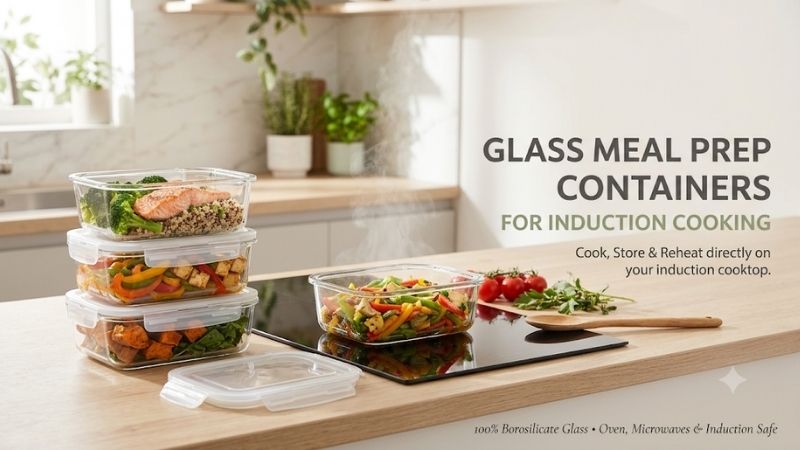
Why induction cooktops require compatible cookware
An induction cooktop generates a changing magnetic field using a coil beneath its cooking surface.
When suitable cookware is placed over the active cooking zone, the magnetic field induces electrical currents within the cookware.
Electrical resistance converts that energy into heat.
The process requires a compatible conductive and magnetic cooking structure.
Traditional induction cookware commonly includes suitable ferromagnetic materials or specially constructed magnetic bases.
Many stainless steel and cast iron products are compatible, although actual construction matters.
Ordinary glass food-storage containers do not provide the appropriate induction-heating base.
As a result, placing such a container on an induction burner generally will not activate the cooking process as intended.
A glass meal prep container should therefore be treated as a storage vessel rather than a cooking pan.
Why oven-safe glass is not automatically induction-safe
Oven-safe glass is designed to tolerate specified oven heating conditions.
That rating does not establish compatibility with electromagnetic induction.
An oven heats food and cookware through its intended heating environment, while an induction burner relies on a compatible cookware structure.
The two systems operate differently.
A glass dish approved for a conventional oven may still be completely unsuitable for direct use on an induction cooktop.
Likewise, a microwave-safe glass container has a separate set of permitted operating conditions.
Do not assume that one heating approval applies to every appliance.
The exact manufacturer instructions should identify supported uses.
If induction compatibility is not explicitly stated for a specialized cooking product, do not attempt to use it directly on an induction burner.
Are there special glass products for induction cooking?
Some specialized cookware designs may combine glass components with induction-compatible materials.
However, such products should not be confused with ordinary glass meal prep containers.
An induction-compatible cooking vessel needs a suitable heating interface and a manufacturer-approved design.
A conventional glass storage dish without an appropriate base cannot become induction cookware merely because it is placed near a magnetic cooking surface.
Some consumers consider induction adapter plates, which are metal accessories designed to heat through induction and transfer heat to another vessel.
However, using an adapter with ordinary storage glass does not automatically make the arrangement safe.
The glass may still be unsuitable for direct heating or exposed to damaging thermal conditions.
Use only combinations explicitly permitted by the relevant manufacturers.
For meal preparation, ordinary induction-compatible cookware followed by glass storage is the simpler and more dependable approach.
Choosing glass containers for an induction kitchen
A household using induction cooking should select glass meal prep containers based on their storage and reheating functions rather than direct cooktop compatibility. Appropriate containers should offer useful portions, secure lids, convenient refrigerator organization, and clear microwave or oven instructions. The cooking stage and storage stage should remain separate.
Choose containers with practical meal capacities
Container capacity should reflect the food portions your household prepares most frequently.
A smaller container may hold vegetables, sauce, or a side dish.
A medium-size vessel can accommodate an individual lunch.
A larger container may be more appropriate for a family portion or substantial leftovers.
For many individual meals, a capacity around 3 to 4 cups is a practical starting point.
However, meals containing leafy vegetables require more volume than similarly weighted portions of rice or cooked meat.
Choose capacity based on actual meal composition.
Avoid filling containers so tightly that lids become difficult to close.
Liquid foods also require appropriate headroom, particularly when freezing.
A useful container should hold a complete portion while remaining manageable to lift, transport, and clean.
Prioritize secure lids and suitable seals
Meal prep containers are often moved between countertops, refrigerators, lunch bags, and workplaces.
A secure lid reduces the likelihood of spills during these transfers.
Locking clips and silicone gaskets are common features in glass food-storage products.
However, an airtight seal and a leakproof seal are not automatically identical.
If you regularly transport meals containing sauces, choose a product with a manufacturer-described leakproof closure.
Inspect the gasket before closing the container.
Food particles can interfere with proper sealing.
Do not assume that a damaged lid remains suitable simply because it attaches to the glass body.
Replacement-lid availability should be considered when purchasing a complete set.
For households preparing several meals, matching lids can simplify organization and reduce confusion.
Select stackable shapes for refrigerator storage
Meal preparation can occupy substantial refrigerator space, particularly when preparing several days of lunches.
Stackable rectangular containers often help use shelf area more efficiently than a collection of unrelated shapes.
However, stacking should remain stable.
Avoid placing heavy glass containers on top of lids that are not designed to support substantial weight.
Do not create tall stacks that are difficult to remove safely.
Measure refrigerator shelves before purchasing a large collection.
Consider both container height and the clearance required to lift an individual vessel from the stack.
Also account for air circulation and the refrigerator’s normal operating requirements.
The best arrangement keeps prepared meals organized without overcrowding the appliance.
Check microwave and oven approvals
Many glass meal prep containers can be reheated in a microwave when the manufacturer permits that use.
Some also have oven-safe glass bases.
However, the lid may not share the same temperature permissions.
Plastic storage lids should not be placed in conventional ovens unless specifically approved.
For microwave reheating, follow instructions concerning lid removal or venting.
Avoid tightly sealed heating when steam must escape.
When using a conventional oven, observe the manufacturer’s published temperature limit and thermal-shock precautions.
Do not assume that every glass base is suitable for broiling.
A storage container that is oven-safe is still not automatically induction-compatible.
Treat each appliance approval as a separate requirement.
A practical induction cooking and meal prep workflow
The safest and most convenient meal-preparation workflow uses induction-compatible cookware for cooking and appropriate glass containers for storage. Separating these functions allows each product to perform the job it was designed for. The process also makes it easier to follow food-safety guidance when preparing several portions of cooked food.
Cook ingredients in induction-compatible cookware
Begin by choosing a skillet, saucepan, or stockpot explicitly approved for your induction cooktop.
Compatible stainless steel and cast iron are common options.
Some aluminum cookware also supports induction through specially constructed magnetic bases.
Check the exact cookware model rather than relying on appearance.
Prepare the ingredients according to the recipe.
For example, vegetables may be sautéed in an induction-compatible skillet while rice cooks in a separate saucepan.
Induction cooking can respond quickly to changes in power, so adjust settings according to the food and cookware.
Avoid heating empty cookware excessively.
When preparing meat or poultry, verify doneness using appropriate food-safety guidance.
The cooking process should be completed before food is transferred to storage containers.
Portion prepared food using appropriate utensils
After cooking, divide food into appropriately sized glass containers.
Use suitable serving utensils and stable work surfaces.
Avoid placing glass containers where they could be knocked from the countertop.
When transferring very hot food, follow the glass manufacturer’s recommendations concerning temperature exposure.
Do not subject chilled glass to sudden contact with hot food if the product’s instructions prohibit that temperature transition.
Likewise, avoid placing hot glass directly onto cold or wet surfaces.
Use appropriate heat-resistant protection when necessary.
Choose portions that will be consumed during individual meals.
Smaller portions may support more efficient cooling than leaving a large volume of hot food in one deep vessel.
However, glass construction and manufacturer instructions must still be respected.
Cool and refrigerate meals safely
Cooked perishable food should be refrigerated promptly.
For general US food-safety guidance, the refrigerator should operate at 40°F or below.
Perishable foods should normally be refrigerated within two hours of preparation.
When ambient temperatures exceed 90°F, the recommended time is one hour.
Use shallow containers to support efficient cooling.
Do not leave large amounts of cooked food at room temperature for extended periods while waiting for them to become completely cold.
If the glass manufacturer’s instructions restrict abrupt temperature changes, use an appropriate cooling method that still meets food-safety requirements.
Label meals with their preparation dates.
Organize containers so meals can be used within recommended storage periods.
Reheat using a compatible appliance
When ready to eat, select a heating appliance approved for the glass container.
Microwave reheating is convenient for many prepared meals, provided the vessel is microwave-safe.
Follow manufacturer instructions concerning lids and steam venting.
Stir food where practical to reduce uneven heating.
For cooked leftovers, reheat to the recommended safe temperature, generally 165°F.
A conventional oven may be appropriate for certain oven-safe glass bases.
Remove incompatible plastic lids before oven use.
Use dry oven mitts when handling hot glass.
Never place the container directly on an induction burner to reheat its contents.
If direct stovetop reheating is preferred, transfer the meal into suitable induction-compatible cookware.
Glass versus stainless steel for induction kitchens
Glass meal prep containers and stainless steel food containers serve overlapping storage functions, but their heating properties differ. Stainless steel can sometimes form part of induction-compatible cookware, while ordinary glass storage containers cannot. Nevertheless, a stainless steel food-storage container should not automatically be treated as a stovetop pan simply because it contains metal.
Glass containers for visibility and microwave reheating
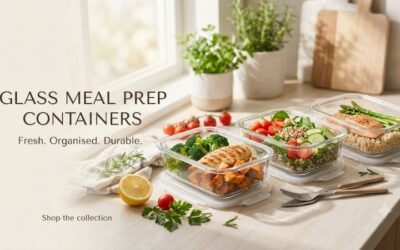
Glass provides a transparent, nonporous food-storage surface.
This makes it convenient for identifying prepared meals and monitoring remaining portions.
Glass generally resists persistent food odors and staining.
Some products are also suitable for microwave reheating.
These characteristics make glass useful for office lunches and refrigerator organization.
However, glass is relatively heavy and can break from impact.
It also lacks the magnetic base required for ordinary induction cooking.
For buyers who routinely reheat prepared meals in a microwave, an approved glass container may be particularly convenient.
Choose the correct size and follow the manufacturer’s instructions.
Stainless steel containers for lightweight durability
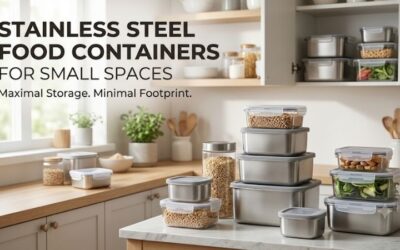
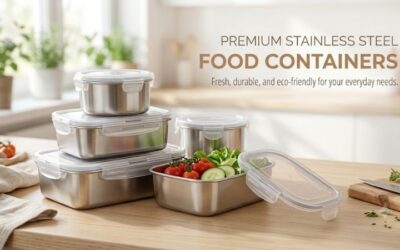
Stainless steel food containers can be useful for storing salads, sandwiches, cold meals, and leftovers.
They are often lighter than comparable glass vessels and less vulnerable to shattering.
However, most ordinary stainless steel food-storage containers are not designed for direct stovetop cooking.
Some stainless steel products may be suitable for specific oven applications, but approval varies.
Standard metal storage containers should not be placed in ordinary microwave ovens unless the container and appliance are specifically approved for the intended application.
Do not assume that magnetic attraction alone establishes safe induction compatibility.
Cookware requires suitable construction, base dimensions, stability, and manufacturer approval.
For someone who transports cold meals frequently, stainless steel storage may be convenient.
For microwave-based reheating, appropriately designed glass containers often provide a simpler solution.
Why induction-compatible cookware should remain separate
A cooking pan must tolerate the heat, mechanical stresses, and handling conditions associated with stovetop use.
A food-storage container is primarily designed to hold prepared food.
Even when both products use stainless steel, their intended applications can differ substantially.
A lightweight storage container may lack the base construction or stability needed for induction cooking.
Likewise, a glass meal prep vessel may be approved for oven reheating without supporting direct burner heating.
Separating cooking and storage equipment avoids unnecessary assumptions.
An induction-compatible skillet or saucepan handles cooking.
A glass or suitable steel container handles storage.
This arrangement also allows households to select each product according to its strongest practical features rather than expecting one vessel to perform incompatible tasks.
Choosing a practical meal prep setup
An induction kitchen does not require specialty glass storage equipment. Most households can combine ordinary induction-compatible cookware with a modest collection of approved glass meal prep containers. The most useful setup depends on household size, cooking frequency, available refrigerator space, and how meals are normally reheated.
Minimal setup for one person
A person cooking for themselves may need one induction-compatible skillet, one saucepan, and several glass food-storage containers.
The skillet can handle proteins and vegetables.
The saucepan can prepare rice, grains, soups, and sauces.
Medium-size glass containers can hold prepared lunch portions.
This arrangement avoids purchasing specialized equipment that rarely receives regular use.
Choose containers that fit comfortably in the refrigerator.
If meals are transported to work, prioritize secure lids.
If the workplace provides a microwave, select products with appropriate microwave compatibility.
A small collection is often easier to maintain than a large set containing numerous unnecessary sizes.
Family setup for several prepared meals
Families may benefit from larger induction-compatible cooking vessels and a wider selection of storage capacities.
A large saucepan or stockpot can support batch cooking.
A wide skillet provides additional room for vegetables and proteins.
Individual glass containers can hold lunches, while larger vessels store family leftovers.
However, the number of containers should be matched to refrigerator space and safe storage periods.
Avoid preparing excessive quantities of perishable food that cannot be consumed or frozen appropriately.
A combination of medium and large containers may provide greater flexibility than identical portions alone.
Also consider who will handle the containers.
Heavy glass vessels may be inconvenient for children or individuals with limited lifting strength.
Setup for microwave-based office lunches
For office lunches, a glass container with a secure lid and manufacturer-approved microwave compatibility can be convenient.
Prepare the meal using induction cookware at home.
Refrigerate it promptly.
Transport the food using appropriate cold-storage equipment when required.
At lunchtime, follow the container’s microwave instructions.
Some lids must be removed, while others require ventilation.
Do not heat sealed containers in a way that allows dangerous steam pressure to develop.
Stir food when appropriate and ensure adequate reheating.
For meals containing components that should remain cold, consider packing those ingredients separately.
A reliable storage and reheating routine can be more useful than purchasing specialized cookware designed to perform every possible function.
Common mistakes involving induction and glass storage
The most important purchasing mistake is confusing general heat resistance with direct induction compatibility. Oven-safe and microwave-safe labels describe specific operating conditions, not universal heating permission. Buyers should also consider glass weight, lid safety, and temperature changes when using meal prep containers alongside induction cookware.
Putting ordinary glass directly on an induction burner
Ordinary glass meal prep containers lack the magnetic cooking structure required for direct induction heating.
Placing them on an induction cooktop is not an appropriate method of reheating prepared food.
Do not attempt to force the cooktop to recognize an unsuitable vessel.
Likewise, do not use improvised heating plates without manufacturer approval.
Transfer food into proper induction cookware when stovetop reheating is required.
Alternatively, use an approved microwave or conventional oven.
Assuming an oven-safe rating covers every appliance
A glass container may be suitable for a conventional oven while remaining unsuitable for broilers, direct burners, or induction cooking.
Different appliances apply heat in different ways.
The manufacturer’s instructions should identify permitted applications and temperature limits.
Storage lids may also have different restrictions from the glass bodies.
Never place plastic lids in an oven unless specifically approved.
Always verify the exact model before heating.
Ignoring thermal shock during transfers
Glass can experience damaging stress when exposed to abrupt temperature differences.
Avoid moving containers between extreme temperature conditions in ways prohibited by the manufacturer.
Do not place hot glass on wet or cold surfaces.
Do not assume that every freezer-safe glass container can move directly into a hot oven.
Follow the product’s instructions concerning freezing, thawing, and reheating.
Discontinue use if the glass develops cracks or chips.
Buying unnecessary specialty accessories
An induction kitchen does not automatically require specialized glass adapters or unusual cookware systems.
For most households, ordinary induction-compatible pans and suitable glass storage containers provide a straightforward solution.
Before buying accessories, identify the actual cooking problem they are intended to solve.
An induction adapter does not guarantee that a regular glass storage dish can safely withstand direct heating.
Avoid paying extra for unsupported universal-compatibility claims.
Choose equipment with clear manufacturer documentation.
Frequently Asked Questions
Induction cooking can create confusion because cookware compatibility depends on more than whether a vessel appears heat-resistant. The following answers distinguish direct induction heating from microwave and oven use while explaining how glass containers fit into an ordinary meal-preparation routine. These distinctions are important for both purchasing decisions and safe everyday cooking.
Can I put glass meal prep containers on an induction stove?
Ordinary glass meal prep containers should not be placed directly on an induction stove for cooking or reheating.
They lack the necessary induction-compatible base.
Use an approved induction skillet or saucepan to heat food, then transfer it to suitable glass containers for storage.
A product must be specifically designed and approved for direct induction cooking before that use is considered appropriate.
Are borosilicate glass containers induction-compatible?
Borosilicate glass has useful heat-resistant properties, but the material itself does not provide the magnetic interface required by induction cooking.
A borosilicate storage vessel is therefore not automatically induction-compatible.
Some specialized cookware systems may incorporate induction-capable materials.
However, compatibility must be explicitly documented for the exact product.
Do not infer induction suitability from the word borosilicate.
Can glass meal prep containers go in a microwave?
Many glass meal prep containers are microwave-safe, but buyers should verify the exact model.
Plastic lids may need to be removed or vented.
Follow the manufacturer’s heating instructions.
Avoid inappropriate temperature changes and use suitable protection when handling hot glass.
For reheated leftovers, follow established food-safety temperature guidance.
Can I transfer food from an induction pan into glass containers?
Yes. Prepared food can be transferred from induction cookware into appropriate glass storage containers.
Use suitable utensils and follow the manufacturer’s temperature-handling instructions.
Portion food into manageable quantities and refrigerate perishable meals promptly.
Avoid subjecting glass to sudden temperature changes beyond its approved conditions.
The glass container does not need to be induction-compatible for ordinary food storage.
Is glass or stainless steel better for an induction kitchen?
For storage, both materials can be useful.
Glass offers visibility and may support microwave reheating.
Stainless steel is generally lighter and less vulnerable to shattering.
However, ordinary stainless steel storage containers are not automatically suitable for induction cooking.
Choose an approved induction pan for stovetop use and select storage materials according to convenience, reheating needs, and transportation.
Can I use an induction adapter under a glass meal prep container?
An adapter plate does not automatically make ordinary glass storage suitable for direct heating.
The adapter can become hot and may expose unsuitable glass to damaging temperature conditions.
Use an adapter only when the equipment manufacturers explicitly approve the intended combination.
For ordinary meal prep containers, transferring food to approved induction cookware is the safer and more straightforward approach.
Conclusion
The best approach to glass meal prep containers for induction cooking is to separate cooking from food storage. Use manufacturer-approved induction cookware to prepare meals, then portion the finished food into suitable glass containers for refrigeration, freezing, or transport. Choose secure lids, practical capacities, and clearly documented microwave or oven compatibility. Ordinary glass storage containers should never be treated as direct induction cookware simply because they are described as heat-resistant or oven-safe.



Write Your Review
No reviews yet. Be the first to share your experience!