
Choosing cereal storage containers for small spaces requires balancing storage capacity with cabinet dimensions, pouring convenience, and freshness protection. A slim container can free up valuable shelf space, but the wrong shape or lid may make breakfast preparation frustrating. This guide explains how to choose compact cereal keepers that fit your kitchen and everyday routine.
What makes a cereal container suitable for small spaces?
The best cereal container for a compact kitchen is not necessarily the smallest model available. It should hold the cereal quantity you normally buy while fitting the available pantry footprint and remaining easy to remove, refill, and pour from. Shape, height, lid design, and handle placement all affect whether a container genuinely saves space.
A practical container should also minimize unused volume.
Buying several oversized cereal keepers can make a small pantry less efficient than leaving cereal in its original packaging.
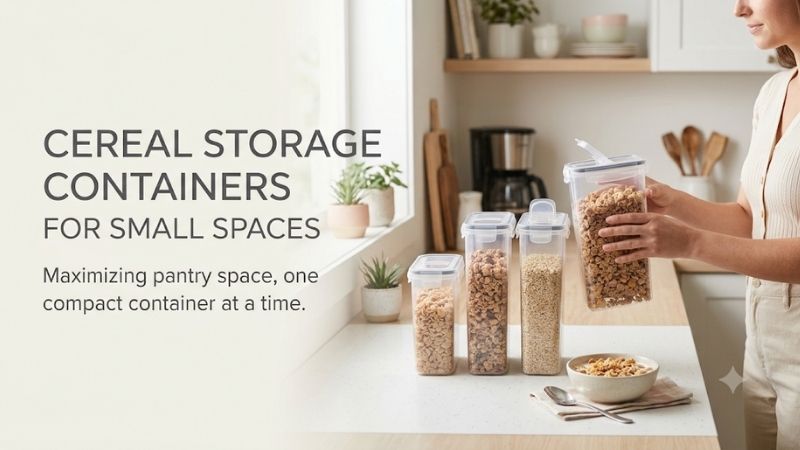
Slim rectangular shapes reduce wasted shelf space
Slim rectangular cereal containers are often well suited to narrow cabinets because their straight sides align closely with neighboring items. They can occupy less unused horizontal space than rounded containers, particularly when several cereal varieties are stored together on the same shelf.
Consider a cabinet that is only moderately wide.
Three narrow rectangular containers may fit in an organized row, while three broad square containers may require multiple shelves.
However, exterior width is only one measurement.
A tall, narrow container may be difficult to remove from a cabinet with limited vertical clearance.
Deep containers can also become inconvenient if the shelf is shallow.
Measure the entire storage space.
Choose a footprint that fits the cabinet without requiring awkward tilting.
For frequently used cereal, consider whether the container can be lifted comfortably with one hand.
A compact shape should improve breakfast preparation rather than make it more difficult.
Low-profile containers work beneath short shelves
Some kitchens have low pantry shelves, shallow drawers, or cabinets divided by fixed shelving. In these situations, a short container may be more useful than a tall cereal dispenser, even if it requires a slightly larger footprint.
Low-profile containers can be especially practical in deep drawers.
They may allow cereal to be stored horizontally beneath a countertop.
However, conventional cereal dispensers are often designed for upright pouring.
A shallow container may therefore require a scoop instead of a dedicated spout.
This trade-off is acceptable when storage height is the main limitation.
Look for containers with wide openings that allow easy access.
Avoid filling shallow containers to the rim.
For families with several cereal varieties, two short containers may be more practical than one large upright keeper.
Consider how the containers will be removed from the drawer.
A design that requires reaching beneath neighboring boxes may not be convenient for daily use.
Stackable designs can use vertical storage space
Stacking allows compatible containers to occupy the same shelf footprint while using vertical space that might otherwise remain empty. This can improve organization in tall cabinets, but it does not automatically make cereal easier to access.
Before purchasing, confirm that the container is designed for stacking.
A flat-looking lid does not necessarily provide a stable support surface.
Check the maximum practical stack height.
Consider the weight of each filled container.
Large cereal keepers are relatively lightweight compared with containers holding flour or rice, but unstable stacks can still fall.
For daily breakfast use, avoid placing the most frequently used cereal at the bottom.
Use short stacks that can be accessed safely.
If several people prepare breakfast independently, arranging cereal containers side by side may be more convenient than stacking them vertically.
The best layout balances capacity and accessibility.
Nesting empty containers makes seasonal storage easier
Nesting means placing empty containers inside one another when their shapes and dimensions permit it. This is useful for households that occasionally purchase multiple cereal varieties but do not need every container throughout the year.
A nesting design can reduce the amount of cabinet space required by unused containers.
However, not every cereal keeper supports nesting.
Pouring spouts, handles, and specialized lids may interfere with the process.
Some containers nest only when their lids are removed.
Check manufacturer descriptions rather than assuming that rectangular containers can nest automatically.
If a product supports nesting, create a dedicated location for its lids.
Avoid forcing containers together.
A tightly wedged container can become difficult to separate and may damage thin plastic edges.
Nesting is most valuable for occasional-use containers.
For cereal consumed every day, filled storage and direct accessibility remain more important.
How to choose cereal storage containers for small spaces
Choosing an appropriate cereal container begins with the grocery package rather than the container itself. Buyers should compare cereal volume, available shelf dimensions, closure design, and household handling preferences before selecting a product. A compact container that fits the pantry but cannot hold the normal cereal package may create additional clutter.
Choose capacity according to the cereal you buy
Cereal package weights can be misleading when selecting storage capacity because different cereal types occupy different volumes. A lightweight puffed cereal may require a larger container than a dense granola product of similar weight.
Small containers around 1.5–2 quarts may be appropriate for modest quantities of cereal.
Medium containers around 2.5–3.5 quarts provide more flexibility for ordinary breakfast purchases.
Larger containers around 4–5 quarts can accommodate greater volumes.
These are approximate buying categories rather than guarantees of package fit.
Always compare the actual cereal quantity with the manufacturer’s published capacity.
If possible, examine whether the container can hold the entire package with a little remaining space.
Avoid purchasing a container that is too small.
Otherwise, the remaining cereal may need to stay in its original packaging, defeating part of the organizational benefit.
Measure the cabinet before shopping
The most reliable way to choose compact cereal storage is to measure the available cabinet or drawer. Advertised capacity does not describe the external dimensions, and small differences in width or height can determine whether a container fits.
Measure the usable width, depth, and height.
Include hinges, shelf brackets, drawer rails, and other obstructions.
Consider whether the container must be tilted during removal.
For shelves above countertops, check that the container can be lifted without hitting the upper shelf.
A container that fits only when pushed tightly against the cabinet wall may be inconvenient.
Leave enough clearance for ordinary handling.
If the container has a hinged or pop-open lid, consider the space required to operate it.
For low shelves, a removable-lid container may work better than a tall dispenser.
Prioritize airtight seals for dry cereal
Airtight cereal containers are designed to limit exposure to ambient air and moisture, helping reduce the conditions that can cause cereal to lose its crisp texture. For compact kitchens, a reliable closure is especially valuable because cereal may be stored near other ingredients in crowded cabinets.
Look for silicone gaskets, secure locking clips, or other documented airtight mechanisms.
Check that the lid closes completely.
Avoid containers with damaged seals or warped openings.
Keep the container dry.
Do not transfer cereal into a vessel that still contains washing water or condensation.
An airtight container cannot restore cereal that was already stale.
It also does not eliminate the need to follow the food manufacturer’s storage recommendations.
For breakfast cereal, a dependable lid is often more valuable than decorative features.
Compare one-handed lids and locking clips
The lid mechanism affects how conveniently a cereal container can be opened during busy mornings. A one-handed opening may be useful for adults preparing breakfast quickly, while locking clips can provide a more deliberate closure that some households prefer.
OXO’s POP Cereal Dispenser uses a pop-open lid intended for easy access.
Sistema KLIP IT PLUS uses locking clips and a dedicated pouring opening.
Other models use flip-top lids that remain attached while cereal is poured.
Each design has advantages.
A pop-open lid can reduce preparation steps.
A clip-lock system may provide a reassuring physical closure.
A removable full lid can simplify thorough cleaning and refilling.
Consider who will use the container.
Children may find some closures easier than others.
However, ease of opening should not compromise secure storage.
Look for comfortable grips and controlled pouring
A container can be compact but still difficult to handle when full. Grip shape, weight distribution, and pouring opening determine whether cereal can be transferred into a bowl without spilling or crushing pieces.
A contoured body may provide a more secure hold.
Some cereal dispensers include dedicated grip areas.
A wide pouring spout can accommodate larger cereal flakes or clusters.
A narrow opening may work well for smaller pieces but become obstructed by irregular foods.
Consider the user’s hand size.
A wide container may be difficult for children or people with limited grip strength.
A smaller container that requires more frequent refilling may still be more convenient.
The right design supports comfortable pouring without excessive wrist movement or awkward tilting.
Choose transparent materials for easy identification
Transparent cereal containers make it easy to identify cereal varieties and check approximate remaining quantities. This is particularly useful in small kitchens where several containers may be stored closely together and there is limited room for large external labels.
Clear plastic is common because it is lightweight and resists shattering better than ordinary glass.
Glass canisters provide a different appearance but are heavier and more vulnerable to breakage.
For daily cereal storage, plastic is often more convenient when containers are moved frequently.
However, material quality and food-contact suitability should still be checked.
Avoid assuming that every clear plastic product is identical.
Look for manufacturer documentation about food storage and cleaning.
Some opaque containers include viewing windows.
These can be useful, but a fully transparent body generally provides a more complete view of the contents.
Consider whether a matching set is necessary
Matching containers can create a coordinated pantry appearance, but purchasing a complete set is not always the best solution for a small kitchen. Different cereal varieties and package sizes may require different capacities.
Begin with the cereal your household uses most frequently.
Choose one container that fits the normal package.
If several varieties are stored, add compatible containers in suitable sizes.
Avoid buying multiple large keepers merely because they are sold together.
A set with identical dimensions may look organized but waste space when some containers are only partially filled.
Mixed capacities can be more efficient.
For example, a large container may hold family cereal while a smaller one stores occasional granola.
The right arrangement depends on actual use rather than visual consistency.
Practical storage setups for compact kitchens
Different small kitchens create different organizational problems. A studio apartment may have only one pantry cabinet, while a family kitchen may have sufficient overall storage but crowded breakfast shelves. Matching the container arrangement to the available space is more effective than following a universal organization formula.
A narrow apartment pantry
A narrow pantry benefits from slim rectangular containers that can be placed in a row without creating excessive gaps. The main objective is to use available shelf depth while keeping the most frequently used cereal accessible.
Choose containers with narrow external dimensions.
Measure shelf height before selecting tall models.
Place daily cereal near the front.
Store less frequently used varieties behind or above it.
Avoid deep arrangements that require removing several containers each morning.
A shallow pull-out organizer may help when the pantry is unusually deep.
However, the organizer itself consumes some space.
Compare its footprint with the available cabinet area before purchasing additional accessories.
For a one-person apartment, a single medium-capacity cereal container may be entirely sufficient.
A small family breakfast cabinet
Families often store several cereal varieties because household members have different preferences. A coordinated collection of cereal keepers can reduce clutter from partly opened cardboard boxes while making it easier to monitor remaining supplies.
Group cereal containers in a dedicated breakfast area.
Keep the most frequently consumed varieties within comfortable reach.
Choose manageable container sizes for children when appropriate.
Avoid placing heavy or unstable containers above head height.
Use labels if cereal varieties look similar.
For family members with food allergies, keep original ingredient information accessible.
Do not assume that a transparent container provides enough information about allergens.
A reliable breakfast organization system should make food selection convenient and accurate.
A deep kitchen drawer
Deep drawers can be useful for cereal storage when they provide adequate height for the selected containers. Unlike traditional shelves, drawers allow users to view and access items from above.
Choose containers with appropriate external dimensions.
Avoid lids that require excessive vertical clearance.
Consider whether the drawer will close fully with the containers inside.
For shallow containers, a scoop may be more convenient than a pouring spout.
Use dividers only when they improve stability.
Do not overcrowd the drawer with containers that cannot be lifted easily.
If the drawer has a weight rating, respect the manufacturer’s limit.
For a compact kitchen, a well-organized drawer may provide more accessible cereal storage than a tall, narrow upper cabinet.
A shared dorm room or kitchenette
Dorm rooms and shared kitchenettes benefit from a small number of clearly identifiable containers. Storage may be limited to a shelf or shared cabinet, making compact dimensions and secure closures especially important.
Choose one or two appropriately sized cereal keepers.
Avoid oversized containers that occupy communal storage.
Use clear labels.
Select lids that remain closed during normal movement.
If cereal is transported between rooms, consider whether the container is designed for that purpose.
A pantry container intended for upright storage should not automatically be treated as leakproof when carried sideways.
Keep cereal away from excessive moisture and heat.
For shared spaces, a compact personal storage system is usually easier to maintain than a large collection.
Common mistakes when buying compact cereal containers
A poorly chosen cereal container can create more storage problems than it solves. Common mistakes include buying by capacity alone, overlooking external dimensions, choosing inconvenient lids, and assuming that airtight storage guarantees indefinite freshness. These issues are preventable when the purchase is based on practical daily use.
Buying containers that are too tall
Tall cereal dispensers can provide substantial capacity without using much shelf width, but they may not fit beneath fixed shelving. Even when the container itself fits, there may be insufficient clearance to open the lid or remove the container comfortably.
Measure the full usable height.
Check whether the lid protrudes above the advertised body dimensions.
Allow room for lifting.
If the cabinet is low, consider shorter containers.
Do not force a tall container beneath a shelf where it may become stuck or damaged.
A slightly wider low-profile model can be more useful than an excessively tall dispenser.
Buying containers that are too small
Small containers save space only when they accommodate the quantity of cereal you intend to store. If cereal must remain partly in its original box, the pantry may end up holding both the new container and the leftover packaging.
Compare the usual cereal package with the container’s capacity.
Account for the type of cereal.
Leave room for comfortable refilling and dispensing.
If you regularly buy large packages, consider one appropriately sized container rather than several undersized pieces.
However, do not choose an enormous container for a small household that rarely finishes a large cereal package.
Ignoring cleaning requirements
Cereal containers can accumulate crumbs and residue around lids, hinges, gaskets, and pouring openings. If these areas are difficult to reach, the container may become inconvenient to maintain.
Choose a design that can be disassembled or cleaned according to the manufacturer’s instructions.
Use appropriate cleaning tools.
Wash the container when changing food types or when residue accumulates.
Allow all components to dry thoroughly before refilling.
Do not leave moisture trapped beneath sealing gaskets.
Avoid using abrasive methods that could damage plastic or silicone components.
Easy maintenance is an important part of long-term usability.
Assuming airtight means indefinitely fresh
An airtight cereal keeper helps reduce exposure to air and moisture, but it does not prevent every type of quality deterioration. Cereal can become stale over time, and poor storage conditions may still affect the product.
Follow original package storage instructions.
Keep cereal in a cool, dry area.
Avoid placing containers near heat-generating appliances.
Inspect cereal for unusual odors, visible contamination, or other signs of deterioration.
Do not mix new cereal with old cereal automatically.
Clean and dry containers before refilling when appropriate.
Airtight storage is a useful protective measure, not a substitute for reasonable food rotation.
How to organize cereal containers efficiently
A compact breakfast storage system should be simple enough to maintain without constant rearranging. The most useful improvements often involve container placement, clear labeling, and avoiding unnecessary inventory. Once the arrangement is established, small habits can preserve the space savings over time.
Group breakfast foods together
Keeping cereal near related breakfast supplies can reduce unnecessary movement around a small kitchen. A dedicated breakfast zone may include cereal containers, oatmeal, granola, breakfast bars, and other shelf-stable ingredients used during morning preparation.
Place frequently used items at comfortable reach.
Keep containers organized according to normal use.
Avoid placing rarely used ingredients in front of everyday cereal.
Use a shallow bin for small packets if necessary.
Do not place food where it may be exposed to excessive heat or moisture.
A breakfast zone should be convenient without interfering with safe food storage.
Use labels and simple inventory habits
Clear containers help identify cereal, but labels remain useful for similar-looking varieties and foods with specific ingredients. This is particularly important when household members have allergies or dietary requirements.
Label each container with the cereal name.
Retain important ingredient and allergen information.
Consider recording the opening date.
Check remaining cereal before buying another package.
Avoid accumulating several partially filled containers containing the same product.
Do not automatically combine different batches without considering freshness and storage history.
A basic inventory routine can reduce waste and unnecessary grocery purchases.
Keep the most-used cereal accessible
The most efficient storage arrangement is not necessarily the one with the greatest number of containers per shelf. Daily accessibility should determine the placement of frequently used cereal.
Keep everyday cereal near the front.
Place occasional varieties farther back.
Avoid storing frequently used cereal beneath heavy containers.
If several family members use the pantry, consider their reach and handling abilities.
A container that fits perfectly but is difficult to remove is not an effective space-saving solution.
Organize around actual behavior rather than appearance alone.
Frequently asked questions
Small-space cereal storage raises practical questions about capacity, container materials, freshness, stacking, and dispensing convenience. The answers below focus on selecting containers that fit real household needs rather than automatically recommending larger or more elaborate storage systems.
What size cereal container is best for a small pantry?
A medium container around 2.5–3.5 quarts may be a useful starting point for many households, but the correct capacity depends on cereal density and the package size purchased.
Measure the cabinet first.
Compare the container volume with the cereal quantity.
Choose a larger or smaller model when your purchasing habits justify it.
Are slim cereal containers better than square ones?
Slim rectangular containers can make better use of narrow shelves, while square containers may offer greater capacity within a compact footprint. Neither shape is universally superior.
The best design depends on shelf width, depth, and height.
Choose the shape that allows easy access without creating wasted space.
Can cereal containers be stacked safely?
Containers can be stacked when the manufacturer identifies them as suitable for stacking and the arrangement remains stable. Use matching footprints where appropriate.
Place heavier items below lighter ones.
Avoid excessively tall stacks.
Do not block access to frequently used cereal.
Should I store cereal in the original box or a container?
The original packaging may be sufficient when it can be closed properly and the cereal will be consumed within an appropriate period. A separate container can improve organization and reduce exposure to air when its closure is effective.
Retain ingredient, allergen, and storage information.
Choose according to convenience, freshness needs, and available pantry space.
Are plastic cereal containers food-safe?
Plastic cereal containers specifically designed for food contact can be appropriate for dry food storage when used according to their manufacturer’s instructions. Material composition and care requirements vary.
Look for clear food-contact information.
Follow cleaning guidance.
Avoid using containers for temperatures or applications outside their stated limits.
How can I keep cereal crispy in a humid kitchen?
Store cereal in a clean, dry container with a suitable airtight seal. Keep the container away from steam, excessive heat, and moisture.
Close the lid promptly after use.
Do not refill a damp container.
Follow the original product’s storage recommendations and use cereal within a reasonable timeframe.
Conclusion
The best cereal storage containers for small spaces are those that fit your shelves, hold your usual cereal quantity, and remain easy to handle during everyday breakfasts. Slim rectangular designs work well in narrow cabinets, while low-profile containers may be better for drawers and short shelves. Prioritize reliable airtight closures, comfortable pouring, clear visibility, and straightforward cleaning. Measure the available space before buying, and avoid oversized matching sets that create unnecessary clutter. A few carefully chosen cereal containers can deliver better organization than an elaborate storage system that is difficult to maintain.



Write Your Review
No reviews yet. Be the first to share your experience!