
Finding the right stainless steel food containers for small spaces can help organize a crowded kitchen without relying on bulky storage boxes. Compact stainless steel containers offer durable food-contact surfaces, reusable designs, and flexible storage options. The key is choosing practical sizes, compatible lids, and arrangements that fit your cabinets and refrigerator.
- Quick verdict: What works best in a small kitchen?
- Why stainless steel containers make sense for small spaces
- How to choose stainless steel food containers for small spaces
- Best container configurations for different small kitchens
- Practical food storage and organization tips
- Frequently asked questions
- Conclusion
Quick verdict: What works best in a small kitchen?
The most practical stainless steel containers for a small kitchen are rectangular or square models that stack securely with their lids attached and nest efficiently when empty. They should have capacities matched to normal meal portions, reliable closures, and dimensions that suit the available shelves rather than simply appearing compact in product photographs.
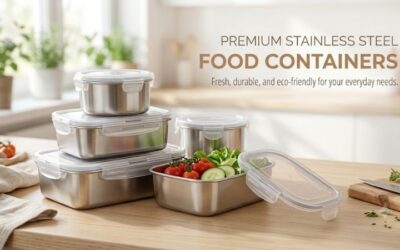
For everyday leftovers, rectangular stainless steel containers with locking plastic lids offer a useful balance between durable food storage and convenient organization.
For packed lunches, shallow stainless steel containers with removable dividers can reduce the need for multiple smaller boxes.
For pantry ingredients, compact stainless steel canisters with suitable airtight seals are more appropriate than ordinary meal-prep containers.
For refrigerator storage, a coordinated collection of two or three sizes generally uses space more efficiently than unrelated round bowls and oversized containers.
One important limitation is visibility. Stainless steel is opaque, so users need labels or a consistent storage system to identify contents without opening every container.
Another consideration is heating. Conventional stainless steel containers must not be placed in ordinary microwave ovens unless the appliance and container manufacturers explicitly approve a specific combination. Oven compatibility is also product-specific and may apply only to the metal base after removing the lid.
Why stainless steel containers make sense for small spaces
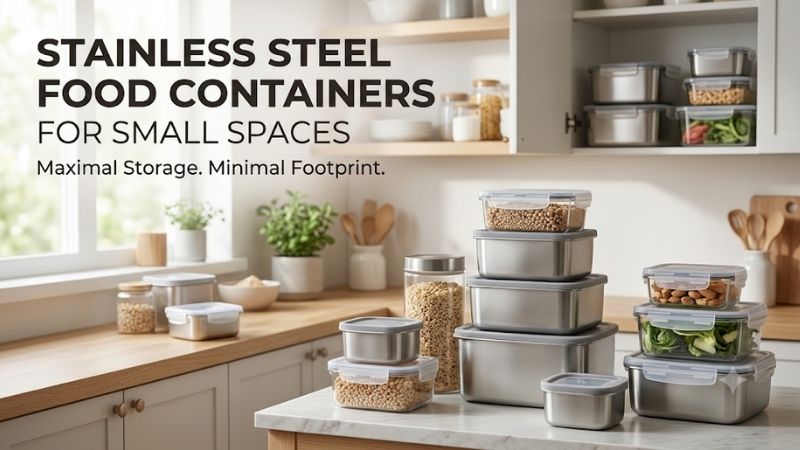
Stainless steel storage containers offer several advantages for compact kitchens, particularly when durability, repeated washing, and organized meal preparation are priorities. Their rigid construction can support frequent use, while carefully selected rectangular designs make better use of shelf and drawer space than irregular collections of disposable packaging.
However, stainless steel is not automatically lighter, smaller, airtight, or more convenient than plastic. The benefits depend on container design, lid construction, size selection, and how the storage system is used.
Durable construction reduces replacement clutter
Food-grade stainless steel containers are useful in busy kitchens because their metal bodies resist many ordinary forms of surface wear. Unlike lightweight disposable containers, a well-made stainless steel box can remain suitable for repeated storage and washing without relying on thin plastic walls that may crack or become permanently stained.
Stainless steel also resists the odor absorption associated with some plastic storage containers.
This can be helpful when regularly storing foods containing garlic, onions, tomato sauces, or strongly seasoned ingredients.
The material does have limitations.
Metal containers can dent if dropped, and low-quality finishes may develop rough edges or damaged seams.
Containers manufactured with unsuitable materials or poorly protected components can also experience corrosion.
Look for smooth food-contact surfaces, cleanly finished edges, and clear material identification.
For long-term use, avoid containers with complex decorative seams that trap food residue.
A straightforward box with rounded internal corners is generally easier to clean.
Durability becomes particularly valuable in small kitchens because each container may be used frequently rather than remaining unused in a large storage cabinet.
Stackable shapes improve cabinet efficiency
The shape of a container often matters more than its advertised volume. Rectangular and square containers can align against cabinet walls, fit beside other storage equipment, and create organized stacks that occupy less unused shelf area than many round containers.
Consider a narrow refrigerator shelf.
Two rectangular containers may sit neatly against the back and side walls, leaving a clear area for other food.
Round bowls often create gaps between their curved edges.
However, a rectangular shape alone does not guarantee secure stacking.
The base should sit properly on the lid beneath it.
Containers with matching dimensions and stable lids are easier to organize.
A system with two or three compatible footprints can be more useful than one with a different shape for every capacity.
Stacking height must also be considered.
A tall pile may occupy little shelf space but make lower containers difficult to reach.
For everyday use, two- or three-container stacks are often easier to manage than a single very tall tower.
Nesting empty containers saves storage space
Nesting means placing smaller containers inside larger ones when they are empty. This feature is especially useful in apartments, dorm rooms, compact kitchens, and RVs where clean storage containers compete with cookware, dishes, and pantry supplies for limited cabinet space.
Not every stainless steel container can nest.
Some have vertical sides or exterior features that prevent one body from fitting inside another.
Others can nest but require the lids to be stored separately.
Before purchasing a collection, check whether the manufacturer specifically identifies nesting capability.
Also consider whether nesting works across different capacities.
A set with gradually increasing sizes may store more compactly than several identical containers.
However, nesting has a practical trade-off.
If the smallest box is at the bottom, retrieving it requires separating the others.
For containers used several times daily, simple shelf stacking may be more convenient.
A good organization plan can combine both methods: keep frequently used containers accessible and nest occasional-use containers in a separate cabinet.
Stainless steel offers practical food-contact properties
Stainless steel is widely used in kitchen equipment because suitable grades provide durable, cleanable food-contact surfaces. It does not depend on a disposable interior coating for ordinary storage, and smooth stainless steel can be washed repeatedly according to the manufacturer’s directions.
However, material safety should not be reduced to broad claims such as completely chemical-free or universally safe.
Stainless steel is an alloy containing metals that vary by grade.
Some grades contain nickel, which may matter to individuals with a diagnosed nickel sensitivity.
Buyers with specific material concerns should examine the manufacturer’s disclosed composition and relevant food-contact documentation.
The presence of a stainless steel body also does not establish the safety of an attached plastic lid, silicone seal, coating, or decorative component.
Each part should be suitable for its intended food-contact use.
Proper cleaning and temperature management remain essential.
A durable container cannot protect food from spoilage if perishable ingredients are stored at unsafe temperatures.
How to choose stainless steel food containers for small spaces
The strongest buying decisions begin with an inventory of the foods being stored and the physical dimensions of the available space. Capacity, shape, lid design, and appliance compatibility should be evaluated together because a container that performs well in one situation may be inconvenient or unsafe in another.
Choose rectangular containers for efficient stacking
Rectangular stainless steel boxes often make particularly good use of small refrigerator and cabinet shelves. Their straight sides align with other containers, while compatible dimensions allow several boxes to form a stable arrangement without creating excessive gaps.
The most useful shape depends on the space available.
A shallow rectangular box is appropriate for a low refrigerator shelf or a crowded lunch bag.
A deeper container may be better for soup, cooked grains, or larger portions.
Square containers work well in narrow cabinets where depth and width are similar.
Round containers remain useful for certain foods, but they may waste space when arranged beside one another.
Before purchasing, measure the shelf width, depth, and usable height.
Check the complete dimensions with the lid attached.
A container advertised as fitting a particular volume may have a wide locking rim that changes its actual footprint.
For a coordinated system, choose sizes that share a compatible base dimension where possible.
Select capacities based on real meal portions
Choosing container sizes based on everyday portions prevents two common problems: wasting refrigerator space with oversized boxes and buying containers too small to hold complete meals. The best capacity depends on the foods being stored, household size, and whether the container is intended for leftovers or meal preparation.
Small containers around 8–12 fluid ounces may be useful for snacks, chopped ingredients, or modest side dishes.
Containers around 20–34 fluid ounces can suit many individual meal portions.
Larger containers can accommodate shared leftovers or batch-prepared food.
These ranges are shopping guidelines, not guarantees that a particular meal will fit.
Solid foods, soups, and bulky vegetables occupy space differently.
Capacity also differs from usable filling volume.
Liquid foods should not be filled to the rim, especially when the container may be moved or frozen.
For a small kitchen, consider a balanced collection containing several medium containers and only one or two larger ones.
That arrangement generally offers more flexibility than a collection dominated by oversized boxes.
Compare airtight, leakproof, and ordinary lids
The words airtight and leakproof describe different performance characteristics. An airtight lid is intended to reduce air exchange, while a leakproof closure is designed to resist liquid escaping under specified conditions. A container may provide one characteristic without necessarily providing the other.
For dry snacks or refrigerated solids, an ordinary secure-fitting lid may be sufficient.
For soup, salad dressing, or meals carried in a bag, a documented leak-resistant or leakproof design becomes more important.
Silicone gaskets and locking clips are common features in containers designed to prevent spills.
However, these components need periodic cleaning.
Food residue can collect beneath removable seals or around latch mechanisms.
A container may also lose sealing performance if its gasket becomes damaged.
Do not assume that a lid marketed as airtight is suitable for carrying liquids while inverted.
Check manufacturer instructions and test a new container with water before trusting it with food during transport.
For compact household storage, simple lid designs can be preferable if the containers are rarely transported.
Check whether the lids support safe stacking
A stainless steel container may have a durable rigid body but still stack poorly if its lid flexes or cannot support another container securely. For small spaces, the lid’s shape and stability are just as important as the box itself.
Look for a lid with a defined seating area or a shape that matches the bottom of another container.
Avoid unstable arrangements where upper boxes slide easily.
Do not place heavy containers on top of lightweight lids unless the manufacturer describes the design as stackable.
Consider how stacks will be accessed.
A shelf containing several towers may appear organized, but retrieving a box from the bottom can become inconvenient.
Group containers by food type or frequency of use.
For example, place tomorrow’s prepared lunch at the front while longer-storage items remain farther back.
A stable, accessible arrangement is more useful than maximizing the theoretical number of containers that fit on a shelf.
Understand microwave and oven compatibility
Stainless steel food containers require careful attention to heating instructions. Ordinary household microwave ovens generally should not be used with conventional metal storage containers, while oven use may be allowed for certain stainless steel bases after removing heat-sensitive lids.
For example, IKEA identifies its IKEA 365+ stainless steel food container body as oven-safe, but that does not mean its plastic lid can enter the oven.
IKEA
Before heating food, examine the exact product instructions.
Do not assume every stainless steel container has the same temperature rating.
Plastic lids, silicone seals, and removable dividers may have separate restrictions.
If the container is intended mainly for leftovers that are reheated in a microwave, glass or microwave-approved plastic may be more convenient.
Another option is transferring the food to a suitable dish before reheating.
For people who primarily refrigerate or transport food, microwave compatibility may be less important than durability and space efficiency.
Consider cleaning access and dishwasher suitability
Daily-use containers should be easy to clean thoroughly, especially when storing foods with oil, sauces, dairy ingredients, or strong flavors. Smooth stainless steel interiors are generally convenient to wash, but complicated corners, seams, removable seals, and narrow openings can make maintenance more demanding.
Look for rounded interior corners that can be reached with a sponge.
Check whether the metal body is dishwasher-safe.
Do not automatically assume that a dishwasher-safe base means the lid can be washed on the same rack.
Some lids or seals require different care.
Remove detachable gaskets periodically if the manufacturer permits it.
Wash away trapped food residue before reassembling the lid.
Dry containers thoroughly before closing them for storage.
A closed, damp container can develop unpleasant odors even when its body is stainless steel.
For very small kitchens, easy cleaning is especially important because there may be limited space to air-dry multiple containers simultaneously.
Evaluate the weight of a full container
Although stainless steel can be relatively lightweight compared with thick glass, the actual weight depends on wall thickness, dimensions, and construction. A container that feels comfortable when empty may become inconvenient when filled with dense foods or several servings.
This matters most for lunch bags, compact refrigerators, and high cabinets.
A large stainless steel container filled with cooked rice or stew can become substantially heavier.
For frequently transported lunches, a medium-sized box may be more manageable than one oversized container.
For freezer storage, choose sizes that are easy to lift and move.
If containers will be stored above shoulder height, avoid placing heavy filled boxes in unstable stacks.
Consider handles or grips only if they are appropriate for the intended use.
The goal is a container collection that makes storage easier without adding handling problems.
Best container configurations for different small kitchens
Not every small kitchen has the same storage constraints. Some have narrow cabinets, others lack refrigerator shelves, and some must accommodate frequent packed lunches. Choosing containers according to the dominant space limitation creates a more effective storage system than purchasing a large collection simply because the pieces match.
Small apartments and studio kitchens
Studio apartments often combine limited cabinetry with a small refrigerator and minimal countertop space. A practical stainless steel storage collection should therefore serve several purposes without requiring numerous dedicated accessories.
Begin with two or three medium rectangular containers and one larger box.
Use matching footprints where possible.
Store prepared lunches and leftovers in the medium containers.
Reserve the larger container for batch-cooked meals or shared portions.
If the containers nest when empty, keep unused pieces together in one cabinet.
Use a shallow bin to organize separate lids.
Avoid buying large sets with many tiny containers unless you regularly portion sauces, snacks, or chopped ingredients.
Opaque stainless steel also makes labeling important.
A small reusable label can prevent unnecessary opening and help identify the oldest stored food.
This is particularly useful when refrigerator space is limited and containers are arranged in several rows.
Dorm rooms and shared kitchens
Dorm rooms and shared kitchens create additional challenges because storage space may be divided among several people. Containers need to be easy to identify, transport, clean, and place securely on crowded refrigerator shelves.
A small collection of medium stainless steel boxes can work well for packed meals and leftovers.
Choose lids that close reliably and remain attached during normal handling.
Avoid oversized containers that occupy excessive shared refrigerator space.
Use labels with food names and preparation dates.
Stainless steel containers may also help reduce confusion when different people use visually similar plastic food boxes.
However, university housing rules may restrict certain appliances or storage practices.
Do not assume that a stainless steel container can be used for reheating in a communal microwave.
Transfer food into a suitable microwave-safe dish.
For shared spaces, a few durable containers are often easier to manage than a large mismatched collection.
Compact family refrigerators
A small family refrigerator needs containers that can store leftovers efficiently while allowing food to cool and remain accessible. Shallow rectangular stainless steel boxes can be particularly helpful because they use shelf area efficiently and can support portion-based organization.
Choose several medium containers instead of relying exclusively on one large box.
Dividing a large batch into shallower containers can help food cool more efficiently when handled according to food safety guidance.
Place perishable foods in the refrigerator promptly.
Keep the refrigerator at 40°F or below.
Use sealed or covered containers to prevent contamination and reduce spills.
Labels with preparation dates help families identify which leftovers should be used first.
Avoid stacking warm containers tightly together before they have cooled adequately.
Do not overcrowd refrigerator shelves in ways that restrict airflow.
Space efficiency should support safe food storage rather than simply maximizing the number of boxes inside the appliance.
RV kitchens and travel setups
RV kitchens benefit from durable, compact equipment, but movement creates additional demands. Containers that remain stable in a stationary cabinet may shift during travel, while unsecured lids and heavy stacks can create spills or damage.
Choose containers with secure closures.
Nest empty containers when practical.
Store filled containers in compartments where they cannot move excessively.
Do not rely on ordinary stacking alone to secure equipment during transportation.
For refrigerated foods, maintain the required storage temperature throughout the trip.
A stainless steel container does not provide refrigeration by itself.
Check whether the container is suitable for your intended use, especially if it will carry liquids.
Avoid storing heavy containers in overhead compartments where they could fall when opened.
A small selection of compatible sizes can provide meaningful storage flexibility without occupying an entire RV cabinet.
Practical food storage and organization tips
The benefits of compact stainless steel containers depend on how they are incorporated into daily kitchen routines. Labeling, portion control, lid organization, and safe refrigerator practices can improve usability more than purchasing additional containers. A simple consistent system also makes it easier to recognize which pieces are genuinely necessary.
Use clear labels and preparation dates
Stainless steel does not allow users to see the contents through the body, which creates an organizational disadvantage compared with transparent glass or plastic. A reliable labeling system resolves much of this problem and can also support better household food rotation.
Use removable labels or a suitable washable labeling method.
Include the name of the food.
For cooked leftovers, add the preparation or storage date.
Avoid placing permanent labels where they interfere with cleaning or lid closure.
For households preparing several similar meals, labels can also identify individual portions.
This reduces unnecessary opening and handling.
When containers are stacked, position labels where they remain visible.
A label on the front or lid may be more useful than one on the bottom.
Store lids separately when containers are empty
Empty stainless steel containers often occupy less space when nested without their lids. However, separating lids can introduce clutter unless they have a dedicated location.
Use a small drawer divider, shallow bin, or vertical organizer.
Group lids by shape and size.
Avoid keeping unrelated lids that no longer match any container.
When choosing a new system, investigate whether replacement lids are available.
A standardized collection with compatible lids can simplify maintenance.
Do not force lids into narrow spaces where locking tabs or sealing edges may become damaged.
Keeping empty containers nested and lids organized can free cabinet space while preserving easy access.
Rotate leftovers and prevent food waste
Compact food storage should make refrigerated meals easier to find and use, not encourage forgotten containers at the back of a shelf. A basic first-in, first-out routine can reduce confusion and improve the use of prepared ingredients.
Place older refrigerated leftovers at the front.
Store newer meals behind them.
Mark containers with dates.
Refrigerate perishable food promptly, generally within two hours, or within one hour when ambient temperatures exceed 90°F.
For many cooked leftovers, USDA guidance recommends refrigerator use within three to four days.
Freeze appropriate portions when they will not be used in time.
Do not use smell or appearance alone to determine whether a potentially unsafe food can be eaten.
Container quality cannot compensate for improper refrigeration.
Frequently asked questions
Stainless steel containers can be useful in compact kitchens, but material differences, heating restrictions, and lid designs create important purchasing questions. The answers below clarify what buyers should expect from stainless steel rather than assuming that every metal storage box offers identical functionality.
Are stainless steel food containers better than plastic?
Stainless steel containers provide durable metal bodies and generally resist staining and odor retention, while plastic containers are often lighter, more affordable, and easier to identify through transparent walls. Neither material is universally better for every storage situation.
Choose stainless steel when durability and repeated washing are priorities.
Choose suitable plastic when low weight, transparency, or microwave compatibility matters more.
Check the actual lid and food-contact specifications in both cases.
Can stainless steel containers go in the freezer?
Some stainless steel food containers are approved for freezer storage, but buyers should verify the specific product instructions. The lid and sealing components must also tolerate freezer conditions.
Leave appropriate expansion space when freezing liquids.
Use freezer-suitable closures.
Avoid overfilling and forcing frozen containers open.
Thaw food safely using approved methods.
Are stainless steel containers airtight?
A stainless steel body does not automatically create an airtight container. Airtight performance depends on the lid, gasket, locking system, and how well the components fit together.
For pantry dry goods, select a product with a documented airtight closure.
For liquids, check leakproof performance separately.
Inspect seals regularly and replace damaged components where possible.
Can I put stainless steel containers in the microwave?
Conventional stainless steel food containers should not be used in an ordinary household microwave unless the microwave and container manufacturers explicitly approve the specific arrangement.
Metal can interact with microwave energy in ways that depend on appliance design and geometry.
When compatibility is uncertain, transfer food to a microwave-safe vessel.
What sizes work best for a small refrigerator?
A combination of shallow medium-capacity rectangular containers and one or two larger containers can provide useful flexibility. Exact dimensions matter more than advertised capacity because refrigerator shelves vary.
Measure the shelf height and depth before purchasing.
Keep frequently used food accessible.
Avoid excessively tall stacks that make it difficult to retrieve the bottom container.
Conclusion
The best stainless steel food containers for small spaces combine compact rectangular shapes, practical capacities, secure lids, and easy-to-clean construction. Choose nesting designs when empty storage space is limited and stable stackable models when refrigerator organization is the priority. Verify freezer, oven, and lid compatibility for each product, and use labels to compensate for the opaque metal body. A small collection of well-matched containers is usually more useful than a large assortment that creates additional clutter.



Write Your Review
No reviews yet. Be the first to share your experience!