
The best airtight food storage containers help protect dry ingredients from moisture, reduce pantry clutter, and make everyday cooking more convenient. However, lid design, capacity, materials, and cleaning requirements vary considerably. This guide compares six identifiable products and explains how to choose containers for flour, cereal, rice, snacks, and other kitchen staples.
- Quick verdict: Which airtight food storage containers are best?
- Quick comparison table
- How we selected these storage containers
- Detailed product recommendations
- Buying guide: How to choose airtight food storage containers
- How to organize a pantry with airtight containers
- Common mistakes to avoid
- Frequently Asked Questions
- Conclusion
Quick verdict: Which airtight food storage containers are best?
The right storage system depends on what you store and how frequently you use it. Push-button lids offer convenient access, locking clips provide deliberate closure, and pour-spout containers make breakfast preparation easier. A useful collection should protect ingredients while fitting comfortably on your shelves and allowing individual containers to be opened without moving several others.
For a coordinated pantry system, the OXO Good Grips 10-Piece POP Container Set is a strong overall choice. Its rectangular shapes, multiple capacities, and push-button lids are particularly convenient for organizing frequently used dry ingredients.
The Rubbermaid Brilliance Pantry Food Storage Container Set is a practical alternative for shoppers who prefer clear Tritan plastic and matching modular containers.
For home baking, the Progressive ProKeeper+ Flour Container provides a specialized design with a silicone seal, measuring markings, and a removable flour leveler.
Sistema KLIP IT PLUS is worth considering for shoppers who want familiar locking clips and versatile storage.
The Vtopmart 24-Piece Airtight Food Storage Container Set targets buyers organizing numerous dry ingredients at once.
For cereal and frequently poured foods, the IKEA 365+ Dry Food Storage Container offers a simple, convenient pour-spout design.
These recommendations serve different needs rather than suggesting that the largest or most expensive set is automatically the best.
Quick comparison table
A meaningful comparison should consider the number of actual containers, their intended food types, the way the lids operate, and whether the designs make efficient use of kitchen space. The following six products have distinct strengths and limitations. Prices and package configurations can change, so focus on the identified design and verify the exact contents when ordering.
| Product | Best for | Key specifications | Main advantage | Trade-off |
|---|---|---|---|---|
| OXO Good Grips 10-Piece POP Set | Overall pantry organization | Ten containers, 0.4–4.4 qt | Push-button airtight lids | Multiple small sizes may not suit bulk storage |
| Rubbermaid Brilliance Pantry Set | Clear modular storage | Four containers, 3.2–16 cups | Transparent Tritan construction | Larger bodies occupy more shelf space |
| Progressive ProKeeper+ Flour | Flour and home baking | Holds a standard 5-lb flour bag | Integrated removable leveler | Specialized for baking ingredients |
| Sistema KLIP IT PLUS | Everyday dry-food storage | Modular, locking-clip range | Secure clip-and-seal design | Individual capacities vary |
| Vtopmart 24-Piece Airtight Set | Large pantry organization projects | Twenty-four containers in four sizes | Coordinated system with labels | May include more containers than needed |
| IKEA 365+ Dry Food Storage | Cereal and easy pouring | 3-qt rectangular version | Integrated pouring spout | Less adaptable for scooping flour |
How we selected these storage containers
The selection prioritizes real, identifiable products with manufacturer-described sealing systems and practical kitchen applications. Capacity, lid construction, material, cleaning requirements, and storage efficiency are the primary evaluation factors. These recommendations are based on published product characteristics and practical storage principles rather than unpublished laboratory testing or personal ownership claims.
An airtight label is useful, but it does not establish how long food will remain fresh.
Actual storage life depends on ingredient composition, initial condition, temperature, humidity, and frequency of opening.
A tightly closed container can reduce exposure to ambient moisture, odors, and pantry pests, but it cannot restore freshness to stale food or guarantee protection from every contamination source.
The evaluation therefore emphasizes realistic household use.
A container for everyday cereal should be easy to open and pour. Flour storage benefits from a wide opening and enough capacity for a standard bag. Rice storage may require a larger vessel with a stable base.
We also considered the drawbacks of oversized sets. A collection with numerous identical containers may look organized but become inconvenient when different ingredients require different capacities.
The most useful choice is the one that fits your actual pantry and food-shopping habits.
Detailed product recommendations
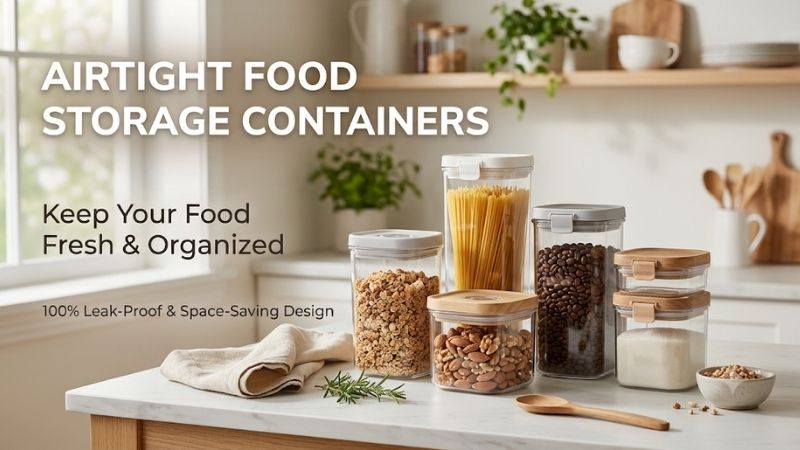
The following six options cover different approaches to airtight storage, including push-button lids, hinged seals, locking clips, specialized flour containers, and pour-spout designs. Each product receives a practical assessment of intended use, construction, advantages, limitations, and purchasing suitability. The objective is to identify which system solves a particular storage problem rather than ranking every container by appearance.
OXO Good Grips 10-Piece POP Container Set — Best overall
The OXO Good Grips 10-Piece POP Container Set is a coordinated dry-food storage system featuring clear BPA-free plastic containers and push-button sealing lids. Its ten vessels range from compact containers for smaller ingredients to a 4.4-quart option for larger pantry staples. The rectangular design makes efficient use of many cabinet shelves.
Best for: Households seeking a coordinated system for everyday pantry ingredients.
Why we picked it: The set combines a recognizable sealing mechanism with multiple practical capacities and a modular footprint.
Key specifications: Ten containers, including one 4.4-quart, one 2.8-quart, one 2.7-quart, one 2.2-quart, two 1.1-quart, two 0.6-quart, and two 0.4-quart vessels. The manufacturer identifies BPA-free construction and top-rack dishwasher compatibility.
Features and benefits: Pressing the button engages the airtight seal, while pressing it again releases the closure. The button also serves as a grip for removing the lid.
The transparent walls allow users to see how much food remains without opening the container.
Different shapes can be organized together on pantry shelves.
Performance and practical use: The larger vessels suit flour, cereal, pasta, or sugar, depending on package volume and ingredient density. Smaller containers work for nuts, coffee, snacks, or baking supplies.
The manufacturer specifically advises against carrying the container by its lid.
What makes it different: Its push-button operating mechanism and variety of modular sizes provide a convenient approach to general pantry organization.
Pros: Easy lid operation, multiple capacities, and coordinated stacking.
Cons: Larger packages of dry food may require additional containers. Small lids and sealing components need appropriate cleaning.
Buy if: You want a consistent pantry system with convenient daily access.
Skip if: You primarily need one large bulk-storage bin or prefer clip-lock lids.
Rubbermaid Brilliance Pantry Food Storage Set — Best clear modular design
The Rubbermaid Brilliance Pantry Food Storage Container Set uses transparent Tritan plastic and airtight sealing lids to create a coordinated storage system. The identified assorted-size configuration contains four vessels ranging from 3.2 cups to 16 cups. This makes the collection useful for households that want clear visibility and different capacities without purchasing dozens of containers.
Best for: Buyers prioritizing visibility, modular storage, and convenient cleaning.
Why we picked it: The collection provides a range of practical dry-food capacities with a coordinated design.
Key specifications: The identified four-container configuration includes 3.2-cup, 7.8-cup, 12-cup, and 16-cup containers with lids. Rubbermaid identifies Tritan plastic construction, an airtight seal, and top-rack dishwasher compatibility.
Features and benefits: Transparent bodies and lids make it easy to identify ingredients from several viewing angles.
The containers are designed to stack, which can simplify pantry organization when shelf dimensions permit.
Their rigid construction is useful for everyday handling.
Performance and practical use: The smaller container is suitable for nuts, snacks, or limited quantities of baking ingredients. Larger sizes can accommodate greater amounts of cereal, flour, sugar, or pasta.
However, check actual package volume before assuming a particular container will hold an entire grocery package.
Food weight and container volume are different measurements.
What makes it different: The combination of transparent construction, multiple capacities, and a matching container system is its main advantage.
Pros: Clear visibility, several useful sizes, and convenient dishwasher care.
Cons: Premium rigid-plastic storage may cost more than basic containers. Large sizes require sufficient shelf clearance.
Buy if: You want a streamlined system without purchasing an extensive multi-dozen-piece collection.
Skip if: You prefer glass or specifically need a pouring spout for cereal.
Progressive ProKeeper+ Flour Container — Best for home bakers
The Progressive ProKeeper+ Flour Container is a specialized airtight storage vessel designed around the needs of home bakers. It accommodates a standard 5-pound bag of flour and features a silicone sealing system, measurement markings, and a removable magnetic leveler. These features address practical frustrations associated with storing and measuring baking ingredients.
Best for: Home bakers who regularly measure flour using cups.
Why we picked it: Unlike generic storage containers, this product includes features specifically designed for flour handling.
Key specifications: The ProKeeper+ Flour Container, model PKS-101, is described as holding a standard 5-pound bag of flour and includes measurement markings up to 16 cups.
Features and benefits: A removable leveler provides a convenient tool for leveling flour in a measuring cup.
The silicone seal helps limit exposure to ambient moisture when the container is properly closed.
A wide access area supports scooping without forcing a measuring cup through an excessively narrow opening.
Performance and practical use: This container is particularly convenient for all-purpose flour used in cookies, cakes, pancakes, and bread.
For more consistent baking results, measuring flour by weight on a kitchen scale is often preferable to relying entirely on volume measurements.
The included leveler remains useful for recipes that specify cups.
What makes it different: Its baking-oriented design provides a reason to choose it over a general-purpose pantry canister.
Pros: Capacity designed for standard flour packaging, integrated leveler, and airtight seal.
Cons: Less adaptable to some foods than a basic rectangular container. Specialized features may be unnecessary for occasional bakers.
Buy if: You use flour regularly and want a dedicated storage station.
Skip if: You rarely bake or only need containers for cereal and snacks.
Sistema KLIP IT PLUS — Best locking-clip storage system
Sistema KLIP IT PLUS is a food-storage range using locking clips and flexible seals to help protect food during storage. The modular rectangular designs can be used in pantries, refrigerators, and freezers according to the manufacturer’s instructions. Its main appeal is a deliberate clip-and-seal closure rather than a push-button lid or specialized dispensing mechanism.
Best for: Families who want versatile reusable containers with familiar locking clips.
Why we picked it: The product range provides a practical alternative to push-button pantry systems and includes rectangular designs that nest when empty.
Key specifications: The KLIP IT PLUS range includes different capacities and shapes. The manufacturer identifies compatible products as food-safe, freezer-safe, and top-rack dishwasher-safe.
Features and benefits: Locking clips provide a visible way to secure the lid.
The flexible seal helps limit air exchange when the container is closed properly.
Rectangular profiles can reduce wasted space compared with round containers on some shelves.
Performance and practical use: Medium-size containers work well for dry snacks, nuts, rice, and other pantry ingredients.
Certain products in the range support refrigerator and freezer applications, although care instructions should be reviewed for the exact vessel.
When freezing foods containing water, leave room for expansion.
Do not assume that every storage container can be moved directly from a freezer into an oven.
What makes it different: Its clip-and-seal system is straightforward for people accustomed to traditional locking food containers.
Pros: Modular shapes, reusable locking mechanism, and versatile storage applications.
Cons: Opening multiple clips may be slower than operating a push-button lid. Size and care instructions vary by model.
Buy if: You want reusable storage that extends beyond dry pantry ingredients.
Skip if: One-touch access is your highest priority.
Vtopmart 24-Piece Airtight Set — Best for organizing a large pantry
The Vtopmart 24-Piece Airtight Food Storage Container Set is designed for households converting numerous dry ingredients from bags and boxes into a coordinated container system. Its identified configuration includes 24 clear plastic containers in four sizes, matching locking lids, and reusable labels. The collection emphasizes uniform appearance and large-scale organization.
Best for: Households with numerous pantry ingredients requiring separate storage.
Why we picked it: The set provides multiple containers across four capacities, making it useful for reorganizing a pantry in one purchase.
Key specifications: The identified package includes six tall containers, six large containers, six medium containers, and six small containers. The manufacturer describes approximate capacities of 2.8, 2.0, 1.6, and 0.8 liters, respectively.
Features and benefits: Side-locking lids incorporate silicone gaskets intended to produce an airtight closure.
Clear walls allow ingredients to remain visible.
Included reusable labels can help identify visually similar foods, such as different flours, grains, and sugars.
Performance and practical use: The collection is appropriate for dry cereal, rice, pasta, baking ingredients, and snacks.
However, buyers should examine the actual size distribution carefully.
Six small containers may be useful for a household storing numerous nuts or seeds but unnecessary for someone keeping only a few major staples.
The number of containers should match the number of ingredients requiring dedicated storage.
What makes it different: Its main advantage is an extensive coordinated collection with labeling accessories.
Pros: Numerous containers, several capacities, and reusable labels.
Cons: May be excessive for small kitchens. Matching lid dimensions do not eliminate the need to clean and dry gaskets properly.
Buy if: You have a substantial pantry and want a coordinated organization project.
Skip if: You need only a few large containers.
IKEA 365+ Dry Food Storage Container — Best for cereal and pouring
The IKEA 365+ 3-Quart Dry Food Storage Container is a rectangular plastic vessel with an airtight lid, silicone seal, and integrated pouring spout. It is designed for dry ingredients that benefit from controlled dispensing, particularly cereal and similar breakfast foods. The transparent body helps users monitor remaining quantities without repeatedly opening the container.
Best for: Households that frequently pour cereal or other dry foods directly into bowls.
Why we picked it: A pouring mechanism can simplify a common daily task and reduce the need to remove an entire lid.
Key specifications: The identified 3-quart version measures approximately 9 inches long, 5 inches wide, and 8 inches high. IKEA specifies polypropylene construction with a silicone seal and top-rack dishwasher cleaning.
Features and benefits: The pouring spout makes controlled dispensing convenient.
The rectangular footprint can fit efficiently beside other pantry containers.
Transparent sides help users recognize when an ingredient needs replenishment.
Performance and practical use: This product is particularly appropriate for cereal, certain dry snacks, and ingredients that pour easily.
It is less convenient for foods that require a large measuring scoop, such as flour.
Avoid placing the container near unnecessary heat or treating it as cookware.
The manufacturer identifies a maximum material temperature of 158°F for this model.
What makes it different: The dedicated pouring design provides a useful alternative to conventional wide-mouth airtight containers.
Pros: Convenient pouring, narrow rectangular footprint, and easy ingredient visibility.
Cons: Not ideal for large scoops. Designed for dry-food storage rather than cooking.
Buy if: You want faster, less messy access to breakfast cereal.
Skip if: You primarily store flour or other ingredients that require wide openings.
Buying guide: How to choose airtight food storage containers
Airtight storage is most effective when container size, lid design, material, and intended food match the household’s routine. Buyers should consider not only whether a container seals but also how easily it can be opened, washed, filled, stacked, and maintained. A coordinated collection provides little benefit if everyday ingredients remain difficult to access.
Understand what an airtight seal actually does
An airtight container uses a closure and sealing mechanism intended to limit air exchange between the stored food and surrounding environment.
Silicone gaskets, locking clips, and compression seals are common approaches.
These systems can help reduce exposure to humidity and external odors.
However, airtight storage does not create a vacuum unless the product uses a separate vacuum-sealing mechanism.
It also does not sterilize food or prevent every form of contamination.
Dry ingredients still have finite quality and storage lives.
Some foods, particularly nuts, whole-grain flours, and products containing oils, can develop undesirable flavors over time even when stored in tightly closed containers.
Temperature, light, initial freshness, and ingredient composition remain important.
Choose airtight containers as one part of proper food storage rather than as a guarantee that food will remain fresh indefinitely.
Match capacity to the actual ingredient package
A common purchasing mistake is selecting containers based on weight labels without accounting for ingredient volume.
A 5-pound bag of flour does not occupy the same space as 5 pounds of sugar, cereal, or pasta.
Ingredient density and shape affect the amount of container volume needed.
Before ordering, examine the amount of food normally purchased and compare it with the container’s usable capacity.
Allow enough space for scooping and closing the lid.
Avoid filling containers so tightly that the seal contacts food or becomes difficult to engage.
Large cereal boxes may require more space than expected because flakes occupy substantial volume.
Rice and sugar are denser, so smaller vessels can hold considerable weight.
When possible, choose container sizes that accommodate an entire regular package rather than leaving partially filled original bags scattered through the pantry.
Choose containers based on access frequency
Frequently used foods benefit from lids that open quickly and close reliably.
For example, breakfast cereal may be accessed every morning, making a pouring spout convenient.
Flour may be used several times a week, so a wide opening that accepts measuring cups is useful.
Bulk rice or dried beans may be accessed less frequently but require larger capacities.
A push-button lid can be convenient for daily use, provided it is operated according to manufacturer instructions.
Clip-lock lids may offer a deliberate closing process, although they can require several movements.
A large container can become inconvenient if it must be removed from a high shelf every time a small quantity is needed.
Think about frequency, movement, and access position together.
The ideal pantry arrangement places frequently used foods at comfortable heights.
Compare plastic and glass storage materials
Plastic containers are often lighter and less vulnerable to shattering when dropped.
Their lower weight makes large containers easier to lift from shelves, particularly when storing heavy dry ingredients.
Clear plastic also provides excellent visibility.
However, different plastics have different heat limits and cleaning requirements.
Some may develop scratches or retain odors after extended use.
Glass is less likely to absorb food odors and can provide a durable nonporous storage surface.
Nevertheless, it is heavier and can break from impact.
Glass containers may be appropriate for smaller quantities of ingredients or households prioritizing a nonplastic storage body.
For large flour and cereal containers, lightweight plastic may be easier to handle.
Choose according to weight, breakage risk, cleaning habits, and available storage space.
Evaluate stacking and cabinet dimensions
Stackable packaging can reduce unused vertical space, but the benefit depends on the actual dimensions of the containers and available shelves.
Before buying a set, measure shelf height, depth, and width.
Remember that lids may extend beyond the container body.
A tall cereal container can be difficult to remove from a shelf with limited overhead clearance.
Containers stacked several levels high may also be inconvenient when lower items are needed frequently.
Choose stable combinations and avoid stacking heavy containers where they could fall.
For deep cabinets, consider grouping similar ingredients.
Labels can improve identification when several containers contain visually similar products.
Storage efficiency should be measured by accessibility and safety, not merely the number of containers that fit into the smallest space.
Check cleaning requirements before buying
A food-storage container must be kept clean and thoroughly dry to function properly.
Seals and lid mechanisms may collect flour, sugar, or other food particles over time.
Follow the manufacturer’s instructions regarding gasket removal, dishwasher placement, and reassembly.
Do not assume that every lid can be placed on the bottom dishwasher rack.
Some models are top-rack dishwasher-safe only.
After washing, allow all components to dry completely before filling them with flour, sugar, rice, or other moisture-sensitive dry ingredients.
Water trapped around a gasket can create unwanted moisture exposure during storage.
Inspect seals for damage or deformation.
If a replacement gasket is available, use the correct manufacturer-approved component.
How to organize a pantry with airtight containers
Airtight containers work best as part of a straightforward organization system. Replacing every package at once may be unnecessary, especially when kitchen space is limited. Start with frequently used ingredients, choose suitable capacities, and establish a consistent method for labeling and replenishing food. This approach minimizes waste while improving daily convenience.
Start with the most frequently opened ingredients
Begin by identifying the dry ingredients you use regularly.
Typical examples include flour, sugar, rice, oatmeal, cereal, pasta, and coffee.
Choose containers for those foods before purchasing storage for rarely used ingredients.
For example, a household preparing oatmeal daily may benefit from a medium container with a wide opening.
A family eating cereal every morning may prefer a tall pour-spout design.
A home baker may prioritize a dedicated flour container.
This approach helps ensure that each purchase solves a real problem.
It also prevents storage collections from becoming unnecessarily large.
After using the initial containers for several weeks, evaluate whether additional sizes would improve the pantry.
Label containers with ingredient and date information
Transparent containers make it easy to see contents, but many dry foods look similar.
White flour, powdered sugar, and certain baking mixes can be difficult to distinguish at a glance.
Use clear labels identifying the ingredient.
When transferring packaged food, record relevant dates and cooking information.
For products with important preparation instructions, consider retaining the original label or packaging information.
Do not assume that removing a food from its commercial package makes the original use-by or quality date irrelevant.
If replenishing a container, avoid repeatedly adding new food over old food without checking what remains.
Clean and dry the vessel when appropriate before refilling.
Good labeling reduces confusion and helps households use ingredients before their quality deteriorates.
Protect ingredients from moisture, heat, and pests
Airtight containers can help protect food from ordinary household humidity, but storage conditions still matter.
Keep dry ingredients in a cool, dry location away from direct sunlight and unnecessary heat.
Do not position plastic containers against hot appliances or surfaces.
Inspect stored foods for signs of infestation, unexpected moisture, or spoilage.
If insects appear in a container, follow appropriate pest-management and food-disposal guidance rather than assuming the food can simply be transferred to another vessel.
Airtight seals help reduce entry opportunities but are not substitutes for a clean storage environment.
Regularly clean shelves and inspect ingredient packaging.
Also remember that perishable foods require appropriate refrigeration or freezing.
An airtight container does not make cooked food safe to store at room temperature.
Common mistakes to avoid
The usefulness of airtight containers depends on correct purchasing, cleaning, and storage habits. Some problems arise when buyers choose unsuitable sizes, misunderstand sealing claims, or transfer food without preserving important package information. Avoiding these mistakes can improve organization without adding unnecessary expense or creating food-safety concerns.
Buying an oversized container collection
Large coordinated sets can create an attractive pantry, but not every household needs dozens of containers.
Before purchasing, count the dry ingredients that actually require dedicated storage.
Consider whether several foods are usually kept in small quantities.
If your kitchen contains only a limited number of dry staples, six appropriately sized containers may be more practical than a 24-piece set.
Unused storage vessels still occupy shelf space.
An extensive collection can also require additional cleaning and labeling.
Start with the most useful sizes and expand only when necessary.
Assuming airtight means indefinitely fresh
An airtight seal reduces exposure to ambient conditions but does not stop every process that affects food quality.
Oils can oxidize, flavors can deteriorate, and ingredients can lose desirable characteristics over time.
Whole-grain flour, nuts, and some other foods may benefit from refrigerated or frozen storage depending on storage duration and manufacturer recommendations.
Follow package guidance.
Do not rely on appearance or smell alone to establish the safety of perishable foods.
Use airtight containers as practical storage tools rather than substitutes for proper food handling.
Neglecting lid seals and cleaning
A container may fail to close properly when flour, sugar, or other particles accumulate around its sealing surfaces.
Wipe away residue before closing the lid.
Inspect silicone gaskets for twisting, cracking, or deformation.
Wash the containers using suitable methods and allow them to dry before adding dry ingredients.
Never force a damaged lid to close.
A secure seal depends on the condition and correct installation of its components.
Regular care helps prevent a well-designed container from becoming frustrating to use.
Frequently Asked Questions
Choosing airtight storage often raises questions about freshness, materials, refrigerator compatibility, and which sizes are practical for everyday ingredients. The following answers address these concerns while distinguishing dry pantry storage from the separate safety requirements of cooked and perishable food. Understanding those differences helps buyers choose containers for the correct applications.
Are airtight containers worth buying for flour and sugar?
Yes. Airtight containers can help reduce exposure to ambient humidity and make flour and sugar easier to organize.
Choose a container large enough for your usual purchase quantity.
A wide opening is useful for measuring and scooping.
For flour, consider a design with a removable leveler or convenient measuring access.
Store ingredients according to package instructions and avoid introducing moisture with wet utensils.
Are plastic or glass airtight containers better?
Plastic is generally lighter and less likely to shatter when dropped, making it practical for large pantry ingredients.
Glass provides a nonporous surface and is often preferred for odor resistance.
Both materials can work well when paired with an appropriate sealing lid.
Choose according to weight, breakage risk, cleaning requirements, and intended storage location.
Neither material automatically guarantees an airtight seal.
Can airtight storage containers prevent pantry pests?
A properly sealed container can reduce opportunities for pests to access stored food.
However, it cannot guarantee protection against every insect or eliminate pests already present in an ingredient package.
Inspect food before transferring it into containers.
Keep the pantry clean and address signs of infestation promptly.
Discard affected food when appropriate rather than mixing it with uncontaminated ingredients.
How many airtight containers does a small kitchen need?
The ideal number depends on the ingredients stored regularly.
A household that primarily uses rice, pasta, cereal, flour, sugar, and coffee might start with approximately six appropriately sized containers.
Other kitchens may need fewer or more.
The important consideration is selecting capacities that suit the food rather than purchasing a large number of matching vessels.
Can airtight pantry containers store cooked meals?
Only if the exact container is suitable for the intended food and storage conditions.
Dry-food containers may not be designed for hot meals, refrigeration, freezing, or microwave reheating.
Perishable cooked food must be refrigerated promptly in appropriate containers.
For cooked leftovers, use containers specifically approved for food storage and follow recommended refrigeration times and temperatures.
Conclusion
Choosing airtight food storage containers starts with understanding the ingredients you store and the way you use your kitchen. The OXO POP Set offers a coordinated solution for general pantry organization, while Rubbermaid Brilliance provides clear modular storage. Progressive ProKeeper+ is especially convenient for flour, Vtopmart suits larger organization projects, and IKEA 365+ simplifies cereal pouring. Prioritize reliable seals, practical capacities, easy cleaning, and accessible storage rather than buying more containers than your household needs.
Write Your Review
No reviews yet. Be the first to share your experience!