
The best bread machine for gluten free bread is one with a named gluten-free cycle, a pan you can dedicate to gluten-free baking, and a 1 to 1.5 pound size setting, and only four of the eight listings below say “gluten-free” in their titles: the two KITCHENARM models, the Elite Gourmet and the Amazon Basics. The other four have attractive features such as ceramic pans, a nut dispenser or a long timer, but their titles do not mention a gluten-free setting, so you would have to confirm that on the listing.
- Eight machines at a glance
- What does a gluten-free loaf cost, and does the machine pay back?
- The eight machines in detail
- How we picked these
- What a gluten-free program actually changes
- Cross-contact and dietary safety
- Storing a gluten-free loaf
- Mistakes that ruin gluten-free loaves
- Which machine to buy
- Related guides
- Frequently asked questions
This difference is the most useful thing to know before you shop. Gluten-free dough is not wheat dough with a swap of flour; it behaves like a thick batter, and the programs designed for it skip long kneading and extra rises. A machine with only a generic “basic” cycle may bake an edible loaf, but a named gluten-free cycle or a custom program makes success far more likely.
Eight machines at a glance
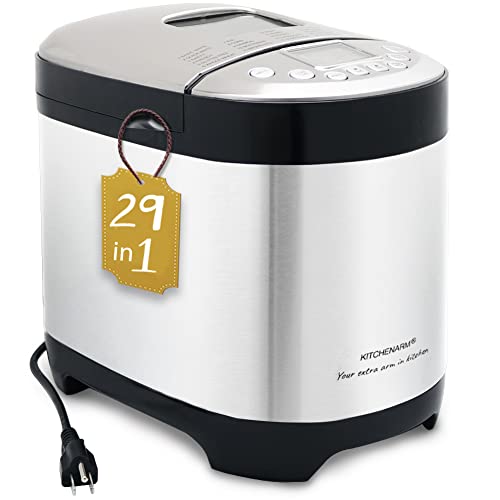
KITCHENARM 29-in-1 SMART Bread Machine with Gluten Free Setting 2LB 1.5LB 1LB Bread Maker Machine with Homemade Cycle - Stainless Steel Breadmaker with Recipes Whole Wheat Bread Making Machine
Included for 'Best Bread Machine for Gluten Free Bread: 8 Machines, 4 With a Named GF Cycle' as a representative product in this roundup; selection reflects the product set returned for this topic.
View on Amazon
Elite Gourmet 2 Lb Programmable Bread Maker, 3 Sizes, 19 Presets, Mint | Gluten-Free, Dough & Jam, Delay Timer, EBM8103M
Included for 'Best Bread Machine for Gluten Free Bread: 8 Machines, 4 With a Named GF Cycle' as a representative product in this roundup; selection reflects the product set returned for this topic.
View on Amazon
2LB Bread Maker, 17 in 1 Automatic Stainless Steel Bread Machine | Non-stick, Beginner-Friendly Controls, 15 Hour Timer, Easy to Clean Low Noise, High Success Rate for Homemade, LCD Display
Included for 'Best Bread Machine for Gluten Free Bread: 8 Machines, 4 With a Named GF Cycle' as a representative product in this roundup; selection reflects the product set returned for this topic.
View on Amazon
Cuisinart Bread Maker Machine, Stainless Steel, 12 Programs, Up to 2 lbs | Compact automatic bread maker with 12 menu options, 3 crust colors & sizes, LCD display, 13-hr delay-start timer, CBK-110P1ES
Included for 'Best Bread Machine for Gluten Free Bread: 8 Machines, 4 With a Named GF Cycle' as a representative product in this roundup; selection reflects the product set returned for this topic.
View on Amazon
Amazon Basics Programmable Bread Maker, 2 Pound Non-Stick Automatic Bread Making Machine, 14 Settings for Breads, Doughs, Gluten-Free Options, ExpressBake, 3 Crust Colors, LCD Display, White
Included for 'Best Bread Machine for Gluten Free Bread: 8 Machines, 4 With a Named GF Cycle' as a representative product in this roundup; selection reflects the product set returned for this topic.
View on Amazon
Neretva 20-in-1 2LB Bread Maker Metal Bread Machine with Dual Heater, Green | Automatic Bread Maker Machine with Nonstick Ceramic Pan, Low Noise, Stainless Steel Breadmaker, 15H Timer & 1H Keep Warm Set
Included for 'Best Bread Machine for Gluten Free Bread: 8 Machines, 4 With a Named GF Cycle' as a representative product in this roundup; selection reflects the product set returned for this topic.
View on Amazon
KBS Pro 710W 2.2LB Bread Maker, Stainless Steel 17-in-1 Smart Bread Machine with Healthy Ceramic Pan, Automatic Nut Dispenser, Tempered Glass Touch Panel, 3 Crust Colors, 15H Timer &Keep-Warm, Recipes
Included for 'Best Bread Machine for Gluten Free Bread: 8 Machines, 4 With a Named GF Cycle' as a representative product in this roundup; selection reflects the product set returned for this topic.
View on Amazon
KITCHENARM 19-in-1 HANDY Bread Machine with Homemade Cycle and Gluten Free Setting - Beginner Friendly 2LB 1.5LB 1LB White Bread Maker Machine with Recipes and Delay Timer
Included for 'Best Bread Machine for Gluten Free Bread: 8 Machines, 4 With a Named GF Cycle' as a representative product in this roundup; selection reflects the product set returned for this topic.
View on Amazon| Machine | Gluten-free in the title? | Other title details | Price tier |
|---|---|---|---|
| Elite Gourmet 2 lb (EBM8103M) | Yes, gluten-free preset | 19 presets, 3 sizes, dough and jam, delay timer | Budget |
| Amazon Basics 2 lb | Yes, gluten-free options | 14 settings, ExpressBake, 3 crust colors, LCD | Budget |
| KITCHENARM 19-in-1 HANDY | Yes, gluten-free setting | 2, 1.5 and 1 lb, homemade cycle, delay timer, recipes | Budget |
| KITCHENARM 29-in-1 SMART | Yes, gluten-free setting | 2, 1.5 and 1 lb, homemade cycle, stainless steel | Mid-range |
| OSIPOTO 17-in-1 2 lb | Not named | Non-stick, 15 hour timer, LCD, low noise | Mid-range |
| Neretva 20-in-1 2 lb | Not named | Ceramic pan, dual heater, 15 hour timer, 1 hour keep warm | Mid-range |
| KBS Pro 710W 2.2 lb | Not named | 17-in-1, ceramic pan, nut dispenser, 15 hour timer, keep-warm | Premium |
| Cuisinart CBK-110P1ES | Not named | 12 programs, up to 2 lb, 3 crust colors, 13 hour delay | Premium |
Tiers are relative inside this set of eight. Prices change quickly, so check the current price before you decide.
What does a gluten-free loaf cost, and does the machine pay back?
Here is a calculation with assumptions you can change. We assume a 1.5 pound loaf uses about 420 grams of gluten-free flour blend, which is a bit under a pound, plus yeast, eggs, oil and a binder. We also assume the blend costs 5 dollars a pound, other ingredients add about 1 dollar, a comparable store-bought gluten-free loaf costs 7 dollars, and electricity costs 17 cents per kilowatt-hour.
| Assumption or result | Value |
|---|---|
| Flour blend per 1.5 lb loaf | about 0.93 lb, roughly 4.65 dollars |
| Other ingredients | about 1.00 dollar |
| Electricity for a 3 hour cycle (assume 550 W heating at half duty, about 0.83 kWh) | about 0.14 dollars |
| Home-baked loaf total | about 5.80 dollars |
| Assumed store loaf | 7.00 dollars |
| Saving per loaf | about 1.20 dollars |
At one loaf a week, that is about 52 loaves and a saving of roughly 62 dollars a year. At two loaves a week the saving doubles. A Budget-tier machine could therefore pay for itself in somewhere between one and two years of regular baking, and a Premium one would take longer. Treat these numbers as a planning exercise, not as a promise, because flour prices and store prices vary widely.
The bigger takeaway is that electricity is a rounding error; ingredients are the cost. The real reasons to bake at home are ingredient control, freshness and the ability to adjust a recipe, so choose the machine on features, not on running cost.
The eight machines in detail
Elite Gourmet EBM8103M: gluten-free on a budget
The Elite Gourmet title lists a 2 pound programmable bread maker with 3 sizes, 19 presets and a mint finish, and mentions gluten-free, dough and jam settings along with a delay timer. The gluten-free mention is the reason it is on top of this list: it is the plainest, lowest-priced route to a machine that names the setting you need.
Three loaf sizes matter for gluten-free baking, because many recipes target a smaller loaf than the 2 pound maximum. The title does not specify the sizes, but the usual set is 1, 1.5 and 2 pounds, so check the manual or listing. The “jam” preset is a nice extra, not a reason to buy it. The title does not mention the pan coating, the paddle count or the window, so expect to read the product page for those.
Its Budget tier price makes it a good test of whether you will bake regularly. It does not have the ceramic pan or nut dispenser of the premium models, but those features do not matter for gluten-free success.
Pros
- Gluten-free preset named in the title
- Budget tier with 19 presets
- Delay timer and three sizes
Cons
- No ceramic pan or special extras mentioned
- Pan coating and paddle details not given
- Delay timer needs care with perishable ingredients
Who it’s for: first-time bread-machine owners who want a named gluten-free cycle at the lowest cost.
Amazon Basics Programmable Bread Maker: the straightforward option
The Amazon Basics title describes a 2 pound non-stick programmable bread maker with 14 settings for breads, doughs and gluten-free options, an ExpressBake setting, 3 crust colors, an LCD display and a white finish. It is the only title that says “gluten-free options” in the plural, which suggests more than one gluten-free-related setting, though the title does not explain.
ExpressBake is a faster cycle on many machines, but the title does not say how fast. Gluten-free doughs do not take the same time as wheat doughs, so check the manual to see whether ExpressBake is meant to be used with gluten-free recipes. In general, do not assume that a speed setting works with every flour.
It sits in the Budget tier, just above the Elite Gourmet by the price shown. The choice between them is mostly about the control panel and the size options, which the product pages describe better than the titles do. If you prefer a plain white appliance with a simple label, this is the more conventional-looking machine.
Pros
- Gluten-free options named in the title
- 14 settings including ExpressBake
- Budget tier
Cons
- Details of the gluten-free cycle are not in the title
- Loaf sizes are not listed
- Few extras beyond the basics
Who it’s for: buyers who want a simple, familiar-looking machine with a gluten-free option and a low price.
KITCHENARM 19-in-1 HANDY: beginner-friendly with recipes
This listing is titled as a 19-in-1 bread machine with a homemade cycle and a gluten-free setting, beginner-friendly, in white, with 2, 1.5 and 1 pound sizes, recipes and a delay timer. The size list is explicit, which is helpful: the 1.5 and 1 pound options fit the size that many gluten-free recipes use.
The homemade cycle is worth understanding. On many machines it is a custom program you can set, with your own times for mixing, rising and baking, and it is a useful tool for gluten-free baking because recipes often differ from presets. The title does not say how much you can customize, so check the manual before relying on it.
The title also mentions recipes, which is helpful for beginners. Treat them as a starting point and confirm that any recipe you use matches your dietary needs. It is in the Budget tier, a little above the Elite Gourmet. This listing looks like a close relative of the 29-in-1 below, so compare the two product pages.
Pros
- Gluten-free setting and 1, 1.5 and 2 pound sizes named
- Homemade cycle for custom recipes
- Recipes included according to the title
Cons
- Close relative of another KITCHENARM listing
- Degree of cycle customization not in the title
- Recipes are general, so check they suit your dietary needs
Who it’s for: beginners who want size options and a custom cycle at a Budget tier.
KITCHENARM 29-in-1 SMART: more programs, stainless steel
The 29-in-1 SMART title includes a gluten-free setting, 2, 1.5 and 1 pound sizes, a homemade cycle, a stainless steel breadmaker body, recipes and whole wheat bread making. It is the same family as the 19-in-1 with more programs and a stainless steel finish, and it sits in the Mid-range tier.
The difference between 19 and 29 programs is mostly about bread styles you may never make. If your goal is gluten-free bread, extra programs for other doughs do not add value, and the price difference might be better spent elsewhere. The stainless steel body may be easier to wipe down than painted plastic, though the title does not explain what part is stainless.
A caution about the whole wheat mention: if you are baking for someone with celiac disease, a machine that also bakes wheat bread carries cross-contact risk. Use a dedicated pan and paddle for gluten-free baking, and clean the machine thoroughly. Ask your doctor or a dietitian what level of precaution applies to you.
Pros
- Gluten-free setting and three loaf sizes named
- Stainless steel finish
- More programs for general baking
Cons
- Costs more than the 19-in-1 with similar core features
- Extra programs add little for gluten-free baking
- Same cross-contact cautions as any shared machine
Who it’s for: households that bake both gluten-free and regular bread and want a broader program list.
OSIPOTO 17-in-1: no gluten-free setting named
The OSIPOTO title describes a 2 pound 17-in-1 automatic stainless steel bread machine, non-stick, with beginner-friendly controls, a 15 hour timer, easy cleaning, low noise, a high success rate for homemade bread and an LCD display. Notice what is missing: it does not say gluten-free. Some machines have a gluten-free program that the title does not mention, so look at the product page and the program list.
If the listing confirms a gluten-free program, this is a quiet, long-timer machine at a Mid-range tier. If it does not, you would have to rely on a basic cycle or a custom program, which is a poorer match for gluten-free dough. A “high success rate” is a marketing claim that we cannot verify.
The 15 hour timer is a long delay, and with perishable ingredients, such as milk or eggs, long delays are not a good idea. For gluten-free recipes, which often include eggs, start the cycle without a long delay unless the manufacturer says it is safe.
Pros
- Quiet operation and long timer named in the title
- Non-stick pan and LCD display
- Mid-range tier
Cons
- Gluten-free setting is not named in the title
- Success-rate claim cannot be verified
- Long delay is unsuitable for perishable ingredients
Who it’s for: buyers who confirm a gluten-free program on the product page and want a quiet machine.
Neretva 20-in-1: ceramic pan and dual heater
The Neretva title lists a 20-in-1 2 pound metal bread machine with a dual heater, a nonstick ceramic pan, automatic operation, low noise, a 15 hour timer and a 1 hour keep-warm setting, in green. As with the OSIPOTO, gluten-free is not named in the title.
The dual heater is a notable feature: the title implies two heating elements, which could give more even baking, but how much it matters depends on the design. A ceramic nonstick pan is attractive to buyers who want to avoid certain coatings, though the title does not explain what the ceramic coating is made of or how durable it is. Read the care instructions, since ceramic coatings can wear if cleaned with abrasives.
The 1 hour keep-warm setting can leave bread in a warm, humid chamber, which can make crusts soft; if you prefer a crisp crust, remove the loaf promptly. For gluten-free loaves, which often dry quickly after cooling, keeping warm can help in some recipes. It is in the Mid-range tier. Confirm the program list for a gluten-free option before buying.
Pros
- Dual heater and ceramic pan named
- Keep-warm and 15 hour timer
- Mid-range tier
Cons
- Gluten-free program is not named in the title
- Ceramic coating durability is unknown
- Keep-warm can soften crust
Who it’s for: bakers who prefer a ceramic pan and are willing to confirm the program list first.
KBS Pro 710W: the feature-rich premium model
The KBS title is the most detailed: 710 watts, 2.2 pounds, stainless steel, 17-in-1 smart bread machine, a healthy ceramic pan, an automatic nut dispenser, a tempered glass touch panel, 3 crust colors, a 15 hour timer, keep-warm and recipes. It is the only machine here with an automatic nut dispenser, which adds nuts and seeds at the right moment in the cycle.
For gluten-free baking, the nut dispenser is a minor point, and a larger concern is whether the machine has a gluten-free program, which the title does not say. At 2.2 pounds, the pan is also the largest in the set, and gluten-free recipes are often written for smaller loaves. Check the manual for the minimum and maximum flour amounts.
Electrical safety is worth a note with a 710 watt appliance. Use a grounded outlet, do not run it on a damaged cord, and follow the manufacturer’s instructions on ventilation and cleaning. It is in the Premium tier, so it makes the most sense if you want a touch panel and extras and have confirmed the gluten-free program.
Pros
- Automatic nut dispenser and touch panel
- Ceramic pan and large 2.2 lb capacity
- Keep-warm and long timer
Cons
- Gluten-free program is not named in the title
- Premium tier
- Large pan may not suit small gluten-free recipes
Who it’s for: households that want a feature-rich machine for many bread types and confirm a gluten-free program.
Cuisinart CBK-110P1ES: the brand-name compact
The Cuisinart title describes a stainless steel bread maker with 12 programs, up to 2 pounds, a compact automatic design, 12 menu options, 3 crust colors and sizes, an LCD display and a 13 hour delay-start timer. It is the highest-priced machine in the group, in the Premium tier, and its title also does not mention a gluten-free setting.
That is worth a clear statement: if gluten-free baking is your goal, the title gives you no evidence this machine has a dedicated program. Cuisinart documents its programs in the manual, so check the listing for a program table before assuming. Brand recognition and a compact body are reasons to buy it, but they are not reasons to buy it for gluten-free bread unless the program list says otherwise.
If the machine does have a program or manual option that fits your recipes, the 12-program list is shorter and may be simpler to use than the 20-plus-in-1 machines. Simplicity is a legitimate advantage, but only if the one program you need is there.
Pros
- Recognized kitchen brand and compact design
- Simple 12-program list
- 13 hour delay-start timer
Cons
- No gluten-free setting named in the title
- Highest price tier in the set
- Fewer extras than cheaper rivals
Who it’s for: brand-loyal buyers who verify the program list includes what they need.
How we picked these
The Editorial team wrote this guide from published specifications, manufacturer documentation and buyer reviews. Nobody on the team used or measured these units. We did not bake in any of these machines, so we make no claims about loaf texture, rise or crust.
The eight listings were supplied for this keyword. The first thing we checked was whether each title mentions a gluten-free setting, because that is the feature the keyword is about. Four do and four do not, and the guide says so openly. We also noted loaf-size options, timers, pan coatings and any note about custom cycles.
Two of the listings are close relatives, the KITCHENARM 19-in-1 and 29-in-1, and we compared them by visible differences. Where a title was silent on a gluten-free program, we recommend checking the product page and the manual, not assuming a yes or no.
What a gluten-free program actually changes
Mixing and rising
Wheat dough relies on gluten to trap gas, so bread machines knead it for a long time and let it rise twice or more. Gluten-free batter lacks that network, so a gluten-free cycle usually mixes briefly, rises once and bakes. Running a wheat program on gluten-free dough can overwork or over-proof it, which is a common cause of collapse.
Loaf size
Many gluten-free recipes are written for a 1 to 1.5 pound loaf. A machine with several size settings, like the two KITCHENARM models and the Elite Gourmet, gives you room to match the recipe.
Custom cycles
Some machines let you set your own times, which is helpful if your recipe calls for a particular mix and rest pattern. Two titles mention a homemade cycle, which suggests this, but you should check the manual for how customizable it is.
Crust and keep-warm
Gluten-free loaves can dry or form a thick crust. A lighter crust setting and prompt removal from the pan after baking help. Extended keep-warm cycles can make the crust soft.
Cross-contact and dietary safety
Gluten-free baking at home is a food-safety topic, not just a recipe topic. If you or a family member has celiac disease or a serious gluten sensitivity, talk to your doctor or a registered dietitian about how careful you need to be. We can provide general guidance, not medical advice.
- A machine with a gluten-free cycle is not a certified gluten-free appliance.
- If the machine has been used with wheat flour, residue can remain in the pan, paddle shaft, lid and seals.
- Consider buying a separate pan and paddle for gluten-free use and label them clearly.
- Wash the pan, paddle and lid thoroughly, and clean the machine interior according to the manual.
- Read every ingredient label, including yeast, binders and flour blends, for cross-contact statements.
Also follow general appliance safety: place the machine on a stable, heat-resistant surface, keep the cord away from the hot parts, use oven mitts for the hot pan, and read the manual for ventilation and cleaning.
Storing a gluten-free loaf
Gluten-free bread tends to go stale faster than wheat bread. Slice it once it is fully cool, store it airtight, and freeze slices you will not eat within a day or two. Our guide to countertop bread boxes covers short-term storage, and if your kitchen is damp, the guide to bread boxes for humid kitchens explains how to avoid mold. For longer storage, freezing is the safer option.
Mistakes that ruin gluten-free loaves
- Using a wheat program. Long kneading and multiple rises can collapse gluten-free dough.
- Overfilling the pan. A 1.5 lb recipe in a 2 lb pan is fine; a 2 lb recipe in a 1 lb setting is not.
- Not weighing ingredients. Volume measures vary a lot with gluten-free flours.
- Leaving out the binder. Many blends need xanthan gum or psyllium unless already included.
- Using a long delay with eggs or milk. Food safety and yeast behavior both suffer.
- Assuming a feature-rich machine has the right program. Confirm the gluten-free setting, not just the feature count.
Which machine to buy
If you want the plainest gluten-free-named machine at the lowest cost, choose the Elite Gourmet or the Amazon Basics. If you want the clearest size and custom-cycle options, choose a KITCHENARM, with the 19-in-1 as the lower-priced one. If you are attracted to ceramic pans, a nut dispenser or a brand name, the Neretva, KBS and Cuisinart are the ones to read closely, but confirm a gluten-free program first. And no matter which one you buy, plan for a dedicated pan and paddle if gluten cross-contact matters to you.
Related guides
- Flat Bottom Carbon Steel Wok For Induction
- Electric Griddle For Pancakes And Bacon
- Blender For Making Oat Milk At Home
Frequently asked questions
Do I need a special bread machine for gluten-free bread?
You do not strictly need one, but a gluten-free cycle helps. Gluten-free dough behaves more like a thick batter, so most recipes call for a shorter mix, one rise and no punch-down, which a dedicated cycle provides. Four of the eight titles here name a gluten-free setting. The others may still work with a manual or custom program, but you would have to confirm that on the listing and in the manual.
Is a bread machine safe for someone with celiac disease?
A machine cannot be certified gluten-free just because it has a gluten-free cycle. Cross-contact can occur if the pan, paddle or seals have been used with wheat flour, and crumbs can hide in corners. Anyone with celiac disease or a serious sensitivity should talk to their doctor or a registered dietitian about precautions, consider a new dedicated pan and paddle, and read every ingredient label carefully.
What loaf size is best for gluten-free recipes?
Many gluten-free recipes are written for a 1 to 1.5 pound loaf, because the dough is heavy and does not rise like wheat dough. Overfilling a 2 pound pan with a recipe written for a smaller one can lead to uneven results. Choose a machine with a size selector, follow the recipe’s stated loaf size, and check the manual for the maximum flour the pan can take.
Can I use the delay timer with gluten-free recipes?
Be careful. Eggs, milk, butter and other perishable ingredients should not sit at room temperature for many hours, and a long delay can also change how yeast behaves. Check the manufacturer’s guidance on what is safe to leave in the pan. If a recipe contains perishable ingredients, consider starting it immediately or using a shorter delay, and never leave raw meat or fish ingredients in the pan.
Why is my gluten-free loaf dense or sunken?
Common causes include too much liquid, the wrong flour blend, old yeast, a missing binder such as psyllium or xanthan gum in the recipe, or an overfilled pan. Gluten-free dough relies on starches and binders rather than gluten for structure. Weigh ingredients, scrape the sides during mixing if the manual allows, and try one change at a time. Follow a recipe written for a bread machine.
Write Your Review
No reviews yet. Be the first to share your experience!