
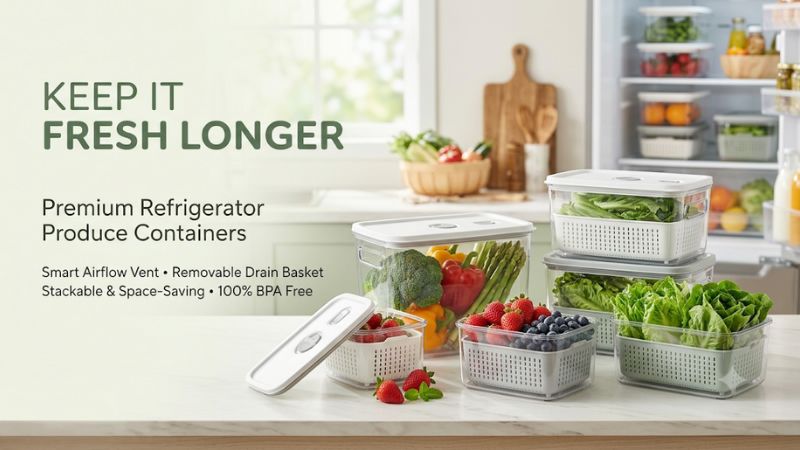
Refrigerator produce containers can help organize fruits, vegetables, and fresh herbs while making groceries easier to see and use. The best designs manage airflow and moisture differently, so one container is not ideal for every ingredient. Compare six identifiable produce keepers and learn how their features, capacities, cleaning requirements, and limitations affect everyday refrigerator storage.
- Quick Verdict: Which Refrigerator Produce Containers Are Best?
- Quick Comparison Table
- How We Selected These Produce Keepers
- Six Refrigerator Produce Containers Reviewed in Detail
- Buying Guide: Choose Containers According to Produce Type
- Food Safety and Proper Produce Storage
- Frequently Asked Questions
- Conclusion
Quick Verdict: Which Refrigerator Produce Containers Are Best?
The best produce keeper depends on which foods you purchase most frequently. Leafy greens may benefit from a large ventilated container with an elevated basket, while berries need smaller compartments that limit crowding and excess moisture. Fresh herbs can require a completely different arrangement. These selections focus on documented design features rather than unsupported claims that one product keeps every type of produce fresh for a specific number of days.
Our six recommendations:
- Best versatile produce storage set: Rubbermaid FreshWorks Produce Saver 8-Piece Set.
- Best for larger leafy vegetables: OXO GreenSaver Produce Keeper, 4.3 Qt.
- Best for small berries: OXO Produce Saver Berry Keeper 2-Piece Set.
- Best for mixed vegetables: Progressive Produce ProKeeper, 3 Qt.
- Best for multiple produce categories: Tupperware FridgeSmart 4-Piece Starter Set.
- Best for fresh herbs: OXO Produce Saver Herb Keeper.
These products are designed for different storage tasks, and their ventilation systems should not be treated as interchangeable.
Manufacturer claims about extended freshness are useful for understanding intended features, but actual shelf life depends on produce condition, temperature, moisture, handling, and the particular food stored.
Quick Comparison Table
A meaningful produce-container comparison should focus on the foods each design can accommodate and how it manages moisture or air exchange. A large box for lettuce is not a direct substitute for a narrow herb keeper, and a berry container may be inconvenient for long carrots or celery. The table below summarizes six distinct products without inventing preservation percentages or unsupported performance rankings.
| Product | Best For | Key Design or Capacity | Main Advantage | Main Trade-Off |
|---|---|---|---|---|
| Rubbermaid FreshWorks 8-Piece Set | Mixed weekly produce | Four containers with 4.6-, 7.2-, 11.3-, and 18.1-cup capacities | Several sizes with elevated bases and FreshVent filters | Requires sorting produce among containers |
| OXO GreenSaver Produce Keeper | Lettuce, broccoli, and larger vegetables | 4.3-quart container, elevated basket, sliding vent, carbon filter | Adjustable moisture environment | Filter maintenance and larger footprint |
| OXO Produce Saver Berry Keeper 2-Piece Set | Berries and cherry tomatoes | Two compact bins with removable ventilated baskets | Small-item organization | Limited capacity for bulky produce |
| Progressive Produce ProKeeper | Carrots, peppers, grapes, and mixed vegetables | 3-quart container with removable colander base | Convenient preparation and storage | One fixed general-purpose capacity |
| Tupperware FridgeSmart 4-Piece Starter Set | Multiple produce categories | Four containers with adjustable ventilation | Flexible grouping and stackable sizes | Higher initial setup and vent management |
| OXO Produce Saver Herb Keeper | Parsley, cilantro, dill, and similar herbs | Tall container with water fill line and ventilated basket | Specialized herb hydration | Less suitable for ordinary bulky produce |
The table compares container designs, not guaranteed freshness outcomes.
A product with advanced ventilation cannot restore produce that was already spoiled or mishandled before purchase.
Safe refrigeration and regular inspection remain essential regardless of the container selected.
How We Selected These Produce Keepers
The six selections were chosen for recognizable manufacturer identities, documented storage features, and meaningful differences in intended use. We evaluated capacity, airflow control, separation from moisture, cleaning, refrigerator fit, and compatibility with common produce types. No original produce-storage trials, microbial testing, or measured shelf-life comparisons were conducted for this guide.
Evaluation criteria:
- Product relevance: Designed specifically for refrigerated produce.
- Capacity: Appropriate size for common grocery quantities.
- Ventilation: Fixed or adjustable airflow features.
- Moisture management: Raised bases, baskets, and drainage arrangements.
- Specialization: Berries, leafy vegetables, herbs, or mixed produce.
- Cleaning: Removable components and documented care requirements.
- Storage efficiency: Fit with common refrigerator shelves.
- Food safety: Suitable use for perishable fresh produce.
The recommended labels reflect practical use cases rather than evidence that a particular product outperformed every alternative in controlled testing.
Manufacturer information was used to identify features, but buyers should verify the exact product configuration before purchasing.
Six Refrigerator Produce Containers Reviewed in Detail
The following products cover several common refrigerator-storage needs. Some provide multiple modular containers, others focus on airflow and moisture management, and specialized models are intended for berries or fresh herbs. Each review explains what the design offers, why that feature matters, and which limitations could affect the purchase. No claim of independent detailed research is made.
Rubbermaid FreshWorks Produce Saver 8-Piece Set
The Rubbermaid FreshWorks Produce Saver eight-piece set includes four containers and four lids in different sizes. The manufacturer identifies capacities of 4.6, 7.2, 11.3, and 18.1 cups and describes an elevated base that separates produce from accumulated moisture. Its FreshVent system is intended to regulate gas exchange, while the modular design can help households store different fruit and vegetable categories separately.
Best For: Households buying several kinds of produce during weekly grocery trips.
Why We Picked It: The four container sizes provide more flexibility than a single large produce keeper.
Key Specifications:
- Brand: Rubbermaid.
- Product: FreshWorks Produce Saver 8-Piece Set.
- Configuration: Four containers and four lids.
- Capacities: 4.6, 7.2, 11.3, and 18.1 cups.
- Ventilation: FreshVent filter system.
- Base: Elevated produce-support design.
- Material: Manufacturer-described BPA-free polymer.
- Care: Dishwasher-safe according to Rubbermaid.
Features & Benefits:
- Different container sizes suit varied produce quantities.
- Elevated bases separate food from some accumulated moisture.
- Built-in filters are designed to regulate airflow.
- Containers provide defined storage categories.
- Compatible components can nest for cabinet storage.
Pros:
- Several practical capacities.
- Dedicated produce-storage design.
- Removable containers for cleaning.
- Useful for mixed weekly groceries.
Cons:
- Four containers occupy considerable refrigerator space when filled.
- Produce must be sorted according to storage needs.
- Additional lids and bases require cleaning.
- Not every fruit or vegetable benefits from the same environment.
Buy If: You regularly refrigerate berries, leafy greens, peppers, and similar produce in several categories.
Skip If: You have a compact refrigerator or purchase only one type of refrigerated produce at a time.
Performance & Practical Use
The range of sizes is the main advantage. A smaller container may suit blueberries, while the larger one can accommodate leafy vegetables or broccoli.
Rubbermaid recommends storing unwashed, uncut produce and keeping different types separated where appropriate.
This helps users create a consistent storage routine without treating every ingredient identically.
What Makes It Different
The FreshWorks set combines multiple capacities with manufacturer-described airflow regulation and raised support surfaces.
Its built-in filter is marketed as lasting for the container’s lifetime without replacement.
That differs from systems using consumable carbon filters, though the marketing feature should not be interpreted as independently proven universal freshness performance.
OXO GreenSaver Produce Keeper, 4.3 Qt
The OXO GreenSaver Produce Keeper uses a removable elevated basket, an adjustable lid vent, and an activated carbon filter. The manufacturer identifies the 4.3-quart configuration as suitable for produce such as lettuce, broccoli, cauliflower, peppers, and medium-size fruits. This makes it especially relevant for households that frequently buy leafy vegetables and want a dedicated container instead of relying entirely on loose crisper storage.
Best For: Leafy greens and medium-to-large refrigerated vegetables.
Why We Pick It: The adjustable vent and elevated basket address common moisture and airflow issues.
Key Specifications:
- Brand: OXO.
- Product: GreenSaver Produce Keeper.
- Capacity: 4.3 quarts.
- Approximate dimensions: 7.6 x 8.4 x 6 inches.
- Ventilation: Adjustable lid vent.
- Filter: Activated carbon filter.
- Basket: Removable elevated insert.
- Care: Dishwasher-safe container as described by the manufacturer.
Features & Benefits:
- Elevated basket separates produce from the container floor.
- Adjustable vent supports different humidity preferences.
- Carbon filter is intended to absorb ethylene.
- Basket can function as a colander.
- Clear construction improves visibility.
Pros:
- Useful for larger vegetables.
- Adjustable ventilation.
- Removable basket.
- Defined moisture-separation design.
Cons:
- Requires a relatively substantial shelf footprint.
- Filter care or replacement must be considered.
- More components than a plain storage box.
- Not ideal for every type of produce.
Buy If: You frequently purchase lettuce, broccoli, or similar refrigerated vegetables.
Skip If: Your main storage need is a small amount of berries or fresh herbs.
Performance & Practical Use
The adjustable lid vent allows users to select a different airflow setting according to the type of produce.
The removable basket keeps food elevated rather than resting directly on the bottom of the container.
This may be useful when moisture collects beneath leafy vegetables.
However, the actual outcome depends on the food’s initial quality and refrigerator conditions.
What Makes It Different
GreenSaver combines an adjustable vent with an activated carbon filter intended to manage ethylene exposure.
This distinguishes it from simple vented trays and from FreshWorks’ different built-in filter arrangement.
The additional components may be worthwhile for someone who regularly purchases large quantities of suitable greens, but they also add maintenance responsibilities.
OXO Produce Saver Berry Keeper 2-Piece Set
The OXO Produce Saver Berry Keeper two-piece set is designed for small refrigerated produce such as strawberries, blueberries, and cherry tomatoes. The manufacturer describes clear stackable bins with removable ventilated baskets, allowing the contents to remain visible while being elevated away from the outer container’s bottom. The compact design suits households that want to separate delicate produce from heavier vegetables.
Best For: Berries and other small, easily crowded produce.
Why We Pick It: The removable baskets and small compartments target the practical problems of handling delicate fruit.
Key Specifications:
- Brand: OXO.
- Product: Produce Saver Berry Keeper 2-Piece Set.
- Configuration: Two compact storage bins.
- Design: Clear lids and removable ventilated baskets.
- Storage: Stackable configuration.
- Features: Integrated handles.
- Material: Manufacturer-described BPA-free polymer.
- Care: Dishwasher-safe according to OXO.
Features & Benefits:
- Small produce can remain grouped by type.
- Elevated baskets reduce direct contact with collected moisture.
- Clear walls improve inventory visibility.
- Removable inserts can be used during suitable preparation tasks.
- Compatible stacking can make use of vertical space.
Pros:
- Designed for smaller fruits.
- Removable ventilated baskets.
- Clear storage.
- Two separate compartments.
Cons:
- Less suitable for large leafy vegetables.
- Multiple pieces require cleaning.
- Stacking can make lower bins less accessible.
- Berries still need regular inspection.
Buy If: You frequently buy berries and want separate visible storage groups.
Skip If: You mainly store bulky vegetables or already have a suitable produce drawer.
Performance & Practical Use
The removable inner baskets are particularly useful because they allow delicate produce to be handled separately from the outer storage bin.
However, unnecessary washing before storage can introduce additional moisture, depending on the produce and care routine.
Follow the product’s instructions and wash produce thoroughly under running water before eating or preparing it.
What Makes It Different
This design emphasizes small, stackable produce compartments rather than one large crisper replacement.
It can help prevent berries from disappearing beneath larger groceries.
For families that buy only occasional small fruit packages, however, the extra containers may not justify the shelf space.
Progressive Produce ProKeeper, 3 Qt
The Progressive Produce ProKeeper is a three-quart refrigerated produce container designed for items such as carrots, small peppers, grapes, and tomatoes. The manufacturer describes a flow-through vent system and a removable lower cover that can function as a colander. This makes it a practical general-purpose option for households wanting one versatile container rather than a complete modular produce-storage set.
Best For: Medium-size vegetables and everyday mixed produce storage.
Why We Pick It: The three-quart size and removable colander design offer a useful balance between storage and preparation convenience.
Key Specifications:
- Brand: Progressive International.
- Product: Produce ProKeeper.
- Capacity: 3 quarts.
- Design: Vented produce-storage container.
- Feature: Removable colander-style base.
- Material: Manufacturer-described BPA-free construction.
- Care: Dishwasher-safe according to Progressive.
Features & Benefits:
- Ventilation supports appropriate air exchange.
- Removable base can assist rinsing.
- Medium capacity suits several vegetable types.
- Clear storage improves visibility.
- One container can serve multiple suitable produce categories.
Pros:
- Versatile medium-size capacity.
- Removable preparation component.
- Straightforward construction.
- Useful for mixed household groceries.
Cons:
- One fixed capacity.
- May not accommodate large lettuce heads.
- Not specialized for long-stemmed herbs.
- Moisture requirements still differ by produce type.
Buy If: You want one general-purpose produce keeper for carrots, grapes, peppers, and similar foods.
Skip If: You primarily need storage for large greens or delicate fresh herbs.
Performance & Practical Use
The removable base offers a useful convenience during food preparation.
For example, suitable vegetables can be transferred to the sink, rinsed using the appropriate component, and prepared without requiring an entirely separate large colander.
However, produce that will be stored for several days should be handled according to the container’s storage instructions and the food’s moisture requirements.
What Makes It Different
The ProKeeper emphasizes a versatile mid-size container with a colander component.
It does not require an activated carbon filter or a large collection of separate bins.
For a small household buying a modest variety of vegetables, that simplicity may be more convenient than an elaborate storage system.
Tupperware FridgeSmart 4-Piece Starter Set
The Tupperware FridgeSmart four-piece starter set includes two Small Deep containers, one Medium container, and one Medium Deep container with matching vented lids. The manufacturer describes a three-position adjustable airflow system and a printed guide for different produce types. This makes the set relevant for households that want to store multiple fruits and vegetables in separate containers while adjusting ventilation.
Best For: Home cooks who regularly purchase several different produce categories.
Why We Pick It: The combination of four container sizes and adjustable venting provides a flexible modular storage system.
Key Specifications:
- Brand: Tupperware.
- Product: FridgeSmart 4-Piece Starter Set.
- Containers: Four, with corresponding lids.
- Small Deep: 7 cups each.
- Medium: 7 cups.
- Medium Deep: Approximately 1 gallon.
- Ventilation: Three-position adjustable slider.
- Material: Manufacturer-described BPA-free polymer.
- Care: Dishwasher-safe according to Tupperware.
Features & Benefits:
- Adjustable vents support different storage settings.
- Several sizes allow produce separation.
- Transparent bases improve visibility.
- Printed guides help users select airflow settings.
- Stackable formats support refrigerator organization.
Pros:
- Multiple containers.
- Adjustable airflow.
- Clear storage.
- Useful for broad weekly grocery lists.
Cons:
- Requires learning the correct vent settings.
- Four containers take up significant shelf space.
- More components to wash.
- Higher initial commitment than one produce bin.
Buy If: You purchase diverse refrigerated produce and want a coordinated multi-container system.
Skip If: You need only one small berry or vegetable keeper.
Performance & Practical Use
The airflow slider is the main distinguishing feature.
Different fruits and vegetables have different storage needs, and the included guide provides settings intended for specific categories.
However, a storage guide does not override general food safety or the need to inspect produce regularly.
Use the manufacturer recommendations for intended foods and keep the refrigerator at safe temperatures.
What Makes It Different
FridgeSmart emphasizes manually adjustable airflow and a multi-size starter system.
Unlike a fixed-vent basket, the user participates in selecting the storage conditions.
This can be helpful for organized households, but it may become inconvenient if users frequently change contents without adjusting the lid settings.
OXO Produce Saver Herb Keeper
The OXO Produce Saver Herb Keeper is a specialized refrigerator container designed for tender fresh herbs such as parsley, cilantro, and dill, as well as some hardier herbs and suitable vegetables. The manufacturer describes a water fill line, ventilated removable basket, and hinged lid that provides access to stored stems. This is a different storage approach from general produce bins because certain herbs benefit from controlled hydration.
Best For: Fresh herbs used regularly in home cooking.
Why We Pick It: The dedicated hydration system addresses a specific produce-storage need that ordinary berry and vegetable containers may not solve.
Key Specifications:
- Brand: OXO.
- Product: Produce Saver Herb Keeper.
- Design: Tall herb-storage container.
- Hydration: Marked water fill line.
- Basket: Removable ventilated insert.
- Access: Hinged lid.
- Material: Manufacturer-described BPA-free construction.
- Care: Dishwasher-safe according to OXO.
Features & Benefits:
- Water fill line supports the intended hydration arrangement.
- Ventilated basket promotes airflow.
- Hinged lid simplifies access.
- Tall construction accommodates certain stems.
- Removable basket can support preparation and cleaning.
Pros:
- Specialized for herbs.
- Defined water-fill guidance.
- Removable basket.
- Convenient upright storage.
Cons:
- Not suitable for every type of produce.
- Water needs monitoring and replacement.
- Tall footprint may not fit short shelves.
- More maintenance than a simple storage tray.
Buy If: You regularly use cilantro, parsley, dill, or similar fresh herbs.
Skip If: You mainly store berries, lettuce heads, or bulk vegetables.
Performance & Practical Use
Fresh herbs can respond differently to moisture than dry storage produce.
The Herb Keeper is intended to provide a controlled hydration environment for suitable varieties.
However, excess stagnant water or neglected plant material can still create problems.
Follow the manufacturer’s fill and care instructions, inspect the herbs regularly, and clean the container between uses.
What Makes It Different
The Herb Keeper is a specialized vertical hydration system rather than a conventional produce box.
Its value depends on how frequently the household uses fresh herbs.
For someone who buys cilantro every week, it may be useful. For occasional herb purchases, a simpler appropriate storage method may be sufficient.
Buying Guide: Choose Containers According to Produce Type
Different fruits and vegetables respond differently to moisture, ventilation, and temperature. A useful refrigerator-storage system should reflect those differences rather than treating all produce as interchangeable. The best container may have an elevated basket, adjustable vent, removable colander, or water reservoir, depending on the ingredient and how it is normally used.
Understand Moisture and Airflow Requirements
Moisture management is central to many produce-container designs. Some foods benefit from higher humidity, while others can deteriorate when excess water collects on their surfaces. Elevated baskets and vented lids can help create different conditions, but the exact requirements depend on produce type.
Features to evaluate:
- Adjustable vents.
- Elevated drainage baskets.
- Removable colanders.
- Water collection space.
- Condensation visibility.
- Cleaning access.
- Manufacturer produce guides.
A sealed container is not automatically better than a ventilated one.
Likewise, excessive ventilation may not suit produce that loses moisture quickly.
Choose the container based on the food being stored.
Match Container Capacity to Grocery Quantity
A large produce keeper can be useful for lettuce or broccoli but waste space when holding a handful of berries. Compact containers help organize small items, while mixed-size sets accommodate broader grocery lists.
Capacity considerations:
- Small berries and cherry tomatoes.
- Medium peppers and carrots.
- Large leafy greens.
- Long-stemmed herbs.
- Family-sized vegetable purchases.
- Weekly shopping frequency.
Avoid overfilling containers because tight packing can reduce airflow and create pressure on delicate produce.
A smaller amount of food in the correct storage environment is often preferable to forcing everything into one large box.
Consider Filter Maintenance and Replacement Parts
Some produce keepers use activated carbon filters, while others rely on fixed ventilation or built-in filter systems. These approaches have different maintenance requirements.
Check before buying:
- Whether a filter is replaceable.
- Manufacturer-recommended replacement intervals.
- Availability of compatible filters.
- Whether inserts are removable.
- Cleaning requirements.
- Availability of replacement lids or baskets.
Do not assume all filters are permanent or all containers require replacement cartridges.
Follow the exact product’s instructions.
Measure Refrigerator Space Carefully
A large container may fit on an empty shelf but interfere with neighboring food or make the refrigerator difficult to clean.
Measure:
- Interior shelf width.
- Usable depth.
- Vertical clearance.
- Door-bin interference.
- Room for lifting lids.
- Access to removable baskets.
- Refrigerator airflow requirements.
Choose containers that leave enough room for normal circulation and convenient retrieval.
Do not block cooling vents or force the refrigerator door around an oversized bin.
Food Safety and Proper Produce Storage
Specialized containers can help organize produce, but they do not replace safe refrigeration, proper washing, or appropriate food handling. The FDA recommends storing perishable fresh produce at 40°F or below. Fruits and vegetables should also be protected from contamination by raw meat, poultry, seafood, and shell eggs.
Wash Produce at the Appropriate Time
For many storage systems, manufacturers recommend placing suitable whole produce into the container unwashed and washing it before preparing or eating. This can help avoid introducing unnecessary moisture during storage.
However, product-specific instructions and the condition of the produce matter.
Safe handling principles:
- Follow container-specific storage instructions.
- Wash produce thoroughly under running water before preparing or eating.
- Do not use soap or household detergents to wash produce.
- Keep hands and preparation surfaces clean.
- Refrigerate cut produce promptly.
- Avoid storing visibly spoiled food with sound produce.
Do not assume that a vented container makes unwashed produce ready to eat.
Keep Refrigerated Produce Away From Raw Animal Products
Fresh produce can become contaminated when raw animal products leak or contact it.
Storage priorities:
- Keep raw meat and poultry securely contained.
- Prevent liquids from dripping onto produce.
- Store ready-to-eat foods separately.
- Clean contaminated shelves promptly.
- Use covered suitable containers for cut produce.
- Maintain safe refrigeration temperatures.
A clear organizer makes items visible, but it does not establish a barrier against contamination if raw juices can reach the food.
Inspect Produce and Containers Regularly
Even properly stored produce can deteriorate. Inspect containers before preparing food and remove spoiled items promptly.
Maintenance checklist:
- Check for standing water.
- Remove visibly spoiled produce.
- Clean removable baskets.
- Inspect vents and filters.
- Wash containers as instructed.
- Dry components before reuse.
- Keep refrigerator shelves clean.
Avoid leaving old food hidden beneath new purchases.
A well-organized system should make produce easier to see and use.
Frequently Asked Questions
Produce-storage containers create understandable questions about moisture, freshness, food safety, and whether specialized features are worth purchasing. The most useful answers depend on the particular fruit or vegetable and the way the household shops. A container should support safe, practical storage rather than promise that all produce will remain fresh for a fixed number of days.
Do Refrigerator Produce Containers Really Keep Food Fresh Longer?
Some are designed to manage airflow, humidity, and contact with excess moisture, which can affect produce quality. However, actual results vary with the ingredient, starting freshness, refrigerator temperature, and handling. Manufacturer claims should not be treated as universal guarantees. Evaluate whether the container provides a practical storage environment for the foods you regularly buy.
Should I Wash Produce Before Putting It in a Keeper?
For many whole fruits and vegetables, storing unwashed produce according to the container instructions can avoid introducing excess moisture. Wash produce thoroughly under running water before preparing or eating it. Cut or prepared produce requires appropriate refrigerated storage and handling. Follow the product’s instructions and the needs of the specific ingredient.
Are Airtight Containers Best for All Vegetables?
No. Different vegetables have different moisture and airflow requirements. Some benefit from higher humidity, while others may deteriorate when excess moisture collects. A permanently airtight container is not automatically ideal for every refrigerated vegetable. Consider adjustable vents or specialized produce keepers when appropriate.
Are Produce Keepers Worth Buying for Small Refrigerators?
They can be useful when they consolidate groceries and reduce hidden spoilage, but their own walls, lids, and inserts occupy space. A small berry container or one compact vegetable keeper may be more practical than a large matching set. Measure the refrigerator first and buy only what solves a real storage problem.
How Often Should Produce Containers Be Cleaned?
Clean containers between uses and whenever residue, standing water, or spoilage occurs. Follow the manufacturer’s instructions for baskets, lids, vents, and filters. Dry components before refilling when the product requires it. Regular inspection helps prevent forgotten produce from deteriorating unnoticed inside the refrigerator.
Conclusion
The best refrigerator produce containers match the foods you actually refrigerate. Rubbermaid FreshWorks and Tupperware FridgeSmart offer modular storage for varied groceries, OXO GreenSaver accommodates larger vegetables, the OXO Berry Keeper organizes smaller fruit, Progressive ProKeeper provides a versatile medium-size option, and the OXO Herb Keeper addresses fresh herb hydration. Measure refrigerator space, follow produce-specific storage guidance, and prioritize safe temperatures and easy cleaning over unsupported freshness promises.








Write Your Review
No reviews yet. Be the first to share your experience!