
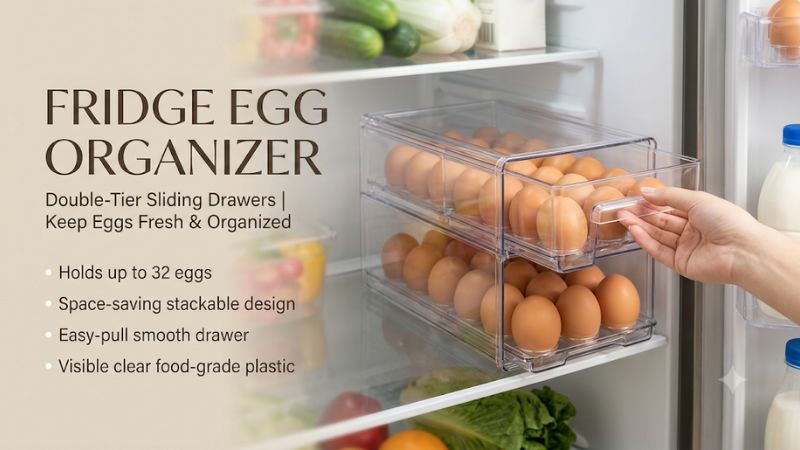
A fridge egg organizer can make eggs easier to count, retrieve, and arrange on a refrigerator shelf. Popular designs include rolling dispensers, stackable trays, and covered egg bins. However, convenience does not automatically improve food safety. This guide compares six identifiable products, explains their practical advantages, and shows when keeping eggs in their original carton is the better option.
Quick Verdict: Which Fridge Egg Organizer Should You Choose?
For shoppers who specifically want a dedicated egg organizer, the most useful choice depends on egg quantity, refrigerator dimensions, and how frequently eggs are used. A covered tray may suit households that want individually separated eggs, while rolling dispensers offer sequential access. Larger families may prefer a high-capacity bin, but original-carton storage remains an important food-safety consideration.
Our six selections:
- Best covered high-capacity bin: OXO Refrigerator Egg Bin With Removable Tray.
- Best for 21 individual egg positions: iDesign Fridge Binz Large Egg Holder.
- Best for compact rolling access: YouCopia FridgeView Rolling Egg Holder.
- Best for larger rolling capacity: YouCopia RollDown Egg Dispenser Double Track.
- Best for removable six-egg groups: Joseph Joseph FridgeStore Egg Storage Caddy.
- Best for a simple dozen-egg tray: mDesign Stackable Covered Egg Holder.
These are design-based buying recommendations, not rankings from firsthand testing. The products were selected for identifiable features, distinct capacity options, and practical storage differences.
Important food-safety consideration: FDA guidance recommends keeping commercially refrigerated shell eggs in their original carton, inside a refrigerator at 40°F or below, rather than in the refrigerator door. Dedicated organizers trade some of the carton’s protective and identification benefits for convenience. They are optional accessories, not a safer replacement.
Quick Comparison Table
A useful comparison should look beyond the number of eggs a container holds. The organizer’s footprint, access mechanism, protective cover, cleaning requirements, and suitability for different egg sizes determine whether it will make daily cooking easier. The following table compares documented product configurations without presenting unverified impact resistance, freshness performance, or durability measurements.
| Product | Egg Capacity | Main Design | Best For | Main Trade-Off |
|---|---|---|---|---|
| OXO Refrigerator Egg Bin With Removable Tray | Up to 20 | Covered bin with removable tray | Larger household inventory | Requires removing eggs from original cartons |
| iDesign Fridge Binz Large Egg Holder | 21 | Clear covered compartment tray | High-capacity individual slots | Long footprint and decanting |
| YouCopia FridgeView Rolling Egg Holder | 12–14 | Rolling dispenser with pull-out tray | Easy sequential access | Gravity-fed design needs suitable positioning |
| YouCopia RollDown Double Track | 24+ | Two-track rolling dispenser | Frequent egg users | Higher capacity and more exposed handling |
| Joseph Joseph FridgeStore Egg Storage Caddy | 12 | Two removable six-egg trays | Divided handling | Limited overall capacity |
| mDesign Stackable Covered Egg Holder | 12 | Clear lidded individual-slot tray | Simple dozen-egg storage | Smaller capacity and added cleaning |
Capacities reflect the identified product configurations. Egg size may affect the practical fit of a dispenser, so follow the manufacturer’s instructions when loading jumbo or unusually shaped eggs.
A larger organizer should not be purchased simply because it has more positions. Consider whether your household actually uses eggs quickly enough to justify removing and transferring several cartons.
How We Selected These Egg Organizers
The six products were selected to represent distinct storage designs rather than minor variations of one model. We considered manufacturer-described capacity, egg access, footprint, protective structure, cleaning, and refrigerator compatibility. We also evaluated how each product changes the handling of eggs compared with leaving them in their original cartons, since convenience should not be mistaken for a food-safety improvement.
Evaluation criteria:
- Product identity: Recognizable branded models.
- Capacity: Documented number of eggs.
- Access: Individual trays, rolling dispensers, or removable compartments.
- Storage protection: Whether the design includes a cover or separated slots.
- Refrigerator fit: Width, depth, and height requirements.
- Cleaning: Removable parts and manufacturer care instructions.
- Inventory control: Ability to recognize older stock.
- Safety: Maintaining appropriate refrigeration and traceability.
No products were physically tested for drop resistance, shell breakage, rolling force, or comparative freshness.
Manufacturer descriptions support the design comparisons, but they do not establish that any plastic egg organizer preserves eggs better than the original carton.
Six Fridge Egg Organizers Reviewed in Detail
The following reviews explain the practical differences between six identifiable products. Each design changes how eggs are stored and retrieved, and each has limitations that matter in real kitchens. Larger covered trays provide organized compartments, while rolling designs emphasize access. A smaller removable caddy may be convenient for certain workflows, but none of these products is necessary for safe refrigerator storage.
OXO Refrigerator Egg Bin With Removable Tray
The OXO Refrigerator Egg Bin With Removable Tray is a covered refrigerator-storage accessory designed to hold up to twenty eggs. The manufacturer describes a removable internal tray that separates eggs and rounded handles that make the bin easier to pull from a shelf. This model is particularly relevant for households that buy more than one dozen eggs but prefer a compartmentalized container instead of a gravity-fed dispenser.
Best For: Households wanting a covered, higher-capacity egg organizer.
Why We Picked It: Its documented twenty-egg capacity and removable tray provide a useful alternative to rolling dispensers.
Key Specifications:
- Capacity: Up to 20 eggs.
- Approximate dimensions: 14.8 inches deep, 5.75 inches wide, and 3 inches high.
- Design: Clear outer bin with removable egg tray.
- Access: Rounded handles.
- Storage: Stackable design.
- Cleaning: Hand washing specified by the manufacturer.
Features & Benefits:
- Individual egg positions help organize the contents.
- Clear construction makes inventory visible.
- Removable tray supports cleaning.
- Handles simplify pulling the bin forward.
- Flat upper surface may support compatible stacking.
Pros:
- More capacity than a standard dozen-egg tray.
- Covered storage.
- Removable internal component.
- Defined individual positions.
Cons:
- Long footprint may not fit shallow refrigerators.
- Eggs must be transferred out of their cartons.
- Hand-washing requirements add maintenance.
Buy If: You want a dedicated covered organizer and have a shelf deep enough for the bin.
Skip If: The original cartons already fit comfortably or you prefer to preserve carton labeling and protection.
Performance & Practical Use
The removable tray is useful because it provides defined positions rather than leaving eggs loose in a large container. It also helps during cleaning, although the tray and cover still need to be maintained.
A twenty-egg capacity can suit households using more than a dozen eggs during normal weekly cooking.
However, the container does not preserve the original carton’s information automatically. Record the relevant purchase or carton details before transferring eggs.
What Makes It Different
OXO’s product emphasizes protected compartments and removable organization rather than sequential rolling access.
For someone who prefers selecting an egg from a visible tray, this may be easier to understand than a gravity dispenser.
The main trade-off is the extra handling involved in transferring eggs and cleaning the organizer.
iDesign Fridge Binz Large Egg Holder
The iDesign Fridge Binz Large Egg Holder is a clear refrigerator tray designed for twenty-one eggs, arranged in individual compartments beneath a removable cover. Its capacity is slightly greater than the OXO covered bin, making it relevant for households that purchase multiple cartons or want to organize a larger egg inventory in one location. The container’s long footprint is an important fit consideration.
Best For: Households wanting a larger clear covered tray with individual compartments.
Why We Picked It: The twenty-one-position design is a distinctive high-capacity alternative to conventional twelve-egg organizers.
Key Specifications:
- Brand: iDesign.
- Product: Fridge Binz Large Egg Holder.
- Capacity: 21 eggs.
- Approximate dimensions: 14.57 inches long, 6.25 inches wide, and 3 inches high.
- Design: Clear covered egg bin.
- Storage: Individual egg compartments.
Features & Benefits:
- Clear walls reveal remaining eggs.
- Individual spaces organize shells.
- Covered construction provides a defined storage area.
- Rectangular footprint supports orderly shelf placement.
- High capacity reduces the need for multiple plastic trays.
Pros:
- Holds twenty-one eggs.
- Clear covered design.
- Individual compartments.
- Useful for households buying more than a dozen eggs.
Cons:
- Requires substantial shelf depth.
- Eggs lose their original-carton context unless recorded separately.
- Additional container surfaces require cleaning.
Buy If: You need a larger tray and have adequate refrigerator shelf dimensions.
Skip If: Your refrigerator is shallow or you rarely store more than one dozen eggs.
Performance & Practical Use
The compartment design keeps eggs in defined positions, reducing the likelihood that they will roll freely inside the organizer during normal handling.
However, the container should still be moved gently, and it should not be treated as impactproof.
Check whether the refrigerator door can close without contacting the bin or neighboring food packages.
What Makes It Different
The main distinction is the twenty-one-egg layout.
It suits shoppers who prefer a larger covered tray rather than a mechanical rolling dispenser.
However, purchasing a larger organizer only makes sense if the household’s egg consumption justifies the additional footprint and transfer effort.
YouCopia FridgeView Rolling Egg Holder
The YouCopia FridgeView Rolling Egg Holder is a gravity-fed refrigerator dispenser designed to hold approximately twelve to fourteen eggs, depending on size. The manufacturer describes a removable tray for loading and a mechanism that lets remaining eggs roll gently toward the front after one is removed. Its clear construction makes the inventory visible, while the compact format suits households prioritizing front access.
Best For: Everyday cooks who want rolling egg access without a large multi-track dispenser.
Why We Picked It: Its identifiable rolling design differs from covered compartment trays and offers a distinct retrieval method.
Key Specifications:
- Capacity: Approximately 12–14 eggs.
- Approximate dimensions: 14.7 inches deep, 6.3 inches wide, and 3.3 inches high.
- Design: Gravity-fed rolling organizer.
- Loading: Pull-out tray.
- Construction: Manufacturer-described BPA-free polymer.
- Use: Flat refrigerator shelf.
Features & Benefits:
- Eggs move toward the front after removal.
- Pull-out tray supports refilling.
- Clear construction provides inventory visibility.
- Stackable upper structure can help organize compatible items.
- No cabinet mounting is required.
Pros:
- Convenient front access.
- Relatively compact footprint.
- Removable loading tray.
- Easy visual inventory.
Cons:
- Requires sufficient refrigerator depth.
- Adds rolling movement to fragile eggs.
- Reloading and cleaning require extra handling.
- Does not retain original-carton information.
Buy If: You want sequential access and can position the dispenser on a suitable stable shelf.
Skip If: You prefer stationary individual compartments or want to keep eggs in original packaging.
Performance & Practical Use
Gravity-fed storage can reduce the need to reach toward the back of the refrigerator, especially when the shelf is deep.
However, eggs are fragile and must be loaded according to the manufacturer’s instructions.
Avoid forcing oversized eggs into the track or using the dispenser on a sloping shelf.
What Makes It Different
The FridgeView uses a rolling arrangement and removable loading tray rather than a simple covered grid.
Its convenience is most apparent in households that use eggs regularly and value front-of-shelf retrieval.
The main limitation is that it introduces more movement and handling than leaving eggs stationary in a carton.
YouCopia RollDown Egg Dispenser Double Track
The YouCopia RollDown Egg Dispenser Double Track is a higher-capacity gravity-fed system designed to hold twenty-four or more eggs, depending on size and configuration. It uses two tracks to move eggs toward accessible front positions. This is particularly relevant for larger households that cook with eggs frequently and want to reduce the number of separate organizers occupying refrigerator shelves.
Best For: Households with high egg consumption and sufficient refrigerator depth.
Why We Picked It: Its double-track design offers substantially more capacity than small rolling organizers.
Key Specifications:
- Brand: YouCopia.
- Product: RollDown Egg Dispenser Double Track.
- Capacity: 24 or more eggs, as described by the manufacturer.
- Approximate dimensions: 14.2 inches deep, 6.6 inches wide, and 4.2 inches high.
- Design: Two gravity-fed tracks.
- Installation: Freestanding refrigerator placement.
Features & Benefits:
- Two dispensing tracks increase capacity.
- Front access reduces deep reaching.
- Narrow arrangement can help organize larger quantities.
- Clear structure makes the contents easier to monitor.
- No permanent refrigerator modification is required.
Pros:
- Higher rolling capacity.
- Compact width relative to the egg count.
- Convenient front retrieval.
- One defined place for a larger inventory.
Cons:
- Requires careful loading.
- More exposed handling than original cartons.
- Larger quantities create rotation-management challenges.
- May be excessive for households with low egg consumption.
Buy If: Your household regularly uses two dozen or more eggs and you accept the additional handling requirements.
Skip If: You buy only one carton at a time or prefer stationary storage.
Performance & Practical Use
The double-track design can be convenient for households preparing breakfast frequently or using eggs in baking.
However, high capacity introduces inventory-management concerns. If older eggs remain in one track while fresh eggs are loaded into another, the dispenser does not automatically guarantee that older eggs are used first.
Keep purchase and carton information recorded, and establish a consistent loading routine.
What Makes It Different
This model is designed around higher-volume sequential dispensing rather than protected individual compartments.
It can make a large inventory more accessible, but the added convenience should be weighed against the FDA’s original-carton storage recommendation.
Joseph Joseph FridgeStore Egg Storage Caddy
The Joseph Joseph FridgeStore Egg Storage Caddy uses two removable trays, each designed to hold six eggs. The combined twelve-egg capacity makes it suitable for households that want a simple way to move smaller groups of eggs within the refrigerator. The trays include carry handles, and the compact design differs from the long covered bins and gravity-fed dispensers discussed above.
Best For: Small households and cooks who prefer separate six-egg groups.
Why We Picked It: Two removable six-egg trays offer a different access pattern from conventional covered grids.
Key Specifications:
- Brand: Joseph Joseph.
- Product: FridgeStore Egg Storage Caddy.
- Capacity: 12 eggs total.
- Configuration: Two six-egg trays.
- Features: Carry handles.
- Material: Polymer construction.
- Use: Refrigerator storage.
Features & Benefits:
- Two trays allow separate handling.
- Clear organization makes remaining eggs visible.
- Carry handles simplify movement.
- Compact configuration suits smaller inventories.
- Defined positions keep eggs separated during ordinary storage.
Pros:
- Removable six-egg groups.
- Straightforward design.
- Useful for small households.
- No permanent installation.
Cons:
- Limited to twelve eggs.
- Eggs must be transferred from cartons.
- Multiple pieces require cleaning.
- Not intended for large bulk egg inventories.
Buy If: You use modest amounts of eggs and prefer removable smaller trays.
Skip If: You need twenty or more egg positions or want a completely covered organizer.
Performance & Practical Use
The ability to remove one six-egg tray may be useful when preparing recipes that require several eggs, but the product should not be used as an excuse to leave eggs at room temperature for extended periods.
Return unused eggs to safe refrigeration promptly.
The trays need gentle handling to protect shells, particularly when being carried.
What Makes It Different
The FridgeStore emphasizes portability and compartment grouping rather than maximum capacity.
Its two-tray configuration can help keep a smaller collection tidy, but it does not provide the same protective packaging information as the original carton.
mDesign Stackable Covered Egg Holder
The mDesign Stackable Covered Egg Holder is a clear refrigerator organizer designed around twelve individual egg positions. Identifiable retail configurations include a removable lid, carrying handle, and stackable shape. It serves buyers who want a straightforward covered dozen-egg container rather than a larger tray or moving dispenser.
Best For: Small households seeking a simple covered twelve-egg organizer.
Why We Picked It: The familiar tray-and-lid construction provides a basic alternative without rolling components.
Key Specifications:
- Brand: mDesign.
- Product: Stackable Covered Egg Holder.
- Capacity: 12 eggs.
- Design: Clear individual-slot tray.
- Accessories: Lid and handle.
- Configurations: Single trays and multipacks are marketed.
- Storage: Stackable format.
Features & Benefits:
- Individual egg positions.
- Clear cover improves visibility.
- Handle helps remove the bin.
- Stackable shape can support compatible storage arrangements.
- Simple construction without a rolling track.
Pros:
- Straightforward operation.
- Clear covered tray.
- Convenient dozen-egg size.
- Available in multipack configurations.
Cons:
- Limited single-tray capacity.
- Requires cleaning after transfer.
- Stackable arrangements need careful loading.
- Original-carton information must be preserved separately.
Buy If: You want a simple removable twelve-egg container.
Skip If: You prefer original-carton storage or need larger capacity in one unit.
Performance & Practical Use
The covered tray can make a dozen eggs easy to identify and organize, particularly when the refrigerator contains numerous other food packages.
However, stacking requires caution. Confirm the exact product’s intended use and avoid placing excessive weight on a lid.
Check that eggs do not contact the cover when closed.
What Makes It Different
This product provides a basic covered egg-storage format without a specialized dispensing mechanism.
That simplicity may appeal to buyers who dislike rolling accessories.
Its usefulness still depends on cabinet fit, cleaning habits, and whether the convenience of decanting outweighs leaving eggs in their original cartons.
Buying Guide: What Matters Most in an Egg Organizer?
A refrigerator egg organizer should be evaluated for more than appearance and capacity. Eggs are fragile, require safe refrigeration, and are sold with packaging that provides useful identification and handling information. Choosing a dedicated container introduces additional handling and cleaning. Buyers should understand those trade-offs before selecting a covered tray, dispenser, or removable caddy.
Capacity and Refrigerator Footprint
Egg organizers commonly provide capacities ranging from a dozen eggs to two dozen or more. A high-capacity organizer can be useful for frequent baking or family breakfasts, but the refrigerator must have enough room for the full container and comfortable access.
Measure:
- Shelf width.
- Usable depth.
- Vertical clearance.
- Door-bin interference.
- Handle clearance.
- Space for removing the container.
- Room around refrigerator vents.
A narrow dispenser may still be too deep for a compact refrigerator.
A covered tray may fit on a shelf but become difficult to remove when heavy products are stacked above it.
Select capacity according to actual consumption.
Covered Trays Versus Rolling Dispensers
Covered trays provide individual positions, while rolling dispensers emphasize access to eggs at the front.
Covered tray advantages:
- Defined compartments.
- Simple stationary storage.
- Clear inventory.
- Less internal movement.
Covered tray limitations:
- Requires reaching into or removing the container.
- May use more shelf area.
- Needs cleaning and drying.
Rolling dispenser advantages:
- Sequential front access.
- Convenient in deep refrigerators.
- Can organize larger quantities in narrow spaces.
Rolling dispenser limitations:
- Additional egg movement.
- Careful loading required.
- Inventory dates can become mixed.
- Does not provide original-carton protection.
Neither design is inherently safer or proven to preserve egg quality better than the original carton.
Food Safety and Original-Carton Storage
Commercially refrigerated shell eggs in the United States should remain refrigerated at 40°F or below. FDA guidance recommends leaving them in their original carton and storing them inside the refrigerator rather than in the door.
Reasons to retain original packaging:
- Identification of the purchase and packing information.
- Easier reference to dates and other labels.
- Less unnecessary transfer.
- Protection from handling and potential breakage.
- Simpler rotation of separate purchases.
If a dedicated organizer is used despite these advantages, keep carton information available and avoid mixing eggs from different purchases without a reliable identification system.
Do not wash commercially processed shell eggs before placing them into refrigerator storage.
Cleaning and Material Suitability
Egg containers can become contaminated when shells crack or leak. An organizer should have removable or accessible surfaces that can be washed according to manufacturer instructions.
Cleaning priorities:
- Remove cracked or leaking eggs.
- Clean affected compartments promptly.
- Wash with appropriate cleaning products.
- Follow hand-wash or dishwasher instructions.
- Dry completely before refilling.
- Keep raw egg residue away from ready-to-eat foods.
A transparent container may make residue easier to see, but it still requires regular inspection.
Avoid assuming that all clear plastic egg holders tolerate high-temperature dishwasher cycles.
Frequently Asked Questions
Egg organizers raise questions about safety, freshness, refrigeration, and whether they provide meaningful advantages over ordinary grocery cartons. The key distinction is between storage convenience and safe food handling. A dedicated tray can simplify access, but it should not be marketed as a substitute for refrigeration, proper handling, or the information supplied with the original egg carton.
Are Plastic Egg Organizers Better Than Original Cartons?
Not necessarily. Plastic organizers may improve visual organization and access, but FDA guidance recommends original-carton storage for commercially refrigerated shell eggs. Cartons also preserve useful identification information and reduce unnecessary handling. Choose a dedicated organizer only when its convenience genuinely matters to your household, and do not assume it extends freshness or improves safety.
Should Eggs Be Stored in the Refrigerator Door?
No. FDA consumer guidance recommends keeping eggs inside the refrigerator rather than in the door, where temperature conditions can be less consistent. Maintain a refrigerator temperature of 40°F or below. Place eggs in an appropriate interior storage area away from situations that could cause breakage or contamination.
Do Rolling Egg Dispensers Damage Eggs?
A properly designed dispenser is intended to move eggs through a controlled track, but that does not guarantee that shells cannot crack. Load eggs according to manufacturer instructions, avoid forcing oversized eggs into the mechanism, and keep the organizer level. Inspect shells before cooking and discard eggs with concerning damage or contamination.
Can I Mix Eggs From Different Cartons?
Mixing purchases makes age and identification more difficult to track. Keeping eggs in their original cartons is simpler and aligns with FDA recommendations. If you transfer them, retain the relevant packaging information and use a clear rotation system. Do not rely on a rolling dispenser alone to ensure older eggs are always used first.
How Often Should an Egg Organizer Be Cleaned?
Clean it whenever an egg breaks or residue appears, and inspect it before refilling. Follow the manufacturer’s cleaning instructions, particularly for products that require hand washing. Dry the container completely before returning it to the refrigerator. Keep egg residue separate from ready-to-eat foods and wash hands after handling raw eggs.
Conclusion
The best fridge egg organizer depends on the number of eggs your household uses and whether convenience justifies transferring them from their cartons. OXO and iDesign offer covered higher-capacity trays, YouCopia provides rolling dispensers, Joseph Joseph offers removable six-egg groups, and mDesign provides a straightforward dozen-egg tray. Measure the refrigerator carefully and prioritize easy cleaning and gentle handling. For food safety and traceability, keeping commercially refrigerated eggs in their original cartons remains the recommended default.








Write Your Review
No reviews yet. Be the first to share your experience!