
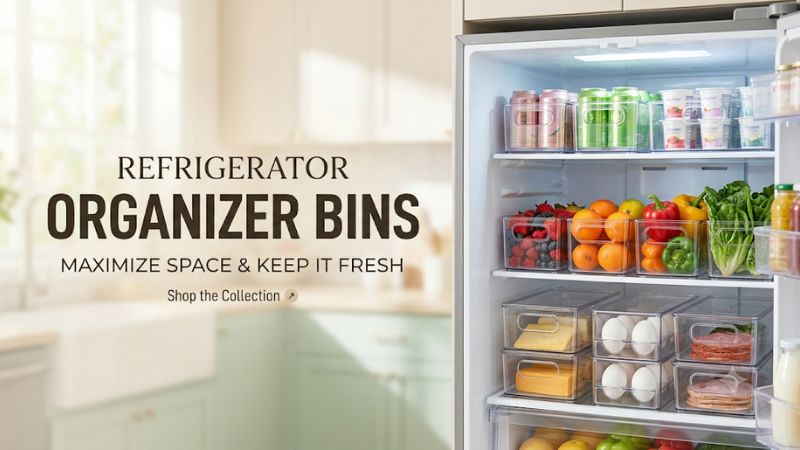
The right refrigerator organizer bins make everyday foods easier to find without blocking cold-air circulation or overcrowding shelves. Clear containers, adjustable dividers, rolling caddies, and produce keepers can serve different needs. This guide compares six practical products and explains how to organize snacks, bottles, fresh produce, and meal-prep ingredients safely.
- Quick Verdict: Which Refrigerator Organizer Bins Are Best?
- Quick Comparison Table
- How We Selected These Refrigerator Organizers
- Detailed Reviews of Six Refrigerator Organizer Bins
- Buying Guide: What Matters When Choosing Refrigerator Organizer Bins
- Food Safety Rules That Matter More Than Organization
- Practical Refrigerator Organization Setups
- Common Refrigerator Organization Mistakes
- Frequently Asked Questions
- Conclusion
Quick Verdict: Which Refrigerator Organizer Bins Are Best?
A well-organized refrigerator should make food easier to see, reach, and use before it spoils. However, the most attractive storage arrangement is not always the most practical. Oversized bins can block airflow, stackable drawers may reduce access to shelves, and produce containers have different ventilation requirements from ordinary food-storage baskets. The best products should fit your refrigerator’s dimensions and support safe, convenient handling.
Our six recommended options:
- Best general-purpose clear bin: OXO Good Grips Refrigerator Storage Bin, 8 × 14 Inches.
- Best for changing storage needs: OXO Good Grips Adjustable Refrigerator Storage Bin.
- Best rolling fridge caddy: YouCopia RollOut Fridge Caddy, 6-Inch.
- Best for pantry-style organization: iDesign Kitchen Binz Stackable Organizer.
- Best dedicated produce container: Rubbermaid FreshWorks Produce Saver, Large Rectangle.
- Best drawer-style set: Sorbus Clear Stackable Refrigerator Storage Drawers.
The OXO 8-by-14-inch storage bin is a straightforward option for grouping related products on a refrigerator shelf. Its clear walls allow food to remain visible, while the smooth base makes it convenient to slide forward.
The adjustable OXO container offers more flexibility when storage needs change throughout the week.
YouCopia’s RollOut fridge caddy is particularly useful for deep shelves because its wheels and handle help bring items toward the front.
The iDesign organizer suits households that want a consistent bin system, while Rubbermaid FreshWorks addresses the specific storage needs of suitable fresh produce.
Sorbus drawers provide a different form of access for households that want stackable compartments.
No organizer makes an overfilled refrigerator safer. Food temperature, airflow, separation, and timely use remain essential.
Quick Comparison Table
Refrigerator organizers should be compared by storage purpose, access mechanism, dimensions, and cleaning requirements rather than appearance alone. A simple open bin is useful for packaged snacks, while a produce keeper includes features intended for particular fruits and vegetables. Sliding and stackable designs can improve accessibility but also consume space that a basic clear bin would leave open.
| Product | Best For | Design | Main Advantage | Main Limitation |
|---|---|---|---|---|
| OXO Refrigerator Storage Bin, 8 × 14 | General groceries | Clear open bin | Easy visibility and access | Fixed footprint |
| OXO Adjustable Refrigerator Storage Bin | Mixed food categories | Removable divider | Flexible sections | Divider reduces some usable space |
| YouCopia RollOut Fridge Caddy, 6-Inch | Deep shelves | Wheeled caddy | Brings rear items forward | Needs clearance for rolling |
| iDesign Kitchen Binz Stackable Organizer | Packaged foods and bottles | Stackable clear bin | Simple coordinated organization | Stackability depends on product and loading |
| Rubbermaid FreshWorks Produce Saver | Suitable fresh produce | Vented produce container | Designed for produce storage | More specialized than an open bin |
| Sorbus Clear Stackable Storage Drawers | Small grouped foods | Stackable drawer format | Separate sliding compartments | Requires height and extension clearance |
These products address different storage problems. An open bin can help organize yogurt cups and snack packages, but it does not necessarily provide the humidity control appropriate for certain vegetables.
A dedicated produce keeper may be useful for leafy greens while offering little benefit for bottled drinks.
Select each organizer for the food category it will actually hold.
How We Selected These Refrigerator Organizers
Our recommendations focus on identifiable products and their documented storage designs. We considered how the containers fit refrigerator shelves, allow access to food, support visibility, and accommodate ordinary cleaning. We also evaluated the difference between basic organizers and specialized produce-storage products. These are editorial comparisons, not claims of independent laboratory testing or measured improvements in food shelf life.
Selection criteria
- Dimensions: Compatibility with usable refrigerator depth and height.
- Visibility: Ease of finding food without removing several containers.
- Access: Handles, smooth bases, drawers, and rolling systems.
- Organization: Open compartments, adjustable dividers, or specialized produce storage.
- Cleaning: Removable components and accessible interiors.
- Material suitability: Manufacturer-intended refrigerator use.
- Airflow: Avoiding unnecessary obstruction of vents.
- Food safety: Supporting separation of raw and ready-to-eat foods.
- Versatility: Ability to accommodate changes in groceries and meal prep.
We intentionally included different storage formats instead of six nearly identical transparent boxes.
A refrigerator with deep shelves benefits from a different solution than one with shallow shelves and many small packaged products.
The ideal organizer should make food easier to use without reducing the refrigerator’s ability to maintain safe temperatures.
Detailed Reviews of Six Refrigerator Organizer Bins
The following products cover simple open bins, adjustable containers, rolling caddies, stackable organization, specialized produce storage, and pull-out drawer systems. Each review examines intended applications, relevant features, realistic benefits, and limitations that can affect whether the organizer is useful in a particular refrigerator. Exact model dimensions and care instructions should be verified before ordering.
OXO Good Grips Refrigerator Storage Bin, 8 × 14 Inches
The OXO Good Grips Refrigerator Storage Bin in the 8-by-14-inch configuration is a clear organizer intended for grouping refrigerated items on shelves. Its open design allows products to remain visible and accessible, while the smooth base helps users slide the bin forward when retrieving items. It is especially practical for organizing packaged snacks, condiments, and everyday groceries in refrigerators with adequate shelf depth.
Best For
- General refrigerator organization.
- Yogurt cups.
- Packaged snacks.
- Condiments.
- Small beverages.
- Meal-prep ingredients in their own containers.
Key Specifications
- Brand: OXO Good Grips.
- Product: Refrigerator Storage Bin.
- Selected nominal size: 8 × 14 inches.
- Material: Clear plastic.
- Design: Open storage bin.
- Base: Smooth sliding construction.
- Intended location: Refrigerator shelf.
Why We Picked It
Simple clear bins solve one of the most common refrigerator problems: small products scattered across a deep shelf.
Grouping them into one container makes the category easier to identify and can reduce the need to move unrelated groceries.
Features and Practical Performance
Use the bin for a defined category such as yogurt, snacks, or sealed condiment containers.
A useful arrangement is to place recently purchased items behind older compatible products so the older items remain easier to reach.
The clear sides help identify what is inside without removing the entire bin.
However, the 14-inch nominal depth requires enough usable shelf space.
A refrigerator may have a deep-looking shelf but still include rear ventilation areas or a protruding door compartment that reduces actual clearance.
Do not place the bin directly against a vent or block the door from closing.
Because this is an open organizer, it does not replace sealed food-storage containers for leftovers or raw ingredients.
Pros
- Clear visibility.
- Simple open design.
- Smooth sliding base.
- Useful for multiple grocery categories.
- Easy to rearrange.
Cons
- Fixed footprint.
- Occupies a defined section of shelf space.
- Does not provide sealed food storage.
Buy If
You need a straightforward transparent bin for grouping everyday refrigerated groceries.
Skip If
Your refrigerator is too shallow for the selected size or you need a lidded container for food storage.
OXO Good Grips Adjustable Refrigerator Storage Bin
The OXO Good Grips Adjustable Refrigerator Storage Bin includes a removable divider that allows the interior arrangement to change according to the stored items. Its clear construction and rounded handles make it useful for grouping foods that vary in size throughout the week. This is particularly relevant to households where the refrigerator alternates between meal-prep ingredients, snacks, and packaged groceries.
Best For
- Changing grocery categories.
- Mixed-size packages.
- Small snacks and condiments.
- Shared family refrigerators.
- Flexible meal-prep organization.
Key Specifications
- Brand: OXO Good Grips.
- Product: Adjustable Refrigerator Storage Bin.
- Material: Clear plastic.
- Internal organization: Removable divider.
- Handles: Rounded grip design.
- Intended application: Refrigerator storage.
- Configuration: Adjustable internal sections.
Why We Picked It
Fixed compartments can become inconvenient when grocery purchases change.
The removable divider allows the bin to accommodate different combinations of items without requiring another organizer.
This flexibility can be useful for families whose refrigerator contents vary between weekdays and weekends.
Features and Practical Performance
A divided arrangement might hold individual yogurt cups on one side and small sealed snack containers on the other.
When a larger food package needs storage, remove the divider to create one open compartment.
The handles help when lifting the bin for cleaning or rearranging.
However, an adjustable divider does not make the container suitable for every food.
Raw meat, poultry, or seafood should remain securely contained and separated from ready-to-eat products according to food-safety guidance.
Do not use the divider as a substitute for leakproof packaging.
The organizer should also be cleaned after spills and dried before being returned to the refrigerator.
Pros
- Removable divider.
- Flexible arrangement.
- Clear visibility.
- Rounded handles.
- Useful for changing storage needs.
Cons
- Divider occupies some interior space.
- Not a substitute for sealed food containers.
- Exact dimensions must be checked.
Buy If
You want one refrigerator bin that can adapt to different groceries rather than maintaining a fixed layout.
Skip If
You only need a simple open tray or require specialized produce storage.
YouCopia RollOut Fridge Caddy, 6-Inch
The YouCopia RollOut Fridge Caddy is a narrow wheeled organizer designed to make items at the back of refrigerator shelves easier to access. Its six-inch-wide format, adjustable dividers, and front handle provide an alternative to ordinary bins that must be lifted out. The caddy is particularly useful for deep shelves containing packaged foods, small bottles, and everyday refrigerated supplies.
Best For
- Deep refrigerator shelves.
- Narrow storage areas.
- Packaged snacks.
- Small bottles.
- Families seeking easier access to rear items.
Key Specifications
- Brand: YouCopia.
- Product: RollOut Fridge Caddy.
- Selected width: 6 inches.
- Approximate depth: 15 inches.
- Movement: Rear wheels.
- Access: Front handle.
- Organization: Adjustable dividers.
- Cleaning: Hand wash with mild soap; not dishwasher-safe.
Why We Picked It
Deep refrigerator shelves can hide groceries behind other products, increasing the likelihood that food will be forgotten.
A rolling caddy changes the retrieval process by bringing the contents forward.
This can be especially useful for short packages that are difficult to see behind taller bottles.
Features and Practical Performance
Position the caddy on a stable shelf and use its dividers to separate small packaged foods.
To access rear items, lift slightly using the front handle so the rear wheels can roll the container forward as intended.
The mechanism differs from a full four-wheel drawer.
It should not be forced across uneven shelf edges or overloaded with heavy containers.
Measure the usable shelf depth carefully. A fifteen-inch caddy may not fit in some compact refrigerators.
The product’s handwashing requirement also matters because refrigerator organizers are frequently exposed to sticky spills.
Avoid placing it in the dishwasher unless the manufacturer’s exact care instructions change.
Pros
- Improves rear-shelf access.
- Narrow six-inch format.
- Adjustable dividers.
- Clear construction.
- Convenient front handle.
Cons
- Requires adequate shelf depth.
- Rolling action depends on correct handling.
- Not dishwasher-safe.
- Less suitable for very heavy items.
Buy If
You have deep refrigerator shelves and often forget products stored behind other groceries.
Skip If
Your shelves are shallow or you prefer simple bins without wheels.
iDesign Kitchen Binz Stackable Organizer
The iDesign Kitchen Binz Stackable Organizer is a clear storage bin intended for keeping household and kitchen items grouped. Refrigerator-compatible configurations can organize packaged foods, condiments, and small groceries while making their contents visible. Some versions are designed to stack, offering an alternative to leaving small products scattered across a refrigerator shelf.
Best For
- Packaged snacks.
- Small bottles.
- Yogurt and dairy packages.
- Grouped refrigerator supplies.
- Households wanting matching clear bins.
Key Specifications
- Brand: iDesign.
- Product family: Kitchen Binz.
- Product type: Clear stackable organizer.
- Selected example dimensions: Approximately 8 × 6 × 14.5 inches for one published configuration.
- Construction: Clear plastic.
- Intended use: Kitchen and compatible refrigerator organization.
- Variants: Multiple sizes and configurations.
Why We Picked It
The Kitchen Binz family provides a straightforward way to group foods by category while keeping labels and package contents visible.
Matching transparent bins can help create a consistent layout when several refrigerator shelves need organization.
Features and Practical Performance
A practical use is to keep sealed snack packages together or create a breakfast section containing compatible packaged items.
Transparent walls make it easier to check inventory before shopping.
When using stackable configurations, confirm the exact manufacturer’s stacking instructions and whether the stored contents allow safe access.
Do not stack containers in a way that blocks refrigerator airflow or creates an unstable arrangement.
A large bin can also make it harder to retrieve items if the refrigerator shelf is too shallow.
Care instructions vary by iDesign product family, so check the selected configuration before using a dishwasher.
Pros
- Clear visibility.
- Suitable for grouping products.
- Multiple size options.
- Can support coordinated organization.
- Useful for packaged foods.
Cons
- Exact variant matters.
- Stacking may restrict access.
- Larger bins can consume substantial shelf space.
Buy If
You want clear matching storage bins to organize multiple categories of packaged refrigerated foods.
Skip If
You need an adjustable divider, rolling mechanism, or dedicated produce-preservation system.
Rubbermaid FreshWorks Produce Saver, Large Rectangle
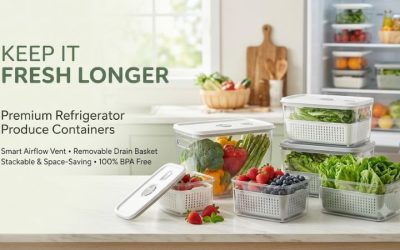
The Rubbermaid FreshWorks Produce Saver is a specialized food-storage container intended for fresh produce rather than general refrigerator organization. Its FreshVent technology regulates airflow, and the container is designed to create an environment suitable for certain fruits and vegetables. The large rectangular format is relevant to households that regularly purchase fresh produce and want a dedicated storage arrangement.
Best For
- Suitable fresh vegetables.
- Selected fruits.
- Meal-prep produce organization.
- Households buying produce regularly.
- Users wanting a dedicated produce keeper.
Key Specifications
- Brand: Rubbermaid.
- Product family: FreshWorks.
- Selected format: Large rectangular produce saver.
- Ventilation: FreshVent technology.
- Storage purpose: Fresh produce.
- Internal arrangement: Produce-oriented design.
- Important consideration: Use according to the intended produce and care instructions.
Why We Picked It
Fresh produce needs different storage conditions from sealed snacks and bottled drinks.
The FreshWorks system addresses this specific need rather than relying on an ordinary open plastic bin.
This makes it a useful specialized option within a broader refrigerator organization plan.
Features and Practical Performance
A large produce keeper can help keep compatible greens or vegetables separated from other groceries.
Rubbermaid describes FreshVent technology as regulating the flow of oxygen and carbon dioxide to support the environment inside the container.
However, this should not be treated as proof that every type of produce will remain fresh for a fixed period.
Freshness also depends on the condition of the food when purchased, refrigerator temperature, moisture, and produce type.
Follow the manufacturer’s instructions for preparing and placing produce inside the container.
Do not use the FreshWorks as a substitute for raw-meat packaging or ordinary meal-prep containers.
Pros
- Designed specifically for produce.
- Dedicated airflow technology.
- Clear storage.
- Useful for separating fresh ingredients.
- Different function from general-purpose bins.
Cons
- More specialized than an open bin.
- Not necessary for every grocery category.
- Cannot guarantee freshness for a specific period.
Buy If
You purchase suitable fresh produce regularly and want a container designed around produce storage.
Skip If
You mainly need to organize bottled drinks, snacks, or packaged leftovers.
Sorbus Clear Stackable Refrigerator Storage Drawers
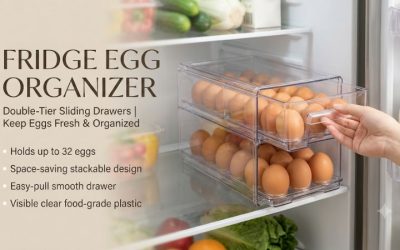
The Sorbus Clear Stackable Refrigerator Storage Drawers are intended to create separate pull-out compartments for small refrigerated items. Clear construction makes contents visible, while the drawer arrangement allows users to retrieve selected products without removing an entire stack of bins. This format can be useful when a refrigerator contains many small packaged foods that otherwise become mixed together.
Best For
- Small packaged foods.
- Snack organization.
- Yogurt cups.
- Individual refrigerated ingredients.
- Households wanting drawer-style access.
Key Specifications
- Brand: Sorbus.
- Product: Clear Stackable Storage Drawers.
- Format: Stackable drawer system.
- Material: Clear plastic.
- Selected package: Verify the exact drawer count and dimensions.
- Access: Pull-out compartments.
- Intended application: Compatible refrigerator and household storage.
Why We Picked It
Drawer-style access provides a different benefit from ordinary open bins.
When several compartments are stacked, a lower drawer can potentially be accessed without lifting all the products above it.
This can be convenient for households that use a refrigerator shelf for multiple small categories.
Features and Practical Performance
A sensible arrangement might place packaged snacks in one drawer and small sealed breakfast items in another.
Clear walls help other household members identify where products belong.
However, stackable drawers consume vertical space, and the assembled unit must fit inside the refrigerator with enough front clearance to open.
Measure the shelf height and door position before buying.
The drawers should not be packed so tightly that they cannot slide smoothly.
They should also be loaded according to the manufacturer’s supported arrangement.
Avoid placing an unstable stack near the front edge of a shelf.
Pros
- Separate pull-out compartments.
- Clear visibility.
- Stackable format.
- Useful for small categories.
- Can reduce loose items on shelves.
Cons
- Requires vertical clearance.
- Drawer extension space is necessary.
- Exact package configuration varies.
- Not suitable for every large food package.
Buy If
You want accessible compartments for small packaged foods and have enough refrigerator height for the selected drawer system.
Skip If
Your refrigerator has low shelves or you mainly store large containers and bottles.
Buying Guide: What Matters When Choosing Refrigerator Organizer Bins
A successful refrigerator organization system should improve visibility without making the appliance harder to use. Large containers can look attractive when empty but become inconvenient once filled with irregular groceries. The best arrangement respects usable shelf space, maintains cold-air circulation, separates potentially hazardous foods, and allows containers to be removed for cleaning. The following factors should guide purchases.
Measure Every Shelf Before Buying
Refrigerators have different internal dimensions, even when their overall appliance sizes are similar. Door shelves, interior lighting, temperature controls, rear vents, and crisper drawers can reduce the available space. Measure the exact location where an organizer will sit rather than estimating from the refrigerator’s exterior width or advertised capacity.
Measurements to record
- Usable shelf width.
- Usable shelf depth.
- Vertical clearance.
- Distance from rear vents.
- Door-bin interference.
- Drawer-extension space.
- Access path for removing the container.
- Height of regularly purchased food packages.
A bin that technically fits on a shelf may still block the refrigerator door from closing properly.
Likewise, a rolling caddy may need more movement space than a fixed open bin.
Measure the completed storage arrangement, not just the organizer.
Choose Different Bins for Different Food Categories
Organizing all groceries in identical containers may produce a uniform appearance, but different foods need different storage conditions. Packaged snacks benefit from clear open bins, while some vegetables need specialized produce storage. Raw animal products require secure containment and separation from foods that are ready to eat.
Useful categories
- Packaged snacks.
- Yogurt and dairy products.
- Condiments.
- Bottled drinks.
- Meal-prep containers.
- Fresh produce.
- Eggs in appropriate packaging.
- Raw foods in secure leakproof containment.
Do not use an open organizer to hold leaking raw meat packages above ready-to-eat foods.
Keep raw animal products securely wrapped or in leakproof containers and positioned to prevent drips onto other foods.
Refrigerator organization should support food safety, not merely visual neatness.
Preserve Airflow and Safe Refrigerator Temperature
Refrigerators rely on cold-air circulation to maintain safe storage conditions. Overloading shelves with tightly packed bins can restrict airflow and reduce cooling efficiency. The refrigerator should remain at 40°F or below for perishable foods, and a suitable refrigerator thermometer can help confirm actual temperature rather than relying only on the control dial.
Airflow checklist
- Keep vents clear.
- Avoid packing bins tightly against the rear wall.
- Do not block the temperature sensor.
- Leave room for air to circulate.
- Avoid obstructing the door seal.
- Confirm shelves remain securely supported.
- Check the appliance temperature regularly.
An organizer cannot correct an appliance that is running too warm.
Even a perfectly arranged refrigerator can allow food to spoil when temperature control is inadequate.
Consider Handles, Sliding Bases, and Wheels
Access features matter most when shelves are deep or frequently used items sit behind larger products. An open bin with a smooth base can be pulled forward, while a rolling caddy reduces some of the effort of reaching into the rear of a shelf. Handles also make it easier to remove containers for cleaning.
Compare the mechanisms
- Open bin: Simple and flexible.
- Handled bin: Convenient for removal.
- Adjustable bin: Separates changing grocery categories.
- Rolling caddy: Helps access deep shelves.
- Sliding drawer: Provides individual compartment access.
- Produce keeper: Adds specialized storage conditions.
Choose the simplest mechanism that solves the access problem.
Wheels are unnecessary in a shallow refrigerator where every item is already visible.
Understand Cleaning and Material Care
Refrigerator organizers are exposed to condensation, food residue, and occasional spills. Clear plastic makes contents visible but may show scratches or stains over time. Different products have different temperature and cleaning restrictions, so follow the manufacturer’s instructions instead of assuming every plastic bin is dishwasher-safe.
Cleaning checklist
- Remove foods before cleaning.
- Wash or wipe according to instructions.
- Clean removable dividers.
- Dry completely.
- Inspect drawers and wheels.
- Remove spills promptly.
- Check for cracked plastic.
- Clean the refrigerator shelf beneath the bin.
Do not use hot water or a dishwasher on a product that is not rated for those conditions.
A simple handwash may be the safest method for many organizers.
Food Safety Rules That Matter More Than Organization
A neat refrigerator is useful only when food remains stored under appropriate conditions. Perishable foods should generally be refrigerated at 40°F or below, and leftovers should be placed in refrigeration promptly. Raw animal products must be prevented from leaking onto ready-to-eat items. Storage bins can help create separate zones, but they do not replace food-safe packaging or temperature control.
Essential practices
- Keep the refrigerator at 40°F or below.
- Use a refrigerator thermometer.
- Refrigerate perishable foods promptly.
- Store raw meat in secure leakproof packaging.
- Keep raw-food juices away from ready-to-eat foods.
- Label leftovers with preparation dates.
- Rotate older groceries toward accessible positions.
- Avoid blocking cold-air vents.
- Remove spoiled foods promptly.
- Wash bins after leaks or contamination.
Perishable foods generally should not remain unrefrigerated for more than two hours, or one hour when the surrounding temperature is above 90°F.
When in doubt about whether food has been stored safely, follow official food-safety guidance rather than relying on how it looks or smells.
Practical Refrigerator Organization Setups
The ideal arrangement depends on household size, grocery habits, and refrigerator dimensions. A single-person apartment may need only two small bins, while a family kitchen may benefit from separate snack, dairy, and meal-prep zones. The goal is to create categories that household members can maintain without overcrowding shelves or interfering with airflow.
Setup One: Small Apartment Refrigerator
A small apartment refrigerator has limited shelf space, making oversized storage bins especially inconvenient. Begin by removing expired food and identifying the categories that repeatedly become disorganized. One narrow handled bin for snacks and another for condiments may be sufficient without consuming valuable space needed for larger food containers.
Suggested setup
- One small bin for packaged snacks.
- One container for condiments.
- A designated area for leftovers.
- Produce stored appropriately.
- Clear airflow around vents.
- Minimal unnecessary stacking.
Avoid buying a complete matching set before measuring the available space.
Setup Two: Busy Family Refrigerator
Family refrigerators often contain multiple yogurt flavors, snack packages, condiments, beverages, and ingredients for meals throughout the week. Clear bins can help establish categories that are understandable to everyone. However, the arrangement must remain accessible to the household while preserving safe storage for raw foods and perishable leftovers.
Suggested setup
- Breakfast bin.
- Snack bin.
- Condiment section.
- Meal-prep container area.
- Dedicated produce storage.
- Secure raw-food section.
- Clear labels when useful.
A flexible system should allow grocery categories to expand and contract rather than requiring every bin to remain full.
Setup Three: Weekly Meal-Prep Refrigerator
A meal-prep routine often produces several sealed containers of cooked food alongside raw ingredients for later meals. The organization system should make dates and meal categories visible while keeping the refrigerator at a safe temperature. Small open bins may group packaged ingredients, while appropriately sealed food containers should hold cooked meals.
Suggested setup
- Label prepared meals with dates.
- Keep sealed cooked food together.
- Use a separate bin for raw ingredients.
- Rotate older meals forward.
- Avoid stacking containers unsafely.
- Preserve airflow.
- Clean spills promptly.
The goal is to make prepared meals easy to identify and use safely.
Common Refrigerator Organization Mistakes
Refrigerator organizers can make storage worse when shoppers choose containers without considering shelf dimensions, airflow, or food safety. Overcrowding may hide food, obstruct vents, and make bins difficult to remove. Another common error is assuming that an ordinary open container can replace a sealed food-storage vessel for leftovers or raw ingredients.
Mistakes to avoid
- Buying bins before measuring shelves.
- Blocking rear vents.
- Using too many organizers.
- Stacking drawers beyond supported limits.
- Storing raw meat above ready-to-eat foods.
- Leaving leftovers unsealed.
- Ignoring refrigerator temperature.
- Using produce keepers for unrelated products.
- Selecting bins that interfere with the door.
- Failing to clean beneath organizers.
- Overloading rolling caddies.
- Using incompatible dishwasher cleaning methods.
- Assuming organization extends food safety indefinitely.
The best system provides visibility and accessibility while leaving enough room for safe cooling and ordinary maintenance.
Frequently Asked Questions
Refrigerator organizer bins are popular because they can make crowded shelves appear orderly, but shoppers often have questions about food safety, airflow, materials, and whether specialized containers offer meaningful benefits. The following answers explain how to choose practical storage without treating visual organization as a substitute for proper refrigeration.
Are Refrigerator Organizer Bins Worth Buying?
They can be worthwhile when small groceries become hidden, food categories are mixed together, or deep shelves make items difficult to retrieve. Clear bins help group products and can make inventory easier to check. However, a refrigerator that is already easy to use may not need additional accessories.
Choose bins according to the actual storage problem.
Avoid filling every shelf with containers simply to create a uniform appearance.
Do Refrigerator Organizer Bins Keep Food Fresh Longer?
Ordinary open organizer bins primarily improve organization rather than preserve food through specialized environmental control. Dedicated produce containers may include features intended to support particular fruits and vegetables, but actual freshness depends on temperature, food condition, humidity, and proper handling.
Do not assume that every clear plastic bin extends shelf life.
Use appropriate sealed containers and food-safety practices for perishable foods.
Can Refrigerator Organizer Bins Block Airflow?
Yes. Oversized or tightly packed bins can obstruct vents or reduce the space available for cold-air circulation. This can interfere with the refrigerator’s ability to maintain consistent temperatures. The risk depends on appliance design and the placement of the containers.
Keep vents clear and avoid overcrowding.
Check the refrigerator temperature regularly using an appropriate thermometer.
Are Clear Plastic Refrigerator Bins Dishwasher-Safe?
Some products are dishwasher-safe, while others require handwashing. Cleaning instructions vary by manufacturer, material, and exact product configuration. Heat from dishwasher cycles can damage containers that are not designed for machine cleaning.
Check the selected model’s instructions.
Use the approved method and dry the bin before returning it to the refrigerator.
What Is the Best Way to Organize a Small Refrigerator?
Start by removing spoiled or unnecessary food, then group products according to frequency of use and storage needs. Use one or two appropriately sized clear bins for categories that repeatedly become disorganized. Keep leftovers sealed, maintain safe temperature, and leave room for cold-air circulation.
Avoid purchasing large storage sets before measuring the appliance.
A few useful organizers are generally better than a crowded collection of containers.
Conclusion
The best refrigerator organizer bins should improve visibility and access without compromising cold-air circulation or food safety. OXO’s clear storage bin suits general groceries, while its adjustable version provides flexible compartments. YouCopia is useful for deep shelves, iDesign offers stackable organization, Rubbermaid FreshWorks serves suitable produce, and Sorbus drawers provide separate sliding compartments. Measure the refrigerator before purchasing, keep raw foods safely contained, maintain temperatures at 40°F or below, and choose only the organizers that solve real storage problems.








Write Your Review
No reviews yet. Be the first to share your experience!