
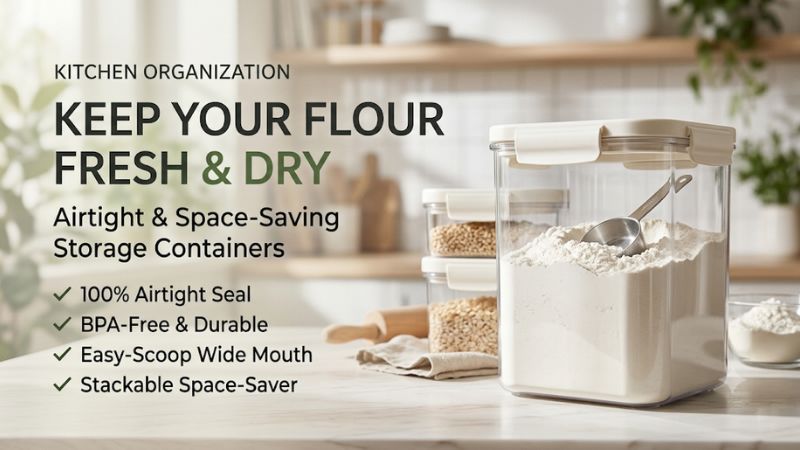
A good flour storage container does more than tidy a shelf: it gives you a dry place to keep baking ingredients, a clean opening for scooping, and a straightforward way to track supplies. These six distinct designs cover everyday flour bags, dedicated baking accessories, bulk-style tubs, glass jars, and smaller home baking routines.
Quick Verdict
Flour creates a special storage challenge because fine powder escapes around rims, settles in lid mechanisms, and can make every refill messy. The right container keeps ingredients organized and reduces exposure to humidity and pantry pests, but it must also be easy to open when your hands are covered with dough or measuring tools. Six choices below are presented by best-fit use case rather than by an invented test score. Each recommendation is based on documented product format and the practical fit of that format to common household needs.
- Best fit for common flour bags: OXO POP Big Square Medium, 4.4 Quart
- Best latch-top pantry canister: Rubbermaid Brilliance Pantry, 16 Cup
- Best baking-specific keeper: Progressive ProKeeper+ Flour
- Best modular workhorse: Cambro CamSquares Camwear, 4 Quart
- Best countertop glass option: Anchor Hocking Montana, 1.5 Gallon
- Best smaller flour-focused alternative: Prep Solutions Flour Keeper, 3.8 Quart
The OXO 4.4-quart model stands out because its maker targets a standard five-pound flour bag, while Rubbermaid provides a larger measured pantry canister with side latches. The Progressive models address the measuring workflow more directly; Cambro is a basic high-access workhorse. The Montana glass jar suits an accessible counter, but glass weight deserves serious consideration.
All-purpose flour, bread flour, whole-wheat flour, and alternative flours do not necessarily keep quality for the same length of time. Whole-grain flours contain more natural oils and can benefit from cooler storage, particularly if used infrequently. No storage container can reverse rancidity or guarantee that flour remains suitable forever.
Quick Comparison Table
A comparison table is most useful when it makes differences visible without pretending that one unit solves every pantry problem. The capacities and features below describe identified product variants; capacities stated in volume are not automatic promises about the weight of a particular ingredient or the number of unusually sized spice bottles that fit.
| Product | Best For | Key Specifications | Main Advantage | Main Trade-Off |
|---|---|---|---|---|
| OXO Good Grips POP Big Square Medium, 4.4 Quart | Everyday bakers who want to decant a standard flour bag | 4.4-quart / 4.2-liter nominal capacity | Maker sizes the container for standard flour packaging | Larger footprint than a small glass jar |
| Rubbermaid Brilliance Pantry Container, 16 Cup | Bakers who prioritize latch closure and a visible fill line | 16-cup capacity | Clear body and firm, recognizable latch closure | Check shelf height carefully |
| Progressive ProKeeper+ Flour Storage Container | Frequent bakers who want a flour-focused container | Flour-specific ProKeeper+ model | Purpose-designed for flour access and baking routines | Accessories and variants can differ |
| Cambro CamSquares Camwear Container, 4 Quart | Batch bakers and home cooks using commercial-style bins | 4-quart CamSquares Classic Camwear food-storage container | Wide access and standardized square form | Verify lid compatibility and inclusion |
| Anchor Hocking Montana Jar with Gasketed Metal Lid, 1.5 Gallon | Countertop-focused bakers who prefer glass construction | Montana glass canister family | Clear glass visibility with an established canister design | Heavy and breakable compared with plastic |
| Prep Solutions by Progressive Flour Keeper, 3.8 Quart | Occasional bakers seeking a simpler flour-specific keeper | 3.8-quart capacity shown for Prep Solutions flour keeper | Flour-oriented lid and measuring workflow | May not fit every standard bag without leftover flour |
The OXO 4.4-quart model stands out because its maker targets a standard five-pound flour bag, while Rubbermaid provides a larger measured pantry canister with side latches. The Progressive models address the measuring workflow more directly; Cambro is a basic high-access workhorse. The Montana glass jar suits an accessible counter, but glass weight deserves serious consideration.
How We Selected These Products
These recommendations use verifiable model identities, published product descriptions, and ordinary considerations involved in daily kitchen storage. They are editorial matches to buyer needs, not the result of our own laboratory, durability, leakproof, or cooking tests. When a size or accessory varies by market, the article identifies that uncertainty rather than inventing a universal specification.
- Verified format: products must be real storage models intended for food or specifically flour.
- Opening and scoop access: assess whether a cup or scoop can reach in without spilling.
- Complete-bag fit: prioritize manufacturer bag-fit guidance instead of converting dry pounds to quarts casually.
- Lid maintenance: fine flour can collect in hinges, gaskets, and button mechanisms.
- Daily usability: compare countertop weight, cabinet height, refilling effort, and label visibility.
Flour creates a special storage challenge because fine powder escapes around rims, settles in lid mechanisms, and can make every refill messy. The right container keeps ingredients organized and reduces exposure to humidity and pantry pests, but it must also be easy to open when your hands are covered with dough or measuring tools.
The shortlist deliberately includes different storage formats. A range of formats is more helpful than filling the page with nearly identical sizes of one model, because the main decision is often how the storage works in your home, not which logo appears on the lid. Manufacturer descriptions are treated as descriptions of design, not as independently measured performance.
Detailed Product Recommendations
Below, each recommendation covers the exact product family or model, its intended buyer, the meaningful advantages of its storage design, and the important limitations that a product listing might not emphasize. Read the trade-off as carefully as the headline feature; a container or rack that does not fit your space is not a good purchase regardless of its stated capacity.
The recommendations are ordered to move from straightforward everyday organization to more specialized storage arrangements. They do not imply that the first product has been independently proved superior to the last. Use the comparison table together with the practical examples below.
OXO Good Grips POP Big Square Medium, 4.4 Quart
OXO Good Grips POP Big Square Medium, 4.4 Quart is most relevant for everyday bakers who want to decant a standard flour bag. The combination of a broad opening and square footprint helps when leveling flour in a measuring cup or reaching in with a scoop. OXO also offers compatible accessories, though the exact set contents must be checked rather than assumed. The clear body makes it obvious when a recipe will empty the remaining supply. Its suitability rests on the documented product format and how that format changes routine storage, not on an invented claim that it outperformed other products in detailed research.
Why we picked it. The maker expressly presents this volume as appropriate for a standard 5-pound flour bag, which solves a real purchase decision that simple quart measurements do not. It earns a strong recommendation where cabinet space is planned around common U.S. grocery packaging.
Features and practical use. Before decanting, wash and completely dry the container and lid according to the maker’s care instructions. Label the flour type, purchase date, and any expiration or best-by information. Do not pour fresh flour onto a thin residue of old flour without periodically emptying and washing the bin; rotation is easiest when the container is nearly empty.
Important limitation. Five-pound bag fit depends on ingredient density and how the flour settles, and a push-button lid should not be treated as permission to store flour near heat or moisture. The container may be larger than necessary for specialty flours bought in one-pound packages.
Key specifications
- 4.4-quart / 4.2-liter nominal capacity
- Square stackable body
- Push-button lid
- OXO says this size is designed around a typical 5-pound flour bag
Pros
- Maker sizes the container for standard flour packaging
- Wide opening and stackable shape
Cons
- Larger footprint than a small glass jar
- Not designed for precision measuring by itself
Best for and decision summary
- Best for: Everyday bakers who want to decant a standard flour bag
- Buy if: You purchase five-pound bags and bake most weeks
- Skip if: You need a narrow container for a crowded door shelf
What to verify before ordering. Compare the full usable footprint with the exact placement you have in mind. Check the product variant, care instructions, and any accessories or mounting hardware, because a similar product photo is not reliable proof that the item will meet your specific needs.
Rubbermaid Brilliance Pantry Container, 16 Cup
Rubbermaid Brilliance Pantry Container, 16 Cup is most relevant for bakers who prioritize latch closure and a visible fill line. Unlike a tall narrow cereal dispenser, the Brilliance pantry container makes it easy to remove a portion with a scoop when the opening is accessible. The clear walls make flour type and remaining quantity visible; a separate exterior label prevents confusing all-purpose flour with bread flour or powdered sugar. Its suitability rests on the documented product format and how that format changes routine storage, not on an invented claim that it outperformed other products in detailed research.
Why we picked it. Rubbermaid explicitly lists flour among the dry goods suited to its pantry products and documents the container’s dimensions and size. The latch system is appealing to households where the container may be moved between a cabinet and the baking counter.
Features and practical use. Stand the container on a solid surface before unlocking both sides, rather than carrying it by the lid. If your measuring scoop frequently strikes the opening, choose a wider canister instead of compensating by pouring flour onto the counter. Use a kitchen scale for repeatable recipe measurements because compression changes how much flour fits in a cup.
Important limitation. The taller profile may conflict with fixed shelves. Also, 16 cups is a volume rating, not a statement that 16 recipe cups of sifted flour are always available after packing; storage volume and baking measurements serve different purposes.
Key specifications
- 16-cup capacity
- Model 1994228
- Clear plastic
- Secure side latches and sealing lid
- Documented dimensions 7.9 × 5.4 × 9.4 inches
Pros
- Clear body and firm, recognizable latch closure
- Documented capacity and dimensions
Cons
- Check shelf height carefully
- Opening geometry may not suit the widest scoops
Best for and decision summary
- Best for: Bakers who prioritize latch closure and a visible fill line
- Buy if: You value a secure lid and visible inventory for regular baking
- Skip if: You need a flour canister with a built-in leveler
What to verify before ordering. Compare the full usable footprint with the exact placement you have in mind. Check the product variant, care instructions, and any accessories or mounting hardware, because a similar product photo is not reliable proof that the item will meet your specific needs.
Progressive ProKeeper+ Flour Storage Container
Progressive ProKeeper+ Flour Storage Container is most relevant for frequent bakers who want a flour-focused container. A dedicated flour keeper is designed around the experience of scooping, leveling, and keeping one commonly used baking ingredient organized. The visible measurement marks help with approximate inventory, but should not replace weighing flour when recipe precision matters. It also lets you keep the flour bag’s information attached to a labeled surface. Its suitability rests on the documented product format and how that format changes routine storage, not on an invented claim that it outperformed other products in detailed research.
Why we picked it. Progressive identifies this as a specific Flour ProKeeper+ product, rather than a generalized food jar that happens to be usable for flour. The baking-oriented design makes more sense for a kitchen that prepares dough, cookies, or pastries several times each week.
Features and practical use. Use the marks to decide whether to add flour to your next shopping list, not to calculate recipe weights. Clean any removable accessory separately and dry the seal thoroughly. Before buying, compare the exact model details because Progressive also sells other ProKeeper, ProKeeper+, and set configurations that are easy to confuse.
Important limitation. Specialized flour-accessory conveniences can increase the number of pieces to wash and may add cost compared with a plain rectangular food container. Confirm the actual accessory package on the listing instead of assuming every bundle contains the same equipment.
Key specifications
- Flour-specific ProKeeper+ model
- Published measuring marks up to 16 cups
- The brand offers flour-storage features and a baking-focused canister design
Pros
- Purpose-designed for flour access and baking routines
- Published cup markings simplify visual inventory
Cons
- Accessories and variants can differ
- Measurements do not substitute for a kitchen scale
Best for and decision summary
- Best for: Frequent bakers who want a flour-focused container
- Buy if: You bake several times weekly and like ingredient-specific tools
- Skip if: You want the simplest possible container with no added parts
What to verify before ordering. Compare the full usable footprint with the exact placement you have in mind. Check the product variant, care instructions, and any accessories or mounting hardware, because a similar product photo is not reliable proof that the item will meet your specific needs.
Cambro CamSquares Camwear Container, 4 Quart
Cambro CamSquares Camwear Container, 4 Quart is most relevant for batch bakers and home cooks using commercial-style bins. A commercial-style square tub gives a roomy opening and a shape that is easy to place alongside other bulk ingredients. It supports a practical system: one labeled bin for all-purpose flour, another for bread flour, and a smaller one for specialty flour. The broad shape is useful when measuring directly with a scoop. Its suitability rests on the documented product format and how that format changes routine storage, not on an invented claim that it outperformed other products in detailed research.
Why we picked it. Cambro has an identified 4-quart food-storage model within its CamSquares series, a format designed for ingredient organization in professional kitchens. This appeals to home bakers more interested in cleaning access and predictable stacking than a decorative countertop canister.
Features and practical use. Buy the exact matching lid at the same time and ensure that it closes correctly. Store the tub away from the stove, dishwasher steam, and sink splash. Keep a clean utensil inside only if it can remain dry and does not prevent closure. Periodic complete emptying allows you to inspect the bottom corners for stale flour.
Important limitation. The lid setup can be less convenient than purpose-built push-button or latch-top pantry canisters, and some commercial lids are sold separately. Avoid describing a simple fitted cover as airtight unless that exact lid-and-container combination supports the claim.
Key specifications
- 4-quart CamSquares Classic Camwear food-storage container
- Square format
- Graduation markings
- Use a compatible food-storage lid selected for the model
Pros
- Wide access and standardized square form
- Practical for more than one labeled baking flour
Cons
- Verify lid compatibility and inclusion
- Utilitarian appearance may not suit counter display
Best for and decision summary
- Best for: Batch bakers and home cooks using commercial-style bins
- Buy if: You batch bake and prefer organized, workhorse containers
- Skip if: You need one-touch lid operation in a shallow cabinet
What to verify before ordering. Compare the full usable footprint with the exact placement you have in mind. Check the product variant, care instructions, and any accessories or mounting hardware, because a similar product photo is not reliable proof that the item will meet your specific needs.
Anchor Hocking Montana Jar with Gasketed Metal Lid, 1.5 Gallon
Anchor Hocking Montana Jar with Gasketed Metal Lid, 1.5 Gallon is most relevant for countertop-focused bakers who prefer glass construction. A large clear glass jar keeps flour visible on an open shelf and avoids absorbing odors into a plastic body. The weight and broad opening can be convenient when the jar remains in one fixed position, but it is a poor choice if someone must repeatedly lift it from a high cupboard. Its suitability rests on the documented product format and how that format changes routine storage, not on an invented claim that it outperformed other products in detailed research.
Why we picked it. Anchor Hocking catalogs identify a 1.5-gallon Montana model with a covered, gasketed form. It fills a distinct need: an exposed-counter flour station where visual presentation matters and the shopper is willing to accept the weight of glass.
Features and practical use. Place the jar below shoulder height and away from an edge where it could be knocked over. Verify that the chosen lid variant includes a gasket, as different Montana designs use different covers. Wipe the lip clean before resealing; trapped flour on the gasket can compromise closure. Use a dry scoop and avoid exposing glass to thermal shock.
Important limitation. Glass is heavier and breakable, and a large decorative vessel may be inconvenient to transport from pantry to work surface. The stated gallon volume does not guarantee a particular flour-bag fit; compare the actual internal shape and opening before purchase.
Key specifications
- Montana glass canister family
- 1.5-gallon jar version documented in Anchor Hocking retail catalogs
- Metal cover with gasket for the specified style
Pros
- Clear glass visibility with an established canister design
- Attractive fixed-counter baking station option
Cons
- Heavy and breakable compared with plastic
- Lid variations require care when shopping
Best for and decision summary
- Best for: Countertop-focused bakers who prefer glass construction
- Buy if: You store flour on a stable, accessible countertop
- Skip if: Children use the container frequently or shelves are high
What to verify before ordering. Compare the full usable footprint with the exact placement you have in mind. Check the product variant, care instructions, and any accessories or mounting hardware, because a similar product photo is not reliable proof that the item will meet your specific needs.
Prep Solutions by Progressive Flour Keeper, 3.8 Quart
Prep Solutions by Progressive Flour Keeper, 3.8 Quart is most relevant for occasional bakers seeking a simpler flour-specific keeper. A compact keeper with a leveling edge aims to simplify a familiar baking action: drawing a measuring cup through flour and removing the excess. Compared with a large plain tub, it is centered on the measuring workflow, especially for home cooks who prefer cup-based recipes rather than weighing every ingredient. Its suitability rests on the documented product format and how that format changes routine storage, not on an invented claim that it outperformed other products in detailed research.
Why we picked it. The named 3.8-quart Prep Solutions flour keeper is a distinct consumer product from the higher-positioned ProKeeper+ canister. It may suit a shopper who likes a baking-specific accessory but does not need a whole matching collection of dry-goods containers.
Features and practical use. Check whether the built-in leveler suits the size and shape of your measuring cup before committing. Avoid compressing flour against a rigid edge; spooning flour into the cup and leveling gently is more consistent. If a recipe states grams, use that weight instead of treating the leveling feature as a precision instrument.
Important limitation. A 3.8-quart capacity may be tight for particular five-pound bags and flour types, so check bag-fit claims rather than assuming every package fits. Retail listings sometimes group several Progressive generations together; confirm the photographed product and model.
Key specifications
- 3.8-quart capacity shown for Prep Solutions flour keeper
- Built-in leveling feature described in retail product listings
- Verify the exact current variant before purchase
Pros
- Flour-oriented lid and measuring workflow
- Smaller format than oversized bulk bins
Cons
- May not fit every standard bag without leftover flour
- Model naming overlaps with other Progressive products
Best for and decision summary
- Best for: Occasional bakers seeking a simpler flour-specific keeper
- Buy if: You bake occasionally using cup measurements and want convenient access
- Skip if: You purchase bulk bags or require an exact complete-bag fit
What to verify before ordering. Compare the full usable footprint with the exact placement you have in mind. Check the product variant, care instructions, and any accessories or mounting hardware, because a similar product photo is not reliable proof that the item will meet your specific needs.
Buying Guide: What Matters Before You Order
The first question is not which flour jar looks nicest on social media. It is whether the container holds your normal package comfortably, makes a measuring cup easy to use, and closes without leaving powder trapped in the seal. A design can be technically airtight yet still annoy its owner at every baking session. The considerations below provide a repeatable checklist that applies to the six models, and they also help assess products that are not on this shortlist. Treat the guidance as a way to make a fit-for-purpose decision, not a reason to overbuy features.
Start by measuring the location, counting your typical supply, and deciding how often you open the container or rack. The following factors explain why different homes benefit from different designs.
Bag fit, capacity, and ingredient variation
One five-pound package of flour does not necessarily occupy the same usable space as five pounds of another powder. Flour settles during shipping, is aerated when scooped, and differs by milling and ingredient type. Choose a maker-stated bag fit where possible and allow space above the flour for a scoop. This factor also changes ongoing maintenance and the amount of extra time needed in the kitchen, so it deserves attention even if a product looks attractive or has a prominent marketing claim.
A 16-cup container has an approximate internal volume rating, but that should not be misread as a guarantee of 16 measured recipe cups after compaction. If you maintain three flour types, three right-sized containers with clear labels are generally easier to rotate than one oversized container that must be cleaned between ingredients.
Practical checks
- Measure the real storage space and available access path before buying.
- Verify the exact product model, size, lid, or mounting configuration.
- Choose a setup you can inspect and clean without special effort.
Consider your future routine as well as the first day after installation or decanting. A product that solves one nuisance but creates daily handling problems is unlikely to remain useful over time.
Ease of measuring and flour dust control
A broad mouth reduces the temptation to pour flour across the counter or force a large cup into a narrow opening. If a built-in leveler is included, check whether it works with the measuring cups you own. For the best recipe repeatability, especially with bread, use a digital scale when the recipe specifies weights. This factor also changes ongoing maintenance and the amount of extra time needed in the kitchen, so it deserves attention even if a product looks attractive or has a prominent marketing claim.
Fine particles collect beneath sealing gaskets and at hinge edges. A lid that needs a complex multi-step disassembly may be less convenient for frequent use, even if it looks sophisticated. Test the opening movement with clean hands and consider whether it is equally workable when multitasking in the kitchen.
Practical checks
- Measure the real storage space and available access path before buying.
- Verify the exact product model, size, lid, or mounting configuration.
- Choose a setup you can inspect and clean without special effort.
Consider your future routine as well as the first day after installation or decanting. A product that solves one nuisance but creates daily handling problems is unlikely to remain useful over time.
Material, countertop placement, and maintenance
Glass is easy to see through and attractive on a shelf, but large glass jars become heavy when filled. Plastic bins are usually easier to lift and are less fragile, but cleaning instructions vary by exact product. Check whether a particular lid can be immersed or machine washed instead of assuming all parts share the same care rating. This factor also changes ongoing maintenance and the amount of extra time needed in the kitchen, so it deserves attention even if a product looks attractive or has a prominent marketing claim.
Keep flour in a cool, dry, dark location away from cooking steam, windows, and heat-producing appliances. Label the flour type and date, especially if you store whole-wheat flour or almond flour. Always let washed seals and corners dry completely before refilling.
Practical checks
- Measure the real storage space and available access path before buying.
- Verify the exact product model, size, lid, or mounting configuration.
- Choose a setup you can inspect and clean without special effort.
Consider your future routine as well as the first day after installation or decanting. A product that solves one nuisance but creates daily handling problems is unlikely to remain useful over time.
Food hygiene and sensible stock rotation
A clean container protects good flour; it does not make spoiled, moldy, or pest-affected flour safe. Check new packages before decanting and avoid topping off a nearly empty old batch indefinitely. Periodically empty the vessel so that you can inspect and wash every corner. This factor also changes ongoing maintenance and the amount of extra time needed in the kitchen, so it deserves attention even if a product looks attractive or has a prominent marketing claim.
If you bake around someone with an ingredient allergy, segregate flours carefully and do not assume rinsing is sufficient for managing cross-contact. Follow appropriate allergen control practices. A label that clearly identifies wheat, nut, or gluten-free ingredients is more useful than matching decorative jars.
Practical checks
- Measure the real storage space and available access path before buying.
- Verify the exact product model, size, lid, or mounting configuration.
- Choose a setup you can inspect and clean without special effort.
Consider your future routine as well as the first day after installation or decanting. A product that solves one nuisance but creates daily handling problems is unlikely to remain useful over time.
Which Setup Fits Your Household?
A useful purchase should fit a household scenario rather than an abstract product ranking. The same nominal capacity or bottle count can be convenient in one kitchen and entirely wrong in another. The examples below connect shopping frequency, available space, and daily habits to practical storage arrangements without assuming that all homes share one ideal layout.
- Someone baking occasional pancakes may prefer a smaller, quick-opening flour keeper rather than a row of huge bins.
- A household regularly purchasing five-pound bags benefits from an explicitly bag-sized canister and clear labeling.
- A bread baker who maintains several types of flour might favor multiple matching square tubs with consistent labels.
- A baker who displays ingredients on a countertop can choose glass if its weight and breakage risk are acceptable.
All-purpose flour, bread flour, whole-wheat flour, and alternative flours do not necessarily keep quality for the same length of time. Whole-grain flours contain more natural oils and can benefit from cooler storage, particularly if used infrequently. No storage container can reverse rancidity or guarantee that flour remains suitable forever.
Before you buy, perform a five-minute setup test: imagine filling the container or mounting the rack, opening it when cooking, getting the ingredient you need, closing it with one hand occupied, and cleaning it after a spill. If any step seems awkward, compare another storage format.
Frequently Asked Questions
These practical questions come up when readers try to translate a product’s specifications into everyday storage decisions. They also clarify the limits of claims such as airtight, high capacity, and space-saving. Consider the answers in the context of your own ingredient type, jar collection, cooking frequency, and the manufacturer’s exact instructions.
The answers focus on reasonable handling, compatibility, and quality rather than promises that any organizer or container works perfectly in every kitchen.
Is glass or plastic better for storing flour?
Both can work when the container is designed for food, closes reliably, and is kept in the right location. Glass is heavier and breakable but visually appealing; plastic is often lighter and easier to move. The best material is the one whose handling, sealing, and cleaning characteristics fit how you bake, not a universal winner. The useful decision is to match the storage practice to the product you actually own and the conditions in your kitchen. A product description may explain a feature but does not replace attention to cleanliness, compatibility, and realistic use.
Practical takeaway: Before purchasing, verify the exact model, its documented cleaning or installation instructions, and the dimensions available in your kitchen. General advice cannot replace these fit checks.
Does every 4-quart canister hold a five-pound flour bag?
No. Different flour densities, container geometry, and filling allowances make a direct conversion unreliable. Seek a specific five-pound bag-fit claim from the maker, or choose extra capacity if you dislike storing a leftover portion in the original package. Avoid forcing flour under a lid that cannot close cleanly. The useful decision is to match the storage practice to the product you actually own and the conditions in your kitchen. A product description may explain a feature but does not replace attention to cleanliness, compatibility, and realistic use.
Practical takeaway: Before purchasing, verify the exact model, its documented cleaning or installation instructions, and the dimensions available in your kitchen. General advice cannot replace these fit checks.
Should whole-wheat flour go in the refrigerator?
Whole-wheat flour contains more natural oils than refined white flour and can lose quality faster in warm pantry conditions. If turnover is slow, cooler storage can help. Protect the flour from condensation and refrigerator odors in a suitable sealed container, and follow the manufacturer’s storage advice for a specialty flour. The useful decision is to match the storage practice to the product you actually own and the conditions in your kitchen. A product description may explain a feature but does not replace attention to cleanliness, compatibility, and realistic use.
Practical takeaway: Before purchasing, verify the exact model, its documented cleaning or installation instructions, and the dimensions available in your kitchen. General advice cannot replace these fit checks.
Do I need to keep flour in its original packaging?
Transferring flour can simplify scooping, but keep the important information from the package: flour type, brand, best-by date, and any lot details you may need. A clipped label or handwritten card can preserve this information without keeping the whole paper bag inside a canister. The useful decision is to match the storage practice to the product you actually own and the conditions in your kitchen. A product description may explain a feature but does not replace attention to cleanliness, compatibility, and realistic use.
Practical takeaway: Before purchasing, verify the exact model, its documented cleaning or installation instructions, and the dimensions available in your kitchen. General advice cannot replace these fit checks.
How often should I clean a flour canister?
There is no single calendar interval that fits every household. Clean when switching flour types, before a major refill if residue has accumulated, after any spill, or when the container smells unusual. The important point is to let the entire container and seal dry before adding flour again. The useful decision is to match the storage practice to the product you actually own and the conditions in your kitchen. A product description may explain a feature but does not replace attention to cleanliness, compatibility, and realistic use.
Practical takeaway: Before purchasing, verify the exact model, its documented cleaning or installation instructions, and the dimensions available in your kitchen. General advice cannot replace these fit checks.
Conclusion
For most home bakers buying standard five-pound bags, the OXO POP Big Square Medium is an especially practical flour storage container because its published sizing directly addresses the usual package. Rubbermaid Brilliance adds a latch-top alternative, and Progressive’s flour keepers make sense when your measuring routine matters more than matching pantry canisters. Cambro suits organized batch baking, while Anchor Hocking glass works best on a stable, accessible counter. Choose for bag fit and everyday handling first, then maintain the seal, label each flour correctly, and rotate supplies before quality declines.

Write Your Review
No reviews yet. Be the first to share your experience!