
The best rifle safes for home security are full-height, fire-rated safes with a certified burglary-resistance rating, a reliable mechanical or electronic lock, and enough interior depth to hold your longest rifle without removing optics.
- Quick picks by buying situation
- What separates the best rifle safes from gun cabinets
- Fire ratings: useful protection, not a guarantee
- Locking systems compared
- Capacity: calculate usable space, not the label
- Installation is part of the security rating
- Durability and ownership realities
- The security trade-offs worth accepting
- Final buying checklist
Quick answer: For most people in 2026, the best rifle safes for home security is the Small budget or first safe — our #1 rated choice. See the full ranked comparison, alternatives and buying advice below.
Quick picks by buying situation
| Situation | Best choice | Why it fits | Main compromise |
|---|---|---|---|
| Small budget or first safe | Mid-size steel rifle safe with an electronic keypad | Usually holds 8–14 long guns and costs less than a premium safe | Thinner steel, less usable capacity, and often a weaker fire rating |
| Several scoped rifles | Wide safe with adjustable shelving | Interior width and door clearance matter more than the advertised gun count | Heavier and more expensive to install |
| Frequent access | UL-listed electronic lock with mechanical override or quality mechanical combination lock | Faster access than a dial lock while retaining a backup opening method | Electronic models need batteries and maintenance |
| Maximum residential security | Heavy safe with a UL Residential Security Container rating, 10–12-gauge body, and bolt protection | Better resistance to prying and forced entry than an unclassified cabinet | Often weighs 500–1,000 pounds before contents |
| Apartment or rented home | Compact safe that can be anchored to structural framing or concrete | Reduces tipping and theft-by-carrying risk without requiring a huge footprint | Fewer rifles and less fire insulation |
What separates the best rifle safes from gun cabinets
Many products marketed for firearms storage are actually thin steel cabinets. A cabinet can help keep children and unauthorized visitors away from firearms, but it may be defeated with hand tools and usually offers little meaningful fire protection. A true residential rifle safe typically has a thicker steel body, a reinforced door, multiple locking bolts, concealed or protected hinges, and a fire-resistant liner.
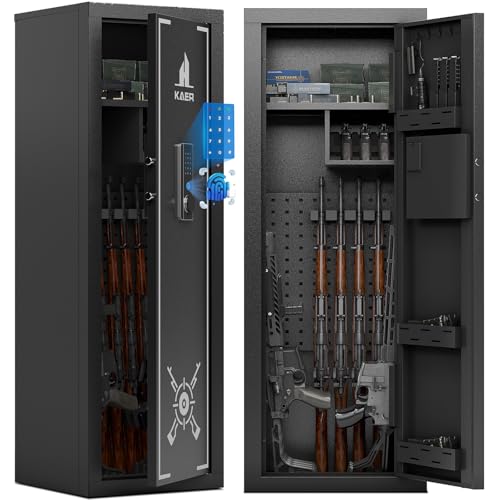
KAER Biometric Gun Safe Rifle,Gun Safes for Rifles and Pistols Holds 14-15 Firearms with Adjustable Racks & Pistol Storage,Fingerprint Keypad Lock Gun Cabinet for Home & Hunting for Enthusiasts
Included for 'Best Rifle Safes for Home Security' as a relevant option in this category; details come from the product listing.
View on Amazon
KAER 3 Gun Safe for Rifles and Pistols,Fully Assembled Long Rifle Safe
Included for 'Best Rifle Safes for Home Security' because the listing specifies Fully Assembled Long Rifle Safe, details this guide uses to compare options.
View on Amazon
INTERGREAT 12-15 Gun Safe, Large Gun Safe for Rifles and Pistols, Quick Access Rifle Safe with 3 Removable Gun Racks and 4 Pistol Pockets, Digital Gun Cabinet with Dual Alarm and Sleep Mode
Included for 'Best Rifle Safes for Home Security' because the listing specifies Large Gun Safe for Rifles and Pistols and Digital Gun Cabinet with Dual Alarm and Sleep Mode, details this guide uses to compare options.
View on Amazon
KAER Biometric Gun Safe for Rifles and Pistols, 12-15 Rifle Safe Quick Access (Fits Scoped Rifles) with 24/7 Burglar Alarm, Adjustable Shelves & Pistol Pockets, Gun Cabinet for Home, Office
Included for 'Best Rifle Safes for Home Security' because the listing specifies Adjustable Shelves & Pistol Pockets and Gun Cabinet for Home, details this guide uses to compare options.
View on AmazonLook for a published burglary-resistance standard rather than relying on phrases such as “maximum security.” In the United States, a UL Residential Security Container rating is a useful baseline for comparing resistance to common hand-tool attacks. It does not make a safe invulnerable, and it is not the same as a commercial vault rating. A safe without an independent rating may still be useful, but you should treat its security claims cautiously.
Fire ratings: useful protection, not a guarantee
Fire ratings commonly appear as 30, 60, 75, or 120 minutes at a stated temperature, often around 1,200 degrees Fahrenheit. The number is meaningful only when you also consider the test temperature, the protected interior temperature, the door seal, and whether the rating comes from an independent test.
- 30 minutes: basic protection for a short residential fire exposure.
- 60 minutes: a more practical target for many homes, particularly when the safe is placed away from obvious fire sources.
- 75–120 minutes: more insulation and usually more weight and cost, but not an assurance that documents, optics, wood stocks, or ammunition will survive every fire.
Fire protection has limitations. Drywall or composite insulation can absorb water and release steam during a fire. Excessive heat may damage scopes, batteries, electronic accessories, leather, and wood finishes even if the safe remains closed. Ammunition should be stored according to local law and manufacturer guidance; a fire rating is not permission to treat the safe as a fireproof ammunition bunker.
Locking systems compared
Electronic keypad locks
Electronic locks are convenient for regular access. A quality keypad generally uses a replaceable 9-volt battery or similar cell and may provide low-battery warnings, wrong-entry lockouts, and a lighted keypad. Choose a model with a documented emergency power method or external battery contact if the battery compartment is inside the safe.
The ownership trade-off is maintenance. Batteries can leak, contacts can corrode, and inexpensive keypads may fail sooner than the safe body. Replace batteries on a schedule rather than waiting for a warning, and keep the emergency key or backup procedure secure but accessible to the authorized owner.
Mechanical combination locks
A mechanical dial does not depend on batteries and can remain usable for decades when maintained. It is a strong choice for infrequent access or long-term storage. The disadvantages are slower opening, a learning curve, and the possibility of forgetting the combination. A dial can also be awkward in a dark or stressful situation.
Key locks
Key-operated locks are simple, but the key becomes a separate security problem. Do not leave it in a nearby drawer or taped to the safe. If a safe uses a key as an emergency override for an electronic lock, protect that key as carefully as the combination.
Capacity: calculate usable space, not the label
Manufacturers often advertise a nominal capacity such as 18, 24, or 36 rifles. Those figures usually assume slim, unscoped firearms arranged tightly together. Scoped rifles, lever actions, bipods, suppressors, and thick recoil pads reduce practical capacity.
| Safe category | Typical exterior size | Approximate weight | Advertised capacity | Realistic scoped-rifle capacity |
|---|---|---|---|---|
| Compact | About 55 in H × 20 in W × 18 in D | 180–300 lb | 8–14 rifles | 5–8 rifles |
| Mid-size | About 59 in H × 28 in W × 20 in D | 350–650 lb | 18–24 rifles | 10–16 rifles |
| Wide premium | About 60 in H × 36 in W × 24 in D | 650–1,000+ lb | 30–40 rifles | 18–28 rifles |
A useful sizing rule is to buy at least 30 percent more nominal capacity than you currently need. If you own eight scoped rifles, a nominal 18–24-gun safe is usually more practical than an eight-gun model. Measure your longest rifle with its optic, magazine, muzzle device, and sling hardware installed. Then check the safe’s interior depth, door-panel protrusion, shelf position, and opening width.
Installation is part of the security rating
A heavy safe that is not anchored can still be tipped, dragged, or loaded onto a vehicle. Most rifle safes include holes for floor or rear-wall anchoring, but the fasteners are only as strong as the structure receiving them.
- Choose the location. Avoid damp areas, plumbing leaks, direct outdoor exposure, and locations where a fire could be attacked easily. Confirm that the floor can support the concentrated load.
- Check the route. Measure doorways, stair turns, elevator dimensions, and ceiling height. Add the safe’s packaging and moving equipment to the measurements.
- Locate structural material. Anchor to concrete, a sound masonry surface, or properly identified floor joists and wall studs. Do not rely on drywall alone.
- Level the safe. An out-of-level safe can make the door bind and may place uneven pressure on the lock and hinges.
- Install the specified anchors. Follow the manufacturer’s fastener size and torque guidance. If the safe is exceptionally heavy or the structure is uncertain, use a qualified safe installer.
- Test before loading. Open and close the door several times, operate the lock with the door open, and verify that every bolt retracts fully before storing firearms.
Durability and ownership realities
The parts most likely to need attention are not usually the steel shell. Electronic batteries, keypad covers, door seals, bolt-work lubricant, hinge adjustment, and interior fabric or foam can wear first. Vacuum dust from the bottom and bolt area periodically, inspect the seal for compression or damage, and use only the lubricant specified by the manufacturer on moving components. Excess oil can collect dust and make the mechanism worse.
Do not overload the door shelves. Heavy optics, loaded magazines, and accessories can pull the door out of alignment over time. Keep firearms unloaded unless local law and your storage plan require otherwise, and prevent stocks and barrels from pressing against the door seal. A desiccant container or low-power safe dehumidifier may help in humid climates, but it must be compatible with the safe and monitored so it does not create a heat or electrical hazard.
The security trade-offs worth accepting
No residential safe optimizes every factor. Thicker steel improves forced-entry resistance but increases weight and cost. More insulation improves fire performance but reduces interior volume. A fast electronic lock improves convenience but introduces batteries and electronics. A very large safe may offer better organization but be impossible to anchor correctly in an apartment.
For most homeowners, the balanced choice is a mid-size safe with an independent residential-security rating, at least a 60-minute stated fire rating, adjustable shelving, protected hinges, a dependable keypad or mechanical dial, and proper structural anchoring. If your priority is rapid daily access, favor lock reliability and installation over an impressive fire number. If your priority is long-term storage, favor mechanical simplicity, thicker construction, and environmental control.
Final buying checklist
- Confirm the actual interior dimensions, not just the advertised rifle count.
- Leave room for optics and future purchases.
- Verify the fire-test temperature, duration, and testing organization.
- Look for a UL Residential Security Container rating or clearly documented equivalent.
- Compare body and door steel gauges, bolt diameter, hinge protection, and relocker design.
- Check battery access, emergency opening procedures, and replacement-lock support.
- Measure the delivery route and confirm floor-loading requirements.
- Plan anchoring before ordering.
- Review local firearm-storage laws and any insurance requirements.
Ready to decide? Our #1 pick for 2026 is the Small budget or first safe.
Live price & availability on Amazon.

Write Your Review
No reviews yet. Be the first to share your experience!