
Choosing stainless steel food containers can simplify lunch packing, meal preparation, and kitchen organization. Stainless steel provides a durable, reusable alternative to glass and many plastic containers, but designs vary in sealing performance, capacity, and heating compatibility. This guide compares seven practical options and explains what to consider before buying.
- Quick verdict: Which stainless steel food containers are best?
- Quick comparison table
- How we selected these stainless steel containers
- Detailed stainless steel food container recommendations
- Stainless steel food container buying guide
- Practical uses for stainless steel food containers
- Common mistakes when purchasing stainless steel containers
- Frequently Asked Questions
- Conclusion
Quick verdict: Which stainless steel food containers are best?
The best stainless steel container depends on whether you need to transport a complete lunch, carry sauces without spills, organize prepared ingredients, or store leftovers at home. Stainless steel construction offers durability and relatively low weight, but the lid design determines whether a container is appropriate for liquid foods or dry snacks.
For general food storage, the U-Konserve Rectangle Stainless Steel Container is a practical option because it combines an 18/8 stainless steel body with a flexible silicone lid and nesting design.
For small sauces and snacks, the U-Konserve Round Container provides a compact option with a manufacturer-described leakproof seal.
The LunchBots Medium Trio is suitable for compartmentalized dry lunches, particularly sandwiches and snacks.
ECOlunchbox Three-in-One offers an all-metal nesting system for people who want separate lunch portions without conventional plastic containers.
PlanetBox Rover provides a larger compartmentalized stainless steel lunchbox that can help organize several foods in one vessel.
IKEA 365+ Stainless Steel Food Container is worth considering for buyers who need straightforward home storage with compatible lids.
Fisher & Paykel Food Preparation Storage Containers offer a more specialized collection with stainless steel bases and glass lids.
These options serve different needs, so the right choice depends on portion size, transport requirements, and storage habits.
Quick comparison table
Stainless steel containers are not interchangeable simply because their bodies use the same general material. Some have leak-resistant silicone lids, while traditional bento boxes may lack liquid-tight seals. Others are primarily designed for refrigerator organization or food preparation. The comparison below highlights practical differences rather than assuming that every metal container can be used for heating.
| Product | Best for | Key specifications | Main advantage | Trade-off |
|---|---|---|---|---|
| U-Konserve Rectangle | General meals and leftovers | 18/8 steel, 25- and 45-oz options | Flexible silicone lid | Leak-resistant rather than universally leakproof |
| U-Konserve Round | Sauces and snacks | 5-, 9-, and 16-oz options | Leakproof silicone closure | Small capacity |
| LunchBots Medium Trio | Dry compartmentalized lunches | Three compartments, 20 fl oz | All-steel food-contact interior | Not leakproof |
| ECOlunchbox Three-in-One | Multi-part dry lunches | Three nesting sections, 31 oz total | Plastic-free steel construction | Not suitable for loose liquids |
| PlanetBox Rover | Divided family lunches | Five-compartment stainless steel lunchbox | Organized meal portions | Not airtight or leakproof |
| IKEA 365+ Stainless Steel | Home storage and reheating | 34-oz rectangular body | Stackable and nesting design | Lid sold in different configurations |
| Fisher & Paykel 5-Piece Set | Premium meal-prep organization | Five steel bases with glass lids | Nesting storage and oven-capable bases | Higher-cost specialized system |
How we selected these stainless steel containers
The selection emphasizes identifiable products with documented construction, capacity, and intended uses. Lid design, portability, food separation, cleaning, storage efficiency, and manufacturer-approved heating methods are central to the assessment. The comparison distinguishes between airtight, leakproof, and leak-resistant claims rather than treating those terms as interchangeable.
The recommendations are research-based editorial assessments, not firsthand durability or leak-resistance tests.
A stainless steel food container should be evaluated as a complete system.
The metal body influences durability and cleaning, but the lid determines whether food can be carried securely.
An open-compartment bento box may be excellent for sandwiches and vegetables while unsuitable for soup.
A silicone-lid container may be better for sauces but less convenient for maintaining separated ingredients.
The intended user also matters.
Children may benefit from manageable containers with easily operated closures.
Adults preparing substantial lunches may prefer larger capacities.
Households organizing leftovers may prioritize stackability and dishwasher compatibility.
The comparison therefore focuses on buyer suitability and practical limitations rather than unsupported performance rankings.
Detailed stainless steel food container recommendations
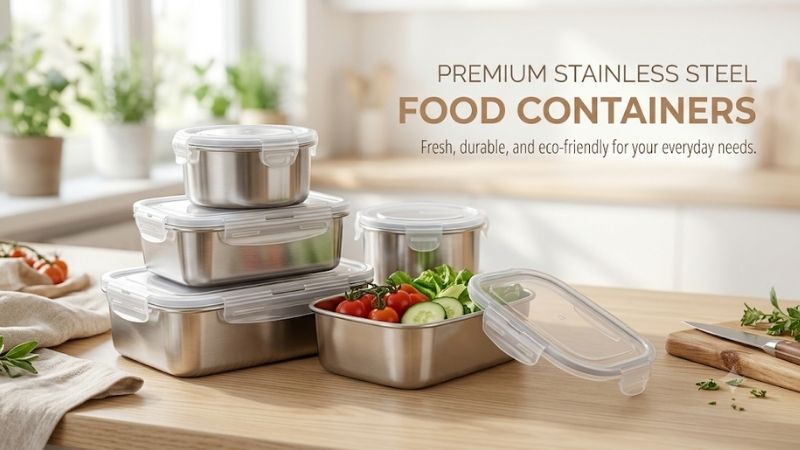
The following seven products illustrate different approaches to stainless steel food storage. Some are designed for portable lunches, while others emphasize versatile refrigerator organization or food preparation. Each product is evaluated according to its construction, size, lid mechanism, useful applications, maintenance requirements, and reasons a different option may be preferable.
U-Konserve Rectangle Stainless Steel Container — Best overall
The U-Konserve Rectangle Stainless Steel Container combines a reusable stainless steel body with a flexible silicone lid. The identified product range includes 25-ounce and 45-ounce capacities, making it appropriate for individual lunches, prepared ingredients, and leftovers. Its nesting design can simplify cabinet storage when several matching containers are used.
Best for: Buyers who want a versatile stainless steel container for everyday meals.
Why we picked it: The rectangular format, flexible lid, and range of capacities make it suitable for several common storage applications.
Key specifications: The manufacturer identifies 304-grade 18/8 stainless steel construction with platinum-grade silicone lids.
The line includes 25-ounce and 45-ounce rectangular options.
Features and benefits: Silicone lids help keep food contained and provide a flexible closure without requiring a rigid plastic lid.
The stainless steel bodies are designed to stack and nest.
The manufacturer identifies dishwasher and freezer compatibility.
Performance and practical use: The containers work well for prepared vegetables, sandwiches, grains, and leftovers.
The silicone lids are described as leak-resistant, so buyers should not automatically assume that every liquid will remain contained when the vessel is carried sideways.
The stainless steel bodies are approved for oven use up to 300°F according to the manufacturer’s instructions, but the lids are not oven-safe.
What makes it different: The combination of nesting construction and a flexible silicone closure provides a balance between home storage and portable meals.
Pros: Durable steel body, multiple capacities, and convenient nesting.
Cons: Not a universal solution for liquid transportation. Silicone lids require appropriate cleaning.
Buy if: You want a reusable container for ordinary meals and refrigerator organization.
Skip if: You regularly carry soup or need internal compartments.
U-Konserve Round Stainless Steel Container — Best for sauces and snacks
The U-Konserve Round Stainless Steel Container is a compact food-storage product available in several capacities. Its round body uses 304-grade stainless steel, while a flexible silicone lid provides a manufacturer-described leakproof closure. The smaller sizes make this product particularly useful for dressings, dips, cut fruit, and snack portions.
Best for: Buyers who need small reusable containers for sauces and side portions.
Why we picked it: The round configuration addresses a different need from larger lunch boxes by focusing on compact portions and liquid containment.
Key specifications: The identified range includes 5-ounce, 9-ounce, and 16-ounce capacities.
The construction combines 18/8 stainless steel and platinum-grade silicone.
Features and benefits: The flexible silicone lid provides a secure closure intended to reduce spills.
The round containers can nest when stored.
Different capacities allow buyers to select a size appropriate for dressings, yogurt, nuts, or snacks.
Performance and practical use: A small round container can carry salad dressing separately from vegetables, preventing premature mixing.
The larger versions can hold modest portions of fruit or leftovers.
The manufacturer identifies freezer and dishwasher compatibility.
The stainless steel bodies have a published oven rating up to 300°F, but the lids must not be placed in the oven.
What makes it different: Its leakproof lid and compact capacities make it more appropriate for small liquid portions than conventional unsealed steel bento boxes.
Pros: Multiple small capacities, leakproof closure, and nesting design.
Cons: Limited meal capacity. Additional containers may be required for a complete lunch.
Buy if: You frequently pack sauces, dressings, or snacks.
Skip if: You need one large container for an entire meal.
LunchBots Medium Trio — Best for small dry lunches
The LunchBots Medium Trio is a stainless steel bento-style lunchbox containing three fixed compartments. Its identified design provides space for half a sandwich and two small side portions. The interior and lid are made from stainless steel, allowing users to pack foods without a conventional plastic storage body.
Best for: Children or adults who prefer smaller dry meals with separated ingredients.
Why we picked it: The fixed compartments make it easy to organize a simple lunch without carrying several individual containers.
Key specifications: The manufacturer identifies a total capacity of approximately 20 fluid ounces, or 600 milliliters.
The container measures approximately 6 inches by 5 inches by 1.75 inches.
It uses food-grade 18/8 stainless steel.
Features and benefits: Three compartments help separate sandwiches, fruit, vegetables, and suitable dry snacks.
The stainless steel lid covers the food without requiring a plastic interior surface.
The product is dishwasher-safe according to the manufacturer.
Performance and practical use: This container works well for crackers, sandwiches, cheese portions, and appropriately prepared vegetables.
However, the manufacturer explicitly states that it is not leakproof.
Loose yogurt, soup, and liquid dressings should not be packed directly into the compartments.
A separate sealed container may be necessary for wet foods.
What makes it different: Its compact size and three-compartment construction are designed around smaller appetites.
Pros: Three sections, durable steel construction, and simple cleaning.
Cons: Not leakproof. Capacity may be insufficient for larger meals.
Buy if: You pack dry lunches with several small components.
Skip if: You need liquid containment or large portions.
ECOlunchbox Three-in-One — Best plastic-free nesting system
The ECOlunchbox Three-in-One Classic is a multi-part stainless steel lunchbox with two main stacked containers and a smaller snack container. Its three-section arrangement allows several foods to be packed separately while remaining within one coordinated system. The product uses stainless steel construction without conventional plastic gaskets.
Best for: Buyers who prefer a stainless steel lunch system without plastic lids.
Why we picked it: The modular nesting design provides multiple food compartments while retaining a straightforward metal construction.
Key specifications: The identified product has a total capacity of approximately 31 ounces.
Its three portions include lower, upper, and snack containers.
The manufacturer describes the product as made from food-grade stainless steel.
Features and benefits: The stacked arrangement helps keep different lunch components separated.
The smaller snack vessel can be removed when additional room is needed.
Metal clips secure the stacked sections.
Performance and practical use: The design is useful for sandwiches, vegetables, fruit, crackers, and other foods that do not require a liquid-tight seal.
Because it lacks sealing gaskets, the manufacturer explicitly states that the product is not leakproof.
Loose sauces and watery foods may escape during transportation.
Use a separate approved leakproof container when packing dressings or dips.
The set is dishwasher-safe but not microwave-safe.
What makes it different: Its all-metal modular construction distinguishes it from products relying on flexible silicone or plastic lids.
Pros: Three nesting sections, reusable steel construction, and no conventional plastic storage body.
Cons: Not leakproof. Layered access may be less convenient than a single open tray.
Buy if: You want a divided stainless steel lunch system for mostly dry foods.
Skip if: You regularly transport soups or liquid meals.
PlanetBox Rover — Best for organized compartmentalized meals
The PlanetBox Rover is a stainless steel lunchbox designed with several compartments for separating food portions. Its five-compartment arrangement is particularly useful for households preparing lunches with a main dish, vegetables, fruit, and additional sides. The rigid metal construction provides a reusable alternative to disposable lunch packaging.
Best for: Families and individuals who prefer visibly separated lunch components.
Why we picked it: The Rover provides a recognizable compartmentalized design with a strong emphasis on meal organization.
Key specifications: The identified model is a five-compartment stainless steel lunchbox.
PlanetBox distinguishes this model from its leakproof product lines.
Features and benefits: Multiple compartments allow food to be portioned without several separate containers.
The rigid body helps maintain the shape of packed ingredients.
The stainless steel construction is designed for regular reuse.
Performance and practical use: Rover is well suited to sandwiches, cut vegetables, fruit, cheese, and other foods that do not release substantial amounts of liquid.
However, PlanetBox explicitly states that Rover is neither airtight nor leakproof.
Wet foods and dips should be packed in suitable separate containers.
The manufacturer does not design Rover for oven or microwave use.
What makes it different: Five compartments provide more separation than conventional two- or three-section lunch boxes.
Pros: Organized food separation, reusable construction, and convenient portion visibility.
Cons: Not airtight or leakproof. Larger footprint than simple single-compartment containers.
Buy if: You prefer a complete lunch organized into several dry-food sections.
Skip if: You mainly transport soups, stews, or liquid-heavy meals.
IKEA 365+ Stainless Steel Food Container — Best simple home storage
The IKEA 365+ Stainless Steel Food Container is a rectangular food-storage vessel available in different capacities and compatible lid configurations. The identified 34-ounce body uses stainless steel and is designed for storing, reheating, and organizing prepared food. Its nesting design makes it attractive for households with limited kitchen storage.
Best for: Buyers seeking straightforward stainless steel containers for home meal preparation and leftovers.
Why we picked it: The product offers a simple reusable steel body with documented oven, freezer, and dishwasher compatibility.
Key specifications: The identified 34-ounce rectangular body measures approximately 8 inches long, 6 inches wide, and 2 inches high.
It is made from stainless steel.
Features and benefits: The body is designed to nest with compatible containers.
IKEA offers separate lid configurations, including plastic lids with silicone seals.
When paired with the appropriate locking plastic lid, the system can provide airtight and leakproof food storage according to manufacturer instructions.
Performance and practical use: The container is useful for vegetables, prepared meals, leftovers, and food organization.
IKEA identifies the steel body as oven-safe, freezer-safe, and dishwasher-safe.
However, the lids have their own material restrictions.
The steel body should not be placed in an ordinary microwave oven.
What makes it different: Its straightforward rectangular construction and multiple lid choices provide flexibility for home storage.
Pros: Nesting design, useful capacity, and documented oven compatibility for the body.
Cons: Lid selection requires attention. Not suitable for standard microwave reheating.
Buy if: You want reusable stainless steel containers for everyday home storage.
Skip if: You need transparent containers or regularly microwave meals without transferring them.
Fisher & Paykel Food Preparation Storage Set — Best premium organization
The Fisher & Paykel Five-Piece Food Preparation Storage Container Set combines food-grade stainless steel bases with borosilicate glass lids. The identified collection includes two small, two medium, and one large container. It is designed for organizing prepared ingredients and meals, with attention to stacking, nesting, and refrigerator storage.
Best for: Buyers who want a coordinated food-preparation system with premium materials.
Why we picked it: The combination of multiple capacities, stainless steel bases, and glass lids provides a distinct alternative to conventional plastic-lid collections.
Key specifications: The set contains five stainless steel vessels in three sizes.
The manufacturer identifies 304 stainless steel bases and borosilicate glass lids with food-safe silicone seals.
Features and benefits: Transparent glass lids allow food contents to be viewed without removing the cover.
The stainless steel bodies can be nested for compact storage.
The manufacturer describes the system as leak-resistant.
Performance and practical use: The different capacities support prepared vegetables, meat portions, soups, sauces, and larger ingredients.
The stainless steel bases are suitable for specified oven use up to 446°F.
However, the glass lids and sealing components must follow their separate instructions.
The steel bases should not be placed in a conventional microwave.
What makes it different: The integrated multi-size system and glass-lid construction are more specialized than ordinary lunch containers.
Pros: Five useful vessels, nesting storage, and transparent lids.
Cons: Premium price positioning. More specialized than many households require.
Buy if: You want a coordinated preparation and refrigerator-storage system.
Skip if: You need an inexpensive single lunch container.
Stainless steel food container buying guide
A stainless steel container should be selected according to its intended application rather than material alone. Lunch packing, refrigerator storage, dry snacks, sauces, and oven reheating all create different requirements. The right product must combine suitable capacity, closure reliability, manageable weight, and clear instructions about cleaning and heating.
Understand stainless steel grades
Stainless steel is an iron-based alloy containing chromium, which contributes to corrosion resistance.
Many food-storage products use stainless steel grades commonly described as 18/8 or 18/10.
These designations generally refer to nominal chromium and nickel proportions.
However, the exact grade should be established through manufacturer documentation rather than appearance.
Food-grade stainless steel is useful because it provides a durable, nonporous surface.
Nevertheless, stainless steel is not completely immune to corrosion under every condition.
Prolonged exposure to aggressive chemicals, unsuitable cleaning products, or damaged surfaces can affect performance.
Follow the manufacturer’s maintenance instructions.
Avoid interpreting vague marketing descriptions such as surgical steel or premium steel as proof of superior food-storage performance.
Construction quality, finish, closure design, and intended use remain important.
Understand leakproof versus leak-resistant containers
The closure is often more important than the metal body when transporting food.
A leakproof container is intended to prevent liquids from escaping under specified conditions.
A leak-resistant container may limit minor leakage without guaranteeing containment when tilted or inverted.
Traditional stainless steel bento boxes often have fitted metal lids without silicone sealing gaskets.
These designs are suitable for many dry foods but not loose liquids.
Silicone lids and locking mechanisms can improve liquid containment.
However, their effectiveness depends on the exact product and correct use.
Before transporting sauces or soup, choose a container with documented suitability for that purpose.
Inspect the seal for residue or damage.
Do not assume that every stainless steel lunchbox is suitable for liquid foods.
Choose capacity based on meal type
A small container may be appropriate for dressings, dips, nuts, or fruit.
A medium-size vessel can hold an individual lunch.
Larger containers are useful for family leftovers or batch-prepared food.
However, capacity must be considered alongside shape.
A wide shallow container is suitable for sandwiches and divided meals.
A deeper vessel may be more convenient for stews or foods containing liquid.
Compartmentalized lunchboxes also have less flexibility than open containers.
A five-compartment design can be excellent for varied lunches but unsuitable for one large portion of pasta.
Choose according to regular meal composition.
Avoid buying oversized containers that occupy unnecessary space when most portions are small.
Evaluate lids and locking mechanisms
Stainless steel food containers use several closure styles, including fitted metal lids, locking clips, silicone covers, and rigid plastic lids with gaskets.
Each approach has practical strengths and limitations.
Fitted metal lids can be simple and durable but may lack leak resistance.
Silicone covers provide flexibility and can be convenient for small containers.
Locking lids may offer more secure transportation when properly designed.
Before purchasing, consider whether the lid can be operated comfortably.
Children may find some closures difficult to open.
Adults transporting liquid foods may prioritize secure locking systems.
Also consider replacement-lid availability.
A damaged lid can make an otherwise useful steel container inconvenient.
The best closure is one that suits the food and can be maintained reliably.
Check heating and appliance compatibility
Stainless steel food containers should not automatically be treated as cooking pans.
Some identified products have manufacturer-approved oven applications, while others are designed only for food storage.
Likewise, standard stainless steel containers should not be placed inside ordinary microwave ovens.
Specialized products or appliances may have specific exceptions, but those combinations require explicit approval.
Induction compatibility is another separate issue.
A stainless steel storage container is not automatically safe or functional on an induction cooktop.
Direct induction cooking requires suitable construction and manufacturer approval.
Always distinguish between a storage vessel and cookware.
When reheating prepared meals in a microwave, transfer food to a suitable microwave-safe container unless the exact storage product is specifically approved for that use.
Consider cleaning and dishwasher care
Stainless steel is generally straightforward to clean, but lids and sealing components may require additional attention.
Some products are dishwasher-safe.
Others have silicone seals or decorative components that should be cleaned separately.
Follow the manufacturer’s instructions for each component.
After washing, dry the container thoroughly before storing it.
Inspect lid edges and gaskets for trapped food.
Avoid abrasive cleaning products that could damage finishes or sealing surfaces.
If the steel develops discoloration or water spots, use only manufacturer-approved cleaning methods.
Regular care helps preserve appearance and function.
A durable steel body offers little practical advantage if a poorly maintained lid prevents secure closure.
Practical uses for stainless steel food containers
Stainless steel containers can support several household routines, but different designs are suited to different foods. A divided lunchbox is convenient for sandwiches and vegetables, while a sealed round container may be more appropriate for dressings. A larger rectangular vessel can support meal prep and leftover storage when its capacity and lid match the intended use.
Packing lunches for work
Adults who bring lunch to work may benefit from stainless steel containers because they are reusable and generally resistant to impact.
A medium rectangular container can hold sandwiches, rice dishes, salads, or prepared vegetables.
For meals containing sauces, choose a suitably sealed model.
Consider whether the lunch must remain cold during transportation.
An airtight or leakproof lid does not provide refrigeration.
Use appropriate insulated bags and cold packs for perishable foods when necessary.
If the workplace provides a microwave, remember that ordinary metal containers should not be used for standard microwave reheating.
Transfer food into a suitable vessel.
Choose a container that fits comfortably into your bag and supports your normal lunch routine.
Preparing school lunches
Stainless steel bento boxes can be convenient for packing several food components in one vessel.
Compartmentalized designs allow sandwiches, vegetables, fruit, and snacks to remain separated.
However, younger children may find some lids or clips difficult to operate.
Choose a design appropriate for the child’s abilities.
A heavy or oversized lunchbox may also be inconvenient to carry.
Consider whether the container fits inside the school bag.
For foods containing liquids, use an appropriate sealed container rather than relying on unsealed metal compartments.
Perishable foods require suitable temperature control during storage and transport.
For younger children, account for age-appropriate food preparation and choking hazards.
A useful school lunch container should be easy to handle and appropriate for the foods being packed.
Storing leftovers in the refrigerator
Stainless steel containers can be useful for storing cooked vegetables, grains, proteins, and other leftovers.
Their durable construction makes them practical for regular refrigerator use.
Rectangular shapes often improve shelf organization.
However, stainless steel is opaque, making it difficult to identify contents without opening the lid.
Labels can solve this problem.
Record preparation dates when necessary.
Keep refrigerated perishable foods at 40°F or below.
Many cooked leftovers should generally be consumed within three to four days when properly stored.
Use shallow containers for appropriate cooling.
An airtight lid does not extend safe storage indefinitely.
For later meals, consider freezing suitable portions.
Organizing dry snacks and ingredients
Small stainless steel containers can hold nuts, dried fruit, crackers, and other shelf-stable snacks.
Their durable construction is useful for carrying food during travel or outdoor activities.
However, not all metal containers have airtight seals.
For foods that require protection from moisture, choose a product with an appropriate closure.
Opaque steel also prevents users from seeing contents without opening the container.
Labels may therefore be helpful.
Avoid storing foods in unsuitable environmental conditions.
Follow ingredient-specific storage instructions, particularly for foods containing oils that may deteriorate over time.
The best snack container should be easy to open, appropriately sized, and suitable for the intended ingredient.
Common mistakes when purchasing stainless steel containers
Stainless steel offers useful durability, but buyers sometimes assume that all steel containers are leakproof, microwave-compatible, or suitable for direct cooking. These assumptions can lead to disappointing purchases or unsafe use. Evaluating the complete product, including its lid and intended applications, is more important than relying on material claims alone.
Assuming every stainless steel lunchbox is leakproof
Many traditional steel lunchboxes do not include gaskets.
They may keep dry foods separated while allowing liquids to escape.
Before purchasing, identify whether the manufacturer describes the product as leakproof or leak-resistant.
Do not assume those terms mean the same thing.
For sauces, dressings, and soups, choose a suitable sealed container.
A divided lunchbox without sealing gaskets is better reserved for foods that do not release substantial liquid.
Trying to microwave ordinary steel containers
Most standard stainless steel food-storage containers are not designed for microwave heating.
Metal can interact with the microwave’s electromagnetic field in ways that depend on its shape, appliance design, and operating conditions.
Some specialized appliances and containers have approved uses, but these exceptions should not be generalized.
For ordinary home microwave reheating, transfer food into an approved container.
Do not experiment with metal vessels simply because another product advertises specialized microwave compatibility.
Buying too many specialized containers
Different food-storage designs serve different purposes.
A household may benefit from one rectangular meal container, a small sauce container, and a compartmentalized lunchbox.
However, purchasing many nearly identical products can create unnecessary cabinet clutter.
Start with the storage tasks performed regularly.
Choose sizes and closure styles accordingly.
An extensive collection is only useful when the containers are used often enough to justify their space and maintenance requirements.
Frequently Asked Questions
Stainless steel food containers raise questions about food safety, heating, cleaning, and long-term durability. The answers depend on the exact product rather than the material alone. Understanding these differences helps shoppers distinguish between storage containers, specialized lunch boxes, and cookware intended for direct heating.
Are stainless steel food containers safe for food storage?
Food-grade stainless steel is widely used for reusable food-storage products.
Its suitability depends on the alloy, construction, surface condition, and intended application.
Choose identifiable products with clear manufacturer instructions.
Avoid damaged containers with sharp edges, severe corrosion, or compromised seals.
Do not interpret marketing phrases such as completely chemical-free as meaningful proof of universal safety.
Are stainless steel food containers better than plastic?
Stainless steel offers durability, resistance to shattering, and a nonporous storage surface.
Plastic containers are often transparent, lightweight, and compatible with certain microwave-reheating applications.
Neither material is universally better.
Choose according to transportation, heating requirements, budget, and cleaning habits.
A suitable closure is especially important when storing liquids.
Can stainless steel food containers go in the oven?
Some stainless steel container bodies are approved for conventional oven use.
For example, certain U-Konserve products and the identified IKEA 365+ steel container have documented oven applications.
However, lid materials may have different restrictions.
Do not assume that every metal food-storage vessel is designed for oven heating.
Follow the exact manufacturer’s instructions.
Can stainless steel containers go in the freezer?
Many stainless steel food containers are freezer-safe when the manufacturer permits that application.
However, food containing substantial water can expand during freezing.
Leave appropriate space and follow the lid manufacturer’s instructions.
Avoid damaging seals through overfilling.
Check the exact product’s freezer compatibility before use.
Are stainless steel containers leakproof?
Some stainless steel containers use silicone gaskets or flexible lids designed to prevent leaks.
Others have simple metal closures and are suitable primarily for dry foods.
Review manufacturer descriptions carefully.
A product described as leak-resistant may not be appropriate for carrying soup sideways inside a bag.
Choose closure performance according to the food being transported.
How long do stainless steel food containers last?
There is no universal lifespan for stainless steel food-storage products.
Durability depends on construction, cleaning, handling, corrosion exposure, and lid condition.
A well-maintained steel body may remain useful for many years.
However, damaged lids, warped components, and compromised seals can reduce practical usability.
Inspect containers regularly and replace unsuitable components when necessary.
Conclusion
The best stainless steel food containers combine suitable capacity, reliable closures, manageable weight, and practical storage features. U-Konserve Rectangle is a versatile choice for everyday meals, while its round containers suit sauces and snacks. LunchBots, ECOlunchbox, and PlanetBox provide different options for separated dry lunches, and IKEA 365+ offers straightforward home storage. Fisher & Paykel suits buyers seeking a coordinated preparation system. Choose according to food type, leak-resistance requirements, and actual heating compatibility rather than assuming all steel containers perform identically.
Write Your Review
No reviews yet. Be the first to share your experience!