
The right glass meal prep containers make it easier to prepare lunches, organize leftovers, and reheat meals without constantly transferring food between dishes. However, glass construction, lid seals, portion sizes, and appliance compatibility vary by product. This guide compares six practical options and explains what matters for everyday meal preparation.
- Quick verdict: Which glass meal prep containers should you buy?
- Quick comparison table
- How we selected these glass food containers
- Detailed glass meal prep container recommendations
- Glass meal prep containers buying guide
- Food safety when preparing meals in glass containers
- Common mistakes when buying glass meal prep containers
- Frequently Asked Questions
- Conclusion
Quick verdict: Which glass meal prep containers should you buy?
For most households, the best glass meal prep containers combine practical portion sizes, secure lids, dependable refrigerator stacking, and straightforward cleaning. Buyers who transport lunches need different features from people who primarily refrigerate leftovers. A complete set can be convenient, but an individual divided container may be better for a specific routine.
The Pyrex Freshlock 10-Piece Meal Prep Glass Storage Set is a useful overall choice for preparing individual meals because it includes five matching glass containers with secure locking lids.
Rubbermaid Brilliance Glass Food Storage Containers are particularly appealing for shoppers who prioritize leak-resistant transportation and modular organization.
Snapware Total Solution Glass Food Storage Set provides a versatile collection with locking lids and multiple sizes.
Ello Duraglass Refresh 10-Piece Meal Prep Set is worth considering when protection against minor impacts is a priority because its glass vessels include silicone sleeves.
IKEA 365+ Glass Food Storage 3-Pack offers a straightforward option for preparing several similarly sized meals.
Bentgo Glass Lunch Container provides three compartments for separating ingredients within one portable lunch container.
Your ideal choice depends on portion size, transportation needs, and whether you regularly microwave or oven-reheat prepared meals.
Quick comparison table
Meal prep containers should be compared by their actual number of food-holding vessels, not simply the advertised package count. A ten-piece set commonly contains five containers and five lids. The table below separates practical capacity, lid design, and intended use so buyers can identify the options that match their normal cooking routine.
| Product | Best for | Key specifications | Main advantage | Trade-off |
|---|---|---|---|---|
| Pyrex Freshlock 10-Piece Meal Prep Set | Weekly individual meals | Five glass containers and five lids | Four-tab airtight locking lids | Set sizes may not suit large portions |
| Rubbermaid Brilliance Glass Set | Transporting prepared meals | Glass bases, vented locking lids | Airtight and leakproof design | Heavier than comparable plastic |
| Snapware Total Solution Glass Set | Mixed meal-prep requirements | Glass containers with snap-lock lids | Versatile portions and storage | Multiple sizes require lid organization |
| Ello Duraglass Refresh 10-Piece Set | Protected everyday handling | Five 3.4-cup glass containers | Protective silicone sleeves | Sleeves add bulk |
| IKEA 365+ Glass 3-Pack | Simple coordinated meal prep | Three 34-oz glass containers | Matching rectangular sizes | Fewer portion-size choices |
| Bentgo Glass Lunch Container | Compartmentalized lunches | Three compartments, 5-cup total capacity | Separates different foods | Large and relatively heavy |
How we selected these glass food containers
The comparison prioritizes identifiable products from established cookware and food-storage manufacturers. Published capacities, lid construction, material properties, cleaning requirements, heating restrictions, and realistic meal-preparation scenarios inform the recommendations. Product descriptions are treated as manufacturer information rather than evidence of independent performance testing.
The evaluation focuses on practical food-storage performance.
A container should hold a useful meal portion without requiring unnecessary empty space.
Its lid should be appropriate for either refrigerator storage or transportation.
The glass base should support the heating methods the buyer actually uses, according to manufacturer instructions.
Stackability matters because a week’s meals can occupy considerable refrigerator space.
Cleaning convenience also affects whether a set remains practical over time.
The comparison does not assume that thicker glass is indestructible or that every locking-lid system performs identically.
Leakproof claims are considered only when specified for the relevant product.
We also distinguish container count from package piece count.
The objective is to help buyers purchase the right number of usable vessels rather than the largest advertised collection.
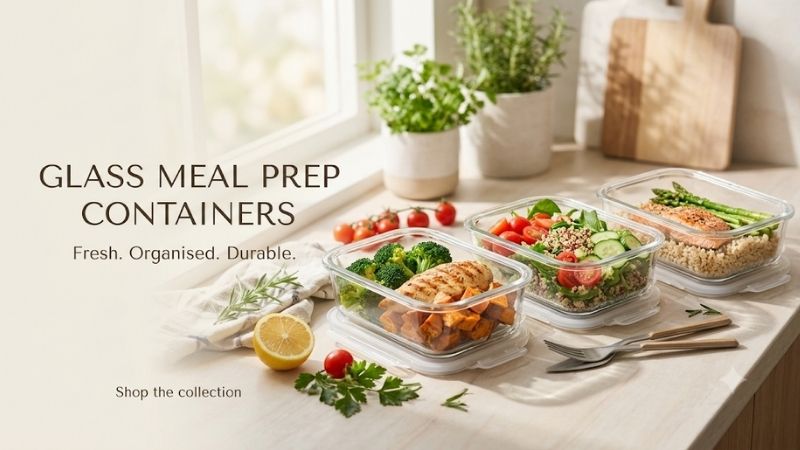
Detailed glass meal prep container recommendations
The following six products serve different meal-preparation needs, from transporting lunch to storing family leftovers. Each recommendation considers the container’s construction, size, lid system, cleaning requirements, practical benefits, and limitations. The most appropriate option is the one that supports your actual weekly cooking habits rather than a universal ranking based on appearance.
Pyrex Freshlock 10-Piece Meal Prep Set — Best overall
The Pyrex Freshlock 10-Piece Meal Prep Glass Storage Set is designed around five individual glass food containers and matching locking lids. The manufacturer identifies the collection as suitable for workweek meal preparation, with airtight, leakproof closures and glass bodies that resist stains and food odors. Its coordinated format is particularly useful for repeatable lunch portions.
Best for: Individuals preparing several workday meals in advance.
Why we picked it: The identified collection directly addresses meal prep with five containers rather than offering an assortment intended primarily for leftovers.
Key specifications: Ten total pieces consisting of five glass vessels and five corresponding lids. The lids use four locking tabs and incorporate an airtight sealing system.
Features and benefits: Locking lids support food transportation and help prevent unwanted spills when closed correctly.
The glass bodies allow users to see their meals without opening the containers.
The set also includes write-and-erase labeling functionality, making it easier to identify contents and preparation dates.
Performance and practical use: This collection is useful for preparing lunches containing rice, vegetables, cooked proteins, pasta, or salads.
The glass bases are suitable for the manufacturer’s specified microwave, refrigerator, freezer, and dishwasher applications.
Do not assume that plastic lids share every heating permission of the glass bases.
What makes it different: The five-container configuration is specifically aligned with a typical five-day meal-preparation routine.
Pros: Coordinated portions, locking lids, and convenient labeling.
Cons: Glass adds weight. A five-container set may not provide enough capacity for family meal prep.
Buy if: You prepare individual weekday lunches and want matching containers.
Skip if: You mainly need large vessels for family-size leftovers.
Rubbermaid Brilliance Glass Food Storage — Best for leakproof transportation
Rubbermaid Brilliance Glass Food Storage Containers combine clear glass bases with locking plastic lids designed to create an airtight, leakproof seal. The product line includes several sizes, and the identified medium rectangular set contains two 2-cup and two 3.2-cup containers with matching lids. Its modular design supports refrigerator organization and everyday food transportation.
Best for: Buyers who frequently transport meals containing sauces, dressings, or other foods that require secure containment.
Why we picked it: The manufacturer identifies a leakproof sealing system and vented lids intended for convenient microwave reheating.
Key specifications: The identified medium rectangular set includes four glass vessels and four lids, with capacities of 2 cups and 3.2 cups.
The glass bases are oven-safe up to 450°F according to the manufacturer’s stated instructions.
Features and benefits: Secure locking latches help contain food during ordinary transportation.
The lids include vents that permit steam release during approved microwave reheating with the latches open.
The glass bases resist staining and odor absorption.
Performance and practical use: These containers are suitable for storing prepared lunches, vegetables, pasta, and leftovers.
The smaller capacities are convenient for side dishes and modest portions.
For large meals, buyers may prefer a bigger container within the same product family.
The manufacturer’s oven rating applies to the glass base, not the plastic lid.
What makes it different: The combination of a documented glass-base oven rating and vented locking lids provides versatile storage and reheating functionality.
Pros: Secure lid design, multiple sizes, and oven-capable glass bases.
Cons: Glass weight and a relatively small capacity in the identified medium set.
Buy if: You want glass containers with manufacturer-described leakproof closures.
Skip if: You prefer lightweight lunch containers or need large meal portions.
Snapware Total Solution Glass Storage Set — Best for varied meal sizes
The Snapware Total Solution Glass Food Storage collection uses glass containers and locking lids intended for food preparation, refrigerated storage, and transportation. The identifiable 18-piece glass set includes multiple containers and matching lids, providing options for different portion sizes. Its flexibility is useful for households storing main dishes, side portions, and leftovers in one coordinated system.
Best for: Families and individuals who need several container sizes rather than identical lunch portions.
Why we picked it: The product family supports a range of storage applications while retaining a recognizable snap-lock lid system.
Key specifications: The identified Total Solution 18-Piece Glass Food Storage Set combines glass vessels with matching airtight locking lids.
Exact capacities depend on the selected package configuration.
Features and benefits: Locking lids help keep stored foods contained, while the glass bodies allow easy identification of ingredients.
Several container sizes can accommodate different meal components.
The collection is useful for refrigerator organization when similarly shaped vessels are stacked correctly.
Performance and practical use: Smaller vessels suit sauces, side dishes, or individual snacks.
Larger containers are more convenient for prepared main dishes and family leftovers.
The glass construction is useful for compatible reheating applications, but users should follow the exact product’s instructions.
Remove lids before conventional oven cooking, and avoid inappropriate temperature transitions.
What makes it different: Its assortment of capacities makes it more flexible than a set containing only one meal-prep size.
Pros: Multiple storage sizes, locking lids, and glass construction.
Cons: More lid sizes to organize. Individual portions may not be uniform.
Buy if: You want one collection for meal prep and general leftover storage.
Skip if: You prefer identical containers for five matching lunches.
Ello Duraglass Refresh 10-Piece Set — Best protective design
The Ello Duraglass Refresh 10-Piece Meal Prep Set includes five 3.4-cup glass containers with matching lids and silicone protection around the glass bodies. Its protective sleeves distinguish the collection from conventional bare-glass storage. The design is intended for individuals who want reusable meal containers while reducing direct contact between glass edges and surrounding surfaces.
Best for: Buyers who want glass meal prep containers with additional protective features.
Why we picked it: The silicone sleeves provide a practical difference from standard glass containers.
Key specifications: Ten pieces, consisting of five 3.4-cup glass vessels and five lids. The identified configuration includes protective silicone boots and leakproof sealing lids.
Features and benefits: Silicone protection can help reduce minor impact contact and provide a more secure grip.
The lids use sealing snaps intended to keep food contained.
The coordinated capacity simplifies preparing similar portions.
Performance and practical use: These containers are suitable for rice bowls, pasta, salads, and other prepared meals.
Their glass bodies resist persistent food odors, while the silicone sleeves can reduce direct contact with hard surfaces during ordinary handling.
However, silicone protection does not make glass unbreakable.
A dropped container can still crack or shatter.
The sleeves also increase the overall storage footprint.
What makes it different: The additional protective material provides a design advantage for people who frequently handle their containers.
Pros: Protective sleeves, matching capacities, and secure lids.
Cons: Additional bulk and components. Glass remains vulnerable to substantial impact.
Buy if: You value protective handling features and coordinated portions.
Skip if: Minimal container dimensions and weight are more important.
IKEA 365+ Glass Food Storage 3-Pack — Best simple value-oriented system
The IKEA 365+ Glass Food Storage 3-Pack offers three rectangular 34-ounce glass vessels with matching plastic lids. The identified set is intended for storing prepared food, reheating meals, and organizing leftovers. Its consistent capacity is useful for households that prefer straightforward containers without specialized compartments or complicated accessories.
Best for: Buyers who want several practical glass containers without purchasing a large assortment.
Why we picked it: The collection provides a simple three-container arrangement with documented heating and storage compatibility.
Key specifications: Three 34-ounce glass containers with matching polypropylene lids and silicone seals.
IKEA identifies the glass bases as suitable for oven, microwave, freezer, and dishwasher use, while the lids have separate restrictions.
Features and benefits: Rectangular shapes help use refrigerator shelf space efficiently.
The transparent bodies allow meals to be identified without opening the containers.
Matching lids simplify storage organization.
Performance and practical use: A 34-ounce capacity is useful for substantial individual meals or smaller quantities of leftovers.
The glass bases can be used for appropriate oven and microwave applications.
However, the plastic lids are not oven-safe.
When microwave reheating with an approved lid, follow the manufacturer’s venting instructions.
What makes it different: The combination of three identical capacities and a simple lid design is useful for buyers who want consistency.
Pros: Matching containers, practical portion size, and documented appliance compatibility.
Cons: No internal compartments. Three vessels may be insufficient for a full workweek.
Buy if: You want a simple coordinated glass storage system.
Skip if: You need multiple sizes or a divided lunch container.
Bentgo Glass Lunch Container — Best divided meal container
The Bentgo Glass Lunch Container features a glass body divided into three compartments with a locking lid. Its identified capacity is approximately 5 cups across the three sections. The design is useful for packing complete meals with separate portions of protein, vegetables, grains, or other foods that benefit from physical separation.
Best for: People who want a single compartmentalized lunch container.
Why we picked it: Its built-in divisions reduce the need to carry several smaller containers for one meal.
Key specifications: Three compartments with a combined capacity of approximately 5 cups. The manufacturer identifies glass construction, locking lid clips, and dishwasher, freezer, microwave, and oven compatibility for the appropriate components.
Features and benefits: The divided design helps keep different foods separated during storage and transport.
A large main compartment provides space for substantial ingredients, while smaller sections hold side dishes.
The glass surface resists persistent food odors.
Performance and practical use: The container is suitable for a prepared lunch consisting of rice, vegetables, and cooked protein.
It can also help organize meals where sauce or moisture would otherwise mix with other ingredients.
However, the internal compartments reduce flexibility for storing large single portions.
The overall container is also larger than many simple lunch bowls.
What makes it different: Its integrated divisions provide a convenient alternative to carrying multiple separate vessels.
Pros: Three compartments, secure locking lid, and practical meal organization.
Cons: More weight and bulk. Less flexible for soups and oversized portions.
Buy if: You regularly pack meals containing several separate components.
Skip if: You mainly store soups, stews, or large single-dish meals.
Glass meal prep containers buying guide
Choosing the right glass meal prep containers requires matching vessel capacity, lid design, and heating compatibility to your cooking routine. An attractive set may be inconvenient if the containers are too heavy for commuting or too large for your refrigerator. Focus on usable capacity, dependable closures, practical cleaning, and manufacturer-approved reheating methods.
Choose the right capacity for each meal
Container capacity affects portion suitability and storage efficiency.
A 2-cup container may be appropriate for snacks, side dishes, or smaller meals.
Containers holding approximately 3 to 4 cups are useful for many individual lunch portions.
Larger vessels can accommodate substantial meals or shared leftovers.
However, nominal volume does not mean the container should always be filled completely.
Foods containing sauces or liquids may require headroom to reduce spills.
Likewise, bulky ingredients such as leafy vegetables occupy more volume than dense foods.
Choose containers based on the meals you actually prepare.
If you prefer large salads, a shallow 3-cup vessel may feel restrictive.
If you prepare compact rice bowls, the same capacity may be adequate.
Consistent sizing can simplify portioning and refrigerator organization.
Understand the difference between airtight and leakproof lids
An airtight lid is designed to limit air exchange between the container and its surroundings.
A leakproof lid is intended to prevent liquids from escaping under specified conditions.
These features are related but not identical.
Some containers provide airtight storage without being suitable for carrying soup sideways inside a bag.
Locking clips and silicone gaskets can improve sealing reliability.
However, gasket condition and correct closure remain important.
Before transporting liquid foods, inspect the seal and ensure the lid is fully secured.
Do not assume that a product described only as airtight can safely carry large quantities of liquid.
For regular commuting, choose containers with clear manufacturer-described leakproof performance.
Compare glass construction and durability
Glass provides a nonporous storage surface that generally resists persistent odors and food staining.
However, different glass products have different manufacturing processes and use limitations.
Tempered glass and borosilicate glass should not be assumed to have identical thermal characteristics.
Manufacturer documentation matters more than broad descriptions such as heat-resistant or premium glass.
Inspect containers for chips and cracks.
Damaged glass should not be used for food storage or heating.
Protective silicone sleeves may help reduce some minor impacts, but they cannot eliminate breakage risk.
Avoid dropping containers or exposing them to unsuitable thermal shocks.
Buyers who frequently transport heavy lunches should consider whether glass weight is acceptable.
Check microwave and oven compatibility separately
A glass container may be microwave-safe without being approved for every oven application.
Likewise, an oven-safe glass base may have a plastic lid that cannot tolerate conventional oven temperatures.
Always review the manufacturer’s instructions for the exact product.
Do not place plastic lids in a conventional oven unless specifically approved.
For microwave reheating, follow instructions concerning lid removal or venting.
Avoid sealing a container tightly while heating food if the manufacturer requires steam release.
Do not place glass storage containers directly on stovetop burners.
Oven-safe storage glass is not automatically stovetop cookware.
Use suitable heat protection when removing hot containers from an oven or microwave.
Consider refrigerator stacking and cabinet organization
Stackable glass containers can help organize several prepared meals on refrigerator shelves.
Rectangular designs often make efficient use of available space.
However, stacking should not place excessive weight on delicate lids or damaged glass rims.
Follow manufacturer recommendations.
When containers are empty, some designs can nest to reduce storage volume.
Others occupy nearly the same space whether filled or empty.
Before buying a large set, measure refrigerator shelf height and cabinet dimensions.
Also consider where lids will be stored during washing and drying.
A practical storage system should make frequently used containers easy to access without removing an unstable stack.
Evaluate cleaning and replacement-lid availability
Glass bases are often convenient to clean, but their lids may require additional attention.
Silicone gaskets and locking mechanisms can collect food residue.
Follow manufacturer instructions for gasket removal and dishwasher placement.
Some plastic lids are top-rack dishwasher-safe only.
Avoid using abrasive tools that could damage sealing surfaces.
Inspect lids regularly for cracking, warping, or loose locking tabs.
Replacement-lid availability can affect long-term ownership costs.
A perfectly functional glass vessel may become less convenient if its original lid is damaged and no compatible replacement exists.
Consider choosing a product line with an established replacement-part system.
Food safety when preparing meals in glass containers
Meal prep containers support organization, but they do not replace refrigeration, cooking hygiene, or safe storage times. Proper food handling is particularly important when preparing several meals at once. Cooked foods should be cooled appropriately, refrigerated promptly, and reheated according to the type of food and established food-safety guidance.
Refrigerate cooked meals promptly
Prepared meals containing cooked meat, poultry, rice, vegetables, or other perishable ingredients should be refrigerated promptly.
For ordinary household food safety, keep refrigerators at 40°F or below.
Perishable foods should generally be refrigerated within two hours of preparation, or within one hour when ambient temperatures exceed 90°F.
Use shallow containers to help hot foods cool more efficiently.
Do not leave large pots of cooked food on the counter for extended periods while waiting for them to become completely cold.
Glass meal prep containers can be useful for portioning food into manageable quantities.
However, avoid placing containers in conditions that conflict with the manufacturer’s thermal-shock precautions.
Safe cooling and correct glass handling must both be considered.
Plan meal-prep quantities around safe storage periods
Preparing an entire week’s lunches can be convenient, but refrigerated meals do not remain safe indefinitely.
Many cooked leftovers are generally recommended for consumption within three to four days when properly refrigerated.
Some foods have different recommended storage limits.
For meals intended later in the week, freezing appropriate portions may be preferable.
Label containers with preparation dates.
Organize the refrigerator so older meals are used first when appropriate.
Do not rely solely on smell or appearance to determine whether perishable food remains safe.
If a prepared meal has exceeded its recommended storage period, discard it.
A leakproof lid does not extend food safety beyond proper storage guidance.
Reheat prepared meals safely
Reheating should use a container approved for the selected appliance.
For microwave reheating, follow manufacturer instructions about removing lids or opening vents.
Stir food when appropriate to reduce uneven heating.
Cooked leftovers should generally be reheated to 165°F.
For conventional oven reheating, use only glass bases approved for that purpose.
Remove unsuitable plastic lids and accessories.
Avoid exposing cold or frozen glass to abrupt temperature changes outside manufacturer instructions.
Use dry oven mitts when handling hot containers.
Do not attempt to reheat food directly on an induction cooktop inside an ordinary glass meal prep container.
Storage glass and induction cookware have different design requirements.
Common mistakes when buying glass meal prep containers
Some meal-prep problems arise from buying too many containers, selecting unsuitable portion sizes, or overlooking heating restrictions. A large set may look economical but become inconvenient when most vessels are rarely used. Choosing a manageable collection with appropriate lids and realistic capacities usually provides greater practical value.
Confusing piece count with container count
An advertised ten-piece set commonly contains five food containers and five lids.
This distinction matters when planning five weekday lunches.
An eighteen-piece set may provide nine usable vessels rather than eighteen.
Check the complete package contents before ordering.
Also verify whether all containers have the same capacity.
A mixed-size set may be useful for leftovers but less convenient for preparing identical lunch portions.
Choose the number of actual food-holding vessels needed for your routine.
Buying containers that are too large or too small
Oversized containers occupy unnecessary refrigerator space and may be awkward to carry.
Undersized vessels can make it difficult to pack a complete meal.
Review actual capacity and dimensions.
For example, a two-cup container may work well for a side dish but be restrictive for a substantial lunch.
A five-cup divided container can support a larger meal but may be unnecessarily bulky for a small portion.
Match capacity to regular meals instead of choosing based on appearance.
Assuming all glass containers tolerate direct heat
Glass meal prep containers are not automatically compatible with stovetop burners, induction heating, or broiling.
Many products are intended for food storage, microwave reheating, and specific oven applications.
Their plastic lids may have lower temperature limits than the glass bodies.
Follow exact manufacturer instructions.
Do not experiment with direct burner heating simply because the glass is labeled oven-safe.
Frequently Asked Questions
Glass meal prep containers are useful for refrigerator organization, transport, and certain reheating applications, but buyers often need clarification about durability, food safety, and heating restrictions. These answers address practical questions that can influence whether a particular product will remain convenient throughout a regular weekly meal-preparation routine.
Are glass meal prep containers better than plastic?
Glass offers a nonporous storage surface that generally resists staining and persistent odors.
It may also support certain oven applications when the exact product is approved.
Plastic containers are typically lighter and less vulnerable to shattering.
Neither material is universally superior.
Choose based on transportation needs, heating requirements, cleaning preferences, and acceptable weight.
What size glass containers are best for meal prep?
Containers holding approximately 3 to 4 cups are a useful starting point for many individual lunches.
Smaller vessels may be suitable for snacks or side dishes.
Larger containers are useful for salads, substantial portions, or family leftovers.
Consider food volume and meal composition rather than relying on capacity alone.
Can glass meal prep containers go in the freezer?
Many glass meal prep products are freezer-safe when used according to manufacturer instructions.
Leave suitable headroom for liquids that expand during freezing.
Avoid sudden temperature changes outside the product’s permitted conditions.
Check whether both the glass base and lid are approved for freezer use.
Can glass meal prep containers go in the oven?
Some glass meal prep containers have oven-safe bases, but their temperature limits vary.
Plastic storage lids are generally not approved for conventional oven use.
Remove incompatible components and follow the exact model’s instructions.
An oven-safe rating does not automatically establish broiler or stovetop compatibility.
How many glass meal prep containers do I need?
Five containers can be convenient for preparing weekday lunches, although safe storage periods may require freezing meals intended for later days.
A household preparing food for several people may need more containers.
Start with the number of portions you regularly prepare rather than buying the largest available set.
Conclusion
Choosing glass meal prep containers depends on practical capacity, secure lids, reliable storage, and appropriate heating instructions. Pyrex Freshlock is useful for coordinating weekday lunches, Rubbermaid Brilliance offers a strong leakproof design, and Snapware provides varied capacities. Ello adds protective silicone sleeves, IKEA 365+ offers straightforward matching portions, and Bentgo suits divided meals. Select a manageable collection that supports safe refrigeration, convenient cleaning, and your regular cooking routine.
Write Your Review
No reviews yet. Be the first to share your experience!