
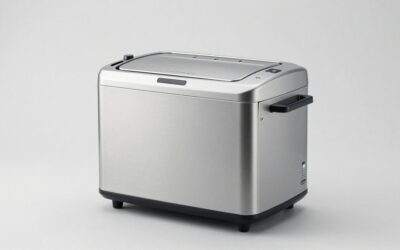
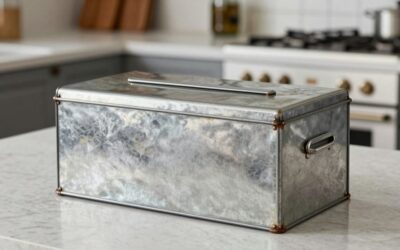
The best stainless steel bread box for a kitchen is usually a fingerprint-resistant roll-top model about 17–20 inches wide, with at least 10 inches of usable depth and ventilation that limits condensation without drying bread too quickly.
- Best stainless steel bread boxes by kitchen situation
- Head-to-head: the main stainless steel designs
- What the numbers reveal about capacity
- Ventilation: enough airflow, not an open basket
- Fingerprint resistance and countertop practicality
- Materials, cleaning, and what wears first
- How to choose without overbuying
- Final verdict
- Related Guides
That description fits most everyday kitchens better than the largest “farmhouse” bread bins. A compact box may suit one small loaf, while a wide front-opening or roll-top design is more practical for two loaves, buns, and an occasional baguette. The important comparison is not exterior width alone: hinge clearance, usable interior height, lid movement, and countertop depth determine whether the box is convenient.
Best stainless steel bread boxes by kitchen situation
| Kitchen situation | Most suitable style | Useful target dimensions | Why it works |
|---|---|---|---|
| Small counter or apartment kitchen | Compact roll-top box | 15–17 in W × 9–10 in D × 7–8 in H | Fits one standard loaf while using less counter depth |
| One or two loaves used several times weekly | Medium roll-top or lift-lid box | 17–19 in W × 10–12 in D × 8–10 in H | Balances capacity, access, and footprint |
| Large homemade loaves and rolls | Wide front-opening bread bin | 19–22 in W × 11–13 in D × 9–11 in H | Allows taller loaves and easier loading |
| Very shallow counter | Vertical or narrow-front box | 12–16 in W × 8–10 in D × 12–15 in H | Uses height rather than valuable front-to-back space |
| Frequent moving, cleaning, or family use | Sturdy stainless body with removable base | Approximately 4–8 lb | Less likely to slide, but still manageable for cleaning |
Head-to-head: the main stainless steel designs
Roll-top bread boxes
A roll-top is the safest general recommendation for the best stainless steel bread box for kitchen use. The curved door travels into the body instead of swinging outward, so it needs less clearance in front. That matters when the box sits below cabinets or beside a toaster.
Its main limitation is internal shape. The rolled door and curved top can reduce the usable height near the front, even when the exterior dimensions look generous. A 17.5-inch-wide box may hold a conventional sandwich loaf comfortably but struggle with a tall artisan boule or a large sourdough loaf. Check the interior opening, not only the advertised outside size.
Brabantia’s Roll Top Bread Bin is a recognizable example of this format, including versions described as matt steel or fingerprint-resistant steel. Its approximately 17–18-inch width makes it a medium-capacity choice rather than a large bakery-style container. Product generations and regional measurements differ, so verify the current specification before ordering.
Lift-lid and hinged-lid boxes
A hinged lid gives the clearest access and usually preserves more rectangular interior space. It is the better design for tall homemade loaves, rolls, or bread stored in a paper bag. The trade-off is clearance: the lid may need several inches of open space above the box, and a lid that opens backward can collide with an upper cabinet.
Lift-lid designs also expose the entire interior at once, which makes crumbs easier to remove. Look for a lid with a full-width handle, a stop that prevents overextension, and a base that does not flex when the box is opened with one hand.
Front-opening bread bins
A front-opening box is convenient when it sits under cabinets because the door moves toward you rather than upward. It can also provide a squarer interior than a roll-top. However, the door needs counter space in front of the box, and a shallow counter may not leave enough room to open it without moving nearby appliances.
Some products described as stainless steel use a stainless exterior with a painted, coated, or plastic interior base. That is not automatically a problem, but it affects cleaning and long-term appearance. Confirm which parts are actually stainless steel if corrosion resistance is your priority.
What the numbers reveal about capacity
Exterior dimensions overstate capacity because they include walls, the lid mechanism, feet, and ventilation gaps. As a practical estimate, subtract about 1 inch from each exterior width and depth and about 1.5 inches from height before judging fit. This is only a screening calculation; the opening shape matters more for irregular loaves.
For example, consider a bread box measuring 18 × 11 × 9 inches outside. A rough usable envelope might be 17 × 10 × 7.5 inches:
- Exterior footprint: 18 × 11 = 198 square inches.
- Approximate internal footprint: 17 × 10 = 170 square inches.
- Approximate footprint lost to walls and mechanisms: 28 square inches, or about 14%.
A standard sliced loaf around 12 × 5 × 5 inches should fit, but two loaves may not sit side by side if the internal door curve reduces the opening. Measure the largest loaf you regularly buy, then add at least 1 inch of clearance on each side so it can be removed without crushing the crust.
Ventilation: enough airflow, not an open basket
Bread boxes need a middle ground. A completely airtight container can trap moisture from fresh bread, making the crust soft and potentially encouraging mold. An entirely open wire basket allows bread to dry quickly. Stainless bread boxes typically use small rear or side vents, a slightly loose lid, or gaps around the door.
For everyday sliced bread, modest ventilation is usually preferable. For a loaf that is still warm, cool it completely on a rack before closing the box. Placing warm bread directly inside is a common mistake: the resulting condensation can defeat even a well-designed ventilation system.
Do not interpret vents as a way to keep bread fresh indefinitely. A bread box slows changes in texture; it does not replace proper storage. Freeze bread that will not be eaten within its normal quality window, and keep the bread box away from the stove, dishwasher steam, and direct sunlight.
Fingerprint resistance and countertop practicality
“Fingerprint-resistant” usually means a brushed or treated finish that makes oily marks less visible; it does not mean the surface never needs cleaning. Smooth polished stainless steel shows smears quickly but is easy to wipe. Brushed steel hides small marks better, although wiping across the grain can leave streaks.
For a busy kitchen, prioritize a removable crumb tray or base liner, rounded seams, and a lid that can be lifted without touching the main front panel. A dark or coated finish may hide fingerprints even more effectively, but scratches can be more conspicuous if the coating is damaged.
Before buying, measure the counter in three directions:
- Width: leave at least 1 inch beside the box if you need to grip its sides.
- Depth: include the handle or front door in its open position, not only the closed footprint.
- Height: allow room for a hinged lid, or confirm that a roll-top clears the cabinet below it.
A 19 × 12-inch bread box occupies 228 square inches. Compared with a 17 × 10-inch model at 170 square inches, it uses about 34% more counter area. That extra capacity is worthwhile only if you regularly store larger loaves or several baked goods.
Materials, cleaning, and what wears first
Look for food-contact surfaces made from corrosion-resistant stainless steel, commonly identified as 18/8 or 18/10 stainless in better-documented products. A stainless body can still develop spots or rust-like marks if salt, acidic residue, or standing water remains on it. These are often surface issues rather than proof that the whole box has failed.
The parts most likely to wear are usually the lid rollers, hinges, handles, feet, and plastic trim—not the steel panels. A heavy lid can feel durable but may put more strain on small hinges. Silicone or rubber feet can loosen, collect crumbs, or harden over time. Check whether replacements are available before treating a premium price as a long-term investment.
For maintenance, remove crumbs weekly or whenever they accumulate, then wipe the interior with warm water and a small amount of mild dish soap. Dry every surface fully. Avoid chlorine bleach, steel wool, abrasive powders, and leaving a wet cloth inside. For brushed stainless steel, wipe in the direction of the grain. Do not put a bread box in a dishwasher unless the manufacturer explicitly permits it; heat and detergent can damage finishes, wood handles, adhesives, and moving parts.
How to choose without overbuying
- Choose compact roll-top if your priority is a small footprint and one ordinary loaf.
- Choose medium fingerprint-resistant stainless steel if the box will remain visible on a busy counter and you want the best balance of appearance and access.
- Choose a hinged or front-opening design for tall homemade loaves or bread kept in bags.
- Choose a larger box only when you can name the items it will hold; empty volume still consumes counter space.
- Choose a coated or darker finish when fingerprints are your main concern, but inspect it carefully for chipped edges and avoid abrasive cleaning.
General market pricing ranges from roughly $25–$45 for basic stainless or stainless-look boxes, $45–$90 for better-finished fingerprint-resistant models, and $90 or more for oversized or highly engineered designs. The most useful upgrade is rarely decorative styling. It is a removable crumb-catching base, a reliable lid mechanism, sensible vents, and dimensions that match your actual loaf.
Final verdict
For most households, a medium roll-top stainless steel bread box measuring about 17–19 inches wide, 10–12 inches deep, and 8–10 inches high is the practical winner. Select fingerprint-resistant brushed steel for an exposed countertop, confirm the internal opening for your largest loaf, and treat ventilation and cleanability as equally important as exterior appearance. If your bread is unusually tall or your counter is shallow, move away from the default: choose a hinged lid for height or a compact vertical design for a smaller footprint.
Write Your Review
No reviews yet. Be the first to share your experience!