
The best bathroom under sink organizers and storage are the ones that match your cabinet’s usable width, leave room around the trap and supply lines, and keep daily items reachable without unloading the whole cabinet.
- Quick picks by bathroom situation
- What to measure before buying
- Best bathroom under sink organizers and storage, compared
- Materials: what survives bathroom conditions?
- Pipe clearance is more important than maximum capacity
- How to set up the cabinet for easier daily use
- Durability and ownership realities
- How much should you spend?
- Final buying decision
Quick picks by bathroom situation
| Bathroom situation | Best organizer type | Useful target dimensions | Why it works |
|---|---|---|---|
| Small pedestal-style vanity or crowded plumbing | Two-tier adjustable rack | 20–30 cm wide; 25–35 cm deep; 25–35 cm high | Separates bottles while leaving a central opening for pipes |
| Wide vanity with mostly open floor space | Pull-out drawer or sliding caddy | 30–40 cm wide; 35–45 cm deep | Brings rear products forward instead of requiring deep reaching |
| Cleaning supplies and tall refill bottles | Open bin with removable divider | 25–35 cm wide; at least 28 cm high | Accommodates irregular bottles and remains easy to wipe clean |
| Rental or frequently rearranged storage | Freestanding shelf insert | Adjustable width or stacked height; 5–10 kg shelf capacity | No drilling and easy to remove when the cabinet layout changes |
What to measure before buying
Measure the cabinet’s usable space, not the vanity’s advertised width. Open the doors and record the narrowest width between hinges, the depth from the front edge to the back wall, and the height from the cabinet floor to the lowest obstruction.

Delamu 2-Tier Multi-Purpose Bathroom Under Sink Organizers and Storage, Stackable Kitchen Pantry Organization, Pull Out Medicine Cabinet Organizer with Movable Dividers, White, 2 Pack
Included for 'Best Bathroom Under-Sink Organizers and Storage' because the listing specifies Stackable Kitchen Pantry Organization and Pull Out Medicine Cabinet Organizer with Movable Dividers, details this guide uses to compare options.
View on Amazon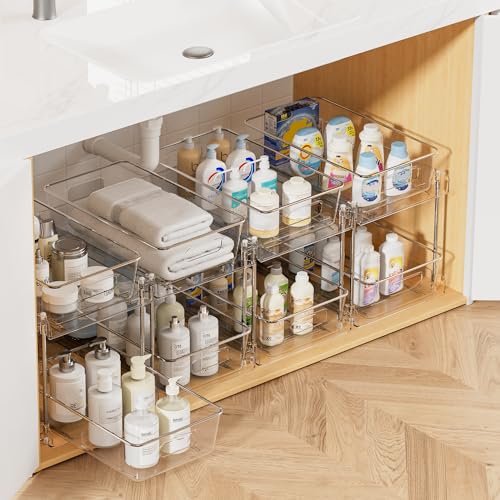
Vtopmart 4 Pack Pull Out Bathroom Under Sink Organizer (S-Standard)
Included for 'Best Bathroom Under-Sink Organizers and Storage' as a relevant option in this category; details come from the product listing.
View on Amazon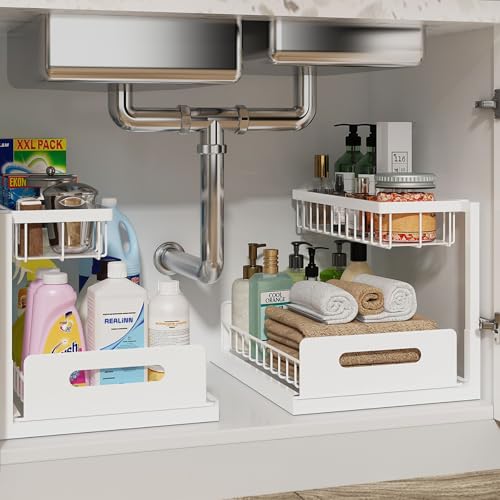
REALINN Under Sink Organizer, L-Shaped 2 Tier Pull Out Cabinet Organizer
Included for 'Best Bathroom Under-Sink Organizers and Storage' because the listing specifies L-Shaped 2 Tier Pull Out Cabinet Organizer, details this guide uses to compare options.
View on Amazon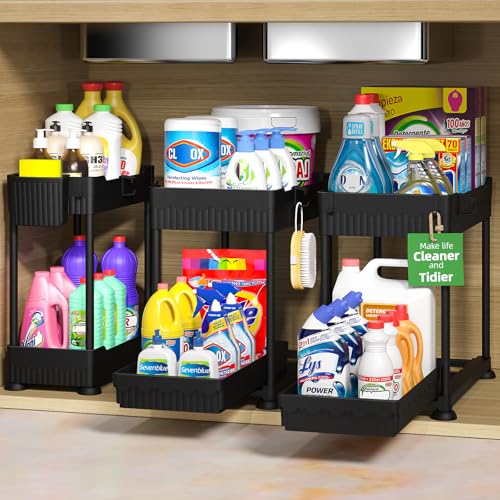
Sevenblue 3-Pack 2-Tier Under Sink Organizers with Sliding Drawers
Included for 'Best Bathroom Under-Sink Organizers and Storage' as a relevant option in this category; details come from the product listing.
View on Amazon- Pipe envelope: Measure the outside width and depth of the drain trap and supply lines. Add at least 2–3 cm of clearance on each side so an organizer does not press against fittings.
- Door clearance: Check whether the organizer’s handles, rails, or drawer fronts collide with the doors when opened.
- Baseboard and hinges: A cabinet may be 60 cm wide outside but offer only 48–52 cm of unobstructed interior width.
- Vertical clearance: Measure to the underside of the basin. A two-tier unit that fits beside the trap may still be too tall beneath the bowl.
A useful sizing rule is to choose an organizer no wider than the narrowest measured opening minus 4 cm. For example, if the clear width is 34 cm, aim for a unit 30 cm wide or less. That leaves approximately 2 cm of side clearance on each side for installation and removal.
Best bathroom under sink organizers and storage, compared
Best overall: an adjustable two-tier rack with a pipe opening
This is the most versatile choice for a typical vanity. Look for a metal or rigid plastic frame with two shelves, several height positions, and a rear or central cutout for plumbing. The IKEA VARIERA shelf insert is a useful example of the general shelf-insert format, while Yamazaki’s Tower under-sink storage rack represents the more purpose-built, adjustable-rack approach. Exact dimensions and configurations vary by model and market, so compare the current product specification with your measurements.
Prioritize a rack around 25–35 cm wide, 25–35 cm deep, and 25–35 cm tall. Adjustable feet or shelves are valuable because bathroom cabinets are rarely perfectly level. Put frequently used skincare or toilet paper on the upper level and heavier refill bottles on the lower shelf.
Best for rear-cabinet access: a pull-out drawer or sliding caddy
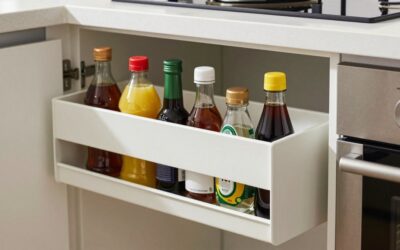
A sliding organizer is preferable when the cabinet is deep and the drainpipe sits toward the rear. Instead of kneeling and reaching behind bottles, you pull the whole tray forward. Choose a model with a raised rim, smooth runners, and a stop that prevents the tray from sliding completely out.
Drawer access is less useful when pipes run across the cabinet floor or when the doors open narrowly. Measure the full travel path, not just the tray’s resting position. A 35 cm-deep caddy needs roughly 35 cm of unobstructed space in front of it when extended.
Best for flexible bottle storage: modular plastic bins
Open bins are often the simplest solution for mixed bathroom essentials. Clear polypropylene or PET bins make contents visible, and a cutout handle allows the entire category—hair products, shaving supplies, or cleaning cloths—to come out together. Choose bins with straight sides rather than sharply tapered walls; they use cabinet volume more efficiently.
For wet areas, drainage holes can help, but they also allow spills to reach the cabinet base. A solid-bottom bin with a removable washable liner is usually better for cosmetics and toiletries. Avoid very shallow trays for liquids because a loose pump bottle can tip during door movement.
Best for a narrow cabinet: a slim vertical organizer
When usable width is under 25 cm, use vertical storage rather than forcing in a wide two-tier rack. A narrow caddy with one or two deep compartments can hold brushes, bottles, and cleaning products beside the trap. Choose a stable base at least 10–12 cm deep and avoid tall, top-heavy containers that can fall when the door is opened.
Materials: what survives bathroom conditions?
| Material | Typical strengths | Common failure point | Best use |
|---|---|---|---|
| Powder-coated steel | Rigid, supports heavier bottles, easy to wipe | Chipped coating can expose metal to rust | Two-tier racks and heavier storage |
| Stainless steel | Good moisture resistance and long service life | Usually costs more; thin wire can flex | Damp cabinets and open-frame shelving |
| Polypropylene plastic | Lightweight, washable, does not rust | Can bow under concentrated weight or become brittle over time | Bins, trays, and sliding caddies |
| Bamboo or wood composite | Warm appearance and good rigidity | Edges and joints may swell after repeated wetting | Dry, well-ventilated vanity cabinets |
For most bathrooms, coated steel or polypropylene offers the best balance. Avoid untreated particleboard in a cabinet that has experienced leaks. If you choose wood, seal exposed edges and keep the organizer away from standing water.
Pipe clearance is more important than maximum capacity
An organizer that holds 20 bottles is not useful if it blocks the shutoff valves or forces the drain trap sideways. Prefer designs with a U-shaped rear cutout, open back, adjustable shelf positions, or separate left-and-right compartments.
Before installation, place a cardboard template on the cabinet floor using the organizer’s footprint. Mark the pipe positions on the template and check that the doors close. This takes less than five minutes and can prevent buying a unit that is technically the correct width but unusable around the plumbing.
How to set up the cabinet for easier daily use
- Remove duplicates and expired products. Storage cannot compensate for unused inventory.
- Group by frequency. Keep daily products at the front or on the top shelf; occasional refills belong at the back.
- Put leaks in containment. Store bottles with loose caps or oily formulas inside a washable bin.
- Keep plumbing accessible. Leave the shutoff valves and trap visible enough to inspect without removing every item.
- Label refill products. A small label prevents mistaking concentrated cleaner or hair treatment for a daily-use product.
- Recheck after one week. If an item is repeatedly moved aside, change the shelf height or category placement rather than accepting the inconvenience.
Durability and ownership realities
The first parts to wear are usually drawer runners, adhesive feet, thin plastic hinges, and powder-coated edges exposed to leaking bottles. Avoid exceeding the stated load capacity; concentrated weight from large shampoo or cleaning-product bottles can deform a plastic shelf even when the overall organizer looks lightly filled.
Clean the organizer monthly with mild soap and water, then dry it before returning products. Do not use abrasive pads on coated steel. Check silicone feet and adhesive pads every few months, especially if the cabinet floor becomes damp. If a shelf rocks, level it immediately—movement gradually loosens joints and can make bottles fall.
How much should you spend?
Basic plastic bins and fixed shelf inserts generally cost about $10–$25 per unit. Adjustable metal racks and sliding caddies commonly fall around $25–$60, while premium stainless-steel or fully fitted drawer systems can cost roughly $60–$150 or more. Paying extra is most worthwhile for smooth drawer hardware, corrosion-resistant materials, and a design that solves difficult plumbing clearance—not simply for a larger capacity.
Final buying decision
Choose an adjustable two-tier rack if you need the best all-purpose arrangement. Choose a pull-out caddy when rear access is the main frustration. Choose modular bins for mixed-size bottles, and choose a slim vertical organizer when pipes or a narrow cabinet eliminate wider options. In every case, prioritize the measured pipe envelope and door path over the organizer’s advertised capacity.

Write Your Review
No reviews yet. Be the first to share your experience!