
The best pot and pan organizer racks are chosen by cabinet dimensions first: use a vertical rack for separated cookware, an adjustable rack for mixed sizes, and a cabinet-mounted rack when you need every pan to slide out instead of stacking.
Quick picks by kitchen situation
| Your situation | Best rack type | Why it fits | Typical budget |
|---|---|---|---|
| One lower cabinet, mixed cookware | Adjustable freestanding rack | Dividers can be spaced around lids, skillets, and saucepans | $20–$55 |
| Tall cabinet or open shelf | Vertical file-style rack | Uses height and keeps each pan in its own slot | $18–$45 |
| Deep base cabinet with a strong face frame | Cabinet-mounted pull-out rack | Slides cookware toward you without unloading a stack | $70–$220 |
| Rental or no-drill installation | Weighted, non-slip freestanding rack | Installs without screws, though capacity is usually lower | $15–$40 |
| Many lids and shallow pans | Adjustable rack with lid slots | Separates awkward flat items from heavier cookware | $30–$70 |
What to compare before buying
Product listings often emphasize the number of dividers, but usable capacity depends on the width of each slot, the rack’s load rating, and whether your cabinet door or plumbing interferes. Measure the clear interior, not the cabinet’s advertised width.

MUDEELA Expandable Pot Pan Lid Organizers inside Cabinet, 10 Divider-Black
Included for 'Best Pot and Pan Organizer Racks for a Tidier Kitchen' because the listing specifies 10 Divider-Black, details this guide uses to compare options.
View on Amazon
ORDORA Pots and Pans Organizer Under Cabinet 16.6", 8-Tier Adjustable Rack
Included for 'Best Pot and Pan Organizer Racks for a Tidier Kitchen' because the listing specifies 8-Tier Adjustable Rack, details this guide uses to compare options.
View on Amazon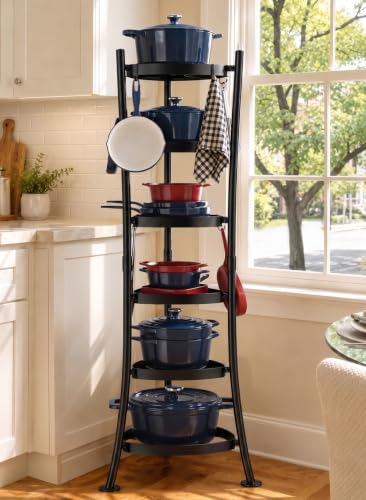
KES 264 Lbs Capacity Freestanding Pot Rack, 6-Tier Cast Iron Cookware Stand with 6 Hooks, Pots and Pans Storage Tower for Kitchen Corner, Stable Base, Anti-tip Strap & Floor Protectors, Black
Included for 'Best Pot and Pan Organizer Racks for a Tidier Kitchen' because the listing specifies 6-Tier Cast Iron Cookware Stand with 6 Hooks and Pots and Pans Storage Tower for Kitchen Corner, details this guide uses to compare options.
View on Amazon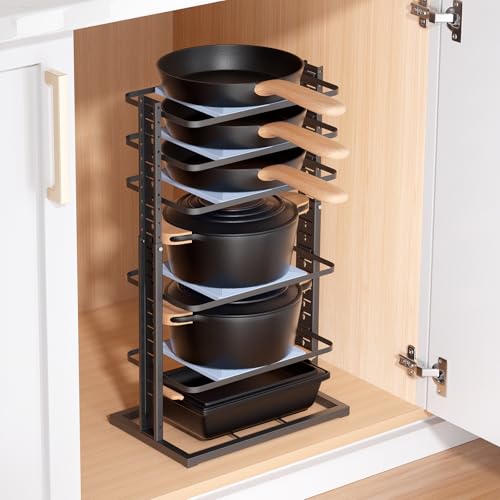
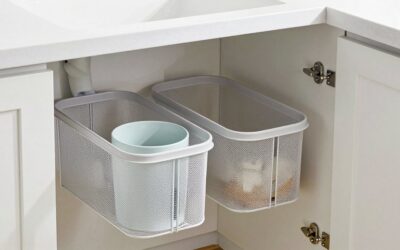
LAMU Pots and Pans Organizer for under Cabinet, 6-Tier Heavy Duty Pan Pot Organizers inside Cabinet Adjustable 14 to 24.57", Pot Rack Kitchen Cabinet Organization and Storage Holds up to 12" Cookware
Included for 'Best Pot and Pan Organizer Racks for a Tidier Kitchen' as a relevant option in this category; details come from the product listing.
View on Amazon- Usable width: Measure between hinges, drawer hardware, and side walls. A nominal 24-inch cabinet may provide only about 21 to 22 inches of unobstructed space.
- Usable depth: Measure from the front obstruction to the back wall. Leave at least 1 inch of clearance so handles and pull-outs do not bind.
- Usable height: Include the height of the tallest pan, lid, or handle. A vertical rack that fits under a shelf may not fit once cookware is inserted at an angle.
- Slot width: A 2-inch slot suits many frying pans, while 3 to 4 inches is more practical for thick cast iron or pans with projecting handles.
- Load capacity: Cast iron can weigh several times more than aluminum cookware. Look for a rack designed for at least 25 pounds if it will hold several heavy pieces.
- Stability: Wide feet, a low center of gravity, rubber pads, and a rigid base matter more than a large divider count.
Head-to-head: adjustable, vertical, and cabinet-mounted racks
Adjustable racks: the most forgiving choice
An adjustable rack uses movable dividers or expandable rails to create custom compartments. It is the strongest general-purpose option when your cookware collection includes different pan diameters, detachable handles, lids, and nesting sets.
Typical freestanding models are about 12 to 16 inches wide, 8 to 12 inches deep, and 7 to 10 inches high. Depending on slot spacing, they usually hold six to ten pieces of cookware. That stated capacity often assumes lightweight pans; a more realistic load for heavy cast iron is four to six pieces.
Choose one with dividers that lock firmly rather than simply resting in shallow grooves. Loose dividers can shift when a pan is removed, causing neighboring cookware to lean or scrape. A steel frame with a powder-coated finish is preferable to thin painted wire, especially in a humid cabinet beneath a sink or dishwasher.
The main drawback is wasted space. A rack designed for eight narrow pans may become inefficient when you need four wide slots. Adjustable racks also remain on the cabinet floor, so they do not solve the problem of bending down to reach cookware.
Vertical racks: best for separation and visibility
Vertical racks store pans on their edges, like files in a cabinet. They are particularly effective for frying pans, griddles, baking sheets, and cutting boards. Because each item has a defined slot, you can remove one piece without lifting the rest.
A useful vertical rack is commonly 8 to 14 inches wide, 8 to 12 inches deep, and 10 to 14 inches high. Five to seven slots is a practical range for a cabinet; more slots can reduce stability unless the base is broad and weighted. Check that the slot height exceeds the pan’s side wall and handle angle. Very shallow pans may slide too far down, while tall handles may collide with the shelf above.
Vertical storage is less suitable for round pots with two side handles. Those pots can occupy two slots or sit awkwardly above the base. You may also need to store lids separately, because a vertical divider cannot automatically keep a loose lid from rattling against a pan.
Cabinet-mounted pull-outs: the accessibility winner
Cabinet-mounted racks attach to the cabinet floor, side walls, or a dedicated pull-out frame. The rack travels forward on slides, bringing cookware into view. This is the best arrangement for a deep base cabinet, especially when the rear half would otherwise become dead storage.
Common pull-out units occupy roughly 10 to 15 inches of cabinet width, 18 to 22 inches of depth, and 18 to 24 inches of height. Many hold 20 to 50 pounds, but the practical limit depends on the cabinet floor and slide hardware. A narrow unit may hold eight to ten lighter pans; a wider, reinforced unit may hold a stack of pots and lids without excessive flex.
Installation is the trade-off. You must account for door hinges, face frames, overlay doors, plumbing, and the location of the cabinet floor. Side-mounted slides need sufficiently strong cabinet sides, while bottom-mounted hardware needs a flat, solid base. A pull-out can also reduce the effective opening if its frame is wider than the door clearance.
Capacity is not the same as storage efficiency
Suppose your cookware includes two 10-inch skillets, one 12-inch skillet, two 3-quart saucepans, one 6-quart pot, and five lids. Stacking everything may occupy only about 12 inches of cabinet width, but every use requires unloading the stack. A vertical rack might require 14 to 18 inches of width while allowing six pans to be removed individually. A pull-out could use 12 inches of width and 20 inches of depth, but it may need a separate lid organizer.
For a realistic estimate, count slots rather than pieces. Two thick pans may need three inches each, while a saucepan with side handles may need four inches. In a 20-inch-wide opening, reserve two inches for clearance and divide the remaining 18 inches by your required slot width. At three inches per slot, that gives approximately six usable positions, not the eight or ten suggested by a tightly packed product photograph.
Best materials and features for long-term ownership
- Powder-coated steel: A good balance of rigidity, weight, and price. Inspect cut edges for exposed metal that could scratch enamel or nonstick coatings.
- Stainless steel: Useful in damp areas and less vulnerable to surface rust, though it can cost more and still needs drying if water collects beneath the feet.
- Silicone or rubber feet: Reduce sliding and protect cabinet floors. Replaceable pads are preferable because they are often the first component to loosen or split.
- Low front rail: Keeps pans from tipping forward on a pull-out or vertical rack without blocking handles.
- Locking dividers: Prevent heavy cookware from pushing slots together.
- Soft contact points: Important for enameled, ceramic-coated, and nonstick cookware. Bare wire can cause chips or scratches over time.
The parts most likely to wear are adhesive pads, plastic end caps, divider clips, and slide bearings. Avoid exceeding the stated load limit, and do not drag a loaded freestanding rack across a cabinet floor. For pull-outs, occasional tightening of mounting screws and cleaning of crumbs from the slide path can prevent wobbling.
How to set up a rack without losing usable space
- Empty the cabinet completely. Measure the opening and the interior at the front, middle, and back; cabinet boxes are not always perfectly square.
- Mark obstructions. Note hinges, plumbing, shelf pins, face frames, and the arc of the door. A rack can fit inside the box and still fail to clear the opening.
- Group cookware by removal frequency. Put daily-use skillets or saucepans in the easiest-to-reach slots. Reserve rear or higher positions for seasonal pieces.
- Set generous initial spacing. Start with one pan per slot, then reduce unused gaps only after confirming that handles do not collide.
- Load heavy items low and centrally. On a freestanding rack, place cast iron near the center or bottom. On a pull-out, distribute weight across the slide-supported area.
- Check the loaded movement. Open and close the door or pull-out several times. Listen for scraping and verify that the cabinet does not flex before adding more cookware.
Which rack should you choose?
Choose an adjustable rack if you want one solution for mixed cookware and may reorganize later. Choose a vertical rack if most of your storage problem is skillets, baking sheets, and lids that are difficult to separate. Choose a cabinet-mounted pull-out if the cabinet is deep, you use the cookware frequently, and you are comfortable with a more permanent installation.
For a small budget, prioritize a rigid base, non-slip feet, and correctly sized slots over extra dividers. For a busy kitchen, spending more on smooth, full-extension hardware can be worthwhile because it improves access every day. The best pot and pan organizer racks do not merely hold the most cookware; they leave enough clearance to remove one item without moving the rest.
Write Your Review
No reviews yet. Be the first to share your experience!