
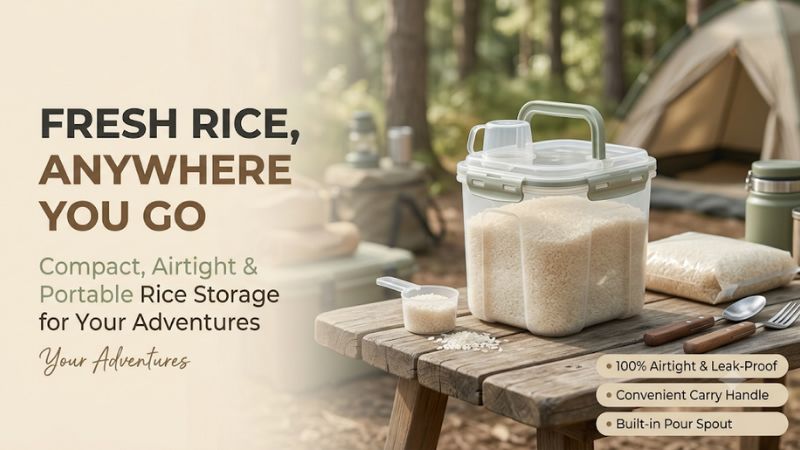
A rice storage container for travel should keep uncooked rice secure and easy to measure without becoming an awkward item in your luggage. Whether you are packing for camping, an extended-stay hotel, or a road trip, the best choice depends on how many meals you plan to cook, what other gear you carry, and how you will keep the container dry.
Quick Answer: What to Buy and Why
For most trips, carry only the amount of dry rice you expect to cook in a clean, food-suitable, securely closing container that fits your baggage. A small screw-top jar or a compact locking-lid box is often more practical than a large household dispenser. Add a clearly marked dry measuring cup if the container is not itself designed for measuring portions. The safest way to choose is to map out the actual workflow from filling to dispensing to cleaning. Product style matters only after you have checked food suitability, closure reliability, and the space available for storage.
Rice is relatively dense, and a bag that looks compact can still add noticeable weight to a backpack or carry-on. In transit, the main problem is not just pantry insects; it is preventing an accidental lid opening, protecting food from moisture, and being able to wash and dry the container when kitchen facilities are limited.
Fast buying checklist
- Confirm the specific model is intended for direct food contact.
- Select capacity from planned use or actual package size, not appearance.
- Choose a closure that fits the handling conditions.
- Check the empty weight, dimensions, and cleaning instructions.
- Keep a dry measuring utensil and an accurate content label.
For most trips, carry only the amount of dry rice you expect to cook in a clean, food-suitable, securely closing container that fits your baggage. A small screw-top jar or a compact locking-lid box is often more practical than a large household dispenser. Add a clearly marked dry measuring cup if the container is not itself designed for measuring portions.
How to Choose the Right Container
The most important buying criteria are not an invented ranking of brands or a promise that all airtight containers perform identically. They are the physical and hygiene constraints of using dry food in a particular setting. A container can be excellent for one person and inconvenient for another because the workflow, space, quantity, and handling conditions differ.
Work through the criteria below in order. The answer to an earlier criterion, such as how much ingredient you actually use, changes the size and shape you need later. A useful purchase should remove friction from the routine instead of creating new chores.
Start with meals and servings, not container size
Estimate how many people you will feed and how many meals will include rice, then compare that plan with the dry-rice instructions for your recipe or cooker. A travel container should be sized around meals you are reasonably sure you will prepare rather than a large emergency surplus that steals bag space. A practical buying decision should therefore prioritize the actual conditions and equipment you already use. Brand design, material, and attractive appearance have value only when they support this real requirement rather than making the task more complicated.
For example, a solo traveler cooking only breakfast oats and occasional rice needs a far smaller supply than a family preparing rice as the main starch each evening. Write down the planned number of meals and a measured amount per meal, then add a modest margin rather than guessing from the container’s external dimensions. Remember that rice cooker measuring cups are not necessarily the same volume as ordinary U.S. measuring cups.
What to check
- Count planned rice-based meals before choosing a container.
- Test-fill the container at home with the rice type you actually use.
- Leave enough headroom to remove a cup or pour without a spill.
If more than one candidate meets these conditions, choose the one with the simplest repeatable opening and cleaning routine. The goal is to keep the ingredient usable and make the relevant kitchen task easier each time.
Choose a closure that survives being moved
A pantry canister may work beautifully on a still shelf but be frustrating in a bouncing vehicle or tightly packed duffel. For travel, pay extra attention to screw threads, locking tabs, and whether the lid can be accidentally released when another object presses against it. A practical buying decision should therefore prioritize the actual conditions and equipment you already use. Brand design, material, and attractive appearance have value only when they support this real requirement rather than making the task more complicated.
A closure that seals reliably when the container stands upright is useful, but only the exact manufacturer instructions can establish whether it is leakproof under every transport condition. Dry rice is not a liquid, yet a detached lid can scatter grains throughout a bag. Use a secondary resealable bag or separate pouch if spilled rice would seriously disrupt the trip.
What to check
- Prefer a positive closure that cannot open from light pressure.
- Test the closed container inside your intended bag before leaving.
- Avoid unsupported “100% spillproof” claims for unverified products.
If more than one candidate meets these conditions, choose the one with the simplest repeatable opening and cleaning routine. The goal is to keep the ingredient usable and make the relevant kitchen task easier each time.
Pick food-suitable material and a manageable shape
A rigid plastic food-storage box or suitable small metal or glass food vessel can be practical, but material matters alongside weight and breakage risk. For hiking and frequent transport, lightweight food-suitable plastic is commonly easier to handle than heavy glass, while rigid shapes protect food better than thin paper packaging. A practical buying decision should therefore prioritize the actual conditions and equipment you already use. Brand design, material, and attractive appearance have value only when they support this real requirement rather than making the task more complicated.
Choose a container that was intended for direct food contact and follow its specific cleaning instructions. Some gasketed utility storage boxes are sold for tools or general household storage; a familiar brand name alone does not make every box food-safe. Rounded corners are easier to wipe; a wider mouth makes complete drying more achievable after washing in a campsite sink.
What to check
- Confirm direct food-contact suitability on the exact item.
- Compare empty weight and shape with the available bag space.
- Avoid glass in situations where impact or breakage is a realistic concern.
If more than one candidate meets these conditions, choose the one with the simplest repeatable opening and cleaning routine. The goal is to keep the ingredient usable and make the relevant kitchen task easier each time.
Plan around where and how you will cook rice
Travel storage is most convenient when it connects to the tools available at the destination. A small rice cooker, camping pot, hotel kitchenette, or outdoor stove creates different measuring and cleaning requirements. A container with a reliable measuring cup can be valuable, but avoid carrying bulky accessories you will not use. A practical buying decision should therefore prioritize the actual conditions and equipment you already use. Brand design, material, and attractive appearance have value only when they support this real requirement rather than making the task more complicated.
If the trip includes a hotel or short-term rental, check whether the property actually has a usable pot, water supply, and permitted cooking facilities. Camping requires attention to water use, food hygiene, and safe fuel handling, not just packing rice. If cooking is not permitted, transferring a large amount of dry rice into a travel jar offers little benefit.
What to check
- Confirm cooking facilities and any restrictions before packing.
- Pack the specific cooker cup required for your appliance if needed.
- Keep the rice container away from fuel, cleaners, and wet cookware.
If more than one candidate meets these conditions, choose the one with the simplest repeatable opening and cleaning routine. The goal is to keep the ingredient usable and make the relevant kitchen task easier each time.
Think about humidity and long travel days
Rice absorbs moisture and odors, so travel with a clean, completely dry vessel and keep it away from wet towels, ice packs, condensation, or fragrant toiletries. A sealed lid helps, but repeated opening in humid environments can still expose the contents to moisture. A practical buying decision should therefore prioritize the actual conditions and equipment you already use. Brand design, material, and attractive appearance have value only when they support this real requirement rather than making the task more complicated.
Store the container in the coolest dry part of your accommodation and close it immediately after measuring. Do not use a wet spoon, and never return rinsed or partly cooked rice to the dry-rice supply. A small amount of rice that gets damp should not be dried on a counter and assumed to be as safe as the untouched supply.
What to check
- Dry the rim and gasket before every refill.
- Keep rice separate from laundry, cosmetics, and cleaning products.
- Discard or assess compromised food appropriately rather than hiding damp clumps.
If more than one candidate meets these conditions, choose the one with the simplest repeatable opening and cleaning routine. The goal is to keep the ingredient usable and make the relevant kitchen task easier each time.
Choose a practical way to label and inspect the rice
A travel container should make it easy to identify what it holds and how long it has been carried. A transparent body helps with inventory checks, but an external label is useful even when the container is clear because several grains can look similar in poor lighting. A practical buying decision should therefore prioritize the actual conditions and equipment you already use. Brand design, material, and attractive appearance have value only when they support this real requirement rather than making the task more complicated.
Mark the rice variety and packing date, especially when different travelers share a kitchen. Keep original package details or a photograph where useful, but avoid exposing the original package to rain or repeated tearing. If a trip involves more than one rice type, small separately labeled containers are more manageable than a mixed supply with uncertain cooking times.
What to check
- Label variety and packing date.
- Inspect for damage, wetness, pests, and unusual odors before cooking.
- Separate rice varieties that require different cooking methods.
If more than one candidate meets these conditions, choose the one with the simplest repeatable opening and cleaning routine. The goal is to keep the ingredient usable and make the relevant kitchen task easier each time.
Size and Format Comparison
A quick table can narrow the selection before you spend time comparing product photography or accessories. The correct container type depends on how often you use the ingredient and the conditions around it, not on a universal “best” label. For these reasons, the suggestions below describe suitable formats rather than products we have personally tested.
| Travel Situation | Sensible Container Format | Advantage | Watch-Out |
|---|---|---|---|
| Weekend road trip | Compact locking-lid food container | Fits a small measured supply | Confirm lid cannot pop open |
| Backpacking | Light food-suitable dry storage | Saves weight and space | Guard against punctures and damp conditions |
| Extended stay | Medium wide-mouth food canister | Supports repeated cooking | Leave shelf and measuring access |
| Shared kitchenette | Separate labeled containers | Prevents rice varieties getting mixed | Keep scoops clean and dry |
Rice is relatively dense, and a bag that looks compact can still add noticeable weight to a backpack or carry-on. In transit, the main problem is not just pantry insects; it is preventing an accidental lid opening, protecting food from moisture, and being able to wash and dry the container when kitchen facilities are limited.
Think about the filled container, not only the empty product. A jar with a perfect capacity on paper may still be difficult to carry, open, or clean at the place you need to use it. Avoid treating any format as completely spillproof or appropriate for every ingredient without verifying the exact manufacturer instructions.
Practical Setups for Different Needs
The following real-world scenarios demonstrate how the same ingredient can call for different container designs. Choosing from a realistic routine is more useful than copying the setup shown in a photograph, where cupboard dimensions, bag contents, water access, or appliance placement may be invisible.
Notice which feature actually changes the daily experience: the amount of supply, the environment, or the frequency of measuring. Each example includes the trade-off that should be considered before purchasing.
Weekend road trip with a kitchenette
A small locking-top food box makes sense when you can store it upright in the car and use a pot or cooker at the accommodation. Choose a shape that stacks with the other dry ingredients and fits into a carry tote, then measure out the intended rice portion at home to avoid overpacking. The best arrangement for this scenario is one that can be repeated without improvising every time. It should keep the food clean, separate it from environmental hazards, and allow measuring and inspection before use.
A compact vessel also reduces the temptation to bring the original half-empty grocery bag, which may shed grains through a loosely folded opening. On arrival, put the rice in a dry cabinet rather than near a sink splash zone. Wash the container at the end of the trip and let it dry fully before storing it empty.
Practical setup steps
- Choose the storage location before choosing the container.
- Confirm the specific closure and the actual filled weight are manageable.
- Label the ingredient and keep the measuring equipment clean.
A simple routine like this also makes it easier to notice problems early instead of discovering a spill or stale ingredient in the middle of preparing a meal.
Camping or backpacking with limited water
A lightweight, securely sealed food container or appropriately rated dry-food pouch may be more efficient than a heavy hard-sided kitchen canister. The choice depends on weather, how the food is packed, and the risk of crushing or punctures inside the bag. The best arrangement for this scenario is one that can be repeated without improvising every time. It should keep the food clean, separate it from environmental hazards, and allow measuring and inspection before use.
Preportioning servings can simplify camp cooking, but avoid assumptions that a thin disposable wrapper is puncture-resistant. Protect rice from moisture, soil, and fuel contamination, and take account of local wildlife and food-storage rules. If cleaning water is scarce, plan a way to keep measuring equipment dry and sanitary.
Practical setup steps
- Choose the storage location before choosing the container.
- Confirm the specific closure and the actual filled weight are manageable.
- Label the ingredient and keep the measuring equipment clean.
A simple routine like this also makes it easier to notice problems early instead of discovering a spill or stale ingredient in the middle of preparing a meal.
Extended-stay hotel or temporary apartment
A somewhat larger container can be worth packing when you will cook regularly for several weeks, especially if the kitchen has shelf space. A wide-mouth food canister with a dependable lid is generally easier to refill from a grocery bag and easier to clean than a decorative narrow jar. The best arrangement for this scenario is one that can be repeated without improvising every time. It should keep the food clean, separate it from environmental hazards, and allow measuring and inspection before use.
Measure the storage cabinet at the destination if possible, and do not assume that hotel countertops have space for large dispensers. Buying rice locally after arrival may save luggage weight. Consider keeping specialty brown rice in smaller amounts and cooler storage if it will be consumed slowly.
Practical setup steps
- Choose the storage location before choosing the container.
- Confirm the specific closure and the actual filled weight are manageable.
- Label the ingredient and keep the measuring equipment clean.
A simple routine like this also makes it easier to notice problems early instead of discovering a spill or stale ingredient in the middle of preparing a meal.
Common Mistakes to Avoid
Many storage mistakes are predictable and avoidable. They usually begin with a container that is technically roomy but poorly suited to the user’s daily conditions, or with a closure treated as a substitute for cleanliness. Correcting these mistakes is often more valuable than buying an expensive accessory or a larger model.
- Packing a much larger rice supply than the trip realistically requires.
- Relying on a loose press lid that can open inside a packed bag.
- Putting a damp measuring cup back into uncooked rice.
- Using an unlabeled utility box for direct food contact without confirmation.
- Confusing raw-rice storage with safe transport of cooked rice.
- Leaving rice next to wet clothing, cleaning products, or strong-smelling toiletries.
Rice is relatively dense, and a bag that looks compact can still add noticeable weight to a backpack or carry-on. In transit, the main problem is not just pantry insects; it is preventing an accidental lid opening, protecting food from moisture, and being able to wash and dry the container when kitchen facilities are limited.
Review these mistakes against the place where you will actually use the container. One or two simple changes, such as moving the storage location or buying a smaller vessel, may improve everyday reliability more than an additional accessory.
Care, Cleaning, and Food-Safety Basics
A correctly chosen container still needs sensible maintenance. Dry foods require clean handling, reliable closure, and protection from spills and contaminated utensils. Storage recommendations should be understood as ways to preserve normal quality and hygiene, not guarantees that ingredients remain safe forever or that a seal can fix material that was already damaged.
Routine to follow
- Wash the container according to its manufacturer instructions before the first use.
- Allow every part, particularly seals and corners, to dry before filling.
- Use a clean, dry scoop and keep package or batch identification.
- Inspect ingredient quality when refilling rather than automatically mixing batches.
- Store the container in an environment appropriate to the ingredient.
For most trips, carry only the amount of dry rice you expect to cook in a clean, food-suitable, securely closing container that fits your baggage. A small screw-top jar or a compact locking-lid box is often more practical than a large household dispenser. Add a clearly marked dry measuring cup if the container is not itself designed for measuring portions.
Do not use decorative claims about odor control, vacuum action, or maximum capacity as substitutes for safe handling. Also consider whether another household member can recognize the contents and correctly close the lid without explanation.
Frequently Asked Questions
Readers often want a simple yes-or-no answer when shopping for food storage, but the important details depend on the exact product and use case. These questions address the most common practical confusions while keeping manufacturer-specific features separate from general household advice.
The answers below emphasize reasonable expectations, correct ingredient handling, and matching the container to the intended daily routine.
How much rice should I pack for a three-day trip?
Start with the number of servings you plan to cook and the dry-rice quantity in your recipe or cooker instructions. Multiply by the planned meals, then add a reasonable margin. Rice varieties and appetites differ, so there is no accurate universal cup count for every traveler. Test the filled container and weigh the packed food before leaving. For an actual purchase, confirm the material, capacity, and care instructions for the specific model in question. Similar-looking containers often have different lids or accessories, so an assumption that works for one unit may not apply to another.
Practical takeaway: Choose a container you can inspect, identify, close, and dry reliably. For product-specific questions, follow the exact model’s instructions rather than assuming all similarly named containers behave the same way.
Is a glass jar a good rice travel container?
Glass may be reasonable in a controlled road-trip setup where it cannot fall or strike hard objects. It is less attractive for hiking, checked baggage, or situations where a broken container could contaminate food and damage belongings. Use suitable cushioning if you choose glass and prioritize a dependable lid over appearance. For an actual purchase, confirm the material, capacity, and care instructions for the specific model in question. Similar-looking containers often have different lids or accessories, so an assumption that works for one unit may not apply to another.
Practical takeaway: Choose a container you can inspect, identify, close, and dry reliably. For product-specific questions, follow the exact model’s instructions rather than assuming all similarly named containers behave the same way.
Can I use a normal plastic utility box for rice?
Only use a box for direct food contact if the exact model is intended and labeled for that purpose. A container designed for crafts or garage equipment may have materials or manufacturing specifications that are unsuitable for food. When uncertain, keep rice in its own intact food packaging inside the outer utility box. For an actual purchase, confirm the material, capacity, and care instructions for the specific model in question. Similar-looking containers often have different lids or accessories, so an assumption that works for one unit may not apply to another.
Practical takeaway: Choose a container you can inspect, identify, close, and dry reliably. For product-specific questions, follow the exact model’s instructions rather than assuming all similarly named containers behave the same way.
Can I store cooked rice in the same travel container?
A container intended for uncooked rice should not be used to hold cooked rice at room temperature for extended periods. Cooked rice is a perishable food that needs appropriate time and temperature control. Use a suitable container, promptly refrigerate within recommended food-safety time limits, and reheat according to safe guidance. For an actual purchase, confirm the material, capacity, and care instructions for the specific model in question. Similar-looking containers often have different lids or accessories, so an assumption that works for one unit may not apply to another.
Practical takeaway: Choose a container you can inspect, identify, close, and dry reliably. For product-specific questions, follow the exact model’s instructions rather than assuming all similarly named containers behave the same way.
What is the difference between dry rice storage and an insulated food jar?
Dry rice containers protect an uncooked ingredient against spills and environmental exposure; insulated jars are designed for transporting prepared foods at appropriate temperatures. One is not a substitute for the other. Do not assume that a dry-grain canister keeps cooked rice safe or that a food jar remains safe for every number of hours without checking its specifications and food-safety guidance. For an actual purchase, confirm the material, capacity, and care instructions for the specific model in question. Similar-looking containers often have different lids or accessories, so an assumption that works for one unit may not apply to another.
Practical takeaway: Choose a container you can inspect, identify, close, and dry reliably. For product-specific questions, follow the exact model’s instructions rather than assuming all similarly named containers behave the same way.
Conclusion
A reliable rice storage container for travel should be sized for planned meals, made for food contact, easy to close securely, and simple to dry after cleaning. For short trips, a compact locking container often beats a large pantry dispenser; for longer stays, buy a slightly larger vessel only if the destination kitchen has room and you will cook often. Protect dry rice from wet equipment and strong odors, label what you packed, and use the correct cooking equipment. The most valuable feature is a routine that prevents spills and maintains food quality, not a promise of indefinite freshness.




Write Your Review
No reviews yet. Be the first to share your experience!