
A drawer utensil organizer for small kitchens should make forks, spoons, cooking tools, and gadgets easier to find without wasting precious drawer space. Narrow trays, tiered cutlery organizers, and modular compartments can each solve different problems. This guide explains how to measure limited storage, choose practical layouts, and keep everyday utensils accessible.
- Quick Answer: Which Organizer Works Best in a Small Kitchen?
- Why Small Kitchens Need a Different Organization Strategy
- How to Choose a Drawer Organizer for a Small Kitchen
- Comparison: Small-Kitchen Drawer Organizer Types
- Step-by-Step Small-Kitchen Drawer Setup
- Small-Kitchen Layout Ideas
- Common Mistakes in Small-Kitchen Drawer Organization
- Frequently Asked Questions
- Conclusion
Quick Answer: Which Organizer Works Best in a Small Kitchen?
For most small kitchens, begin with a compact cutlery tray that fits the drawer’s true interior dimensions, then use any remaining space for the cooking tools you reach for most often. A tiered tray can save width by storing flatware in overlapping compartments, while modular bins may work better when the drawer has irregular dimensions. Avoid buying a large expandable organizer unless its minimum size actually fits.
Useful organizer formats:
- Narrow drawer: Compact cutlery organizer.
- Shallow drawer: Low-profile conventional tray.
- Deep drawer: Sliding or layered compartments.
- One mixed-use drawer: Expandable utensil organizer.
- Irregular drawer shape: Modular interlocking bins.
- Limited cabinet width: Tiered cutlery storage.
- Long cooking utensils: Separate deep or long compartment.
A small kitchen does not need the same number of organizers as a large family kitchen.
It may be more effective to keep frequently used forks and spoons in one compact tray and move rarely used serving utensils to another cabinet.
The goal is not to maximize every square inch with compartments.
Instead, create a layout that makes essential tools available without overcrowding the drawer.
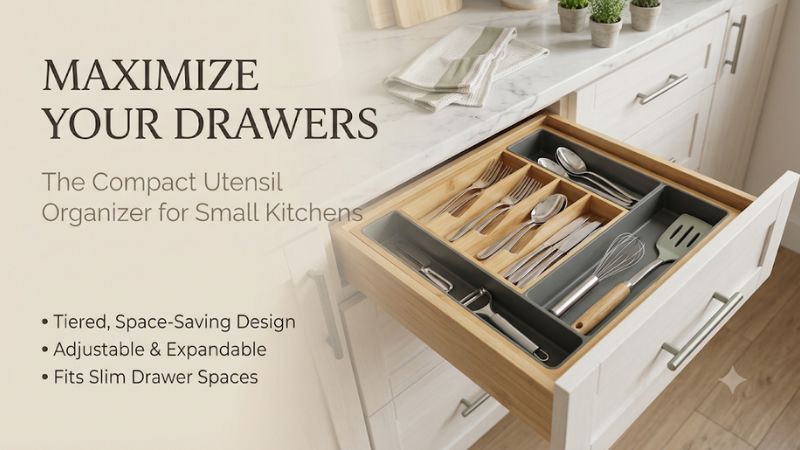
Why Small Kitchens Need a Different Organization Strategy
Small kitchens often have narrow drawers, shallow cabinet openings, and limited space for separating cooking tools from dining utensils. A standard full-width silverware tray may consume nearly the entire drawer, leaving no place for measuring spoons or a can opener. A large utensil organizer can create the opposite problem by forcing the drawer to become overcrowded.
A useful system must account for the available storage rather than requiring the kitchen to adapt to an oversized product.
Common small-kitchen challenges
- Narrow interior drawer width.
- Shallow drawer height.
- Long utensils that do not fit.
- Mixed flatware and cooking tools.
- Limited alternative storage.
- Irregular cabinet shapes.
- Complicated access to rear sections.
- Too many duplicate kitchen gadgets.
- Little room for additional storage containers.
The most effective improvement often begins with reducing the number of items in the drawer.
A kitchen drawer filled with three spatulas, several duplicate bottle openers, and rarely used accessories may need decluttering more than a new organizer.
Once unnecessary products are removed, a compact tray can create clear categories for the remaining essentials.
How to Choose a Drawer Organizer for a Small Kitchen
The right organizer should fit without modifications, support the utensils used daily, and allow the drawer to open and close normally. In small kitchens, height and depth can be just as important as width because stacked flatware or tall gadgets may interfere with the drawer frame. The following criteria explain how to select a suitable design without wasting money or storage space.
Measure the Real Drawer Opening
Before shopping, measure the usable interior dimensions of the drawer. Cabinet drawers may have decorative fronts that appear wider than the actual storage compartment, while internal runners and corner details reduce the space available for a tray. Height should be measured carefully because a compact organizer can still be too tall once utensils are loaded.
Measurements to record
- Interior width.
- Interior depth.
- Clear height.
- Space beneath the drawer frame.
- Length of the longest utensil.
- Height of stacked cutlery.
- Rear clearance.
- Space required for removable sections.
Use the smallest relevant dimension rather than rounding upward.
For example, a drawer that measures 12 inches wide at the front may have less usable space farther back.
An organizer that fits tightly might be difficult to remove for cleaning.
Leave a small amount of practical clearance where necessary.
Buying recommendation: Select the organizer’s size from internal drawer measurements, not cabinet-front dimensions.
Choose a Compact or Tiered Cutlery Tray
Compact and tiered trays are especially useful when the kitchen has limited width but still needs separate storage for forks, spoons, and table knives. A tiered design places compatible flatware into overlapping compartments, allowing more categories to occupy a narrow footprint. However, stacked arrangements require enough drawer height for both the organizer and the utensils.
Compact tray advantages
- Uses less width.
- Maintains separate flatware categories.
- Can fit narrow drawers.
- Often requires no installation.
- Easy to remove and rearrange.
Tiered tray considerations
- May save horizontal space.
- Can increase loaded height.
- Requires correct utensil orientation.
- May not fit oversized handles.
- Needs regular cleaning beneath overlapping sections.
Joseph Joseph’s DrawerStore compact tiered design illustrates this approach, while the OXO Compact Utensil Drawer Organizer is intended for tight and shallow drawers.
The best option depends on the utensils’ thickness and the drawer’s height.
Buying recommendation: Use tiered storage when width is limited but sufficient vertical clearance remains.
Separate Everyday Flatware From Long Tools
A small kitchen may have only one main utensil drawer, but forks and long cooking tools do not need to occupy the same compartment. Flatware is relatively short and narrow, while spatulas, tongs, and whisks require longer spaces. Organizing them by shape and frequency of use can make one drawer more functional without adding unnecessary accessories.
Suggested categories
- Forks.
- Spoons.
- Dinner knives.
- Measuring spoons.
- Small kitchen gadgets.
- Spatulas.
- Tongs.
- Whisks and other long tools.
If space is extremely limited, move some long utensils to an appropriate countertop holder or cabinet location.
Avoid placing sharp blades loosely inside the main flatware tray.
Choose safe knife storage designed for the purpose.
Buying recommendation: Give prime drawer space to the utensils used most frequently.
Consider Modular Bins for Irregular Drawers
Modular drawer organizers are individual compartments that can be arranged according to available space. They may be useful when a drawer has an unusual shape or when a conventional rectangular tray leaves large gaps. However, modular systems can become inefficient if too many small containers are used for products that would fit in one larger section.
Modular storage advantages
- Flexible arrangement.
- Independent compartments.
- Can adapt to different utensils.
- Easier to replace one component.
- Useful for changing storage needs.
Potential limitations
- Gaps between containers.
- More surfaces to clean.
- Small bins may shift without interlocking.
- Too many compartments can create clutter.
- Cost increases when purchasing multiple pieces.
For a drawer containing mixed measuring tools and small gadgets, several interlocking bins may work better than a standard flatware tray.
However, do not purchase a large modular set simply to create a matching appearance.
Buying recommendation: Choose modular compartments when the drawer shape or contents genuinely require flexibility.
Evaluate Expandable Organizers Carefully
Expandable utensil organizers can make better use of available drawer width, but the minimum dimensions still matter. A product that expands to fit a large drawer may be too wide for a compact kitchen even in its smallest position. Expansion mechanisms can also introduce additional components that require cleaning and proper alignment.
Questions to ask
- What is the minimum width?
- What is the maximum width?
- Does expansion use the drawer’s width or depth?
- Does it lock into position?
- How tall is the loaded organizer?
- Can compartments be removed?
- Does expansion create useful storage?
- Can the drawer close normally?
Some products expand sideways, while others extend toward the back of a deep drawer.
These mechanisms are not interchangeable.
A side-expanding tray may be ideal for a medium-width drawer but unsuitable for a narrow cabinet.
Buying recommendation: Verify both the minimum and maximum dimensions rather than relying on the word expandable.
Use Drawer Height Without Blocking Movement
Small kitchens sometimes have deep drawers that offer opportunities for layered storage. A sliding upper compartment can hold smaller gadgets while longer tools remain below. However, a layered system must leave enough clearance for the contents and movement. A design that jams every time the drawer opens is not a useful improvement.
Height considerations
- Total organizer height.
- Height of utensils inside.
- Clearance beneath the cabinet frame.
- Space needed for sliding components.
- Drawer runner position.
- Stability when loaded.
- Access to the lower layer.
A deep drawer may benefit from a sliding system, but an ordinary shallow drawer often works better with one simple tray.
Do not attempt to stack unapproved organizers on top of one another.
Buying recommendation: Use vertical organization only when the complete loaded arrangement fits safely.
Choose Easy-Clean Materials and Simple Corners
Utensil organizers collect crumbs, food residue, and dust over time, particularly in households that use the kitchen frequently. A product with accessible corners and removable parts is easier to maintain than one with complicated narrow grooves. Materials and care requirements also vary between plastic, bamboo, and other constructions.
Material comparison
| Material | Main Advantage | Cleaning Consideration |
|---|---|---|
| Plastic | Lightweight and versatile | Some models require handwashing |
| Bamboo | Attractive natural appearance | Avoid prolonged moisture |
| Stainless steel | Rigid construction | Check corners and surface care |
| Soft-grip lining | Helps reduce utensil movement | Can trap crumbs |
| Removable tray sections | Easier access for cleaning | Reassemble correctly |
Do not assume that every plastic tray is dishwasher-safe.
Some manufacturers specify handwashing even for products intended for everyday kitchen use.
Buying recommendation: Choose an organizer that can be cleaned using the routine you are willing to maintain.
Avoid Buying Storage for Rarely Used Gadgets
A small utensil drawer should serve the daily kitchen routine first. Tools used once or twice a year do not need to occupy the same accessible positions as forks, spoons, and essential cooking utensils. Removing duplicates and relocating infrequently used gadgets can create more usable space than purchasing a complicated organizer.
Items worth reviewing
- Duplicate measuring spoons.
- Extra bottle openers.
- Rarely used specialty peelers.
- Damaged utensils.
- Unnecessary serving tools.
- Duplicate spatulas.
- Promotional kitchen gadgets.
- Outdated tools no longer used.
Keep utensils that genuinely support the household’s cooking habits.
A compact drawer with fewer useful items is easier to maintain than a large organizer filled with unnecessary products.
Buying recommendation: Declutter before investing in additional compartments.
Comparison: Small-Kitchen Drawer Organizer Types
A narrow drawer may need a compact tray, while a deeper compartment can accommodate modular or layered storage. No format is universally superior because each addresses a different constraint. The following comparison helps match the organizer to the available space and intended contents without assuming that every household needs an expensive adjustable system.
| Organizer Type | Best For | Main Benefit | Watch-Out |
|---|---|---|---|
| Compact cutlery tray | Narrow drawers | Uses little width | Limited large-tool space |
| Tiered cutlery organizer | Narrow but adequately deep drawers | Overlapping compartments | Loaded height |
| Expandable tray | Medium-size drawers | Adjustable coverage | Minimum size |
| Modular bins | Irregular compartments | Flexible arrangement | Gaps and shifting |
| Long utensil tray | Spatulas and tongs | Accommodates long tools | Requires drawer depth |
| Sliding upper compartment | Deep drawers | Uses vertical space | Movement clearance |
Choose one primary organizer format before adding supplementary components.
A combination of two simple organizers may work better than one complex product when the drawer contains very different tools.
Step-by-Step Small-Kitchen Drawer Setup
Organizing a small drawer is easier when the project follows a practical sequence. The main goal is to identify everyday essentials, choose a fitting storage layout, and test whether utensils remain accessible during normal cooking. Starting with the contents instead of the organizer reduces wasted purchases and helps create a system that can be maintained.
Step 1: Empty and Sort the Drawer
Remove every utensil and place the contents on a clean surface. Separate daily essentials from occasional tools and inspect items for damage. This reveals how much storage is truly required and may identify duplicate products that occupy valuable space.
Actions
- Remove all utensils.
- Clean the drawer.
- Sort flatware by type.
- Separate cooking tools.
- Remove duplicates.
- Inspect damaged utensils.
- Identify the longest items.
- Count daily-use products.
Do not force yourself to keep every gadget inside the drawer.
Move occasional accessories to an appropriate secondary location.
Step 2: Create a Simple Layout
Arrange utensils on the counter in the approximate shape of the drawer. This makes it easier to estimate the number and size of compartments required. Place commonly used items in the most accessible positions, while less frequently used tools can occupy the rear sections.
Suggested layout
- Main section: Forks and spoons.
- Separate section: Dinner knives.
- Small compartment: Measuring spoons.
- Long section: Spatula or tongs.
- Remaining space: Selected gadgets.
Keep the layout simple enough that another household member can understand it immediately.
Step 3: Install and Test the Organizer
Place the chosen tray in the drawer and load it gradually. Check that the drawer opens and closes without contact, and make sure utensils do not rise above the available clearance. If the organizer slides excessively, verify that its nonslip components are correctly positioned.
Test checklist
- Drawer closes completely.
- No utensils catch the frame.
- Organizer remains stable.
- All compartments are accessible.
- Long tools fit.
- Sharp items are safely stored.
- Tray can be removed for cleaning.
If the fit is awkward, consider a different configuration rather than forcing the drawer shut.
Step 4: Maintain the Arrangement
A small drawer becomes crowded quickly when new utensils are added without removing old ones. Review the contents periodically and return each item to its intended compartment after cleaning. Maintaining a simple system is usually easier than adding more organizers.
Maintenance habits
- Return utensils to designated sections.
- Remove crumbs promptly.
- Clean the tray periodically.
- Avoid accumulating duplicates.
- Check for damaged components.
- Reevaluate storage as cooking habits change.
The system should remain practical during ordinary use.
Small-Kitchen Layout Ideas
A compact kitchen may have one narrow flatware drawer, a deep lower drawer, or an unusual arrangement where utensils share space with cooking tools. Each situation benefits from a different organization approach. The examples below focus on keeping essentials accessible while reducing unnecessary containers and complicated layouts.
Studio Apartment With One Main Drawer
A studio kitchen may have only one drawer for silverware and small gadgets. A compact tray should occupy one side, while a narrow open section can hold essential cooking tools. Large spatulas or bulky utensils may be better stored elsewhere.
Suggested arrangement
- Compact flatware tray.
- One small gadget compartment.
- Separate storage for long utensils.
- Minimal duplicates.
- Clear drawer movement.
A simple arrangement can be highly effective when the utensil collection is modest.
Small Family Kitchen
A family kitchen may need more flatware than a studio apartment while still having limited drawer space. A compact or tiered tray can organize everyday utensils, and a separate container may hold measuring tools or child-sized utensils when appropriate.
Suggested arrangement
- Main compartments for daily flatware.
- Dedicated small-item section.
- Separate cooking-tool location.
- Safe storage for knives.
- Clear labels if useful.
Do not use a crowded utensil drawer as unsecured storage for sharp blades.
Older Kitchen With Irregular Drawers
Older cabinetry may have unusual drawer dimensions or internal obstructions that prevent conventional trays from fitting. Modular organizers can be arranged around these constraints without requiring cabinet modification. However, too many small compartments can waste space, so begin with the fewest pieces possible.
Suggested arrangement
- One main flatware organizer.
- One or two additional bins.
- Adequate clearance around drawer hardware.
- No forced installation.
- Easy removal for cleaning.
A flexible layout may be more useful than a standard matching tray.
Common Mistakes in Small-Kitchen Drawer Organization
Small kitchens are especially sensitive to storage mistakes because one oversized accessory can make an entire drawer unusable. Common problems include ignoring loaded height, buying a tray with an unsuitable minimum width, and trying to keep every kitchen gadget in the main drawer. Avoiding these errors can improve organization without major expense.
Mistakes to avoid
- Measuring the cabinet front instead of the drawer interior.
- Ignoring utensil stack height.
- Purchasing a large expandable tray for a narrow drawer.
- Creating too many tiny compartments.
- Storing long utensils across the top of flatware.
- Keeping duplicate tools unnecessarily.
- Allowing trays to slide during drawer movement.
- Failing to clean beneath organizers.
- Storing sharp knives loosely.
- Using unsuitable cleaning methods.
- Forcing drawer mechanisms.
- Choosing appearance over everyday access.
The best small-kitchen organizer makes the drawer easier to open, use, and maintain.
Frequently Asked Questions
Small kitchen drawers can be difficult to organize because they must accommodate everyday utensils within limited dimensions. Buyers often wonder whether expandable trays, tiered organizers, or modular bins provide the best use of space. The following answers clarify the practical differences and help avoid common fit and maintenance problems.
What Is the Best Drawer Utensil Organizer for a Small Kitchen?
A compact or tiered cutlery organizer is often a sensible starting point when drawer width is limited. Modular bins can be useful for irregular drawers, while an expandable tray may fit better when the drawer has sufficient width.
Measure the actual interior first.
The most suitable design depends on your utensils and available height.
How Do I Organize Utensils in One Small Drawer?
Separate everyday flatware into clear categories and reserve the remaining space for only the most frequently used gadgets. Long cooking tools may need a separate location if they prevent the drawer from closing.
Remove unnecessary duplicates.
Avoid trying to fit every kitchen accessory into one organizer.
Are Tiered Cutlery Organizers Good for Shallow Drawers?
Tiered organizers can save width, but their overlapping sections and stored utensils may require more height than a conventional flat tray. Some shallow drawers cannot accommodate them.
Check the fully loaded height.
Do not rely only on the organizer’s empty dimensions.
Can I Use Expandable Organizers in Narrow Drawers?
Only when the organizer’s minimum dimensions fit the drawer. Some products expand sideways and are intended for medium or large drawers, while others adjust in depth.
Verify the exact measurements.
An organizer described as adjustable is not automatically suitable for a small drawer.
How Can I Keep a Small Utensil Drawer Organized?
Keep only useful items in the drawer, return tools to their designated compartments, and remove duplicates periodically. Clean the tray and underlying drawer surface when crumbs or residue accumulate.
A simple repeatable layout is more important than having many compartments.
Conclusion
The right drawer utensil organizer for small kitchens should preserve space while keeping everyday flatware and cooking tools easy to retrieve. Compact trays are practical for narrow drawers, tiered organizers can make better use of width when height permits, and modular bins help with irregular layouts. Measure the drawer carefully, separate long utensils where possible, and remove unnecessary gadgets before buying. A small number of well-chosen compartments can create a more functional kitchen than an oversized adjustable tray that barely fits.







Write Your Review
No reviews yet. Be the first to share your experience!