
A pot lid organizer for meal prep should make it easier to switch between saucepans, skillets, and stockpots while preparing several dishes. Instead of searching through stacks of cookware, you need lids that are visible, accessible, and stored safely. This guide explains how to choose the right organizer for your kitchen layout, cookware sizes, and weekly meal preparation routine.
- Quick Answer: What Kind of Organizer Works Best?
- Why Meal Prep Changes Your Storage Requirements
- How to Choose a Pot Lid Organizer for Meal Prep
- Comparing Organizer Formats for Meal Preparation
- Recommended Meal-Prep Storage Setups
- Common Mistakes When Organizing Lids for Meal Prep
- Frequently Asked Questions
- Conclusion
Quick Answer: What Kind of Organizer Works Best?
For regular meal preparation, the most practical solution is usually an adjustable organizer that holds several lids vertically and allows each one to be removed independently. A cabinet or deep-drawer rack works well when you use multiple pots during the same cooking session, while individual door-mounted holders may be better when cabinet shelves are already crowded with cookware.
Best organizer formats by need:
- Several different pot lids: Adjustable divider rack.
- Deep cookware drawer: Expandable vertical organizer.
- Small kitchen cabinet: Cabinet-door lid holders.
- Three frequently used lids: Compact freestanding stand.
- Combined pan and lid storage: Multipurpose cookware rack.
- Very limited shelf space: Compatible wall-mounted holder.
The main priority is not maximizing the number of lids stored in one rack. Meal preparation involves repeated movements, and a crowded organizer can become frustrating when one cover must be removed from between several others.
Choose a design that gives each important lid enough space for quick retrieval.
Why Meal Prep Changes Your Storage Requirements
Meal preparation often involves cooking several foods during a relatively short period. A household might simmer rice, steam vegetables, cook a protein, and prepare soup during the same session. Different cookware sizes can require different lids, and covers may be removed repeatedly to stir, check doneness, or control evaporation. A suitable organizer should support this workflow rather than merely make the cabinet look tidy.
A useful meal-prep storage system should:
- Keep frequently used lids close to the cookware.
- Make different sizes easy to identify.
- Reduce unnecessary stacking.
- Allow quick removal without disturbing other lids.
- Keep hot-lid handling separate from long-term storage.
- Support easy cleaning after cooking.
- Accommodate changes in the cookware collection.
For example, a family preparing meals twice weekly may routinely use one large stockpot, two medium saucepans, and a covered skillet.
If the lids are stacked together, retrieving the correct cover can require several unnecessary movements.
A vertical rack allows the cook to identify and remove the desired lid more directly.
However, a storage organizer is not necessarily a heat-safe resting place for lids removed from active cooking.
Hot lids should be placed on an appropriate heat-resistant surface or designated cooking accessory, not automatically returned to a plastic cabinet organizer.
How to Choose a Pot Lid Organizer for Meal Prep
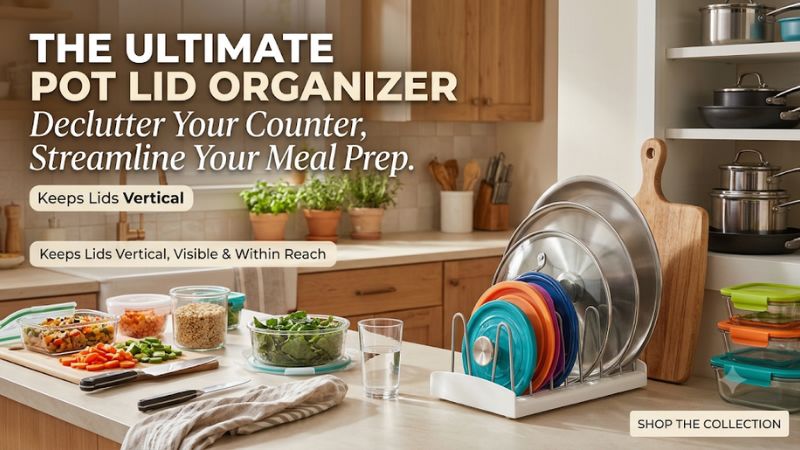
Buying a lid organizer for frequent cooking requires more attention to daily access than buying one for occasional cookware storage. Size, support geometry, location, cleaning effort, and compatibility with existing lids all affect whether the organizer genuinely improves meal preparation. A practical selection process begins with the cookware you use most often, not a photograph of a perfectly arranged cabinet.
Count the Lids You Actually Use During Meal Prep
The first step is to identify the lids that regularly participate in cooking sessions. Many households own more lids than they use, especially when cookware sets include several similar saucepan covers. Counting the entire collection can lead to buying an oversized organizer when only a few lids need convenient daily access.
Make a simple inventory
- Large stockpot lid.
- Medium saucepan lid.
- Small saucepan lid.
- Skillet lid.
- Sauté pan lid.
- Specialty cooker lid.
- Extra lids used occasionally.
Separate these into frequently used and occasional categories.
For example, if you use three lids every weekend and two additional lids only during holidays, the main organizer does not necessarily need to accommodate all five in the same accessible position.
Keeping rarely used covers elsewhere can create more comfortable spacing for everyday cookware.
Consider whether any lids are interchangeable between pots of the same size. Only treat them as interchangeable when they fit correctly and are suitable for the intended cooking task.
Buying recommendation: Choose an organizer that accommodates the frequently used lids without tight packing, then decide whether the occasional covers should share that space.
Measure Diameter, Rim Thickness, and Knob Height
A pot lid’s diameter is only one part of its storage footprint. Glass lids commonly have projecting knobs, raised rims, and metal fittings that increase their effective thickness. These features matter particularly in deep drawers, where a lid may fit horizontally between dividers but extend too high to allow the drawer to close.
Measurements to record
- Diameter: Widest part of the cover.
- Rim thickness: Width of the edge that enters the organizer.
- Knob height: Distance from the lid surface to the top of the handle.
- Overall storage height: Required clearance when standing upright.
- Weight: Important for mounted holders.
- Handle position: Central knob or side handles.
Use a tape measure to record the largest lid first.
Then identify the smallest and most irregularly shaped covers.
These dimensions provide a useful compatibility range when evaluating adjustable racks.
For drawer storage, measure the internal height with the drawer fully closed. Do not rely solely on the height of the empty organizer.
A large glass lid may rise significantly above a low rack.
Buying recommendation: Adjustable partitions are particularly useful when the collection contains lids with different rim thicknesses and knob profiles.
Choose Between Cabinet, Drawer, and Door Storage
The storage location affects how efficiently lids can be retrieved during cooking. Deep drawers allow top-down visibility and can keep cookware within easy reach, while cabinets offer more flexibility for taller covers. Door-mounted holders use otherwise empty surfaces but need enough interior clearance to avoid collisions when the cabinet closes.
Cabinet shelf storage
- Suitable for freestanding organizers.
- Accommodates a wide range of lid heights.
- Easy to rearrange.
- May require bending or reaching into the cabinet.
Deep drawer storage
- Provides convenient top-down access.
- Works well with upright lids.
- Often keeps pots and lids together.
- Requires careful knob-height measurements.
Cabinet-door storage
- Frees shelf space.
- Works for a small number of lids.
- Requires suitable mounting surfaces.
- Must not interfere with door movement.
For meal prep, the most convenient location is usually near the primary cooking area but away from hazards associated with hot burners and steam.
Avoid placing a lid organizer where it interferes with opening the oven, dishwasher, or other frequently used equipment.
Buying recommendation: Choose the location that minimizes unnecessary movement during meal preparation without creating unsafe storage conditions.
Evaluate Adjustable and Fixed Divider Designs
Adjustable organizers give you the ability to change the spacing between lids, which can be valuable when replacing cookware or reorganizing a kitchen. Fixed-divider racks may be simpler but can waste space when several lids have unusually large handles. Neither design is automatically superior; the choice depends on whether the cookware collection is uniform or varied.
Adjustable racks are useful when:
- Lid sizes differ significantly.
- Several glass covers have thick knobs.
- You frequently replace or add cookware.
- The rack also stores frying pans.
- You want flexible spacing.
Fixed racks are useful when:
- Lids are similar in shape.
- Storage requirements rarely change.
- You prefer a simple layout.
- The slot dimensions have already been confirmed.
- The organizer fits a dedicated compartment.
A compact fixed rack can work extremely well for a small set of matching saucepans.
However, an adjustable product can better accommodate a changing kitchen.
Check how the dividers attach to the base. Some designs use removable steel wires, while expandable racks rely on a connected frame.
The mechanism should remain stable when loaded according to manufacturer instructions.
Buying recommendation: For a mixed meal-prep cookware collection, adjustable spacing is generally the more flexible starting point.
Prioritize Stability and Protection for Glass Lids
Many cookware sets include tempered glass lids that are convenient for monitoring food during simmering. These covers need secure support, because collisions with other hard objects or accidental falls can cause damage. A storage rack should prevent lids from rolling and reduce unnecessary contact between adjacent covers.
Useful safety features
- Stable base.
- Appropriate divider spacing.
- Coated contact surfaces.
- Nonslip feet where applicable.
- Secure individual support.
- Adequate room for knobs.
- Suitable cabinet location.
When testing a rack, pay attention to how lids behave while being removed.
If lifting one cover causes another to tip, the spacing or arrangement should be adjusted.
Avoid storing large glass lids on high unstable shelves where they could fall during retrieval.
Inspect cookware regularly for damaged rims, chips, loose handles, or other defects.
Do not continue using glass cookware that shows signs of unsafe damage.
Buying recommendation: Favor secure support and adequate clearance over a higher nominal capacity.
Consider How You Handle Hot Lids During Cooking
A permanent organizer is primarily a storage tool, not necessarily a heat-resistant cooking accessory. During meal preparation, lids may become hot and collect steam condensation. Returning them directly to a plastic cabinet rack can damage the organizer, introduce moisture, or create a burn hazard. The cooking workflow should include a separate safe place to rest hot lids.
Practical handling tips
- Use appropriate oven mitts or heat-resistant protection.
- Keep hot lids away from children.
- Place hot covers on suitable heat-resistant surfaces.
- Allow condensation to drain safely.
- Keep wet lids away from dry storage supplies.
- Return lids to cabinet storage only when appropriate.
- Follow cookware-specific cooling and care instructions.
Some countertop lid stands are intended for use during cooking, but their actual heat limitations must be verified.
Do not assume that a rack designed for storing cold cookware is suitable for holding a hot lid.
Also avoid placing hot glass directly on a cold or wet surface if the cookware manufacturer’s instructions warn against thermal shock.
Buying recommendation: Separate long-term lid storage from temporary hot-lid handling unless the selected product is specifically suitable for both.
Choose Materials That Are Easy to Maintain
Meal-prep kitchens experience frequent cooking, making grease, steam, and water exposure relevant to organizer maintenance. Plastic bases, coated steel dividers, stainless steel frames, and adhesive-mounted holders have different cleaning needs. A practical organizer should allow food residue and dust to be removed without extensive disassembly.
Material considerations
- Coated steel: Provides structured support with a protective finish.
- Stainless steel: Common in adjustable racks and relatively simple to wipe.
- Plastic: Lightweight and often suitable for hand cleaning.
- Nonslip components: Help keep freestanding units in place.
- Adhesive mounts: Require compatible surfaces and correct installation.
- Removable partitions: Can simplify access during cleaning.
Follow the specific manufacturer’s care instructions.
For example, some rack bases should be hand-washed rather than placed in the dishwasher.
Grease can accumulate around divider sockets and inside cabinet corners.
Cleaning should include the underlying shelf, not only the visible organizer.
A rack that can be removed easily may be particularly convenient when cookware is used every day.
Buying recommendation: Choose a system that can be cleaned and inspected without complicated maintenance.
Comparing Organizer Formats for Meal Preparation
The most appropriate organizer depends on the number of lids used in one cooking session, the available cabinet configuration, and the frequency of access. A cook who prepares several meals simultaneously may benefit from a large adjustable rack, while someone who uses only two saucepan lids may find an individual holder more convenient. The following comparison summarizes the strengths of different storage formats.
| Organizer Format | Best Use | Main Benefit | Key Limitation |
|---|---|---|---|
| Adjustable divider rack | Mixed cookware collection | Flexible spacing | Uses shelf or drawer space |
| Expandable rack | Wide drawers | Adjustable overall footprint | Can be awkward in narrow compartments |
| Door-mounted holder | Limited shelf space | Uses cabinet door | Weight and clearance restrictions |
| Compact stand | Two or three lids | Small storage footprint | Limited expansion |
| Pan-and-lid organizer | Shared cookware drawer | Multipurpose storage | Requires more room |
| Individual wall holder | One frequently used lid | Minimal shelf usage | Surface compatibility matters |
An organizer format should be selected according to the actual storage problem. Buying the largest rack may be unnecessary when the collection is small, while an individual holder may become frustrating when preparing several dishes requiring different lids.
Recommended Meal-Prep Storage Setups
A practical kitchen organization system should reflect how meals are prepared, which cookware is used together, and where cleaning and storage take place. The following examples show how different households can organize lids without committing to unnecessary accessories. Each setup emphasizes accessible storage, adequate spacing, and a location that supports routine cooking.
Setup One: Weekly Meal Prep for One or Two People
A smaller household preparing several lunches at once may use one medium saucepan, a skillet, and a covered pot for rice or vegetables. In this situation, three compatible lid positions can provide enough organization without occupying a large cabinet. A compact stand or small adjustable rack is usually worth considering before more elaborate storage systems.
Suggested arrangement
- Store three frequently used lids together.
- Position the rack near the cookware cabinet.
- Use the easiest slot for the most frequently used cover.
- Keep larger occasional lids elsewhere.
- Leave enough room to remove each lid separately.
This arrangement is especially practical in apartment kitchens where cabinet space is limited.
Avoid adding multiple organizers unless the existing storage problems justify them.
Setup Two: Family Meal Prep With Several Pots
A family preparing a week’s worth of meals may use multiple saucepans, skillets, and large stockpots. The lid collection can include several glass covers with different knobs and rim profiles. An adjustable divider rack or combined pan-and-lid organizer offers more flexibility than a small fixed stand.
Suggested arrangement
- Group lids by diameter.
- Keep the most-used covers near the front.
- Assign wider spaces to thick glass lids.
- Keep large heavy covers in stable lower storage.
- Label occasional lids if several look similar.
- Store matching cookware nearby.
A deep drawer can be particularly useful if its height accommodates all the lids.
If the drawer is too shallow, a cabinet shelf may be the better option.
Setup Three: Compact Kitchen With Crowded Cabinets
When pots already occupy most cabinet shelves, moving lids to a suitable cabinet door can reclaim valuable space. Individual holders may be preferable to a wide freestanding rack, provided the door’s interior surface and clearance are compatible. The arrangement should allow the door to close normally without striking cookware or shelves.
Suggested arrangement
- Choose the two or three most frequently used lids.
- Measure the available door area.
- Check each lid’s weight.
- Confirm the mounting requirements.
- Test cabinet closure before installation.
- Leave sufficient space around hinges.
This is a useful option for small kitchens but should not be used where the door or mounting system cannot safely support the load.
Setup Four: Cookware Drawer With Frying Pans and Lids
A mixed cookware drawer may contain several frying pans, their covers, and one or two saucepan lids. Separate organizers can consume considerable space, especially when the drawer is wide but not especially deep. A multipurpose rack with adjustable dividers may allow cookware to stand upright while using the same storage area efficiently.
Suggested arrangement
- Place large pans in wider slots.
- Keep lids in narrower spaces.
- Orient handles according to the rack design.
- Test drawer closure with all cookware loaded.
- Avoid contact between delicate nonstick surfaces.
- Remove unnecessary duplicates.
The main benefit is a coherent storage arrangement rather than a higher number of compartments.
Common Mistakes When Organizing Lids for Meal Prep
A lid organizer can become frustrating if it is overloaded, placed too far from the cooking area, or selected without accounting for handle dimensions. Meal preparation makes these weaknesses particularly noticeable because lids are accessed repeatedly during a relatively short period. Avoiding common mistakes helps maintain an efficient cooking routine and reduces unnecessary contact between cookware pieces.
Mistakes to avoid
- Buying based only on the advertised number of slots.
- Forgetting to measure raised lid knobs.
- Storing heavy glass lids high above the counter.
- Returning hot lids to unsuitable plastic organizers.
- Using a crowded rack that causes lids to collide.
- Mounting holders on unsuitable cabinet surfaces.
- Allowing wet lids to remain in enclosed storage.
- Blocking drawers with protruding handles.
- Keeping rarely used lids in prime storage positions.
- Ignoring cleaning around the rack base.
An effective organizer should make lids easier to access without forcing the cook to think about the storage system during every meal.
Frequently Asked Questions
When choosing a lid organizer for meal prep, buyers often focus on capacity but overlook workflow, cookware compatibility, and hot-lid handling. The following questions explain how to choose storage that supports frequent cooking while preserving safety and avoiding unnecessary expense or installation complexity.
What Is the Best Pot Lid Organizer for Weekly Meal Prep?
An adjustable divider rack is a practical starting point for households using several different lids each week. It allows spacing to be changed for thick glass covers and smaller metal lids. A deep-drawer arrangement may be particularly convenient when the cookware is stored nearby, provided the height and drawer opening are suitable.
Choose a rack that accommodates your actual collection.
A model with fewer well-spaced slots may be more useful than a crowded organizer advertised for a larger number of lids.
Should I Store Pot Lids Separately From Cookware?
Separate storage is often useful when stacking pots and lids creates instability or makes individual covers difficult to retrieve. Keeping lids upright may reduce contact between glass surfaces and metal cookware. However, storing a lid with its pot can also be convenient when both pieces fit securely and the cabinet has enough room.
The best arrangement depends on how frequently each pot is used.
For weekly meal prep, keeping frequently used lids near their matching cookware is often helpful.
Can I Put Hot Pot Lids Into a Cabinet Organizer?
Do not assume that an ordinary cabinet organizer is suitable for hot cookware. Plastic bases, adhesives, protective coatings, and cabinet finishes may have temperature restrictions. Condensation from a hot lid can also introduce moisture into storage spaces. Use a suitable heat-resistant surface while cooking, and follow the cookware manufacturer’s cooling instructions.
Return lids to normal storage only when they can be handled safely and the organizer is suitable.
How Many Pot Lids Should a Meal-Prep Kitchen Keep Accessible?
Keep the lids you use regularly in the most convenient storage positions. The exact number depends on the household’s cooking routine, cookware collection, and available space. Many people need immediate access to only a few lids, while larger families may use several covers during one preparation session.
Start with the frequently used cookware and expand storage only when necessary.
Avoid allowing occasional specialty lids to crowd daily-use supplies.
Can a Pot Lid Organizer Also Hold Frying Pans?
Some adjustable racks are designed for both pans and lids, while specialized lid holders may not be suitable for cookware. Check the manufacturer’s intended use and load restrictions before storing frying pans in a lid organizer. Frying-pan handles also change the amount of required cabinet depth and height.
A multipurpose rack can be convenient when the entire cookware collection needs reorganizing.
However, dedicated lid holders are usually more compact when only covers need storage.
Conclusion
The best pot lid organizer for meal prep should keep frequently used covers easy to identify, remove, clean, and return after cooking. Adjustable racks are particularly useful for mixed cookware collections, while compact stands and cabinet-door holders can make sense in smaller kitchens. Begin by measuring the actual lids, including handles and rims, then choose a storage location that supports your cooking routine without blocking cabinets or creating safety hazards. Prioritize stable spacing and convenient access rather than maximum capacity, and use separate appropriate surfaces for hot lids during meal preparation.

Write Your Review
No reviews yet. Be the first to share your experience!