
A pan organizer rack for easy cleaning should make cookware accessible while preventing grease, dust, and moisture from collecting in hard-to-reach spaces. The best design separates frying pans, allows simple cabinet maintenance, and supports safe storage after washing. This guide explains which materials, features, and layouts make a rack easier to clean and maintain.
- Quick Answer: Which Pan Organizer Is Easiest to Clean?
- Why Cleaning Matters When Choosing a Pan Rack
- How to Choose a Pan Organizer Rack for Easy Cleaning
- Comparison: Which Pan Rack Design Is Easiest to Maintain?
- A Simple Cleaning Routine for Pan Organizers
- Common Mistakes That Make Pan Racks Harder to Clean
- Practical Storage Setups for Different Kitchens
- Frequently Asked Questions
- Conclusion
Quick Answer: Which Pan Organizer Is Easiest to Clean?
For most households, a freestanding rack with removable dividers and an accessible base is a practical choice. It allows cookware to be taken out individually while making the organizer easier to wipe down. Powder-coated steel or suitable plastic components can work well when cared for according to the manufacturer’s instructions. The best option is not necessarily the most complex organizer, but one that can be cleaned without unnecessary disassembly.
Look for these features:
- Removable or adjustable dividers.
- Open construction.
- Accessible corners and base surfaces.
- Suitable moisture-resistant materials.
- Smooth, easy-to-wipe contact points.
- Stable placement.
- Enough space between cookware.
- Simple removal from the cabinet.
A well-designed rack should also be compatible with the pans you own.
A model that is easy to clean but cannot support your cookware safely is not an appropriate purchase.
The goal is to reduce everyday maintenance while improving access to clean, dry cookware.
Why Cleaning Matters When Choosing a Pan Rack
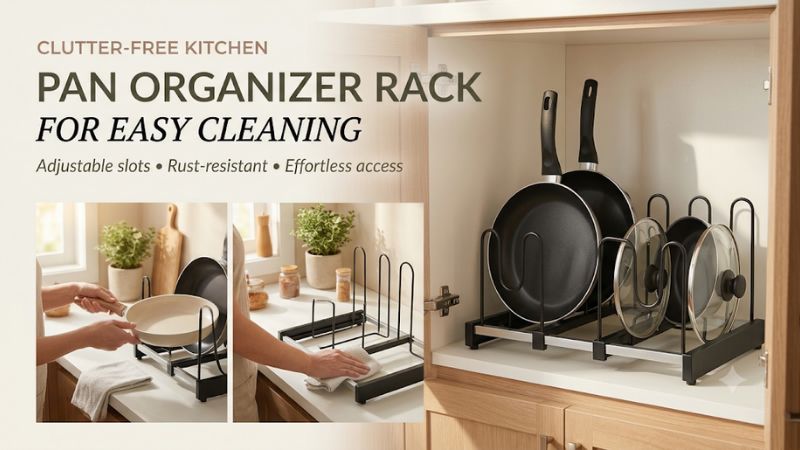
Cookware storage areas can collect grease, food particles, dust, and moisture over time. These problems are especially noticeable when pans are stored near the stove or when washed cookware is returned before drying completely. A rack that separates pans can make individual items easier to inspect, but the organizer itself must also be cleaned periodically. Choosing a simple, accessible design helps prevent hidden residue.
An easy-clean organizer offers several advantages.
- Fewer inaccessible contact areas.
- Easier inspection for spills.
- Better access to cabinet surfaces.
- Simpler handling of clean cookware.
- Less direct contact between stacked pans.
- More convenient removal of individual items.
- Easier identification of moisture or residue.
Consider a cabinet where four frying pans are stacked directly on top of one another.
When the bottom pan is needed, the upper pieces must be lifted and placed elsewhere.
This can create unnecessary contact between cooking surfaces and make the cabinet harder to clean.
A vertical rack allows each compatible pan to occupy a separate position.
However, vertical storage only improves organization if the dividers remain clean and the rack is positioned correctly.
How to Choose a Pan Organizer Rack for Easy Cleaning
Selecting an easy-clean organizer requires more than choosing a product advertised as washable. The cleaning process depends on the materials, construction, number of components, cabinet location, and everyday cookware routine. A design with removable sections may offer better access than a complicated fixed frame, while a smooth solid base can be easier to wipe than some intricate wire arrangements.
Choose Materials That Match Your Cleaning Routine
Organizer materials differ in how they respond to water, cleaning products, grease, and repeated handling. Stainless steel, powder-coated steel, and suitable plastic are common choices for kitchen storage, but their specific care requirements depend on product construction. An easy-clean rack should tolerate the cleaning method you plan to use without damaging its finish or weakening components.
Common materials
- Stainless steel: Often suitable for regular wiping and careful washing.
- Powder-coated steel: Provides a protective finish but should be kept dry.
- Plastic: Can be lightweight and convenient to hand-clean.
- Coated wire: Helps separate cookware and reduce bare-metal contact.
- Nonslip feet: Improve stability but may require separate cleaning.
- Wood: May need extra care to avoid prolonged moisture exposure.
The important distinction is between water resistance and dishwasher compatibility.
A rack may tolerate wiping with mild soapy water without being suitable for a dishwasher.
High heat and aggressive cleaning cycles can damage certain coatings, adhesives, and plastic parts.
Always follow the exact manufacturer’s care instructions.
Buying recommendation: Prefer a material you can maintain using simple household cleaning methods without risking damage to the rack.
Prioritize Removable Dividers
Removable dividers can make an organizer more flexible and easier to clean. When a rack has fixed narrow gaps, crumbs and grease may collect around the supports where a cloth cannot reach easily. A design with removable partitions allows the base and individual supports to be cleaned separately, provided the parts can be reassembled securely afterward.
Benefits of removable dividers
- Easier access to the base.
- More flexible cleaning.
- Adjustable cookware spacing.
- Ability to inspect contact points.
- Simpler removal of trapped debris.
- Better compatibility with different pan shapes.
For example, the YouCopia StoreMore Pan & Lid Rack uses adjustable dividers that can be repositioned according to the cookware being stored.
The OXO Adjustable Cookware Organizer also uses removable supports.
Both formats illustrate why modular construction can be convenient for maintenance.
However, removable components must be reinstalled correctly.
A divider that is not fully seated can shift when cookware is placed against it.
Buying recommendation: Choose removable dividers when you want to clean the organizer thoroughly without struggling around fixed narrow compartments.
Look for Open Construction and Accessible Surfaces
Open racks are often easier to inspect because the contents and support structure remain visible. This can help identify grease buildup, crumbs, or moisture before they become a larger maintenance problem. However, open construction is not automatically easier to clean in every case, because intricate wire joints and narrow gaps can still trap residue.
Useful design features
- Wide openings.
- Smooth support surfaces.
- Accessible base corners.
- Minimal decorative grooves.
- Removable components.
- No unnecessary hidden compartments.
- Easy removal from the cabinet.
A solid plastic base may be simple to wipe when its corners are accessible.
A wire structure may allow crumbs to fall through, but this also means the cabinet floor beneath it needs cleaning.
Think about the entire storage area rather than only the rack.
A removable organizer can make it easier to wipe the shelf below and inspect for spills.
Buying recommendation: Favor construction that allows you to see and reach all the surfaces that will require cleaning.
Measure Enough Space for Comfortable Pan Removal
A rack can be easy to clean yet frustrating to use if the pans are packed too closely together. Cookware should have sufficient clearance for individual removal without striking adjacent pieces. Adequate spacing also makes it easier to inspect the underside and handle of each pan before storage.
Measurements to consider
- Largest pan diameter.
- Pan depth.
- Total handle length.
- Cabinet opening.
- Drawer height.
- Rack width.
- Divider spacing.
- Clearance for lifting cookware.
Avoid choosing an organizer solely because it advertises a high capacity.
If the pans are tightly packed, they may be difficult to remove and clean around.
For example, a deep sauté pan can require much wider spacing than a thin frying pan.
A glass lid with a large knob also occupies more room than a flat cover.
The best rack accommodates the actual cookware collection without forcing pieces into narrow slots.
Buying recommendation: Leave enough space for comfortable retrieval, even if that means using fewer positions than the rack could theoretically provide.
Consider Moisture Control After Washing
Returning damp cookware to storage can create unnecessary moisture around the rack, cabinet floor, and neighboring pans. The organizer should support a routine in which cookware is cleaned, dried appropriately, and then stored without trapping water. Open racks may provide more exposed space around cookware, but they should not be treated as substitutes for proper drying.
Practical moisture-control tips
- Allow cookware to dry before storage.
- Wipe moisture from handles and rims.
- Check beneath pan bottoms.
- Avoid storing wet lids in closed cabinets.
- Keep the cabinet free from standing water.
- Dry the rack after cleaning.
- Inspect wood cabinet surfaces for moisture damage.
Some cookware may require specific drying or seasoning steps.
Cast iron, for example, should be cleaned and dried according to its manufacturer’s care instructions to reduce corrosion risk.
Nonstick pans also require appropriate handling to avoid coating damage.
An organizer should not encourage storing cookware while it is still dripping.
Buying recommendation: Choose a rack that supports your normal drying routine and does not trap moisture against the cabinet.
Think About the Cabinet’s Location
A pan rack positioned directly beside the stove may be exposed to more airborne cooking grease than one placed inside a distant pantry cabinet. Under-sink storage introduces different concerns, including potential plumbing moisture and cleaning-product exposure. The location affects how frequently the rack needs attention and which materials may be appropriate.
Location considerations
- Distance from cooking grease.
- Exposure to steam.
- Likelihood of water splashes.
- Cabinet ventilation.
- Access for regular cleaning.
- Proximity to cleaning chemicals.
- Structural support for heavy cookware.
A lower cabinet close to the cooking area can be convenient, but it should still allow the organizer to be removed for maintenance.
Under-sink storage should preserve access to plumbing and avoid direct contact with damp surfaces.
Do not place cookware where household cleaners could leak onto food-contact items.
The best location balances convenience with cleanliness and safety.
Buying recommendation: Prioritize a dry, accessible cabinet that allows the rack and cookware to remain clean between uses.
Avoid Overly Complicated Mechanisms
Sliding drawers, elaborate frames, and multi-level organizers can improve access, but they may also introduce tracks, corners, joints, and moving components that require maintenance. A simpler freestanding rack can be more convenient when the primary goal is easy cleaning rather than maximum storage capacity.
Simple racks may offer:
- Fewer moving parts.
- Easier removal.
- More straightforward washing.
- Flexible repositioning.
- Less installation work.
More complex systems may offer:
- Full-extension access.
- Multiple storage levels.
- Permanent cabinet organization.
- Specialized handle support.
- Improved use of deep cabinets.
The correct choice depends on which problem matters most.
If a deep cabinet makes cookware difficult to reach, a mounted pull-out may justify the extra cleaning requirements.
If the cabinet is already accessible, a simple adjustable rack may be sufficient.
Buying recommendation: Do not pay for additional mechanisms unless they solve a genuine accessibility or storage problem.
Comparison: Which Pan Rack Design Is Easiest to Maintain?
Different organizer formats introduce different maintenance tasks. A removable rack is usually straightforward to take out and wipe down, while a mounted system may provide easier access to cookware but require attention to rails and hardware. The following comparison helps identify the format that best matches your cleaning preferences and cabinet configuration.
| Rack Type | Cleaning Advantage | Main Maintenance Concern | Best For |
|---|---|---|---|
| Adjustable plastic-base rack | Removable dividers | Cleaning divider sockets | Everyday cookware |
| Stainless steel expandable rack | Open construction | Water spots and joints | Simple cabinet storage |
| Modular cookware organizer | Components can be rearranged | Reassembly and stability | Mixed cookware |
| Powder-coated steel rack | Rigid support surfaces | Protecting the finish | Cabinets with adequate space |
| Mounted sliding organizer | Brings cookware forward | Cleaning tracks and hardware | Deep cabinets |
| Elevated storage rack | Access to two storage levels | More surfaces and joints | Tall cabinets |
A rack that is easy to maintain should also be appropriate for the cookware’s dimensions and weight.
Do not select a lightweight organizer for heavy pans simply because it has fewer components to clean.
A Simple Cleaning Routine for Pan Organizers
A consistent cleaning routine can keep an organizer useful without adding unnecessary work to the kitchen. The process should include the cookware, rack, and underlying cabinet surface. Cleaning only the visible parts of the rack may leave grease or crumbs beneath it, especially when the structure has an open bottom.
Step One: Remove the Cookware Safely
Begin by removing the pans and placing them on a clean, stable surface. This allows the rack to be inspected without the weight of cookware interfering with handling. It also provides an opportunity to check whether any pan is damp, greasy, or in need of additional cleaning before being returned to storage.
Actions
- Remove pans individually.
- Avoid dragging coated surfaces against rack supports.
- Inspect handles and bottoms.
- Separate cookware requiring additional cleaning.
- Confirm all items are cool enough to handle safely.
Do not attempt to clean a loaded rack when the weight makes it unstable.
Step Two: Clean the Organizer and Divider Surfaces
Follow the manufacturer’s care instructions for the specific rack. Where permitted, use a soft cloth with mild soapy water to remove ordinary kitchen residue. Removable dividers may be cleaned separately, but avoid forcing components apart or using abrasive tools that could damage protective coatings.
Actions
- Remove dividers where permitted.
- Wipe accessible surfaces.
- Clean around attachment slots.
- Inspect coated wires for damage.
- Rinse only as instructed.
- Dry all components thoroughly.
Do not assume dishwasher safety unless explicitly stated.
Step Three: Clean the Cabinet Surface
The shelf beneath an organizer can collect crumbs, dust, moisture, and grease. Removing the rack periodically makes it easier to inspect these areas and address problems before they affect cabinetry. This is especially important for lower cabinets near sinks or cooking equipment.
Actions
- Wipe the cabinet floor.
- Remove accumulated debris.
- Check for moisture.
- Inspect cabinet corners.
- Dry the surface completely.
- Look for loose hardware or damaged finishes.
If moisture appears repeatedly, investigate its source rather than simply wiping it away.
Step Four: Reassemble and Reload Correctly
Once the rack and cabinet are dry, reinstall dividers according to the manufacturer’s instructions and place cookware back in its intended positions. This is a useful opportunity to improve spacing and remove unnecessary duplicates from the storage area. Correct loading helps preserve both stability and cookware condition.
Actions
- Check each divider is seated securely.
- Position the rack on a stable surface.
- Leave enough clearance between pans.
- Place heavy cookware appropriately.
- Confirm handles do not obstruct drawers.
- Test removal of frequently used items.
A good storage arrangement should remain easy to use after cleaning, without constant rearrangement.
Common Mistakes That Make Pan Racks Harder to Clean
Even a well-designed organizer can accumulate unnecessary grime when it is overcrowded or placed in an unsuitable location. Most maintenance problems begin with storing damp cookware, ignoring residue beneath the rack, or using cleaning methods that damage the product’s finish. Avoiding these mistakes can extend useful life and reduce the effort required for routine kitchen care.
Mistakes to avoid
- Returning wet pans to the cabinet.
- Allowing cooking grease to accumulate.
- Overcrowding dividers.
- Ignoring dirt beneath an open wire rack.
- Using abrasive cleaners on coated surfaces.
- Dishwashing products not rated for machine cleaning.
- Failing to dry removable components.
- Keeping chipped or damaged supports in contact with delicate cookware.
- Storing cleaning chemicals near cookware.
- Choosing a rack that is difficult to remove.
- Overloading a lightweight organizer.
- Failing to inspect mounting hardware.
The purpose of easy-clean storage is to create a repeatable routine, not to eliminate the need for maintenance entirely.
Practical Storage Setups for Different Kitchens
A useful organizer should fit the kitchen’s layout, cookware collection, and cleaning habits. Someone with a few lightweight frying pans may need only a compact freestanding rack, while a household using multiple heavy skillets may require a stronger support arrangement. The following examples illustrate how to balance accessibility, cleaning convenience, and safe storage.
Setup One: Small Apartment Kitchen
A small apartment kitchen often has limited cabinet width and a modest cookware collection. A compact adjustable rack can keep two or three frying pans separate without requiring permanent installation. The most important requirements are fitting the cabinet, allowing the pans to be removed safely, and making the rack easy to take out for cleaning.
Recommended setup
- Use a compact freestanding rack.
- Keep everyday pans in accessible positions.
- Avoid unnecessary divider crowding.
- Leave room for handles.
- Remove the rack periodically for cleaning.
A larger rack may provide no benefit if it occupies space needed for other kitchen essentials.
Setup Two: Family Kitchen With Multiple Pans
A family kitchen may contain several frying pans, sauté pans, and compatible lids used throughout the week. An adjustable rack with removable dividers can accommodate these different shapes while making individual pieces easier to access. Proper spacing also helps reduce contact between cooking surfaces.
Recommended setup
- Group pans by size.
- Reserve wider slots for deep cookware.
- Keep the most-used pieces near the front.
- Allow clearance around handles.
- Use suitable protective contact surfaces.
- Clean the rack and cabinet regularly.
Avoid assuming that every pan should be stored vertically if some are too heavy for the selected organizer.
Setup Three: Kitchen With Heavy Cast Iron Cookware
Heavy cast iron skillets can require different storage arrangements from lightweight aluminum pans. The combined weight of several pieces may exceed the supported load of an ordinary adjustable rack. A stable lower shelf or appropriately rated heavy-duty storage system may therefore be preferable.
Recommended setup
- Confirm the manufacturer’s load rating.
- Keep heavy cookware on stable lower surfaces.
- Avoid top-heavy arrangements.
- Follow cast iron care instructions.
- Keep stored pans dry.
- Choose a rack only when compatibility is clear.
Easy cleaning remains important, but safe weight support must take priority.
Frequently Asked Questions
Readers shopping for easy-clean pan storage often have questions about washing methods, moisture control, cookware protection, and whether modular racks are easier to maintain than permanently mounted systems. These answers focus on practical decisions and help distinguish general cleaning convenience from manufacturer-specific claims.
What Is the Easiest Pan Organizer Rack to Clean?
A freestanding rack with accessible surfaces and removable dividers is often a practical choice because it can be taken out of the cabinet and cleaned without complicated disassembly. However, actual cleaning requirements depend on the materials and construction of the specific model. Smooth surfaces and simple joints generally make maintenance easier than inaccessible crevices.
Check the manufacturer’s care instructions.
A rack should also be stable and compatible with the intended cookware.
Can I Put a Pan Organizer Rack in the Dishwasher?
Only when the manufacturer specifically states that the exact model or component is dishwasher-safe. Some plastic bases, protective coatings, adhesive parts, and nonslip feet may not tolerate dishwasher conditions. Other organizers are intended for hand cleaning with mild soap and water.
Do not assume that stainless steel construction automatically makes the complete rack dishwasher-safe.
Follow product-specific instructions and dry all parts before reassembly.
Should Pans Be Completely Dry Before Storage?
Yes, cookware should be dried appropriately before returning it to an enclosed cabinet. Remaining water can collect around the rack and cabinet surface, while certain cookware materials may develop corrosion if stored damp. Pay attention to handles, rims, and areas where water can remain hidden.
Follow the cookware manufacturer’s drying and maintenance guidance.
Allow the organizer to dry completely after washing as well.
Do Pan Racks Help Prevent Scratches?
A well-spaced organizer can reduce direct contact between cookware pieces and make it easier to remove individual pans without lifting a stack. However, protection depends on the rack’s contact materials and how the cookware is handled. Coated dividers can be useful, but they do not make a pan immune to damage from impacts or scraping.
Avoid overcrowding and lift cookware carefully.
Follow the manufacturer’s guidance for nonstick and ceramic-coated surfaces.
Are Plastic or Metal Pan Racks Easier to Maintain?
Both can be practical depending on their construction. Plastic bases may be convenient to wipe, while stainless steel and coated metal racks can provide open support structures. Complex joints, removable components, and protective coatings affect cleaning more than material alone.
Choose the model whose care requirements fit your routine.
Do not use harsh chemicals or abrasive cleaning tools unless approved for the specific product.
Conclusion
The best pan organizer rack for easy cleaning should combine accessible storage with simple maintenance, appropriate cookware support, and enough space for individual pans to be removed safely. Freestanding designs with removable dividers are practical for many households, while open metal racks and modular organizers may suit different cabinet layouts. Choose materials that can be maintained according to their instructions, allow cookware to dry before storage, and clean beneath the rack periodically. A well-organized cabinet should reduce everyday effort without creating hidden grease, moisture, or stability problems.









Write Your Review
No reviews yet. Be the first to share your experience!