
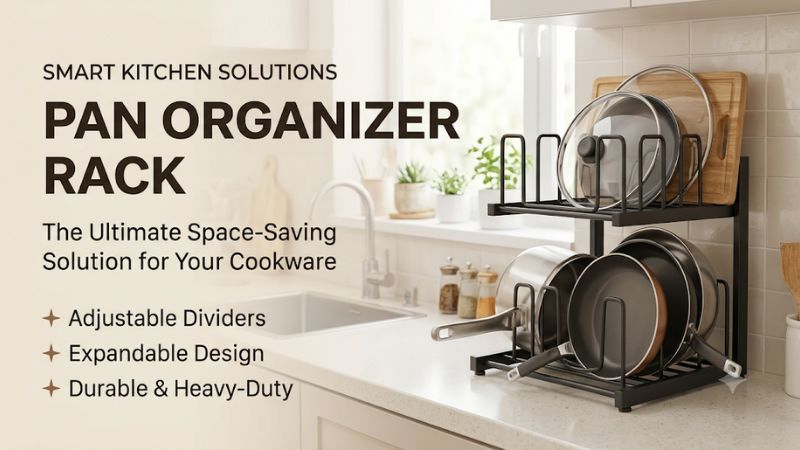
A practical pan organizer rack keeps frying pans, skillets, and cookware lids separated so you can reach the item you need without lifting a heavy stack. The right rack can protect delicate cooking surfaces, improve cabinet accessibility, and make cleanup easier. This guide compares six distinct organizers for different kitchen layouts and cookware collections.
- Quick Verdict: Which Pan Organizer Rack Should You Buy?
- Quick Comparison Table
- How We Selected These Pan Organizer Racks
- Detailed Reviews of Six Pan Organizer Racks
- Buying Guide: What Matters When Choosing a Pan Organizer Rack
- Cleaning and Maintaining a Pan Organizer Rack
- Frequently Asked Questions
- Conclusion
Quick Verdict: Which Pan Organizer Rack Should You Buy?
Choosing a pan rack starts with understanding the cookware collection. Thin frying pans, deep sauté pans, cast iron skillets, and glass lids have different weight and clearance requirements. A rack that works for lightweight nonstick pans may be unsuitable for several heavy cast iron pieces. The ideal organizer keeps cookware stable, provides enough space for handles, and fits the cabinet without requiring awkward retrieval.
Our recommended products:
- Best Overall: YouCopia StoreMore Pan & Lid Rack.
- Best for Larger Cookware Collections: YouCopia StoreMore Cookware Rack.
- Best Modular System: OXO Adjustable Cookware Organizer.
- Best Simple Expandable Rack: IKEA VARIERA Pot Lid Organizer.
- Best for Frying Pans and Lids: Yamazaki Tower Adjustable Pot Lid & Frying Pan Organizer.
- Best Elevated Under-Sink Storage: Yamazaki Tower Height Adjustable Under-Sink Pot and Pan Storage Rack.
The YouCopia StoreMore Pan & Lid Rack is an adaptable starting point for conventional kitchen cabinets because its dividers can be repositioned for different cookware shapes.
OXO’s Adjustable Cookware Organizer offers another flexible format with removable dividers and the ability to connect compatible units.
For kitchens with deep drawers, IKEA’s expandable design and Yamazaki’s adjustable cookware organizer may be practical alternatives.
Yamazaki’s height-adjustable rack serves a different purpose by allowing cookware to be organized above an additional storage area in suitable under-sink cabinets.
None of these products should be assumed suitable for every cookware weight or dimension. Always verify compatibility with the selected model.
Quick Comparison Table
The main differences between pan organizers involve divider construction, adjustability, footprint, and installation. A fixed-width rack may be suitable for a small collection, while an expandable system offers more flexibility when cookware sizes vary. The table below summarizes the intended applications and important limitations of six identifiable products without inventing independent performance measurements.
| Product | Best For | Key Features | Main Advantage | Trade-Off |
|---|---|---|---|---|
| YouCopia StoreMore Pan & Lid Rack | General pan and lid storage | Expandable base, ten adjustable dividers | Versatile cookware spacing | Requires horizontal cabinet space |
| YouCopia StoreMore Cookware Rack | Mixed cookware collection | Adjustable wire dividers, expandable design | Supports upright organization | Large pieces reduce usable capacity |
| OXO Adjustable Cookware Organizer | Modular cabinet storage | Five adjustable dividers, linking capability | Flexible arrangement | Multiple units occupy more space |
| IKEA VARIERA Pot Lid Organizer | Simple drawer organization | Expandable stainless steel structure | Easy to adapt to available length | Not intended for every heavy pan |
| Yamazaki Tower Adjustable Organizer | Skillets and lids | Adjustable partitions, handle support | Helps organize pan handles | Drawer dimensions matter |
| Yamazaki Tower Height Adjustable Rack | Vertical under-sink storage | Adjustable shelf height and dividers | Uses upper and lower storage areas | Requires substantial clearance |
A product that allows cookware to stand vertically may improve access, but its real usefulness depends on the pans being stored. Heavy cast iron, wide sauté pans, and delicate nonstick cookware may require different spacing and support. The organizer’s stated dimensions and load restrictions should take priority over promotional photographs.
How We Selected These Pan Organizer Racks
The shortlist focuses on products with identifiable manufacturer descriptions and practical storage characteristics. We considered adjustable spacing, construction, contact surfaces, capacity, installation requirements, and compatibility with real cookware. The recommendations are editorial assessments based on documented product designs and household storage principles, not claims of firsthand testing.
Selection criteria
- Cookware compatibility: Support for frying pans, skillets, and suitable lids.
- Adjustability: Ability to accommodate varied pan depths.
- Stability: Appropriate support when removing individual pans.
- Surface protection: Contact materials and risk of scratching.
- Cabinet fit: Width, depth, height, and handle clearance.
- Installation: Freestanding versus mounted or assembled storage.
- Cleaning: Ability to remove grease, crumbs, and dust.
- Weight restrictions: Suitability for the intended cookware load.
We deliberately included several different organizer formats rather than filling the comparison with nearly identical wire racks.
For example, the elevated Yamazaki design is intended for a different cabinet arrangement from the compact IKEA model.
This distinction helps shoppers choose by kitchen layout rather than assuming the largest rack is automatically the best.
Detailed Reviews of Six Pan Organizer Racks
Each product in this section addresses a recognizable cookware storage problem, whether the issue is unstable stacking, limited cabinet width, mixed lid sizes, or unused vertical space. The reviews explain construction, relevant features, daily handling, practical advantages, and purchase limitations. They also identify situations where the design may be unsuitable despite fitting inside the cabinet.
YouCopia StoreMore Pan & Lid Rack — Best Overall
The YouCopia StoreMore Pan & Lid Rack is an adjustable cabinet organizer designed to hold frying pans, cookware lids, and certain flat kitchen items upright. Its expandable base supports ten removable dividers that can be positioned to accommodate different cookware shapes. The manufacturer describes coated steel wires and nonslip feet, making it a practical option for kitchens that need adaptable storage without permanent cabinet modifications.
Best For
- Everyday frying pans.
- Mixed cookware lids.
- Households with multiple skillet sizes.
- Cabinets with adequate horizontal space.
- Cooks who prefer adjustable dividers.
Key Specifications
- Brand: YouCopia.
- Product: StoreMore Pan & Lid Rack.
- Divider count: Ten adjustable dividers.
- Structure: Expandable base.
- Divider material: Coated steel.
- Base: Nonslip support.
- Installation: Freestanding.
Why We Picked It
Cookware collections often include several items that cannot be stacked efficiently.
The StoreMore design allows the owner to adjust spacing around the depth and shape of individual pans.
This provides more flexibility than a rack with permanently fixed slots.
Features and Practical Performance
Vertical storage makes it possible to identify each pan without lifting others from a stack.
For a typical cabinet, arrange the largest compatible frying pan in a wider slot and reserve narrower gaps for lids or thinner cookware.
The rack should stand on a flat surface, and cookware must be loaded within the manufacturer’s supported conditions.
When retrieving a pan, lift it carefully rather than dragging its cooking surface against an adjacent piece.
Coated dividers reduce direct contact with bare metal, but no organizer can completely eliminate surface damage caused by impacts or careless handling.
What Makes It Different
The combination of an expandable base and multiple removable dividers provides flexibility for mixed cookware.
It can adapt when the collection changes, provided the new pans remain compatible.
Pros
- Ten adjustable dividers.
- Expandable construction.
- Protective coated wires.
- Nonslip base.
- Suitable for mixed pans and lids.
Cons
- Requires cabinet floor space.
- Larger pans reduce practical capacity.
- Heavy cookware suitability must be verified.
Buy If
You want a versatile freestanding rack for several frying pans and lids of different sizes.
Skip If
You mainly store exceptionally heavy cast iron cookware or lack the horizontal space needed for upright pans.
YouCopia StoreMore Cookware Rack — Best for Larger Collections
The YouCopia StoreMore Cookware Rack is a dedicated organizer for keeping multiple cookware items visible and separated inside a cabinet or suitable pantry compartment. Its adjustable wire-divider system is designed to support upright cookware storage rather than unstable stacking. This model is worth considering for households that own several frying pans, sauté pans, and other pieces requiring different amounts of space.
Best For
- Larger collections of cookware.
- Mixed frying pans.
- Wide base cabinets.
- Households seeking adjustable spacing.
- Kitchens where stacking causes surface contact.
Key Specifications
- Brand: YouCopia.
- Product family: StoreMore.
- Product: Cookware Rack.
- Format: Adjustable dividers.
- Construction: Base with coated wire supports.
- Storage orientation: Upright.
- Important distinction: Separate product from the Pan & Lid Rack.
Why We Picked It
A larger cookware collection needs more flexibility than a small fixed-slot organizer.
The StoreMore Cookware Rack is designed to separate cookware pieces and make each one easier to reach.
Its dedicated cookware format is particularly relevant when pans are stored together in a wide cabinet.
Features and Practical Performance
An organized setup might group everyday frying pans near the accessible end while reserving wider sections for deeper pans.
The exact spacing depends on pan diameter, depth, and handle geometry.
Do not assume that the rack can carry any cookware that fits between the dividers.
Heavy pans require a stable supporting cabinet floor and a rack rated for the intended load.
If you store nonstick cookware, leave enough space to lift each piece cleanly without scraping the cooking surface.
The rack should also be removable or accessible for cleaning. Cooking grease and dust can accumulate around divider attachment points even when the pans themselves are clean.
What Makes It Different
Compared with a general pan-and-lid organizer, this model focuses more directly on cookware storage.
It is appropriate when the main problem is arranging a collection of pans rather than organizing a few lids.
Pros
- Adjustable divider layout.
- Upright cookware visibility.
- Separate support positions.
- Suitable for wider cabinets.
- Reduces the need to stack compatible pans.
Cons
- Requires adequate horizontal space.
- May be excessive for a small cookware collection.
- Heavy pans require careful compatibility checks.
Buy If
You own multiple pans and want a dedicated adjustable storage system.
Skip If
You only need to organize a few lids or your cabinet is too narrow for upright cookware.
OXO Adjustable Cookware Organizer — Best Modular System
The OXO Adjustable Cookware Organizer is designed to create customizable storage positions for pots, pans, lids, and selected flat kitchen items. It includes five adjustable and removable dividers, with smaller end-cap components that can support accessories such as sheet pans and cutting boards. Compatible units can also be connected to extend the storage arrangement, making the design useful for kitchens that may need more capacity later.
Best For
- Modular cabinet organization.
- Mixed cookware sizes.
- Frying pans and cookware lids.
- Kitchen cabinets with flexible floor space.
- Households that may expand their collection.
Key Specifications
- Brand: OXO.
- Product: Adjustable Cookware Organizer.
- Main dividers: Five adjustable, removable dividers.
- Additional components: End caps for smaller items.
- Modular feature: Compatible organizers can be linked.
- Storage format: Freestanding cabinet organizer.
Why We Picked It
The OXO organizer offers a modular approach to cookware storage.
Instead of requiring a single large rack, users can begin with one organizer and connect a compatible second unit when additional capacity is needed.
The removable dividers allow the arrangement to change with the cookware collection.
Features and Practical Performance
The organizer is suitable for creating separate storage positions according to pan thickness and shape.
A narrow nonstick skillet may need less spacing than a deep sauté pan.
An owner can rearrange the dividers so frequently used cookware is accessible without moving other items.
The end-cap components also expand the range of possible uses.
For example, selected flat kitchen accessories may fit in the smaller end sections.
However, modularity does not eliminate cabinet restrictions. Two connected units still require sufficient width or depth, and the completed arrangement must remain stable.
What Makes It Different
The ability to link compatible organizers distinguishes it from ordinary single-piece racks.
This feature is valuable for households whose storage needs change over time.
Pros
- Five adjustable main dividers.
- Removable components.
- Connectable modular design.
- Suitable for different cookware categories.
- Flexible internal arrangement.
Cons
- Multiple units require additional space.
- Maximum capacity depends on cookware dimensions.
- Heavy cookware compatibility still requires verification.
Buy If
You prefer a modular system that can be reorganized or extended as storage needs evolve.
Skip If
You need only a small fixed rack or have insufficient space for connected units.
IKEA VARIERA Pot Lid Organizer — Best Simple Rack
The IKEA VARIERA Pot Lid Organizer is an expandable stainless steel rack originally intended for organizing cookware lids but also useful for certain compatible flat cookware items. Its simple folding structure allows the spacing and overall length to be adapted to the available drawer or cabinet area. This makes it an appealing choice for households that want a straightforward organizer rather than a large dedicated storage system.
Best For
- Lightweight compatible cookware.
- Flat lids and selected shallow pans.
- Deep kitchen drawers.
- Small kitchens.
- Users who prefer simple adjustable hardware.
Key Specifications
- Brand: IKEA.
- Product: VARIERA Pot Lid Organizer.
- Material: Stainless steel with plastic components.
- Design: Expandable partitioned rack.
- Storage orientation: Upright.
- Placement: Suitable drawers or cabinets.
- Installation: Freestanding.
Why We Picked It
A simple expandable rack can offer enough organization for a modest collection of pans and lids.
The design is useful when a household wants to avoid purchasing an oversized adjustable system with many separate pieces.
It is also easy to understand how the structure should be positioned.
Features and Practical Performance
Use the rack for items that fit securely between its supports.
Flat cookware and thin lids generally require less space than deep pans.
Before buying, measure the diameter and depth of the frying pans you intend to store.
A pan with a long handle may require more cabinet width than the rack itself.
Likewise, the organizer may support the pan body while the handle interferes with drawer closure.
Do not rely on the rack for unusually heavy cookware without confirming that the intended use is supported.
The best application is a compact, manageable group of compatible items.
What Makes It Different
The VARIERA uses a straightforward expandable structure rather than individually placed removable wire supports.
It is a useful alternative for households prioritizing simplicity.
Pros
- Expandable length.
- Stainless steel construction.
- No permanent mounting.
- Compact storage approach.
- Suitable for matching compatible lids and pans.
Cons
- Less specialized for deep frying pans.
- Heavy cookware suitability must be checked.
- Handle clearance can limit placement.
Buy If
You need an adjustable rack for a modest collection of compatible flat cookware and lids.
Skip If
You primarily store large heavy skillets or deep sauté pans requiring substantial support.
Yamazaki Tower Adjustable Pot Lid & Frying Pan Organizer — Best for Pan Handles
The Yamazaki Tower Adjustable Pot Lid & Frying Pan Organizer is designed specifically for storing cookware in an upright arrangement within deep drawers or suitable cabinets. Its adjustable partitions accommodate different pan sizes, while the additional handle holder helps position frying pans with their handles facing upward. This design addresses one of the most inconvenient aspects of pan storage: long handles extending into surrounding cabinet space.
Best For
- Deep cookware drawers.
- Frying pans with long handles.
- Mixed lids and skillets.
- Households with several pan diameters.
- Kitchens needing adjustable compartments.
Key Specifications
- Brand: Yamazaki.
- Collection: Tower.
- Product: Adjustable Pot Lid & Frying Pan Organizer.
- Format: Expandable.
- Divider spacing: Adjustable in three-centimeter increments.
- Included feature: Frying-pan handle support.
- Placement: Suitable drawers and cabinets.
Why We Picked It
Many pan organizers focus on supporting the circular cooking surface but do little to control the long handles.
This can lead to a rack that looks organized while the drawer remains difficult to close.
Yamazaki’s handle support makes the product particularly relevant to frying-pan storage.
Features and Practical Performance
Place pans in upright slots with sufficient room between their cooking surfaces.
Position handles according to the intended support arrangement.
The goal is to prevent the handles from crossing awkwardly over neighboring cookware.
Before ordering, measure the total height of the pan from the lower edge to the handle’s uppermost point in its intended orientation.
Also measure drawer depth and width.
An expandable rack can occupy a significant amount of space once several larger pans are loaded.
The organizer should remain easy to clean, and pans should be allowed to cool and dry before storage.
What Makes It Different
The combination of adjustable partitions and handle support distinguishes it from basic wire organizers.
It may be particularly useful for kitchens where cookware handles create the main storage problem.
Pros
- Designed for frying pans and lids.
- Adjustable partitions.
- Handle support.
- Expandable construction.
- Helps organize a mixed cookware drawer.
Cons
- Requires adequate drawer dimensions.
- Larger pans reduce available positions.
- Not a replacement for heavy-duty support in every application.
Buy If
You want an upright organizer that accounts for both pan bodies and long handles.
Skip If
Your cabinet is shallow or you only need a small rack for flat lids.
Yamazaki Tower Height Adjustable Under-Sink Pot and Pan Storage Rack — Best Elevated Storage
The Yamazaki Tower Height Adjustable Under-Sink Pot and Pan Storage Rack is a larger storage structure designed to organize cookware while using the space beneath the rack for other compatible items. It combines adjustable divider positions with three height settings and a support for frying-pan handles. This makes it substantially different from simple floor-standing dividers and suitable for cabinets with enough vertical clearance.
Best For
- Wide under-sink cabinets.
- Vertical cookware organization.
- Households needing upper and lower storage areas.
- Multiple pans and lids.
- Kitchens with adequate cabinet height.
Key Specifications
- Brand: Yamazaki.
- Collection: Tower.
- Product: Height Adjustable Under-Sink Pot and Pan Storage Rack.
- Main frame dimensions: Approximately 52 cm wide, 20.5 cm deep, and 38 cm high, excluding the handle holder.
- Height configuration: Three settings.
- Divider adjustment: Three-centimeter increments.
- Main material: Powder-coated steel.
- Manufacturer-stated load capacity: 8 kg.
- Recommended cookware size range: Approximately 18–30 cm.
Why We Picked It
The product offers vertical organization rather than only dividing a cabinet floor.
For a kitchen with enough space beneath the sink, this can provide a way to store suitable lids and pans above while keeping other items below.
The adjustable height helps accommodate different storage requirements.
Features and Practical Performance
A household might use the upper organizer for several lightweight compatible pans and lids while keeping appropriate containers beneath the shelf.
The rack must not obstruct drainpipes, shutoff valves, or other plumbing components.
Its eight-kilogram stated load capacity should also be respected.
This is particularly important with heavy cookware because the combined weight of several pans can rise quickly.
The organizer is more complex and physically larger than a compact divider rack, making accurate measurements essential.
Before buying, map the full available cabinet space and confirm that the frame, handles, and stored items can fit without contacting plumbing.
What Makes It Different
Its elevated adjustable design creates a second storage function beneath the cookware rack.
This makes it relevant to a different household need from ordinary pan dividers.
Pros
- Uses vertical cabinet space.
- Adjustable shelf height.
- Adjustable cookware partitions.
- Dedicated handle support.
- Published load capacity.
Cons
- Requires a relatively large installation area.
- More complex than a compact rack.
- Plumbing may reduce compatibility.
- Weight limits matter for heavy cookware.
Buy If
You have a compatible under-sink cabinet with enough space for an elevated cookware rack.
Skip If
You need a compact organizer for a narrow drawer or mainly store heavy cast iron cookware.
Buying Guide: What Matters When Choosing a Pan Organizer Rack
The right cookware organizer should make pans easier to retrieve while preserving their cooking surfaces and avoiding unstable stacking. Buying the wrong rack can create scratches, wasted cabinet space, or awkward access even when the product technically fits. Before choosing a model, evaluate cookware dimensions, weight, handle placement, material compatibility, and the space required for everyday use.
Measure Your Pans and Cabinet Space
Frying pans differ significantly in diameter, depth, handle length, and total weight. A 10-inch skillet may occupy much more space than its nominal diameter suggests, particularly when its handle is long or angled. Measure the cabinet and each intended pan before buying, then evaluate whether the rack can support the cookware in its planned orientation.
Measurements to record
- Largest pan diameter.
- Pan depth.
- Handle length.
- Overall height when stored upright.
- Cabinet opening width.
- Usable cabinet depth.
- Available drawer height.
- Weight of heavy cookware.
Pay special attention to pan handles.
A rack may fit comfortably on a shelf while the handles extend beyond the cabinet opening.
The ideal arrangement allows each pan to be lifted out without scraping another cooking surface.
Choose Between Vertical and Horizontal Storage
Vertical storage keeps cookware separated and visible, while horizontal stacking may use less shelf width. Each approach has advantages depending on cookware weight and cabinet geometry. Vertical racks are often helpful for nonstick frying pans because they reduce direct contact between surfaces, while properly protected horizontal storage may be more suitable for certain heavy pieces.
Vertical storage works well for:
- Lightweight frying pans.
- Mixed skillet sizes.
- Nonstick cookware.
- Deep drawers.
- Cookware requiring individual access.
Horizontal storage may work better for:
- Some heavy cookware.
- Cabinets with limited width.
- Nested compatible pans.
- Sets with manageable stacking arrangements.
Neither method is universally superior.
Choose according to cookware instructions, available space, and safe handling.
Protect Nonstick and Ceramic Cooking Surfaces
Nonstick and ceramic-coated cookware can be damaged by contact with hard or sharp objects. A pan organizer reduces direct stacking, but the rack’s contact points and the user’s handling still matter. Protective divider coatings can help, although they should not be treated as guarantees against scratches or impacts.
Practical protection tips
- Leave adequate spacing between pans.
- Avoid dragging cooking surfaces across rack supports.
- Check for damaged or exposed metal contact points.
- Lift cookware rather than pulling it sideways.
- Follow cookware manufacturer storage instructions.
- Use suitable protectors when stacking is unavoidable.
Also keep cookware clean and dry before storage.
Food residue or moisture trapped against a rack can make maintenance more difficult.
Account for Heavy Cast Iron and Large Cookware
Heavy cast iron skillets require particular attention because several pieces can create a substantial load on a rack and cabinet floor. A lightweight organizer suitable for nonstick pans is not automatically appropriate for heavy iron cookware. Always check manufacturer specifications and the condition of the supporting cabinet structure before selecting vertical storage for heavy items.
Safety checks
- Confirm intended cookware compatibility.
- Verify the stated load rating.
- Use a stable supporting surface.
- Avoid top-heavy arrangements.
- Keep heavy cookware accessible without excessive lifting.
- Inspect the rack periodically.
- Do not exceed recommended loading conditions.
If a rack cannot clearly support the intended cookware, choose a more suitable storage method.
A conventional stable lower shelf may be safer than an unrated organizer.
Cleaning and Maintaining a Pan Organizer Rack
Cookware organizers often sit in cabinets near cooking areas, where grease, dust, crumbs, and occasional moisture can accumulate. A rack that is difficult to clean may become an additional maintenance problem rather than an improvement. Choose a design with accessible surfaces and removable components when possible, then follow the exact manufacturer’s cleaning instructions.
Recommended maintenance routine
- Remove cookware before cleaning the rack.
- Wipe the base and divider contact points.
- Remove grease and debris promptly.
- Dry components thoroughly.
- Inspect damaged coatings.
- Check stability after repositioning dividers.
- Confirm that mounted parts remain secure.
- Avoid exposing materials to unsuitable cleaning chemicals.
Do not place the rack in a dishwasher unless the manufacturer specifically allows it.
A simple removable divider system can be convenient because it provides access to otherwise hidden areas around the base.
Frequently Asked Questions
Pan organizers can appear similar in product photographs even though they differ in weight capacity, spacing, materials, and intended cookware types. These questions address the most common purchasing concerns and explain how to choose storage that supports safe handling and everyday kitchen organization.
What Is the Best Pan Organizer Rack for a Small Kitchen?
A compact adjustable rack is often a useful starting point because it can separate compatible frying pans without requiring a large cabinet modification. However, the ideal choice depends on the size and weight of the cookware. A narrow drawer may suit an expandable rack, while a deeper cabinet could accommodate a larger vertical organizer.
Measure both the pan bodies and handles.
Do not choose an organizer based only on the number of slots shown in a photograph.
Can a Pan Organizer Rack Hold Cast Iron Skillets?
Some organizers may be suitable for cast iron cookware when their load ratings and construction support the intended use. However, cast iron is substantially heavier than many nonstick pans, and an organizer should never be assumed suitable without checking specifications. Multiple heavy skillets can overload both the rack and the cabinet supporting it.
Confirm the manufacturer-approved load.
Use an appropriately supported lower shelf if compatibility is uncertain.
Is It Better to Store Pans Vertically or Stacked?
Vertical storage often improves access and reduces direct contact between cooking surfaces. Stacking may save space in some cabinets but can require lifting several pieces to reach one pan. The best arrangement depends on cookware material, weight, available space, and the use of suitable protective pads.
For frequently used lightweight pans, vertical storage can be convenient.
For certain heavy pieces, a stable protected stacking arrangement may be more appropriate.
Do Adjustable Pan Racks Protect Nonstick Surfaces?
Adjustable racks can reduce contact between pans by providing separate storage positions. However, surface protection depends on the divider material, spacing, and handling. Coated wire supports may reduce contact with bare metal, but a pan can still be scratched if dragged against another object or stored carelessly.
Choose a rack with suitable contact surfaces.
Lift pans gently and follow cookware-specific care instructions.
Can One Rack Store Both Pans and Lids?
Yes, several organizers are designed to hold frying pans, pot lids, and certain flat kitchen items together. Adjustable dividers allow different spacing for thick pans and thin covers. However, combining several categories can reduce capacity, especially when cookware has long handles or large knobs.
Arrange the intended items before buying.
Choose enough space for comfortable retrieval rather than forcing every item into the same rack.
Conclusion
The best pan organizer rack should keep cookware accessible while protecting cooking surfaces and fitting the available cabinet space. YouCopia StoreMore is a flexible choice for mixed frying pans and lids, while OXO offers a modular alternative that can expand with your collection. IKEA VARIERA suits simpler storage arrangements, and Yamazaki’s adjustable racks are useful when pan handles or vertical cabinet space create additional challenges. Measure cookware dimensions carefully, verify load restrictions, and prioritize stable support over advertised capacity.




Write Your Review
No reviews yet. Be the first to share your experience!