
A spice drawer organizer keeps seasonings visible, prevents bottles from rolling, and frees cabinet space. The best design depends on drawer depth, jar shape, spice count, and whether you prefer flexible liners or rigid tiers. Compare six identifiable products, their trade-offs, and the measurements to check before buying.
Quick Verdict: Which Spice Drawer Organizer Fits Your Kitchen?
The strongest drawer system is one that matches the bottles you already own and allows the drawer to open and close without snagging caps. It should keep labels readable while reducing the effort required to retrieve the back row. These selections span foam liner, compact molded tray, bamboo, wood, expandable trays, and a complete jar-and-rack kit; they are editorial fit recommendations, not a claim that the products underwent original comparative testing.
- Best flexible cut-to-fit solution: YouCopia SpiceLiner 10-Foot Spice Drawer Organizer.
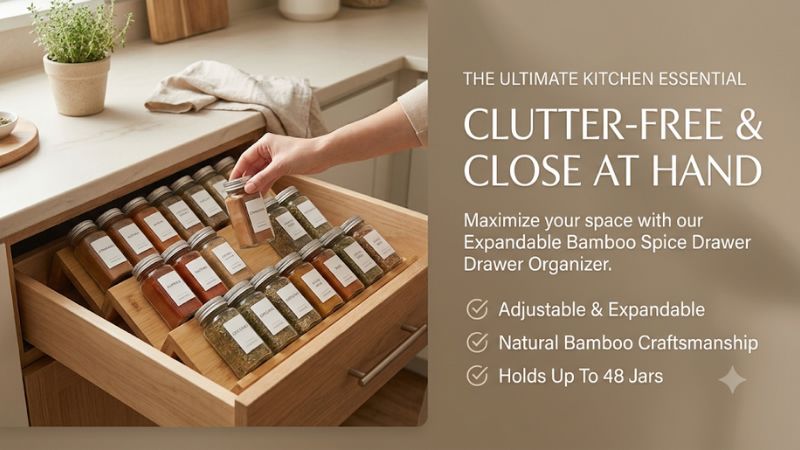
- Best expandable bamboo insert: SpaceAid Bamboo 4-Tier Drawer Spice Organizer.
- Best compact molded tray: OXO Good Grips Compact Spice Drawer Organizer.
- Best trim-to-fit built-in look: Rev-A-Shelf 4SDI-24 Three-Tier Wooden Spice Drawer Insert.
- Best expandable tray system: Lynk Professional Expandable Spice Rack Tray Drawer Organizer.
- Best coordinated jar-and-rack kit: SpaceAid Spice Drawer Organizer With 28 Spice Jars.
A drawer insert may look spacious in a product photograph yet fail to fit when paired with taller grocery-store jars. The decisive measurements are the usable inside dimensions of the drawer and the total height of the organizer with a filled bottle lying at its intended angle. If you own short square jars and tall round bottles, choose an organizer with enough flexibility for mixed shapes rather than assuming a uniform tiered rack is universally compatible.
Quick Comparison Table
The following table summarizes six distinct design approaches. The most important comparisons are whether an organizer is adjustable, whether it includes jars, and which kind of drawer it suits. Product specifications are based on described manufacturer or product listings and should be checked for the selected model and finish before purchase. Advertised bottle capacity is never a guarantee that every brand and bottle diameter will fit.
| Product | Best For | Key Design or Specifications | Main Advantage | Trade-Off |
|---|---|---|---|---|
| YouCopia SpiceLiner | Irregular drawer sizes | 10-foot cut-to-fit foam liner | Adaptable layout and soft bottle support | Requires measuring and careful cutting |
| SpaceAid Bamboo 4-Tier | Wider drawers and matching bottles | Expandable bamboo design, listed 12–23-inch width | Adjustable width, tiered label visibility | Depth and jar height must be checked |
| OXO Compact Spice Drawer Organizer | Smaller dedicated spice drawers | Tiered molded tray, nonslip feet, removable tray | Stable compact layout and easy cleaning | Fixed footprint limits customization |
| Rev-A-Shelf 4SDI-24 Wooden Insert | Built-in style and substantial drawers | Three-tier, trim-to-fit wooden insert | Integrated appearance | More planning and fitting effort |
| Lynk Professional Expandable Tray | Adjustable modular storage | Two-piece expandable spice tray system | Flexible arrangement within drawer | Pieces may shift without a suitable fit |
| SpaceAid Organizer With 28 Jars | Complete matching spice reset | Tiered rack with 28 glass spice jars and labels | Coordinated bottles and layout | Requires decanting and more setup |
The table separates organizer function from the larger kitchen storage decision. A rack does not preserve herbs automatically; jar seals and storage conditions still matter. Drawers usually limit direct sunlight exposure, but one directly under a hot cooking surface or next to persistent steam may still be unsuitable. Check installation instructions, drawer movement, and surrounding conditions before transferring a valuable spice collection.
How We Selected These Drawer Organizers
The six recommendations were chosen because they represent meaningfully different configurations and because product descriptions are available for their identifying design features. We considered the buyer problem each system solves, available information about material and adjustability, expected cleaning work, and practical compatibility with common spice bottle shapes. No detailed research or original stability measurements were performed, and exact fit remains a kitchen-specific question.
- Verified identity: Each selection is a named product or identifiable manufacturer model.
- Meaningful differences: Flexible foam, compact molded design, expanding bamboo, trim-to-fit wood, modular expandable trays, and a full jar kit.
- Usability: Label visibility, retrieval, refill effort, drawer access, and maintenance.
- Compatibility caution: A listed width is not equivalent to guaranteed fit with your particular bottles.
- Safety: Do not claim that every container, coating, or rack can tolerate every heat or cleaning condition.
Manufacturer descriptions support broad design comparisons, but they do not establish that one product performs better in every household. A kitchen with a 15-inch drawer full of mismatched bottles has different needs from one with a wide drawer of identical four-ounce jars. We therefore assign “best for” labels to specific configurations rather than pretending a single test score could rank all six products fairly.
Six Spice Drawer Organizers Compared in Detail
These reviews focus on who should buy each organizer, how its construction changes practical use, and what can go wrong if drawer dimensions or bottle sizes are overlooked. Check the exact item variation before purchase: the same brand may offer narrow, wide, or complete-kit versions that are not interchangeable. A stylish drawer is a successful purchase only if it survives daily opening, meal preparation, and cleanup without frequent rearrangement.
YouCopia SpiceLiner 10-Foot Spice Drawer Organizer
The YouCopia SpiceLiner is a soft cut-to-fit foam organizer rather than a rigid tray. The manufacturer describes a ten-foot roll that can be trimmed with scissors and arranged inside drawers to support spice bottles at an accessible angle. This design appeals to people whose drawers do not match standard insert sizes or who want to keep existing retail bottles without purchasing a complete matching jar collection.
Best for: Unusual drawer widths, mixed bottle collections, and buyers who prefer an adaptable layout.
Why We Picked It: A cut-to-fit solution offers exceptional layout flexibility without requiring a full matching jar set.
Performance & Practical Use: Its usefulness depends on measured row spacing and correct liner orientation, not a verified universal bottle capacity.
What Makes It Different: Flexible foam strips instead of a single rigid tray.
- Verified design: A ten-foot foam liner roll trimmed to fit the drawer.
- Features: Soft support strips can be arranged to hold multiple bottles.
- Pros: Flexible sizing; no need to buy matching jars; low-profile design.
- Cons: Cutting and arranging take time; a soft liner does not create the rigid appearance of a wooden insert.
- Buy if: You have a clean shallow drawer and want to customize rows around your existing jars.
- Skip if: You prefer a single solid rack that lifts out as one piece.
The manufacturer’s instructions indicate that the liner should be oriented correctly, with the strip profile facing the intended direction. That detail matters: an incorrectly flipped piece may not cradle bottles as designed. Begin with an empty drawer, test a few round and square bottles, and cut only after confirming the number of rows. Avoid filling every available inch immediately, because a little clearance makes labels easier to read and jars easier to lift.
A foam liner can be especially practical in a rental kitchen where permanent modifications are undesirable. Its limits are equally important. It does not automatically prevent jar movement if you force oversized containers into rows or overfill the drawer, and its cleaning method should follow the manufacturer’s directions. Users wanting an integrated cabinetmaker appearance may prefer wood instead of a visible modular liner.
SpaceAid Bamboo Four-Tier Expandable Drawer Spice Organizer
SpaceAid’s bamboo four-tier drawer organizer is a rigid stepped insert designed to expand in width. The manufacturer describes an approximate twelve- to twenty-three-inch expansion range for the referenced model. Its tiered construction helps present bottles at an angle with labels facing upward, making it appealing for a wider drawer and a reasonably consistent spice bottle collection.
Best for: Wider drawers where an adjustable bamboo design can use available width.
Why We Picked It: The documented adjustable width addresses a common mismatch between fixed organizers and wider drawers.
Performance & Practical Use: Angled tiers can improve label visibility when depth and closed-drawer clearance are sufficient.
What Makes It Different: Bamboo construction and width expansion, unlike molded or foam inserts.
- Verified design: Bamboo construction, four-tier angled arrangement, expandable width listed from 12 to 23 inches.
- Pros: Attractive natural finish; width adjustment; straightforward label visibility.
- Cons: Drawer depth and bottle height still limit fit; bamboo requires appropriate cleaning and drying.
- Buy if: Your drawer dimensions fall within the exact model’s intended range and you have suitable bottles.
- Skip if: You need a very narrow insert or often store irregular packets with bottles.
An adjustable width does not mean adjustable depth. A common shopping mistake is to measure the drawer side to side while ignoring front-to-back space consumed by sloping tiers. Check the manufacturer’s full dimensions and calculate whether the drawer can close with jars in their intended position. Also make sure the bottom of the drawer is flat enough for the rack to sit securely without rocking.
Bamboo lends itself to a coordinated kitchen style, but treating it as ordinary disposable plastic can damage the finish. Follow cleaning instructions, wipe spills promptly, and avoid soaking wooden components unless explicitly allowed. Some spice jars with wide shoulders or unusual lids may not settle neatly into the tiers; test one of your tallest bottles in the mock layout before buying or decanting an entire collection.
OXO Good Grips Compact Spice Drawer Organizer
OXO’s Compact Spice Drawer Organizer uses a tiered molded tray intended for standard round and square spice jars. The manufacturer highlights non-slip feet, square corners to reduce wasted drawer space, and a removable tray for cleaning. This is a practical choice for cooks who want a defined small rack with fewer installation decisions and who do not need a large wall-to-wall bamboo insert.
Best for: Compact drawers and small-to-medium seasoning collections that fit the tray’s fixed footprint.
Why We Picked It: The manufacturer documents non-slip feet and removable tray target everyday stability and cleaning.
Performance & Practical Use: It can hold standard round and square jars in a tiered arrangement, but oversized bottles still require measurement.
What Makes It Different: A compact preformed tray with cleaning and grip features rather than custom trimming.
- Verified design: Tiered tray; support for standard round and square spice jars; non-slip feet; removable tray.
- Pros: Straightforward setup; reduced rolling; easy access for cleaning.
- Cons: A fixed shape is less adaptable; oversized or unusually tall jars may not fit.
- Buy if: You have a dedicated spice drawer and value a compact organizer that needs little preparation.
- Skip if: You want a customizable full-width insert or store primarily flat pouches.
A molded rack’s stability depends on how it contacts the drawer bottom and how its tiers cradle your specific bottles. The presence of non-slip feet helps resist movement but does not mean the rack will never shift in a drawer that is slammed repeatedly. Evaluate daily use with the drawer fully loaded and leave clearance around the front row. If the tray is removable, take advantage of that for occasional crumb and powder cleanup.
The fixed footprint can be a benefit when you intentionally want to leave space beside the rack for measuring spoons or seasoning packets. It becomes a limitation when a collection grows far beyond the available tiers. Rather than assuming this organizer is too small or too large based on a photo, count your bottles and compare the product dimensions with the usable drawer interior before ordering.
Rev-A-Shelf 4SDI-24 Three-Tier Wooden Spice Drawer Insert
The Rev-A-Shelf 4SDI-24 represents a trim-to-fit wooden insert approach. Retail descriptions identify this family as a three-tier drawer spice organizer, designed to create a more integrated appearance inside a kitchen cabinet. It is appealing when a homeowner wants a deliberate, semi-custom layout rather than a portable liner or a small tray that occupies only part of a drawer.
Best for: Homeowners planning a more permanent, finished-looking drawer interior.
Why We Picked It: The identified trim-to-fit wood model serves the buyer who wants a dedicated, built-in drawer appearance.
Performance & Practical Use: It can create an integrated layout when measured and fitted correctly; this is not a no-tool universal insert.
What Makes It Different: Trim-to-fit wood rather than an adjustable freestanding rack.
- Identifying detail: 4SDI-24 model in a three-tier trim-to-fit wood insert family.
- Pros: Integrated appearance; clear bottle rows; useful for a dedicated spice drawer.
- Cons: Fitting requires care; less portable and less flexible after trimming.
- Buy if: You are comfortable measuring precisely and following the model’s cutting instructions.
- Skip if: You rent, frequently change layouts, or lack the tools for a trim-to-fit insert.
Trim-to-fit does not mean you can cut any edge without limitation. Read the manufacturer’s specifications and trim instructions to determine where material may be removed and how much adjustment is permitted. Check drawer depth, cabinet hardware, and the radius of any corners. A product that appears to be an exact fit from the outside may still conflict with internal drawer rails or supports.
Wood also requires attention to spills and moisture. A spice drawer may collect ground turmeric, paprika, and garlic powder over time, and the insert should be cleaned according to manufacturer guidance rather than soaked indiscriminately. For buyers who want to change kitchens often, that maintenance and installation commitment may outweigh the visual benefit. A foam or modular tray can provide easier reversibility.
Lynk Professional Expandable Spice Rack Tray Drawer Organizer
Lynk Professional markets an expandable spice rack tray drawer organizer using a modular tray arrangement. This design sits between a single fixed insert and a fully custom liner: it provides defined angled channels while allowing some adjustment to overall coverage. The brand also offers fixed-width spice tray models, so confirm that the product selected is specifically the expandable two-piece version rather than a similarly named non-expanding tray.
Best for: Buyers who want firm bottle channels but cannot match a fixed insert width exactly.
Why We Picked It: The two-piece expandable system provides a distinct middle ground between fixed trays and cut-to-fit foam.
Performance & Practical Use: Defined channels aid separation when they match bottle geometry and the pieces remain stable.
What Makes It Different: Modular expansion with rigid channels rather than a single molded tray.
- Verified design: Expandable two-piece drawer spice tray system identified by Lynk Professional.
- Pros: Adjustable coverage; structured channels; no need for complete bottle replacement.
- Cons: Multiple pieces require careful positioning; exact jar compatibility remains model-specific.
- Buy if: The usable drawer dimensions match the stated adjustment range.
- Skip if: The drawer is too shallow or you prefer soft cut-to-fit flexibility.
With modular pieces, the most important practical question is whether the components remain stable during normal drawer movement. Adjust them according to product instructions and check that the front row does not interfere with the drawer face. A slightly unused strip of drawer space is better than squeezing pieces so tightly that they bow or pop out when the cabinet expands or contracts with humidity.
The structured channels can make a drawer visually tidy without the commitment of sawing a wooden insert. However, a highly varied spice collection may include jars that are wider than the channels or caps that sit at an awkward angle. Inventory your existing containers and use the current product dimensions, not a stock photo, to judge fit. If replacement jars would be required, include their cost and refill work in the decision.
SpaceAid Spice Drawer Organizer With 28 Spice Jars
SpaceAid offers a complete drawer organizer kit with twenty-eight glass spice jars and labeling accessories. This is a different purchasing proposition from its bamboo insert alone: the buyer acquires a coordinated container system and rack rather than fitting a rack around existing retail bottles. It suits cooks who want to reset an inconsistent collection, but the setup demands transferring ingredients and preserving their identifying information.
Best for: A larger household seeking a matching jar-and-drawer arrangement in one kit.
Why We Picked It: It coordinates the rack and included bottles for buyers replacing mismatched jars throughout a larger collection.
Performance & Practical Use: Uniform containers can simplify planning, but refilling and fit checks introduce substantial initial setup.
What Makes It Different: An entire glass-jar-and-organizer package rather than a rack-only purchase.
- Verified identifying details: Complete SpaceAid drawer organizer marketed with 28 spice jars and labels.
- Pros: Uniform containers; coordinated drawer presentation; labeling accessories included.
- Cons: Decanting takes time; increased glass handling; exact drawer dimensions must be checked.
- Buy if: You have a drawer that fits the system and want a consistent twenty-eight-position layout.
- Skip if: You want to preserve original packages or only use six to ten spices.
The kit can save time on finding containers of compatible shapes, but it does not save you from measuring. Confirm the current rack dimensions, intended bottle orientation, and drawer clearance. Plan time to wash or otherwise prepare containers as instructed, dry them thoroughly, and label them before filling. Keep ingredient information for blends and allergens, and avoid combining old and new spices simply to fill every jar.
Twenty-eight jars can be excessive for a household with a narrow selection of frequently used seasonings. It also represents more items to clean and track. The right buyer has a genuinely broad spice collection and values consistent labeling and presentation. Everyone else may achieve better results with a smaller rigid tray or a cut-to-fit liner that accepts existing packages.
Buying Guide: Measure, Plan, and Compare Real Drawers
Choosing a spice drawer organizer begins with the interior dimensions of the drawer and the geometry of the bottles, not with a product ranking. An angled rack reduces clutter only when the drawer can close, the labels remain visible, and the jars can be removed easily. Careful measurement also prevents wasting money on attractive inserts that require different bottles, woodworking, or an entirely different storage location.
Measure Width, Depth, and Closed Height Correctly
Measure the usable width from interior side to interior side and the usable depth from the back wall to the drawer face. Include space taken by runners, dividers, structural braces, and the front lip where the drawer closes. For height, check clearance beneath the cabinet frame with the drawer shut rather than relying on the apparent height of the drawer box itself.
- Inside width: Measure at the location the organizer will actually occupy.
- Inside depth: Account for any rear stops or obstruction.
- Closed clearance: Test with your tallest jar at the planned angle.
- Access allowance: Leave space to grip lids without striking the cabinet above.
- Drawer movement: Open and close slowly with a cardboard mockup in place.
A simple measurement template can prevent a frustrating return. Place a few bottles on cardboard cut to the proposed organizer footprint, then tilt them to approximate the rack angle. The goal is to see whether labels remain readable and whether the drawer clears the cabinet. A product advertised as expandable may address only one dimension; verify exactly which dimension moves and what remains fixed.
Decide Whether to Keep Existing Bottles or Decant
Keeping existing retail bottles avoids unnecessary washing and transferring, and it preserves original ingredient information. However, a drawer filled with mismatched bottle sizes may be harder to organize using a rigid tray. Decanting into a coordinated jar kit can improve fit and labeling consistency, but it creates extra work and sometimes encourages buying more containers than are genuinely useful.
Keep existing bottles when: Their sizes are reasonably compatible with a liner, modular tray, or compact organizer.
Decant when: A matching jar system materially improves visibility and space usage, and you are willing to prepare containers safely.
For many kitchens, a hybrid approach is most efficient. Put frequently used standard-size bottles on a tiered insert and store irregular bulk packets in a separate small bin. Avoid turning every spice into a matching jar merely because a product page depicts uniform bottles. The best arrangement helps you find ingredients quickly, not simply achieve a staged visual effect.
Evaluate Material, Stability, and Cleaning
Bamboo and wood inserts can create a finished appearance and structured rows, while molded plastic trays and foam liners can provide easy setup and different cleaning possibilities. Each has trade-offs. Wood can be sensitive to excessive moisture; foam may be harder to wipe than a removable solid tray; and plastic products vary in construction and care instructions. Product material alone does not determine quality or durability.
- Choose broad support surfaces for narrow or round bottles that otherwise roll.
- Check whether an insert has feet, grips, or a stable geometry for your drawer.
- Prefer surfaces you can clean after spice spills without complicated disassembly.
- Keep paper packets in a separate dry compartment rather than trapping them under jars.
- Follow product-specific directions for moisture exposure and cleaning agents.
A drawer organizer helps protect spices from direct light, yet a drawer under a hot range may still be exposed to excessive heat. Store herbs and powders in tightly closed containers in a cool, dry location. Never pour spices from the jar directly into billowing steam, and avoid keeping them beside cleaning products that could contaminate food items.
Organize the Drawer for Real Cooking
A practical spice drawer is organized around how the cook moves through the kitchen. Ingredients should be easy to identify before grabbing, remain stable during drawer movement, and return to a predictable position after use. The most successful layouts accommodate daily habits instead of imposing a complicated arrangement that works only immediately after a deep-cleaning session.
Sort by Frequency, Then by a Clear Label System
Sort seasonings into frequently used, weekly, and occasional groups before loading the organizer. Place the frequently used group in positions visible from your normal standing angle; arrange the remaining jars alphabetically or by dish type. Either system is workable if everyone sharing the kitchen can find and return items without guessing.
Label the top or sloped-facing surface of each bottle so the name is visible when the drawer opens. Distinguish similar items, such as chili powder versus cayenne, and ground cumin versus cumin seed. If spice blends have ingredient warnings, preserve that information somewhere accessible after decanting. A clear system should reduce wrong-ingredient mistakes, especially when several people cook in the same space.
Leave Breathing Room and Maintain the System
It is tempting to fill every available rack channel, but an overpacked drawer may become harder to use than an ordinary shelf. Leave enough room to lift a jar vertically or at the required angle, and avoid placing caps where they scrape the cabinet frame. A partially filled organizer with comfortable access can outperform a theoretical maximum-capacity installation.
Wipe up spills promptly and inspect the drawer for crumbs, sticky residue, or moisture. Check that bottles are closed before returning them, and rotate older spices rather than buying duplicates. When a label is damaged, replace it before two similar-looking powders are confused. Maintenance is easier when the organizer can be emptied and cleaned section by section without removing every item in the kitchen.
Frequently Asked Questions
Before buying a drawer organizer, shoppers often want to know whether the rack needs matching jars, how deep the drawer must be, and which materials are easiest to maintain. These are fit questions rather than universal product facts, because the correct answer depends on the combination of the exact rack, your own containers, and the available cabinet clearance.
How Deep Does a Drawer Need to Be for Spice Jars?
There is no single minimum that covers all organizers and bottles. Measure the drawer’s usable front-to-back depth as well as its closed vertical clearance. A tiered design needs room for inclined jars, and tall caps may contact the cabinet frame even when the organizer itself fits. Compare the actual manufacturer’s dimensions with the tallest bottle you plan to store and test a mock layout before making a final purchase.
Will a Spice Drawer Organizer Fit Grocery-Store Bottles?
Some inserts are designed for standard round or square retail jars, while complete kits are intended for their included containers. Bottles vary widely in shoulder width, cap diameter, and height, so “standard” should not be interpreted as universal. Measure two or three of your most unusually shaped jars and compare them against the rack design. A cut-to-fit liner may provide more flexibility than a rigid channel system.
Is Bamboo Better Than a Plastic Spice Drawer Insert?
Bamboo may appeal to buyers seeking a natural-looking, integrated drawer interior, whereas plastic molded trays can be simpler to remove and wipe. Neither material is automatically more stable, more hygienic, or longer lasting in every kitchen. The relevant factors are construction, cleaning instructions, moisture tolerance, and the fit with your jars. Choose whichever lets you maintain a clean, accessible drawer without unnecessary effort.
Should I Transfer All My Spices Into New Glass Jars?
Only decant when it solves a meaningful storage problem. Uniform jars can maximize a coordinated rack and simplify label placement, but transferring them requires clean, dry containers and accurate content identification. If original bottles fit a liner or compact tray, retaining them avoids wasted work and preserves ingredient details. For seasoning blends, keep allergy and component information available even after moving the contents.
Do Spice Drawers Help Keep Seasonings Fresh?
A drawer can reduce direct light exposure and keep jars away from a busy countertop, which may help preserve flavor when the location is cool and dry. It cannot compensate for loose lids, humidity, or heat from nearby appliances. Store dried seasonings tightly closed, measure away from steam, and replace ingredients as their characteristic aroma fades or if there are signs of contamination or moisture damage.
Conclusion
The right spice drawer organizer is the one that fits your usable drawer dimensions and keeps real spice bottles easy to retrieve. Choose YouCopia for flexible cut-to-fit rows, SpaceAid bamboo for adjustable structured tiers, OXO for a compact molded tray, Rev-A-Shelf for a trim-to-fit finished look, Lynk for modular expansion, or SpaceAid’s 28-jar kit for a complete reorganization. Before buying, verify closed-drawer clearance, container compatibility, stability, and cleaning requirements; then organize labels around how you actually cook.






Write Your Review
No reviews yet. Be the first to share your experience!