
Choosing an under cabinet shelf for small kitchens can help organize everyday essentials without crowding countertops or replacing existing cabinetry. Clip-on baskets, compact drawers, and specialized hanging racks make use of overlooked vertical space, but the best solution depends on shelf thickness, cabinet clearance, storage needs, and installation restrictions.
- Quick Answer: Which Under Cabinet Shelf Works Best?
- Why Small Kitchens Benefit From Vertical Storage
- How to Choose an Under Cabinet Shelf for Small Kitchens
- Comparing Under Cabinet Shelf Formats for Small Kitchens
- Practical Storage Setups for Different Small Kitchens
- Common Mistakes to Avoid in Small-Kitchen Storage
- Frequently Asked Questions
- Conclusion
Quick Answer: Which Under Cabinet Shelf Works Best?
For most small kitchens, begin with a compact organizer that attaches beneath an existing shelf and stores one clearly defined category of lightweight items. A clip-on basket is versatile, while an under-shelf drawer may work better for packets and small accessories. Specialized holders can organize bottles, wraps, spices, or glassware when the household has enough compatible items to justify the extra accessory.
Quick selection guide
- Mixed pantry items: Clip-on wire basket.
- Small packets: Pull-out under-shelf drawer.
- Spice jars: Dedicated under-shelf spice rack.
- Travel mugs: Compatible bottle holder.
- Dish towels: Hanging rack with suitable supports.
- Stemmed glasses: Purpose-designed glass holder.
- Small cookware and plates: Appropriate freestanding shelf insert.
The main objective is not to fill every available gap. It is to make commonly used items accessible while preserving enough room for cabinet doors, food containers, and safe handling.
Choose the smallest organizer that solves the actual storage problem.
Why Small Kitchens Benefit From Vertical Storage
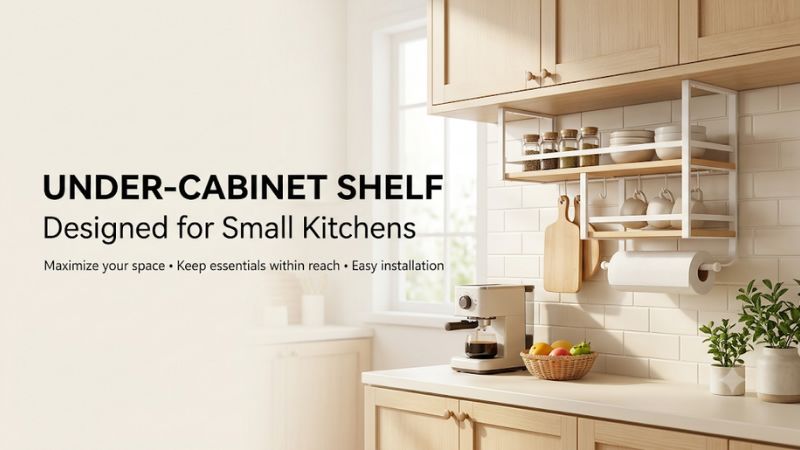
Small kitchens frequently have a mismatch between storage volume and organization. A cabinet may be tall enough for several rows of mugs but provide only one fixed shelf. Another compartment may contain small food packets scattered across a deep shelf, leaving unused space above them. Under-shelf accessories can divide these areas into more practical storage zones without requiring new cabinetry.
Vertical storage can provide several advantages.
- Reduces clutter on countertops.
- Makes small items easier to group.
- Provides storage without expanding the kitchen footprint.
- Improves visibility in deep cabinets.
- Creates dedicated spaces for everyday accessories.
- Supports more consistent organization.
- Can sometimes be installed without drilling.
However, additional storage does not automatically mean better accessibility.
An organizer that hangs too low may make it difficult to remove items from the shelf below. Likewise, one that protrudes toward the cabinet door may interfere with closing.
The best small-kitchen solution uses vertical space carefully instead of crowding the entire cabinet.
How to Choose an Under Cabinet Shelf for Small Kitchens
A compact kitchen demands more precise planning because even a small installation error can eliminate the intended storage benefit. A hanging basket may block the plates below it, while a shallow sliding drawer may be incompatible with the existing shelf thickness. Understanding the following criteria helps prevent wasted money and ensures the finished arrangement remains practical.
Start by Measuring Available Vertical Space
The most important measurement is not always the width of the cabinet. Vertical clearance determines whether a hanging organizer will improve the space or simply interfere with everything beneath it. Measure from the underside of the existing shelf to the tallest item stored below, then account for the depth of the proposed organizer and the room required to retrieve its contents.
Measurements to record
- Interior cabinet width.
- Usable shelf depth.
- Thickness of the existing shelf.
- Distance between shelves.
- Height of the tallest stored item.
- Cabinet-door clearance.
- Space required for opening a sliding compartment.
Consider a cabinet containing dinner plates on the lower shelf and small bowls above.
If the space between shelves is limited, a deep hanging basket could prevent the dinner plates from being removed comfortably.
In that situation, a shallow drawer or a freestanding shelf insert may be more practical.
Measure the actual storage arrangement instead of estimating from a product photograph.
Choose the Right Shelf Design for the Stored Items
Under-cabinet storage products are designed around different contents. A wire basket can accommodate mixed lightweight objects, while a sliding drawer is better suited to packets that might fall through open wire. Dedicated bottle holders, spice racks, and glass racks are useful when the household repeatedly struggles with a particular category.
Common designs
- Clip-on basket: Flexible storage for small accessories.
- Sliding under-shelf drawer: Better organization for compact packets.
- Hanging rack: Useful for lightweight kitchen textiles.
- Spice rack: Stores compatible seasoning containers.
- Bottle holder: Provides dedicated positions for reusable bottles.
- Stemware holder: Supports compatible hanging glassware.
- Freestanding shelf riser: Divides a cabinet without attaching underneath a shelf.
Choose by observing what occupies the kitchen’s most inconvenient storage space.
If snack packets repeatedly fall behind larger containers, a dedicated drawer may provide a meaningful improvement.
If reusable mugs consume an entire cabinet shelf, a compatible bottle holder could free some of that area.
Avoid purchasing a specialized product unless enough suitable items exist to justify it.
Consider Renter-Friendly Installation Methods
Small kitchens are common in apartments and rental homes, where permanent modifications may be restricted. Clip-on organizers can be useful because they attach to compatible shelves without conventional drilling. Adhesive-assisted designs offer another possibility, but they still require appropriate surface preparation and may create removal concerns depending on the cabinet finish.
Installation options
- Clip-on supports.
- Adhesive-assisted brackets.
- Freestanding shelf inserts.
- Removable hanging baskets.
- Permanently mounted hardware.
For renters, start with reversible options whenever possible.
Check the shelf material and thickness before choosing a clip-on model.
Some shelf edges are rounded, unusually thick, or covered by trim that prevents a clip from seating correctly.
Adhesive-assisted accessories should be installed only on surfaces approved by the manufacturer.
Do not assume that an adhesive can be removed without damaging every type of cabinet finish.
Use the Space Beneath Cabinets Without Blocking Countertops
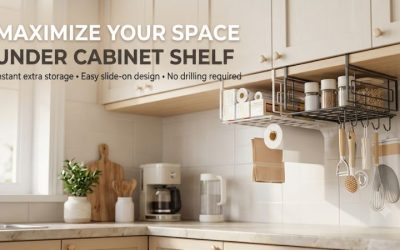
The area beneath wall cabinets can be valuable for storing lightweight accessories, but the storage arrangement must preserve usable countertop space. A hanging rack may be convenient for paper towels or small kitchen tools, while a deeper basket can interfere with appliances positioned below. Careful placement is particularly important near coffee machines, kettles, and food preparation areas.
Placement priorities
- Preserve working space for food preparation.
- Avoid blocking appliance controls.
- Keep storage away from direct heat.
- Leave room for opening appliance lids.
- Avoid steam paths from kettles and coffee machines.
- Keep hanging items away from burners.
- Ensure cabinet doors operate normally.
For example, a hanging rack positioned directly above a kettle may be exposed to repeated steam.
A different shelf or cabinet location may be more appropriate.
The goal is to improve organization without creating new safety or cleaning problems.
Match Shelf Material to Kitchen Conditions
Metal, plastic, and wood can all be suitable materials for certain kitchen storage accessories, but their behavior differs under moisture, heat, and repeated cleaning. Powder-coated steel offers a rigid structure, while plastic is often lighter and easier to wipe down. Wood can provide an attractive finish but generally requires more attention to moisture exposure.
Material considerations
- Powder-coated steel: Rigid and commonly used in hanging baskets.
- Plastic: Lightweight and suitable for many compact drawer designs.
- Wood: Attractive but should be protected from repeated moisture.
- Wire structures: Improve visibility but may not contain tiny objects.
- Solid-bottom compartments: Better for small packets and loose accessories.
Consider both the organizer and the cabinet.
A heavy shelf attached to a thin or damaged cabinet board may be unsuitable regardless of the organizer’s material.
Also check the manufacturer’s care instructions.
An organizer that can be wiped with a damp cloth should not automatically be assumed dishwasher-safe.
Choose Storage That Improves Everyday Access
An organizer is effective only when it makes relevant products easier to retrieve. Small kitchens can become frustrating when storage accessories force users to move several objects before accessing one item. Avoid unnecessary stacking, excessive compartmentalization, and arrangements that conceal labels. Frequently used products should remain visible or easy to identify.
Accessibility checklist
- Can you reach the contents comfortably?
- Are labels visible?
- Can the drawer or basket be opened fully?
- Does the organizer obstruct other storage?
- Can items be replaced without rearranging the cabinet?
- Is cleaning straightforward?
- Can other household members understand the system?
A simple storage arrangement may be more useful than a complicated organizer with many compartments.
For instance, a small rack dedicated to frequently used spices can improve daily cooking more than a large hanging basket filled with rarely used products.
Storage should reflect real habits rather than an idealized kitchen photograph.
Plan for Safe Weight Distribution
Hanging storage accessories place additional loads on existing cabinet shelves. This means the organizer’s own weight limit is only part of the safety assessment. The shelf and its supports must also be strong enough to carry the extra load. Heavy ceramic mugs, insulated bottles, or glass containers can quickly increase the combined weight.
Safe loading practices
- Check the organizer’s stated load limit.
- Confirm the supporting shelf is secure.
- Keep heavy cookware on appropriately supported shelves.
- Avoid uneven loading.
- Inspect attachment points periodically.
- Do not improvise structural supports.
- Keep fragile items away from areas where they could fall.
A lightweight packet organizer should not be treated as a substitute for a heavy-duty cookware shelf.
Similarly, a stemware rack must be compatible with the actual glass shape and attachment requirements.
Safe installation takes priority over achieving the highest possible storage density.
Comparing Under Cabinet Shelf Formats for Small Kitchens
Different accessories can improve storage in different ways. A compact drawer supports small-item organization, while a basket provides more flexible storage. Specialized racks may be highly efficient for one category but unsuitable for others. Comparing the available options according to space, installation, and storage needs helps narrow the selection.
| Organizer Format | Main Purpose | Installation Complexity | Best Kitchen Situation |
|---|---|---|---|
| Clip-on basket | Mixed lightweight items | Low | Pantry cabinet with unused clearance |
| Under-shelf drawer | Small packets | Low to moderate | Crowded pantry shelf |
| Spice rack | Seasoning bottles | Low to moderate | Small cooking area |
| Bottle holder | Reusable mugs and bottles | Low to moderate | Kitchen with several drink containers |
| Hanging hook rack | Towels and utensils | Low | Compact preparation area |
| Freestanding shelf insert | Plates and bowls | Usually low | Tall cabinet with no extra fixed shelves |
The most appropriate format depends on whether you want to increase storage capacity, improve access, or organize a specific category.
In many small kitchens, combining two modest accessories in separate locations is more effective than placing one oversized organizer in an already crowded cabinet.
Practical Storage Setups for Different Small Kitchens
Small kitchens vary considerably in cabinet configuration, available counter space, and household routines. A studio apartment may need highly flexible storage, while a family apartment may require a more structured system for dishes, snacks, and reusable bottles. The following examples illustrate how to create useful storage without relying on unnecessary purchases.
Setup One: A Compact Apartment Pantry
A compact pantry often contains mixed food packets, cans, spices, and small containers arranged on only one or two shelves. A clip-on basket or shallow under-shelf drawer can create a dedicated zone for lightweight items while leaving the main shelf available for larger packages. This arrangement works best when the cabinet still has enough clearance for comfortable access.
Suggested arrangement
- Store large containers on the main shelf.
- Use a hanging basket for lightweight packets.
- Keep commonly used seasonings near the front.
- Label smaller products where necessary.
- Reserve space for opening and retrieving items.
Avoid placing heavy canned goods in an accessory intended for lightweight storage.
The organizer should remain easy to remove for cleaning.
Setup Two: A Small Coffee and Breakfast Station
A coffee station can become crowded with mugs, coffee pods, filters, packets, and reusable bottles. Instead of placing every accessory on the countertop, use appropriate under-shelf storage to create categories. A small sliding drawer may organize packets, while a compatible bottle holder can reduce the number of travel mugs occupying a main shelf.
Suggested arrangement
- Keep the coffee machine and grinder accessible.
- Use a drawer for lightweight packets.
- Store compatible bottles in a dedicated holder.
- Keep coffee beans and ingredients in suitable food containers.
- Avoid areas exposed to direct steam.
- Preserve a clear surface for preparation.
A compact system should make the morning routine easier rather than require moving several organizers before preparing coffee.
Setup Three: A Small Family Kitchen
Family kitchens often need space for plates, cups, snacks, utensils, and reusable drink containers. An under-shelf organizer can help establish dedicated storage zones, but the arrangement must remain convenient for frequent use. Fragile glassware and heavy objects require additional consideration when choosing hanging storage.
Suggested arrangement
- Use a stable shelf insert for suitable dishes.
- Keep small packets in a separate drawer.
- Store lightweight accessories in a hanging basket.
- Reserve accessible locations for everyday mugs.
- Keep fragile objects securely supported.
- Avoid overloading shelves.
The household should be able to return items to their designated places without complicated instructions.
When the system is easy to maintain, organization is more likely to last.
Common Mistakes to Avoid in Small-Kitchen Storage
A small kitchen has little room for purchasing mistakes. An organizer that occupies the wrong space can interfere with several other storage areas, while one that is too specialized may become unused when household needs change. Avoid selecting products solely by advertised capacity or visual appeal without confirming the dimensions and everyday workflow.
Common mistakes
- Buying before measuring shelf thickness.
- Ignoring the height of stored objects.
- Installing racks where cabinet doors cannot close.
- Overloading clip-on baskets.
- Choosing specialized holders for incompatible containers.
- Blocking appliances or countertop workspace.
- Placing storage near excessive steam or heat.
- Assuming adhesive accessories suit every surface.
- Creating too many small compartments.
- Filling every gap until access becomes difficult.
One particularly useful principle is to preserve empty space where it improves movement.
A cabinet that is easy to use is often more valuable than one filled to its absolute physical capacity.
Frequently Asked Questions
The most common questions about under-cabinet storage relate to compatibility, safety, installation, and whether the resulting space savings justify the extra accessory. The answers below address those issues from the perspective of a small kitchen, where every organizer needs to support a practical daily routine without creating new handling problems.
What Is the Best Under Cabinet Shelf for a Tiny Kitchen?
A compact clip-on basket or shallow under-shelf drawer is often a good starting point because it uses existing space without requiring a large structure. The correct choice depends on the category of items being stored and the clearance beneath the current shelf. A general-purpose basket is more flexible, while a drawer is better for small packets.
Measure the intended installation area before buying.
The best solution is the smallest compatible product that improves the daily routine.
Can I Use an Under Cabinet Shelf in a Rental Apartment?
Many clip-on and freestanding accessories are suitable options for rental apartments because they may not require permanent cabinet modifications. However, compatibility with the existing shelf and the terms of the rental agreement still matter. Adhesive-assisted products may leave residue or damage certain finishes when removed.
Choose reversible designs where possible.
Follow installation instructions and avoid drilling without permission.
How Do I Make More Cabinet Storage Without Adding Shelves?
You can often improve organization by grouping related items, removing unnecessary packaging, using appropriately sized containers, and placing frequently used products near the front. An under-shelf basket or drawer is one option, but it is not always necessary. Better product arrangement can sometimes reclaim enough space without purchasing additional accessories.
Start by emptying the cabinet and identifying unused vertical areas.
Add a storage product only when a specific problem remains.
Are Under Cabinet Shelves Strong Enough for Dishes?
Some shelf inserts are intended for dishes, while other under-shelf organizers are designed only for lightweight accessories. The safe load depends on the specific product and supporting cabinet construction. A rack designed for food packets should not be assumed suitable for stacked dinner plates or heavy ceramic bowls.
Check the manufacturer’s weight restrictions.
When storing heavy dishes, prioritize a properly supported fixed shelf or an appropriately rated freestanding insert.
How Do I Keep Under Cabinet Shelves Clean?
Clean the organizer according to its material and manufacturer instructions. Open baskets can collect dust and crumbs, while sliding compartments may accumulate small particles around their moving parts. Remove stored items periodically, wipe accessible surfaces, and allow the organizer to dry before reloading.
Avoid excessive moisture around wood components or adhesive attachments.
Regular inspection also helps identify loose supports before they become a safety problem.
Conclusion
An under cabinet shelf for small kitchens should create useful storage without interfering with daily cooking, cabinet access, or safety. Clip-on baskets offer flexibility for mixed lightweight items, while sliding drawers and specialized holders can organize packets, spices, bottles, and suitable glassware. The best results come from measuring shelf thickness and vertical clearance, respecting weight limits, and choosing storage around real household habits. Start with one clearly needed organizer, evaluate its usefulness, and add other accessories only when they solve additional problems.



Write Your Review
No reviews yet. Be the first to share your experience!