
A cutting board organizer for families should keep frequently used boards accessible, separated, and properly dried without taking over valuable kitchen space. Families often need multiple boards for different food-preparation tasks, making upright storage especially useful. This guide explains how to choose a stable organizer, compare materials, measure available space, and maintain a practical system for daily cooking.
- Quick Answer: What Type of Cutting Board Organizer Works Best?
- Why Families Need Dedicated Cutting Board Storage
- Types of Cutting Board Organizers for Families
- How to Choose the Right Organizer Size
- Materials and Construction: What Matters Most?
- Organizing Cutting Boards for Family Meal Preparation
- Common Mistakes Families Should Avoid
- Frequently Asked Questions
- Conclusion
Quick Answer: What Type of Cutting Board Organizer Works Best?
For most family kitchens, a freestanding vertical organizer with several sufficiently wide dividers is a practical starting point. It allows individual boards to stand separately, improving access and helping clean boards dry. The best configuration depends on the number of boards, their thickness and weight, available cabinet space, and whether the organizer is intended for wet drying or completely dry storage.
Recommended configurations:
- Best overall: An adjustable vertical rack for boards of different thicknesses.
- Best for large families: A sturdy organizer with four to six usable compartments.
- Best for heavy wooden boards: A wide-base metal rack with adequate support.
- Best for small kitchens: A compact cabinet-mounted or narrow freestanding organizer.
- Best for frequent washing: A well-ventilated rack placed near an appropriate drainage area.
- Best for renters: A portable rack that requires no drilling.
The most important factor is not the number of advertised slots but whether each board can be removed without disturbing the others. A rack that technically holds six boards may become inconvenient when thick butcher blocks, flexible mats, and handled cutting boards compete for the same narrow compartments
Why Families Need Dedicated Cutting Board Storage
Families often prepare several foods during one meal, including vegetables, fruit, bread, raw meat, and cooked ingredients. Multiple cutting boards can help organize these tasks, but the boards also need proper washing, drying, and storage. Stacking damp boards can trap moisture, while leaving them scattered around the countertop creates clutter and makes them harder to find.
Keeping Different Cutting Boards Organized
A family kitchen may contain several board types because no single surface is ideal for every preparation task. A large wooden board can provide a stable area for vegetables and bread, while a nonporous board may be convenient for raw meat when handled and sanitized properly. Flexible mats can be useful for transferring prepared ingredients into bowls or pans.
Common family cutting boards include:
- Large preparation board: Everyday vegetable chopping and meal preparation.
- Nonporous cutting board: Raw meat or poultry preparation when properly cleaned and sanitized.
- Small cutting board: Fruit, sandwiches, and quick snacks.
- Bread board: Slicing loaves and other baked goods.
- Flexible cutting mat: Transferring chopped ingredients.
- Heavy wooden board: Tasks requiring a stable, substantial surface.
An organizer should accommodate these differences rather than forcing every board into identical slots.
For example, a narrow compartment suitable for a flexible mat may not accept a thick wooden cutting board. An adjustable rack provides greater flexibility when board sizes vary substantially.
Supporting Better Cleaning and Drying Habits
Clean cutting boards should dry thoroughly before being placed in enclosed storage. Moisture trapped between boards or against cabinet surfaces can encourage unpleasant odors and create conditions that make maintenance more difficult. Vertical storage allows air to circulate around the boards when there is sufficient spacing and ventilation.
Good drying practices:
- Wash boards after each appropriate use.
- Follow material-specific cleaning instructions.
- Sanitize surfaces after raw-meat contact using suitable food-safe procedures.
- Allow boards to dry thoroughly.
- Avoid stacking damp boards.
- Keep the organizer clean and dry.
Wooden boards often require different care from dishwasher-safe plastic boards. Do not assume that all wood, bamboo, composite, or plastic products tolerate the same cleaning method.
A cutting board rack supports good hygiene habits, but it does not replace washing and appropriate sanitizing.
Making Shared Family Cooking Easier
When several people prepare food, clear storage reduces confusion and unnecessary searching. Children preparing snacks, adults cooking dinner, and family members assembling breakfast may all need different boards. A consistent storage system makes it easier to locate the appropriate board and return it after cleaning.
A practical arrangement can group boards by their intended use, keeping the most frequently used items in the easiest positions.
Benefits for shared kitchens:
- Faster board retrieval.
- Less countertop clutter.
- More predictable organization.
- Easier inventory checks.
- Reduced unnecessary stacking.
- Better separation of different board sizes.
Color-coded boards may help identify intended tasks, but color alone does not prevent cross-contamination. Proper cleaning, sanitizing, and separation of raw and ready-to-eat foods remain essential.
Types of Cutting Board Organizers for Families
Cutting board racks come in several formats, ranging from simple countertop stands to adjustable cabinet systems. Each approach offers a different balance of accessibility, ventilation, portability, and available capacity. Families should evaluate the size and weight of their existing boards before choosing a product, particularly when larger wooden or composite boards are involved.
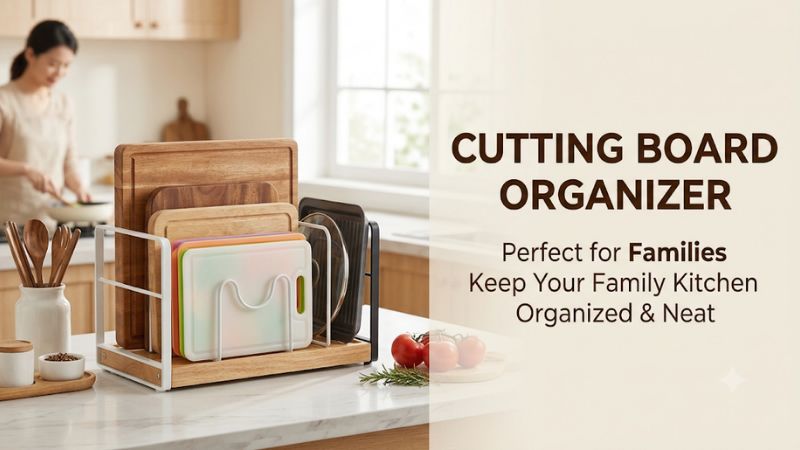
Freestanding Vertical Cutting Board Racks
A freestanding rack uses several upright dividers to hold boards separately. These organizers can be placed on a countertop, inside a suitable cabinet, or on a pantry shelf. They are generally straightforward to use because individual boards can be lifted without opening a specialized sliding mechanism.
Best For: Families who want an uncomplicated organizer for everyday boards.
Key Features:
- Multiple vertical storage slots.
- Metal, polymer, or other sturdy construction.
- Stable supporting base.
- Optional non-slip feet.
- Open sides for easier access.
Pros:
- No permanent installation.
- Easy to relocate.
- Good visibility.
- Suitable for many board shapes.
- Simple daily operation.
Cons:
- Fixed slot widths can restrict thick boards.
- Some lightweight racks may tip with oversized boards.
- Countertop models occupy preparation space.
Buy If: You have a suitable cabinet or counter location and want a simple storage solution.
Skip If: Your kitchen has extremely limited space or the boards are too heavy for the selected rack.
Stability matters particularly when large boards are removed from one side. A rack with a narrow base may become less balanced if heavy boards are concentrated on one end.
Check product dimensions and intended use rather than assuming any metal stand can support every board.
Adjustable Cutting Board Organizers
Adjustable organizers use movable dividers that let users create compartments of different widths. This makes them useful for families storing both thin plastic boards and substantial wooden chopping surfaces. Some systems are marketed for cookware and bakeware as well, allowing cutting boards to share storage with trays or pot lids.
Best For: Households with boards of different thicknesses.
Key Features:
- Movable or removable dividers.
- Variable compartment widths.
- Horizontal base.
- Often suitable for several kitchen-storage categories.
- Freestanding installation on many designs.
Pros:
- Better accommodation of mixed board sizes.
- Flexible organization.
- Useful when board collections change.
- May also support baking sheets and cookware lids.
Cons:
- Adjustment requires some initial setup.
- Dividers vary in rigidity.
- Very large boards may exceed the rack’s intended size.
Buy If: Your boards differ significantly in thickness or you want storage flexibility.
Skip If: Your collection contains only two similarly sized boards and a basic stand already fits.
When setting up adjustable dividers, give each board enough room to be removed comfortably without scraping neighboring surfaces.
Avoid packing the slots so tightly that damp boards cannot dry properly.
Cabinet-Mounted Cutting Board Organizers
Cabinet-mounted organizers attach to the interior of a cabinet door, side panel, or designated mounting surface. They can free countertop space while keeping boards accessible. However, mounting introduces additional considerations, including cabinet-panel thickness, door hinges, organizer weight, and interference with shelves when the door closes.
Best For: Kitchens with suitable cabinet space and permission for installation.
Key Features:
- Fixed mounting brackets.
- Vertical holding compartments.
- Compact footprint.
- Cabinet-door or wall installation options.
- Hardware requirements that vary by model.
Pros:
- Frees countertop space.
- Creates dedicated storage.
- Can use otherwise unused cabinet areas.
- Keeps boards near other kitchen equipment.
Cons:
- Requires drilling or approved mounting.
- Door clearance can be restrictive.
- Heavy boards may strain unsuitable installations.
- Less portable than freestanding racks.
Buy If: You have a structurally suitable cabinet and want a permanent storage position.
Skip If: You rent, cannot drill, or have heavy boards that would exceed the installation’s capacity.
Cabinet-door organizers require special care because the door must support the added weight during repeated opening and closing.
Always verify the manufacturer’s installation instructions and load limits.
Drawer-Based Cutting Board Storage
Some kitchens have deep drawers that can hold boards upright using adjustable dividers. This arrangement keeps boards out of sight while providing convenient access near the food-preparation area. However, the drawer must have sufficient height and width for the boards, and the sliding hardware must support the combined contents.
Best For: Kitchens with deep, sturdy lower drawers.
Key Features:
- Vertical internal dividers.
- Hidden storage.
- Potentially adjustable spacing.
- Convenient retrieval near workstations.
- No countertop footprint.
Pros:
- Clean visual appearance.
- Keeps boards organized with other preparation tools.
- Reduces countertop clutter.
- Can accommodate large boards in suitable drawers.
Cons:
- Requires substantial drawer height.
- Heavy boards increase drawer load.
- Damp boards should not be enclosed.
- Drawer dividers may require customization.
Buy If: You have a deep drawer designed to support the intended weight.
Skip If: The available drawer is shallow or frequently exposed to moisture.
Drawer storage works best for boards that have already been completely cleaned and dried.
Avoid placing damp wooden boards inside enclosed cabinetry simply to maintain a tidy appearance.
How to Choose the Right Organizer Size
The correct organizer size depends on the dimensions of the boards, not merely the number of compartments. A family with three thick wooden boards may require a wider rack than a household storing six thin plastic mats. Measure the tallest, widest, and thickest boards, then compare their dimensions with the usable spacing and support area of the organizer.
Measure Board Thickness and Width
Board thickness is often the first limitation in a vertical organizer. A slot that accepts an ordinary plastic cutting board may not accommodate a butcher block or a board with raised feet. Handles, grips, and unusual shapes can also prevent a board from settling into the intended position.
Measure:
- Maximum board thickness.
- Board width.
- Board height.
- Thickness around handles.
- Any feet or raised edges.
- Combined storage space required.
Place your boards upright against a stable surface and estimate the clearance necessary to lift each one independently.
If the organizer has fixed slots, compare the narrowest relevant opening with your thickest board.
For adjustable models, check how many dividers remain usable after creating wider spaces.
Consider Weight and Stability
Large wooden boards can be much heavier than flexible mats, creating a greater demand on the organizer’s support structure. A rack may fit the board geometrically but still be unsuitable if the base is too narrow or the manufacturer does not support that weight.
Stability considerations:
- Base width and depth.
- Strength of the dividers.
- Non-slip feet.
- Total stored weight.
- Board height relative to rack height.
- Load distribution.
Place heavy boards where the organizer remains balanced.
Avoid allowing tall boards to lean at a sharp angle against neighboring items.
If the rack shifts when removing one board, reconsider the arrangement or choose a more stable design.
Plan for Future Board Replacement
Cutting boards wear over time and may eventually need replacement because of deep grooves, warping, cracks, or other damage. An organizer that fits only one exact board size can become inconvenient when the household buys a replacement with different dimensions.
An adjustable system may provide useful flexibility for changing equipment.
However, buying an oversized rack for hypothetical future boards can waste valuable cabinet space.
Choose a design that accommodates the existing collection with a modest allowance for realistic changes.
A practical organizer should support current needs first.
Materials and Construction: What Matters Most?
Cutting board organizers are made from coated metal, stainless steel, polymer materials, bamboo, and other constructions. Each material affects appearance, cleaning, stability, and moisture tolerance. The strongest buying decision evaluates the complete rack, including its base and divider spacing, rather than assuming one material is universally superior.
Metal Cutting Board Racks
Metal racks are popular because relatively narrow dividers can separate boards without occupying excessive storage space. Powder-coated steel and stainless steel are common approaches, although the exact corrosion resistance and maintenance requirements depend on the product’s construction and finish.
Advantages:
- Slim structural dividers.
- Good visibility.
- Useful for vertical storage.
- Often easy to wipe.
- Available in fixed and adjustable formats.
Potential drawbacks:
- Coatings can become damaged.
- Some finishes may corrode if neglected.
- Thin wire designs may be less stable for heavy boards.
- Rough edges can contact board surfaces.
Choose products with smooth contact points and a suitable supporting base.
Do not assume that every steel rack is rustproof or dishwasher-safe.
Bamboo and Wooden Organizers
Bamboo and wood organizers can match other kitchen accessories and offer an attractive natural appearance. They are often designed with broad slots that support boards upright. However, repeated moisture exposure can affect certain finishes and joints, so these materials are better suited to appropriately dry storage conditions unless the manufacturer specifies otherwise.
Advantages:
- Attractive natural appearance.
- Broad support surfaces on some designs.
- Useful for dry board storage.
- Can coordinate with wooden kitchen accessories.
Potential drawbacks:
- Moisture sensitivity.
- Material-specific cleaning requirements.
- Fixed compartments may limit flexibility.
- Some designs occupy more space than wire racks.
Wipe wooden organizers according to product instructions and avoid prolonged soaking unless explicitly permitted.
Allow cutting boards to dry thoroughly before storing them in enclosed wooden racks.
Polymer and Mixed-Material Organizers
Polymer organizers can provide a continuous base with removable metal dividers. Such designs may offer flexibility and stability while avoiding some concerns associated with placing boards directly against hard wire edges. Construction quality and cleaning requirements still vary between products.
Advantages:
- Lightweight bases.
- Potentially easy cleaning.
- Adjustable divider systems.
- Suitable for many cabinet interiors.
Potential drawbacks:
- May flex under excessive weight.
- Not automatically heat-resistant.
- Plastic components can wear or crack.
- Divider connections require inspection.
Look for a stable assembly and sufficient support for the largest board.
Avoid assuming that a lightweight product can hold heavy butcher blocks unless the manufacturer confirms suitability.
Organizing Cutting Boards for Family Meal Preparation
Once the organizer is selected, the arrangement should support everyday cooking rather than simply maximize the number of boards in one location. A clear system makes it easier to distinguish boards, retrieve frequently used surfaces, and maintain safe food-preparation routines. Position the organizer near the preparation area when possible, but avoid locations exposed to excessive heat or persistent moisture.
Separate Boards by Their Intended Tasks
A family may use different boards for raw ingredients and ready-to-eat foods. Keeping these boards identifiable can reduce confusion, particularly when children or multiple adults help prepare meals. However, designating boards does not eliminate the need for proper washing, sanitizing, and safe handling of raw animal products.
Example organization:
- Board A: Vegetables and fruit.
- Board B: Raw meat or poultry.
- Board C: Bread and baked goods.
- Board D: Quick snacks.
- Board E: Large meal preparation.
Labels or color coding can help, but every board must still be cleaned appropriately after use.
Food safety depends on correct handling practices rather than the organizer’s appearance.
Make Frequently Used Boards Easy to Reach
The most-used boards should occupy positions that allow comfortable retrieval without moving heavier equipment. For many households, a medium-size everyday board belongs near the front of the organizer, while a large specialty board can be positioned in a more substantial compartment.
Keep heavy boards in stable positions and avoid awkward overhead storage.
Practical arrangement:
- Place everyday boards in easy-access slots.
- Give thick boards wider compartments.
- Keep flexible mats grouped without folding them unnecessarily.
- Separate boards with incompatible cleaning needs.
- Leave clearance for airflow where drying is intended.
An organizer should not force users to move several boards just to retrieve one item.
If that occurs repeatedly, reduce the number stored in the rack or adjust the dividers.
Create a Dedicated Drying Routine
Cutting boards should not be enclosed while damp. A practical family routine may involve washing boards, allowing them to air-dry in a suitable ventilated location, and then returning them to cabinet storage once dry. Some organizers can serve both functions, but others are intended only for dry storage.
Check the manufacturer’s stated use.
Avoid placing a wet rack where dripping water can damage wooden cabinets or collect beneath the organizer.
For raw-meat preparation boards, use appropriate cleaning and sanitizing methods before drying.
A tidy storage arrangement should support hygiene, not replace it.
Common Mistakes Families Should Avoid
Cutting board organizers often disappoint when buyers focus on appearance or slot count without considering real board dimensions and daily cooking habits. Heavy boards may overload an unstable stand, narrow compartments can make retrieval difficult, and damp storage can create maintenance problems. These issues are usually avoidable through measurement and realistic evaluation.
Buying an Organizer With Narrow Fixed Slots
A rack with many narrow compartments may seem efficient, but it can become unsuitable when boards vary in thickness. A heavy wooden board or raised-edge composite model may not fit at all.
Measure before purchasing.
Do not rely on advertised board capacity without checking individual slot dimensions.
An adjustable organizer may be the better choice for mixed collections.
Stacking Boards Before They Are Dry
Placing damp boards closely together limits airflow and can trap moisture between contact surfaces. This is particularly concerning when boards are stored inside enclosed cabinets.
Dry boards thoroughly and keep the organizer in an appropriate location.
Follow manufacturer care instructions for wood, bamboo, and polymer materials.
Do not use a cabinet organizer as a substitute for an appropriate drying area when the design lacks ventilation or drainage.
Ignoring Organizer Stability
A tall rack can become unstable when heavy boards are concentrated on one side or when a large board is removed suddenly.
Check that the base rests flat and does not slide.
Use suitable compartments and avoid exceeding published capacity.
Keep heavy boards out of locations where tipping could injure someone.
For cabinet-mounted organizers, verify that the installation can safely support the load.
Frequently Asked Questions
Family cutting board storage raises questions about hygiene, the number of boards needed, suitable materials, and whether organizers should be placed in cabinets or on countertops. The best answers depend on the actual board collection and household cooking habits. A practical system prioritizes safe preparation, thorough drying, stable support, and easy access.
How Many Cutting Boards Does a Family Need?
There is no universal number. Many families benefit from having separate boards available for raw animal products and ready-to-eat foods, along with an appropriately sized everyday preparation board. The ideal collection depends on cooking frequency, food types, and cleaning routines. Avoid purchasing additional boards solely to fill an organizer; choose the tools your household actually uses.
Is Vertical Cutting Board Storage Better Than Stacking?
Vertical storage often improves access and allows more airflow around boards when sufficient spacing is available. Stacking can be acceptable for completely dry boards in suitable storage, but it may make lower boards harder to retrieve. Vertical organizers are particularly helpful when several boards are used frequently. Choose a stable rack and avoid forcing thick boards into narrow slots.
Can Wooden Cutting Boards Be Stored Upright?
Yes, many wooden cutting boards can be stored upright after proper cleaning and thorough drying, provided the rack supports them securely and does not encourage warping or damage. Follow the board manufacturer’s care instructions. Avoid prolonged moisture exposure, unstable leaning positions, and unsuitable heat sources. Heavy wooden boards may require broader support than thin plastic boards.
Should Cutting Board Organizers Be Kept Inside Cabinets?
Cabinet storage can protect boards from kitchen clutter and direct exposure, provided the boards are clean and completely dry. A countertop rack may be more convenient for frequently used boards and can offer better ventilation during drying. The right location depends on available space, moisture conditions, and how often the boards are retrieved. Avoid enclosed storage for damp boards.
Can One Organizer Hold Cutting Boards and Baking Sheets?
Some adjustable organizers are designed for both cutting boards and bakeware. This can be useful when the household has limited cabinet space and the items are suitably sized. However, heavy boards and large baking sheets require adequate divider support and cabinet clearance. Confirm the rack’s intended uses and dimensions before combining different equipment.
Conclusion
A cutting board organizer for families should provide stable upright storage, appropriate separation, and easy access to the boards used during everyday meal preparation. Adjustable vertical racks are versatile for mixed collections, while sturdy fixed stands or cabinet organizers may suit more consistent board sizes. Measure thickness and weight, provide proper drying conditions, and organize boards around family cooking habits. The best system is one that remains safe, clean, and convenient long after the initial kitchen reorganization.





Write Your Review
No reviews yet. Be the first to share your experience!