
Choosing an omelet pan for families requires balancing cooking capacity, ease of handling, cleaning, and everyday versatility. A small pan may work for individual servings but become inconvenient when preparing breakfast for four or more people. This guide explains how to select a suitable diameter, surface material, and pan design for family meals.
What makes a good omelet pan for family cooking?
A family omelet pan should provide enough usable cooking surface for the household’s breakfast routine without becoming awkward to maneuver or wash. It should heat predictably, accommodate fillings, and allow cooked eggs to be transferred without unnecessary tearing. For many households, a versatile nonstick frying pan makes more sense than an extremely specialized omelet pan.
Family size alone does not determine the best pan. The number of eggs cooked at once, the preferred omelet style, and the number of separate servings matter just as much.
For example, a family of four may prefer preparing two medium omelets rather than cooking one enormous omelet.
A larger pan spreads egg mixture more thinly, potentially creating problems when the cook attempts to fold a heavy omelet containing substantial fillings.
The objective is therefore to select cookware that supports manageable portions and repeatable cooking.
Choosing the right omelet pan size for families
Pan diameter is one of the most important buying considerations because it affects the usable cooking area, omelet thickness, and the number of portions that can be prepared comfortably. The best size depends on whether the household prefers individual omelets, shared breakfast servings, or a combination of both.
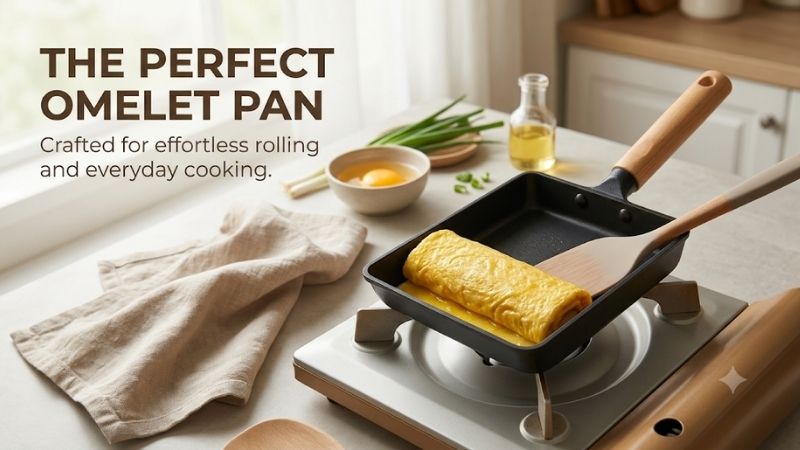
Eight-inch omelet pans for individual portions
An 8-inch omelet pan is a practical choice for preparing individual servings, especially when cooking one or two eggs at a time. It provides a compact cooking area that helps contain the mixture, but it is less suitable for large quantities of vegetables, cheese, or other fillings.
Small pans work particularly well when different family members prefer different ingredients.
One person might want spinach and mushrooms, while another prefers cheese and tomatoes.
Cooking separate omelets allows each serving to be customized.
The disadvantage is that a family breakfast may require repeated cooking batches.
An 8-inch pan is often most useful as a supplementary breakfast pan rather than the household’s only frying pan.
Ten-inch omelet pans for everyday family breakfasts
A 10-inch frying pan offers a practical balance between usable cooking space and manageable dimensions. It can accommodate modest family-sized portions or larger individual omelets while remaining versatile enough for other foods. For many households, this is the most useful starting point when choosing a dedicated breakfast pan.
The All-Clad HA1 Expert 10-Inch Fry Pan is an example of an induction-compatible coated option.
The Tramontina Pots & Pans 10-Inch Fry Pan provides another general-purpose alternative for compatible gas and electric stovetops.
Both offer room for eggs and fillings without requiring the space of a large 12-inch pan.
A 10-inch model is often easier to tilt and fold than a substantially wider pan.
However, cooking one omelet for a large family may still be impractical.
Twelve-inch omelet pans for larger portions
A 12-inch frying pan can accommodate more ingredients and larger egg mixtures, making it relevant for households that frequently prepare shared breakfasts. The extra cooking surface is particularly useful for vegetable-heavy egg dishes, although it also increases storage requirements and can complicate folding delicate omelets.
The All-Clad HA1 Expert cookware range includes a 12-inch fry pan.
A larger pan may also support cooking multiple fried eggs rather than one large omelet.
However, a broad surface spreads a small quantity of eggs into a thin layer.
For this reason, a 12-inch pan works best when the food volume justifies its size.
Buyers should also check whether their stovetop burner can heat the base adequately.
Selecting the best omelet pan material for families
Material selection affects food release, cleaning convenience, heating behavior, and long-term ownership. For a household cooking eggs frequently, a suitable coating can reduce preparation time and simplify washing. However, some families prefer carbon steel or cast iron because they want an uncoated surface that can be maintained over time.
Traditional PTFE nonstick cookware
PTFE-coated frying pans are often convenient for family omelet preparation because their cooking surfaces reduce egg adhesion under appropriate operating conditions. They generally require less surface preparation than uncoated stainless steel, carbon steel, or cast iron, making them useful when breakfast must be prepared quickly.
The All-Clad HA1 Expert is an example of this category.
Its hard-anodized aluminum body and nonstick surface support general cooking.
The pan’s flared walls help when loosening and turning eggs.
PTFE cookware should not be overheated, and users should follow manufacturer instructions for utensils and cleaning.
The coating will also require careful maintenance to preserve its performance.
Ceramic-coated omelet pans
Ceramic nonstick cookware provides another option for families that prefer a particular coating type. These pans often use aluminum bodies with a sol-gel ceramic-based cooking surface. The material can provide convenient initial food release, although its performance and durability depend on the specific formulation and use conditions.
GreenPan offers several ceramic-coated frying pan ranges.
The Lima 8-Inch Frypan is suited to individual portions, while larger sizes in the collection offer more cooking area.
The brand states that its Thermolon ceramic nonstick coating is made without intentionally added PFAS.
However, individual models can differ in induction compatibility and care requirements.
For example, the GreenPan Lima line is not intended for induction cooking.
Buyers should confirm specifications before choosing a family pan.
Carbon steel omelet pans
Carbon steel provides an uncoated alternative that can develop a seasoned cooking surface through use and maintenance. Dedicated models such as the de Buyer MINERAL B Omelette Pan have curved walls designed for folding eggs, making them attractive to experienced home cooks who regularly prepare traditional omelets.
The 11-inch de Buyer MINERAL B Omelette Pan is designed for approximately three to four eggs.
It has an 8.3-inch cooking surface and a listed weight of 4.6 pounds.
Although the overall diameter is relatively large, the actual flat cooking area is smaller.
This distinction matters when evaluating how much food can fit inside the pan.
Carbon steel can also require more maintenance than coated cookware, particularly after washing.
Cast iron omelet pans
Cast iron skillets can prepare omelets and other breakfast foods, but their considerable thermal mass and weight make them different from lightweight dedicated omelet pans. They retain heat effectively yet require careful temperature management, particularly when preparing delicate eggs that can become dry with excessive cooking.
Lodge cast iron skillets are an example of this approach.
A properly seasoned skillet can be useful for eggs, potatoes, breakfast meats, and vegetables.
The principal advantage is multipurpose cooking rather than easy folding.
If family members prefer soft French-style omelets, a lighter curved pan may be more convenient.
Cast iron also requires proper drying and seasoning maintenance.
Important features to consider before buying
Practical features such as handle comfort, pan depth, base construction, and cleaning requirements can have a greater impact on daily use than decorative finishes. Families often use breakfast cookware repeatedly throughout the week, so a convenient pan should be easy to handle when full and simple to clean after preparing several portions.
Handle comfort and safe lifting
A family-size omelet pan becomes heavier when filled with eggs, vegetables, cheese, or other ingredients. Handle design therefore influences lifting comfort and control during cooking. Riveted metal handles, silicone-covered grips, and helper handles each offer advantages, but none should be assumed to remain cool under all circumstances.
Choose a handle that feels secure.
Check the manufacturer’s heat and oven guidance.
Avoid lifting a full pan abruptly.
For larger pans, consider whether a helper handle would make movement safer.
Keep handles positioned away from children and busy walking areas.
Flared sidewalls and easy folding
Flared sidewalls help a spatula reach beneath cooked eggs and allow the finished omelet to slide toward the plate. This is especially important for larger omelets because their weight makes folding more difficult than with individual servings.
For American-style omelets, a conventional frying pan with gently sloped sides is often practical.
For French omelets, a dedicated pan with more rounded curvature may offer better control.
Avoid very deep cookware when ease of folding is your primary concern.
Cooktop compatibility and heat distribution
Cooktop compatibility affects whether a pan will function correctly on gas, electric, radiant glass, or induction burners. Pan size also affects heating because a large cooking surface may extend beyond the most effective heating area of a small burner.
Induction cookware requires a suitable magnetic base.
Hard-anodized aluminum pans are not automatically induction-compatible.
For example, the All-Clad HA1 Expert has a compatible stainless steel base, while GreenPan Lima is not designed for induction.
Always verify the exact model rather than relying on material descriptions alone.
Cleaning and dishwasher requirements
A family omelet pan is likely to be washed frequently, making convenient cleaning an important ownership consideration. Smooth nonstick surfaces can reduce the difficulty of removing egg residue, but dishwasher compatibility and preferred cleaning methods vary across manufacturers.
All-Clad lists its HA1 Expert cookware as dishwasher-safe but recommends gentle hand washing to preserve the surface.
Tramontina also lists dishwasher compatibility for its Pots & Pans nonstick frying pan.
Carbon steel and traditional cast iron generally require hand washing and prompt drying.
Choose a maintenance routine you can follow consistently.
How to cook omelets efficiently for a family
Cooking omelets for multiple people requires more planning than making a single serving. Ingredients should be prepared in advance, pan temperature should remain controlled between batches, and cooked servings should be transferred promptly. An organized process helps maintain consistent texture while limiting unnecessary waiting.
Prepare fillings in advance
Vegetables, cheese, cooked meats, and herbs should be prepared before eggs are poured into the pan. Ingredients that release significant water or require thorough cooking should generally be cooked separately because an omelet sets quickly and cannot accommodate every ingredient’s cooking requirements.
Chop vegetables into manageable pieces.
Cook mushrooms or other moisture-rich fillings when appropriate.
Prepare raw meat separately and follow safe cooking-temperature guidance.
Keep cold ingredients refrigerated until needed.
Arrange prepared fillings so individual omelets can be customized without delaying cooking.
Cook individual omelets rather than one oversized omelet
Cooking separate omelets often provides better portion control and folding convenience than preparing one extremely large omelet. It also allows family members to select different fillings and reduces the likelihood that a heavy finished omelet will tear during transfer.
A medium pan works well for this approach.
Cook one portion at a time using consistent quantities of egg mixture.
Adjust the heat between batches as needed.
Wipe away excessive residue when safe and appropriate.
Serve promptly, or keep finished food warm using safe food-holding practices.
Avoid overcrowding the pan
Adding too many fillings can interfere with egg setting and make folding difficult. Vegetables may also release moisture that creates a soft or watery center, while large amounts of cheese or meat can make the omelet heavy enough to tear.
Use fillings in proportion to the egg mixture.
Distribute them evenly over the intended area.
Avoid placing a thick mound directly along the folding line.
If the family prefers substantial fillings, consider preparing a skillet egg dish rather than forcing everything into a delicate folded omelet.
Control heat between repeated batches
Repeated cooking can gradually increase the temperature of cookware, especially when using a heavy pan that retains heat. A burner setting that worked for the first omelet may produce excessive browning during later batches.
Observe how quickly the egg mixture sets.
Reduce the burner setting when necessary.
Allow excessive heat to dissipate before the next portion.
Avoid pouring eggs into a smoking-hot pan.
Consistent heat management is more important than cooking every serving at exactly the same burner setting.
Common buying mistakes
Families often choose cookware based on the advertised diameter or attractive appearance without checking whether the pan fits their burner, cleaning preferences, or normal breakfast portions. A practical purchase should solve a recurring cooking problem rather than simply provide the largest possible cooking surface.
Assuming a larger pan always feeds more people
Large frying pans offer more surface area, but an omelet does not always scale conveniently with pan diameter. An oversized omelet can become difficult to fold, cook unevenly, or tear when transferred, particularly when it contains numerous fillings.
Consider whether preparing separate portions would be more effective.
For many families, a 10-inch pan is more versatile than an oversized dedicated omelet pan.
Buying cookware incompatible with the stove
Pan material does not guarantee compatibility with every cooktop. Some aluminum nonstick pans lack an induction-compatible base, while cookware dimensions may exceed the useful heating area of a compact electric burner.
Confirm compatibility before purchasing.
Check the manufacturer’s exact model description.
Ignoring coating maintenance
A nonstick omelet pan can be convenient, but coating longevity depends on appropriate heat, utensils, cleaning, and storage. Excessive temperatures and abrasive tools can damage the finish, potentially reducing the benefit that originally motivated the purchase.
Use manufacturer-approved utensils.
Avoid overheating empty coated pans.
Clean gently and store carefully.
Frequently Asked Questions
Selecting a family omelet pan raises questions about portion sizes, cookware materials, and whether one large pan is better than several small servings. The following answers address practical concerns that affect everyday breakfast preparation and long-term cookware value.
Is a 10-inch or 12-inch pan better for family omelets?
A 10-inch pan often provides a more manageable cooking surface for individual and medium-sized omelets. A 12-inch pan offers additional room for larger egg dishes but requires more storage space and can make thin omelets difficult to fold.
Choose according to portion size and burner dimensions.
How many eggs can fit in a family omelet pan?
The practical quantity depends on usable cooking area, desired omelet thickness, and filling volume. A 10-inch pan can accommodate several eggs, but a very large mixture may be more suitable for a different cooking method.
Use the manufacturer’s size guidance and adjust the recipe to the pan.
Is one large omelet pan better than two smaller pans?
One large pan reduces the number of cookware pieces needed, while two smaller pans can help prepare customized portions simultaneously when the stove has enough burners. Both arrangements have advantages.
Choose based on household preferences, available cooking space, and cleanup requirements.
Which omelet pan is easiest to clean?
A suitable nonstick aluminum pan is generally convenient for everyday cleaning because cooked eggs tend to release more easily. However, follow the manufacturer’s instructions and avoid abrasive cleaning methods that could damage the surface.
Can an omelet pan also fry other foods?
Most omelet pans can cook additional foods such as scrambled eggs, vegetables, pancakes, and sandwiches, depending on their shape and construction. A general-purpose frying pan offers more versatility than a highly specialized shallow omelet design.
Conclusion
The best omelet pan for families is usually one that supports manageable portions, simple cleaning, and several breakfast recipes. A 10-inch nonstick frying pan offers a useful compromise for many households, while a 12-inch model makes sense for larger egg dishes. Families that prefer traditional omelet technique may appreciate a curved carbon steel pan, but coated aluminum generally provides easier initial food release. Check burner compatibility, actual cooking area, handle design, and cleaning requirements before purchasing, and consider preparing separate omelets when one enormous serving becomes difficult to handle.




Write Your Review
No reviews yet. Be the first to share your experience!