
A single serve coffee maker for limited counter space should deliver a satisfying cup without taking over your kitchen. Yet the smallest machine is not always the most convenient. Water tank access, mug clearance, capsule storage, and cleaning can create problems in tight spaces. This guide explains how to choose a compact brewer that fits your counter, coffee preferences, and everyday routine.
- Quick Verdict: Which Single-Serve Coffee Maker Is Best for Small Spaces?
- Understanding Single-Serve Coffee Maker Types
- Measuring Your Counter Space Correctly
- Fixed vs. Removable Water Reservoirs
- Coffee Quality: What Really Matters?
- Pod vs. Ground Coffee: Long-Term Trade-Offs
- Choosing the Right Controls
- Cleaning and Maintenance
- Safety in Small Kitchens
- Choosing by Lifestyle
- When a Single-Serve Coffee Maker Is the Wrong Choice
- Common Buying Mistakes
- Frequently Asked Questions
- Conclusion
Quick Verdict: Which Single-Serve Coffee Maker Is Best for Small Spaces?
For most households preparing one cup at a time, a narrow single-serve coffee maker with accessible water filling, straightforward controls, and a removable drip tray offers a practical balance of convenience and space efficiency.
However, the right brewing system depends on whether you prefer prepackaged coffee pods or freshly ground coffee.
A pod-based model can minimize handling and cleanup, while a podless single-cup drip brewer offers greater freedom to choose coffee and generally avoids proprietary capsules.
| Brewer Type | Main Advantage | Main Drawback | Best Fit |
|---|---|---|---|
| Compact pod brewer | Convenient, pre-portioned coffee | Recurring capsule expense | Busy individual |
| Podless single-cup drip brewer | Uses ground coffee | Requires filter and grounds cleanup | Fresh-coffee enthusiast |
| Single-serve espresso capsule machine | Concentrated espresso-style drinks | System-specific capsules | Espresso-focused household |
| One-cup pour-over dripper | Minimal equipment footprint | Requires manual pouring and kettle | Minimalist kitchen |
| Grind-and-brew single-serve machine | Freshly ground beans | Larger housing and more maintenance | Daily whole-bean coffee drinker |
The best choice is the machine that occupies the least useful kitchen space while supporting the drinks you actually make. That includes the room needed to operate, refill, and clean it—not just its advertised width.
Understanding Single-Serve Coffee Maker Types
Pod-Based Single-Serve Coffee Makers
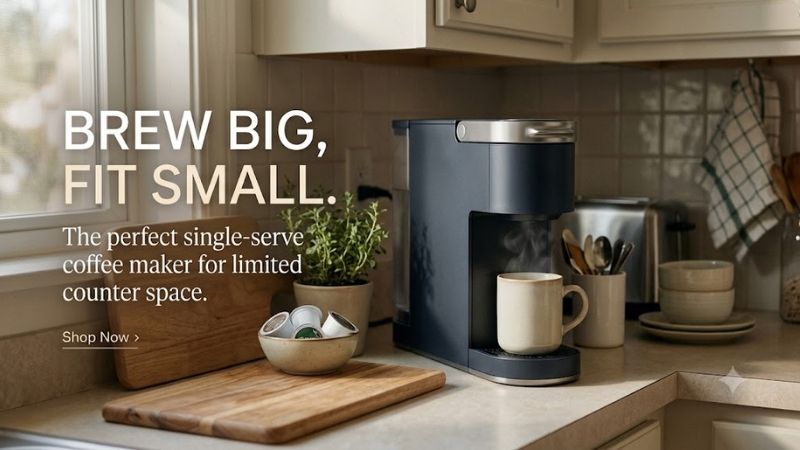
Pod brewers use pre-portioned coffee contained in compatible capsules or soft pods. The user adds water when necessary, inserts a coffee portion, chooses a beverage size, and starts brewing.
This reduces the need to measure loose coffee or handle wet grounds after every drink.
For someone sharing a small kitchen, that convenience can be valuable. However, individual capsules occupy storage space and create recurring costs.
Another concern is compatibility. Coffee pod formats are not universal, and a machine designed for one system may not accept another.
Before buying, compare the available coffee choices and the long-term cost of the compatible pods.
Podless Single-Cup Drip Brewers
A podless single-cup brewer uses ground coffee and a suitable filter.
Water is heated and distributed over the coffee, then drains into a mug.
This gives you greater flexibility over coffee beans, grind size, and beverage strength.
It also avoids depending on a proprietary capsule system.
However, the filter basket and used grounds require cleaning.
Some machines use reusable filters, while others require paper filters.
A podless brewer is often the better choice for someone who values coffee selection over maximum convenience.
One-Cup Espresso Capsule Machines
Espresso capsule systems focus on smaller, concentrated beverages.
They can be relatively compact, but the coffee they produce varies by brewing system.
Some are designed for espresso-style extraction, while others offer larger coffee drinks.
A concentrated capsule beverage should not automatically be assumed identical to traditionally prepared espresso.
If you primarily drink ordinary American-style mugs of coffee, an espresso-focused machine may not be the most practical choice.
Manual Pour-Over Drippers
A manual dripper can occupy very little storage space.
It typically sits over a mug or carafe and requires hot water to be poured over ground coffee.
However, the complete setup also needs a kettle, filters, and ideally a grinder or access to appropriately ground coffee.
A small dripper is not necessarily the most space-efficient solution if you must purchase several additional appliances.
For households that already own a kettle, however, it can be an excellent minimalist alternative.
Measuring Your Counter Space Correctly
Width Is Only One Dimension
Many single-serve machines are marketed as compact because of their narrow bodies.
However, a narrow machine can still extend deep into the counter.
Start by measuring the available width, depth, and height.
Consider whether the appliance sits beside a refrigerator, sink, stove, or other kitchen equipment.
A machine projecting too far toward the counter edge may interfere with meal preparation.
When comparing models, use complete exterior dimensions rather than relying on terms such as slim or mini.
Check the Space Above the Machine
Some coffee makers have top-loading water tanks or capsule compartments.
These may require considerable clearance when opened.
A machine may fit neatly beneath a wall cabinet but become inconvenient if its lid cannot open fully.
Measure the height of the machine with all normal operating components open.
If the manufacturer does not provide open-lid dimensions, inspect the product’s operating instructions before purchasing.
Mug Clearance
Mug height is especially important for people who use insulated travel mugs.
Some single-serve machines accommodate only ordinary coffee cups.
Others have removable drip trays that provide additional vertical clearance.
However, removing the drip tray may create a greater risk of spills if the cup is not positioned properly.
Measure the height of your preferred mug, including the base shape.
Do not assume that every machine advertising travel-mug compatibility accommodates every travel mug.
Water Tank Access
A rear-mounted tank can be inconvenient when the machine sits against a wall.
Some reservoirs lift vertically, while others detach from the side.
For small kitchens, easy water access can be more important than reservoir volume.
A brewer that must be moved each morning to refill it may become frustrating despite its compact footprint.
Fixed vs. Removable Water Reservoirs
Fixed Reservoir Designs
Some compact coffee makers require the user to pour a measured amount of water into the machine for each cycle.
This can reduce the size of the appliance.
It also eliminates the need to keep a large reservoir filled.
However, daily filling requires careful measuring and pouring.
For a person making only one cup each morning, this may be perfectly acceptable.
Removable Water Tanks
A removable reservoir allows the user to carry the tank to a sink.
This can make filling and cleaning more convenient.
However, the tank may add width or depth to the machine.
The attachment mechanism should be easy to operate without excessive force.
Check how the reservoir fits into the housing and whether it can be accessed in your intended location.
Large Reservoirs: Convenience or Wasted Space?
A large water tank reduces refill frequency.
However, it increases the appliance’s footprint and may encourage water to remain unused for longer periods.
For a household brewing only one cup daily, a modest reservoir may be more appropriate.
For several daily coffees, a larger tank can reduce interruptions.
Choose according to actual consumption rather than maximum advertised capacity.
Coffee Quality: What Really Matters?
Brewing Temperature
Water temperature influences the extraction of soluble compounds from ground coffee.
For conventional filter coffee, a commonly used brewing reference is approximately 195–205°F.
However, the temperature that matters is the water contacting the coffee—not merely the heater’s advertised temperature.
Some low-cost brewers may heat water inconsistently during a brewing cycle.
For buyers who prioritize flavor, credible independent brewing-temperature testing is more meaningful than an unverified marketing claim.
Brew Time and Contact Time
Contact time describes how long water interacts with coffee grounds.
Appropriate contact time depends on grind size, brewing method, and beverage volume.
A very short brewing cycle is convenient, but speed alone does not guarantee proper extraction.
Likewise, a machine that brews slowly does not automatically make better coffee.
Choose a brewer whose coffee preparation method matches your taste preferences.
Coffee-to-Water Ratio
For conventional filter coffee, approximately 55 grams of ground coffee per liter of water is a useful starting reference.
This corresponds to roughly 16.5 grams for 300 milliliters of water.
However, it is a starting point rather than a mandatory recipe.
Actual preferences vary with roast, grind, and brewing equipment.
Pod brewers offer less freedom because the coffee quantity is determined by the capsule.
With a podless brewer, you can adjust the ratio more directly.
Grind Size
A single-cup drip brewer generally needs a grind suited to its filter basket and water-flow behavior.
If the grind is too fine, the coffee bed may drain too slowly.
If it is too coarse, extraction may be weak.
Avoid assuming that the grind labeled medium works identically for every machine.
Start with manufacturer guidance and adjust based on flavor and flow.
Water Quality
Water affects coffee flavor and mineral buildup.
Very hard water can increase scale formation.
Water with undesirable odors or flavors may negatively affect the cup.
Use potable water that meets the machine’s requirements.
A built-in water filter may improve certain water characteristics, but its effectiveness depends on the filter design.
Pod vs. Ground Coffee: Long-Term Trade-Offs
Daily Convenience
Pods reduce measuring and grounds handling.
This can make the morning process simple and predictable.
Ground coffee requires more preparation but offers greater flexibility.
Consider how much time you are willing to spend on each cup.
A difference of a minute or two may be unimportant for occasional use but meaningful during a rushed morning.
Coffee Variety
Ground-coffee machines allow you to use many different coffee beans and roasts.
Pod systems limit you to compatible products.
However, some capsule ecosystems offer extensive selections.
The important question is whether your preferred coffee is available in the format the machine uses.
Ongoing Expense
Capsules can create higher recurring costs than some ground-coffee brewing methods.
For example, someone drinking two coffees daily uses about 60 capsules in a 30-day month.
At a hypothetical $0.70 per capsule, that represents $42 monthly before accounting for equipment and other supplies.
Ground coffee cost depends on the coffee dose and price per bag.
Compare your actual choices rather than assuming one method is always cheaper.
Packaging Waste
Single-use capsules create packaging that may require specialized disposal.
Some systems offer recycling programs, but local availability varies.
Reusable capsules may reduce some packaging waste, although they add filling and cleaning steps.
A podless brewer with a reusable filter avoids proprietary capsules but still requires grounds disposal.
Choosing the Right Controls
One-Touch Brewing
A simple start button can be valuable when preparing coffee while cooking breakfast.
However, one-touch does not necessarily mean the machine automatically selects the correct amount of water.
Check whether the appliance requires manual filling for each cup.
Cup-Size Selection
Multiple cup sizes provide flexibility.
However, sending more water through the same coffee portion can produce a weaker beverage.
A larger cup button does not create additional coffee grounds.
Choose a machine with settings appropriate for your desired coffee strength.
Brew-Strength Settings
Some machines offer a strong setting.
This may change water flow, contact time, or another brewing parameter.
The exact mechanism varies.
Do not assume a strong button adds more coffee or guarantees better extraction.
Programmable Brewing
Scheduling can be useful for certain ground-coffee machines.
However, many compact pod brewers do not need advance scheduling because preparation is already straightforward.
If programmability increases the appliance’s price or complexity, consider whether you will use it.
Cleaning and Maintenance
Cleaning Pod Compartments
Used capsules may leave coffee residue inside the brewing chamber.
Remove spent capsules according to the manual.
Never place fingers near sharp capsule-piercing components.
Follow approved procedures for clearing blockages.
Cleaning Reusable Filter Baskets
Podless machines require regular cleaning of the filter basket.
Coffee oils and fine grounds can accumulate.
A removable filter that is easy to rinse can make everyday operation more convenient.
Drip Tray Maintenance
Drip trays collect spilled coffee and rinse water.
Empty them regularly.
Check whether the tray is dishwasher safe.
Descaling
Mineral deposits can accumulate inside water-heating pathways.
Descale according to the manufacturer and local water conditions.
Use approved cleaning products.
Do not assume vinegar is suitable for every machine.
Cleaning Frequency
A compact machine is not automatically low-maintenance.
Daily cleaning may include removing used capsules, rinsing the filter basket, and wiping spills.
Periodic maintenance may include descaling and cleaning water-contact components.
Choose a model whose instructions are clear and whose removable parts are accessible.
Safety in Small Kitchens
Hot Water and Steam
Single-serve coffee makers can release hot water and steam.
Keep hands away from dispensing areas during operation.
Do not open brewing compartments while the machine is pressurized or actively heating unless the manual permits it.
Electrical Placement
Use an appropriate outlet.
Keep cords away from sinks and hot burners.
Avoid placing the machine where water spills could reach electrical connections.
Stable Countertop Position
A narrow coffee maker should sit securely on a stable surface.
Avoid placing it near the counter edge.
Children and Pets
Keep hot drinks, capsules, and electrical cords out of reach.
Used capsules may remain hot immediately after brewing.
Choosing by Lifestyle
One-Person Apartment
A compact podless brewer or narrow capsule machine may be ideal.
Prioritize easy filling and minimal cleanup.
Shared Apartment
Different coffee preferences can favor a capsule machine, provided the compatible system offers suitable choices.
However, the household should agree on capsule costs and cleaning responsibility.
Home Office
A single-serve machine can provide convenient coffee throughout the day.
For frequent use, a larger water reservoir may be worthwhile.
Minimalist Kitchen
A manual dripper may occupy less storage space if you already own a kettle.
Avoid buying a separate electric machine without considering existing equipment.
Frequent Travel-Mug Users
Check cup clearance and the supported beverage volume.
A machine that requires transferring coffee into a travel mug may add unnecessary work.
When a Single-Serve Coffee Maker Is the Wrong Choice
Several People Drink Coffee Together
Preparing cups sequentially may be inefficient.
A small batch drip brewer may suit the household better.
You Want Extensive Espresso Control
A basic single-serve coffee maker is not equivalent to a semi-automatic espresso setup.
You Prefer Large Quantities of Coffee
Repeated single-cup brewing can become inconvenient.
You Dislike Proprietary Consumables
Choose a podless machine or manual brewing method rather than committing to an incompatible capsule system.
Common Buying Mistakes
Measuring Only the Machine Width
Depth, lid clearance, and water tank access matter.
Ignoring Mug Height
Travel mugs may not fit beneath the outlet.
Choosing by Brew Speed Alone
Fast brewing does not guarantee satisfying extraction.
Buying an Oversized Reservoir
A large tank may waste space when only one cup is prepared daily.
Forgetting Capsule Costs
The initial machine price is not the complete ownership cost.
Assuming Every Compact Brewer Is Easy to Clean
Internal brewing pathways and small removable components can require regular care.
Frequently Asked Questions
What Is the Best Type of Single Serve Coffee Maker for Limited Counter Space?
A narrow pod brewer or compact podless drip machine is a practical starting point. Choose based on coffee preferences, full operating dimensions, and cleaning requirements.
Are Podless Single-Serve Coffee Makers Better?
They provide greater freedom to choose ground coffee and avoid proprietary capsules, but they require filter and grounds cleanup.
Can a Single-Serve Coffee Maker Brew Into a Travel Mug?
Some can. Verify maximum mug height and supported beverage volume before buying.
Do Single-Serve Coffee Makers Use More Electricity?
Energy use depends on heater design, brewing frequency, standby operation, and beverage volume. A compact size does not establish total energy consumption.
How Often Should I Descale a Single-Serve Coffee Maker?
Follow the manufacturer’s schedule and water-hardness recommendations. Descaling frequency varies.
Is a Single-Serve Machine Better Than a Small Drip Coffee Maker?
A single-serve machine is convenient for one cup at a time. A small drip brewer may be better when several people want coffee together.
Conclusion
The best single serve coffee maker for limited counter space combines an appropriate brewing method with practical dimensions, accessible water filling, and straightforward cleaning. Pod brewers offer convenience, while podless machines provide more flexibility over coffee selection and cost. Measure the full operating footprint, check mug and cabinet clearance, and prioritize the routine you use every day rather than choosing the smallest advertised machine.




Write Your Review
No reviews yet. Be the first to share your experience!