
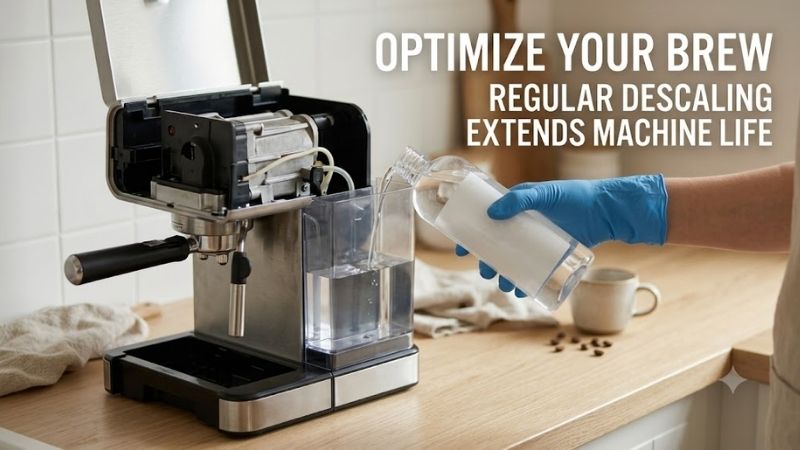
An espresso machine descaler helps remove mineral buildup that can restrict water flow and interfere with heating. Choosing one requires more than comparing bottle sizes: the formula must be approved for your machine. This guide examines six descaling products, their intended uses, compatibility limits, and the maintenance mistakes to avoid.
Quick Verdict: Which Espresso Machine Descaler Should You Buy?
Best for De’Longhi owners: De’Longhi EcoDecalk. De’Longhi recommends its own descaler for its coffee machines, making EcoDecalk the first product to consider for a compatible De’Longhi system.
Best for supported Breville machines: Breville Descaler. A brand-approved solution is the sensible choice when your specific machine’s manual identifies it.
Best for compatible general-purpose equipment: Urnex Dezcal. The Dezcal product family includes formulations for different maintenance applications, but exact machine compatibility and dosing must be checked.
No descaler deserves a universal recommendation independent of the machine it will be used in.
Comparison Table
| Product | Best For | Format | Main Advantage | Important Limitation |
|---|---|---|---|---|
| De’Longhi EcoDecalk | Compatible De’Longhi machines | Liquid concentrate | Manufacturer-recommended care | Follow exact De’Longhi model instructions |
| Breville Descaler | Supported Breville espresso machines | Manufacturer-specific descaler | Designed for approved Breville maintenance | Different Breville models have different cycles |
| Urnex Dezcal Home Descaler | Compatible domestic coffee equipment | Product-dependent | Dedicated mineral-scale removal | Check precise formulation and approval |
| Urnex Dezcal Powder | Approved commercial coffee equipment | Powder | Flexible preparation for specified equipment | Commercial formula is not a universal home-machine choice |
| Durgol Swiss Espresso | Compatible espresso and coffee machines | Liquid | Convenient measured liquid format | Manufacturer approval remains essential |
| Gaggia Decalcifier | Supported Gaggia machines | Liquid | Brand-oriented descaling option | Do not substitute cleaning tablets |
How We Selected These Descalers
Descaling is a chemical maintenance process, not an ordinary cleaning task. Its purpose is to dissolve accumulated mineral deposits, particularly calcium-containing scale, inside suitable water-contact components.
A responsible comparison must therefore prioritize machine compatibility before concentration, package size, or cost per treatment.
We considered the stated equipment applications, liquid versus powder dosing, ease of following an approved cleaning cycle, and whether the product should be confused with coffee-oil cleaners.
We did not independently test scale-removal speed, corrosion, heating efficiency, or internal component compatibility. Those outcomes require controlled measurements and knowledge of the exact machine materials.
Detailed Product Reviews
1. De’Longhi EcoDecalk — Best for De’Longhi Espresso Machines
Best For: Owners of compatible De’Longhi manual and automatic espresso machines.
Why We Picked It
Manufacturer-specific maintenance products reduce uncertainty about chemical compatibility. De’Longhi recommends EcoDecalk for its coffee equipment and directs owners to their machine manual for the cleaning procedure.
Key Features
- Liquid descaling solution
- Intended for De’Longhi coffee-machine maintenance
- Designed to address mineral-scale deposits
- Supplied in different packaging formats
- Used through the appropriate machine descaling cycle
Practical Advantages
The major benefit is not a special promise of better-tasting espresso. It is having a product supported by the equipment manufacturer.
Scale can restrict water movement and interfere with heating. Removing it correctly helps maintain the system’s intended operation.
For many De’Longhi procedures, the manufacturer specifies a 100mL dose, although users must follow their particular machine and product instructions rather than assume one universal dilution.
Limitations
EcoDecalk is not a substitute for brew-group cleaning or milk-system maintenance.
It also does not repair a blocked valve, failed pump, damaged heater, or other mechanical defect.
Pros
- Recommended by De’Longhi.
- Liquid formulation avoids measuring dry powder.
- Dedicated scale-removal purpose.
Cons
- Specific dosing procedures vary.
- Not an all-purpose cleaning chemical.
- May cost more than generic alternatives.
Buy If: You own a compatible De’Longhi and want to follow its supported maintenance process.
Skip If: You own equipment whose manufacturer requires another descaler.
2. Breville Descaler — Best for Supported Breville Machines
Best For: Owners of supported Bambino, Barista, Infuser, and Oracle-family espresso machines.
Why We Picked It
Breville specifies approved descaling solutions and model-specific cycles. That matters because a Bambino’s controls and cleaning sequence are not necessarily the same as those of a Barista Touch or Oracle.
Key Features
- Manufacturer-oriented espresso descaler
- Used with compatible Breville descaling procedures
- Intended for mineral buildup rather than coffee-oil residue
- Requires complete rinsing after treatment
Practical Advantages
Choosing an approved product reduces the risk of using an unsuitable household acid or an overly concentrated mixture.
Breville specifically advises users not to use vinegar in its relevant maintenance guidance.
Limitations
A Breville cleaning tablet and a Breville descaler serve different purposes.
The tablet addresses coffee residue in supported brew-cleaning cycles, while the descaler addresses water-related mineral deposits.
Using one where the other is required is not equivalent maintenance.
Pros
- Aligns with supported manufacturer procedures.
- Purpose-built maintenance category.
- Straightforward choice for compatible machines.
Cons
- Not automatically appropriate for unrelated brands.
- Requires checking the exact model.
- Full rinse sequence cannot be skipped.
Buy If: Your Breville manual identifies the descaler or approves its formulation.
Skip If: Compatibility cannot be established.
3. Urnex Dezcal Home Descaler — Best General-Purpose Consideration
Best For: Owners of domestic coffee equipment whose manufacturer permits the specific Dezcal formulation.
Why We Picked It
Urnex is an established coffee-equipment maintenance brand with products addressing mineral deposits.
Its descaling range is useful to consider when an equipment manufacturer permits a compatible aftermarket treatment.
Key Features
- Designed for mineral-scale removal
- Offered in different product formats
- Intended for specified coffee-equipment applications
- Distinct from Urnex Cafiza coffee-oil cleaners
Practical Advantages
A dedicated descaler can be more appropriate than improvising with vinegar or household cleaners.
However, the Dezcal name covers more than one formulation or packaging configuration.
Limitations
Do not assume the dilution directions for one Dezcal package apply to another.
A home-machine formula and a commercial equipment powder may have different intended procedures.
Pros
- Established coffee maintenance product family.
- Dedicated descaling function.
- Useful alternative where approved.
Cons
- Multiple formulations can cause confusion.
- Exact machine compatibility is essential.
- Incorrect dilution can cause problems.
Buy If: Your equipment supports the specific Dezcal product.
Skip If: Its suitability is uncertain or the manual requires a brand-specific treatment.
4. Urnex Dezcal Descaling Powder — Best for Approved Commercial Equipment
Best For: Operators of compatible commercial brewing systems that specifically permit this powdered descaler.
Why We Picked It
Urnex markets its current Dezcal Powder for commercial coffee equipment, including suitable boilers and hot-water components.
Key Features
- Powdered descaling product
- Commercial-equipment orientation
- Intended to dissolve mineral buildup
- Requires weighing and mixing
- Manufacturer-provided dilution directions
Practical Advantages
Powder can be practical when maintaining approved equipment that requires larger cleaning volumes.
It also allows a precisely measured cleaning solution to be prepared according to the product instructions.
Limitations
This commercial formula should not be casually recommended for every home espresso machine.
Urnex supplies a particular dilution specification for this product, but that does not override a machine manufacturer’s compatibility or maintenance requirements.
Pros
- Dedicated scale-removal formula.
- Appropriate for certain commercial applications.
- Measurable powder dosing.
Cons
- Requires accurate mixing.
- Not a universal domestic espresso choice.
- Incorrect concentrations may damage equipment.
Buy If: You maintain approved equipment and can follow both the descaler and machine instructions.
Skip If: You simply need an approved descaler for a consumer espresso machine.
5. Durgol Swiss Espresso — Best Ready-to-Use Liquid Alternative
Best For: Owners of coffee machines whose documentation permits the specific Durgol descaling product.
Why We Picked It
Durgol Swiss Espresso is a dedicated liquid descaler marketed for coffee and espresso equipment.
Its liquid format avoids handling powdered descaler.
Key Features
- Liquid descaling formulation
- Coffee and espresso equipment application
- Intended to address limescale
- Requires machine-specific compatibility verification
- Used with an approved descaling process
Practical Advantages
A prepared liquid can make measuring and mixing less complicated.
The product is worth considering for compatible equipment when brand-specific products are unavailable.
Limitations
A broad coffee-machine label does not prove suitability for every boiler metal, seal, valve, or automatic cleaning system.
Pros
- Liquid format.
- Dedicated scale-removal purpose.
- Convenient for compatible machines.
Cons
- Compatibility must be established independently.
- Not a coffee-oil cleaner.
- No guarantee of repair for heavily obstructed equipment.
Buy If: Your machine documentation permits its use.
Skip If: The machine manufacturer requires a different product.
6. Gaggia Decalcifier — Best for Supported Gaggia Machines
Best For: Owners of Gaggia espresso machines that specify an approved liquid descaler.
Why We Picked It
Gaggia’s maintenance products provide a manufacturer-oriented choice for compatible models.
Key Features
- Liquid mineral-scale remover
- Designed for compatible coffee equipment
- Model-specific usage instructions
- Separate from Gaggia coffee-oil cleaning tablets
Practical Advantages
Manufacturer-approved products are sensible when maintaining a machine whose internals are not readily accessible for inspection.
Limitations
Gaggia machines differ. Traditional portafilter machines and automatic bean-to-cup systems may have different procedures.
Pros
- Brand-specific maintenance option.
- Dedicated descaling function.
- Suitable for supported models.
Cons
- Not universal.
- Exact procedure varies by machine.
- Does not remove coffee oils in the same way as brew-group detergent.
Buy If: Your Gaggia manual supports it.
Skip If: You cannot verify compatibility with your exact machine.
Espresso Machine Descaler Buying Guide
Why Espresso Machines Develop Scale
Water contains dissolved minerals, including calcium and magnesium compounds. Heating and other conditions can cause some of these minerals to form deposits within water-contact components.
Scale can interfere with flow, heating, and temperature regulation.
The amount and rate of buildup depend on water chemistry and machine operation.
Descaling vs. Cleaning Tablets
These products address different problems.
Descalers target mineral deposits.
Cleaning tablets generally target coffee oils and brewing residue.
A steam-wand milk cleaner targets another category of contamination.
Do not substitute these products merely because they all appear in a coffee-machine maintenance category.
Manufacturer Approval Comes First
Before buying, identify your exact machine model.
Read the maintenance section of its manual.
Confirm the product type, concentration, cycle, and rinsing instructions.
An approved product is generally a more defensible choice than an inexpensive generic descaler with unclear compatibility.
Liquid vs. Powder
Liquid descalers are convenient for users who prefer measured bottle doses.
Powders can be economical in specified applications but require careful mixing.
Neither format is inherently safer for every machine.
Formulation and compatibility matter more.
Water Hardness
Water hardness influences scale risk.
Hard water generally creates more scale concerns than softer water.
However, extremely low-mineral water is not automatically appropriate for all espresso machines.
Follow the manufacturer’s water-quality recommendations.
How Often Should You Descale?
Use the manufacturer’s maintenance schedule or indicator.
Water hardness, coffee consumption, and filtration affect the interval.
There is no universal schedule suitable for every espresso machine.
Why Vinegar Is Not Always Appropriate
Vinegar is commonly suggested as a household descaler, but some manufacturers explicitly advise against it.
Unapproved acidic solutions may create compatibility or rinsing concerns.
Follow the machine’s approved procedure instead.
Complete the Rinse Cycle
Rinsing removes dissolved scale, residue, and remaining descaling solution.
Do not shorten the procedure or brew coffee for consumption before the required rinsing is complete.
When Descaling Is Not Enough
Restricted water flow can also result from blocked components, a faulty pump, or mechanical problems.
If an approved cleaning cycle cannot complete, consult qualified service support rather than increasing chemical concentration.
Common Descaling Mistakes
Using a Coffee-Oil Tablet as a Descaler
These products are not interchangeable.
Mixing Chemicals
Never combine descalers with bleach, detergent, or other cleaners.
Increasing the Concentration
A stronger mixture is not automatically safer or more effective.
Interrupting the Cycle
Follow the full procedure, including rinsing.
Descaling Without Checking Compatibility
Even an established cleaning brand cannot guarantee that every formulation suits every espresso machine.
Frequently Asked Questions
What is the best espresso machine descaler?
The correct choice depends on the equipment. De’Longhi EcoDecalk and approved Breville or Gaggia descalers are sensible brand-specific options.
Can you use Urnex Dezcal in every espresso machine?
No. Verify both the product formulation and machine approval.
Are descaling tablets the same as cleaning tablets?
No. Their intended cleaning functions may be different.
Can you use vinegar?
Only if the machine manufacturer explicitly permits it.
How often should an espresso machine be descaled?
Follow the machine’s instructions and account for water hardness and usage.
Does a water filter eliminate descaling?
Not necessarily. Filtration effectiveness and maintenance requirements vary.
Why is the descaling light still on?
The machine may require a completed rinse cycle or a model-specific reset or completion sequence.
Can descaling repair a machine with no water flow?
It may address some scale-related problems, but severe blockage or mechanical failure can require service.
Conclusion
The best espresso machine descaler is one approved for your exact machine. Choose EcoDecalk for compatible De’Longhi equipment, Breville’s approved descaler for supported Breville models, or Gaggia’s product where specified. Urnex and Durgol offer alternatives for approved systems. Correct dosing and complete rinsing matter more than universal-cleaner claims.





Write Your Review
No reviews yet. Be the first to share your experience!