
Choosing an electric kettle for induction cooking requires understanding one important distinction: electric kettles and induction-compatible stovetop kettles use different heating systems. A standard electric kettle heats water through its powered base, not an induction burner. This guide explains how to select the right kettle for your induction kitchen without making costly or unsafe compatibility mistakes.
- Quick Verdict: Which Kettle Should You Choose?
- Understanding Electric Kettles and Induction Cooking
- Choosing the Right Kettle for Your Kitchen
- Materials and Construction
- Heating Performance and Temperature Control
- Everyday Use Cases
- Cleaning and Maintenance
- Important Safety Considerations
- Frequently Asked Questions
- Conclusion
Quick Verdict: Which Kettle Should You Choose?
If you want to heat water directly on an induction cooktop, choose a stovetop kettle explicitly labeled induction compatible.
If you want a kettle that operates independently of the cooktop, choose a standard electric kettle with its own powered base.
These are different appliance categories. An electric kettle is not automatically suitable for placement on an induction burner.
| Feature | Induction-Compatible Stovetop Kettle | Electric Kettle |
|---|---|---|
| Heating source | Induction cooktop | Built-in electric heating system |
| Magnetic base required | Yes | Not for normal operation |
| Wall outlet | Required for the induction cooktop | Required for the kettle |
| Temperature settings | Controlled through the cooktop | Model-dependent |
| Automatic shutoff | Typically controlled manually | Common on electric models |
| Portability | Depends on cooktop availability | Can operate near a suitable outlet |
| Counter space | Uses existing cooking surface | Requires a powered base |
| Main consideration | Magnetic-base compatibility | Electrical features and safe operation |
For small kitchens with an existing induction stove, a compatible stovetop kettle can avoid adding another permanently stationed appliance.
For tea drinkers who want dedicated temperature presets or automatic shutoff, an electric kettle may be more convenient.
Understanding Electric Kettles and Induction Cooking
How Does Induction Heating Work?
Induction cooktops use electromagnetic fields to produce heat within compatible cookware.
The cookware must contain a suitable ferromagnetic material in its base.
This is different from a traditional electric coil or radiant cooktop, which transfers heat from a hot surface.
Induction cookware compatibility depends on both the material and the base design.
A kettle with insufficient magnetic material may not be detected by the cooktop.
Even a magnetically responsive kettle may be unsuitable if its base is too small for the cooking zone or does not meet the manufacturer’s requirements.
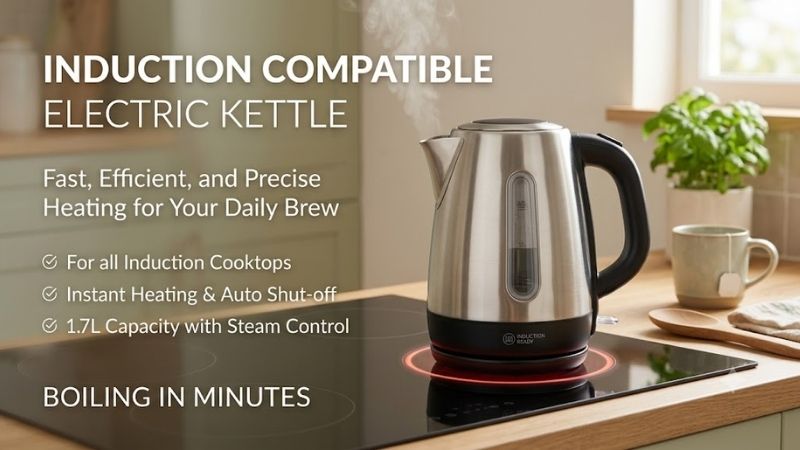
Why Regular Electric Kettles Cannot Be Used on Induction Cooktops
A typical electric kettle contains a heating element or integrated heating system designed to operate with its dedicated powered base.
It may also include electrical connectors, plastic components, sensors, and temperature-control electronics.
Placing this appliance on an induction cooktop can damage those components and create serious hazards.
A stainless steel exterior does not make an electric kettle induction compatible.
Never place an electric kettle on an induction burner unless its manufacturer explicitly designs and approves that exact configuration.
For ordinary household electric kettles, use only the supplied compatible power base.
What Makes a Stovetop Kettle Induction Compatible?
Induction-compatible stovetop kettles require a suitable magnetic base.
Some use magnetic stainless steel, while others incorporate layered construction with a magnetic exterior.
However, not every grade of stainless steel is magnetic.
Copper, aluminum, and glass kettles generally need an appropriate induction-compatible base construction to work on an induction cooktop.
A product described simply as stainless steel should not be assumed compatible.
Check for an explicit induction compatibility statement from the manufacturer.
Can You Test a Kettle With a Magnet?
A magnet can provide a useful preliminary indication of whether a kettle’s base contains magnetic material.
If a magnet sticks firmly to the bottom, that suggests the base may work with induction heating.
However, the magnet test is not a complete compatibility guarantee.
The induction cooktop must also recognize the cookware, and the base needs an appropriate diameter and construction.
Manufacturer documentation remains the better purchasing reference.
Choosing the Right Kettle for Your Kitchen
Check Cooktop Compatibility First
Before purchasing an induction-compatible stovetop kettle, review the induction cooktop’s operating instructions.
Some cooking zones require cookware bases within a specified diameter range.
A very small kettle may not activate a larger induction zone.
The kettle should have a suitable flat base, with adequate magnetic contact area.
A kettle that works on one induction stove may not be recognized by another.
This is particularly relevant to compact gooseneck kettles and certain specialized coffee equipment.
Determine the Right Capacity
Choose capacity based on how much hot water you regularly need.
For one person preparing tea or pour-over coffee, a relatively small kettle may be enough.
A larger household might prefer a kettle that serves several cups without repeated filling.
However, a larger kettle becomes heavier when filled and requires more space.
Check the minimum and maximum fill markings.
A kettle’s stated capacity does not mean that it can safely be filled to the rim.
Consider the Base Diameter
Base diameter can influence induction compatibility.
Induction cooktops often have minimum cookware detection requirements.
A kettle with a narrow base may not work properly on certain cooking zones, even when the material is magnetic.
Compare the kettle’s stated base dimensions with the cooktop manual.
Do not assume that a larger decorative body means the bottom has a sufficiently large magnetic heating area.
Evaluate Handle Comfort and Heat Protection
A kettle can become heavy and hot during use.
Look for a handle that provides a secure grip and appropriate clearance from hot surfaces.
Some designs incorporate heat-resistant materials or protective handle features.
However, these do not guarantee that every part of the handle remains cool under all conditions.
Follow the manufacturer’s handling instructions and use suitable protection when necessary.
Materials and Construction
Stainless Steel Kettles
Stainless steel is common in kitchen kettles because it offers a practical combination of strength, corrosion resistance, and cleanability.
For induction cooking, the specific base construction is essential.
Some stainless steel grades are nonmagnetic or insufficiently magnetic for induction use.
Choose a product explicitly approved for induction rather than relying on material descriptions alone.
Enameled Steel Kettles
An enameled steel kettle may work with induction if its underlying steel and base design are compatible.
The enamel coating provides a finished surface but may be vulnerable to damage from impacts or improper handling.
Inspect the manufacturer’s instructions for cooktop suitability and care requirements.
Avoid using a kettle with damaged surfaces when the manufacturer advises against continued operation.
Glass and Aluminum Kettles
Ordinary glass and aluminum do not provide the magnetic base required for direct induction heating.
Some products incorporate compatible metal bases or specialized designs.
However, compatibility must be established for the exact kettle.
Do not assume that a product described as suitable for electric stoves is also suitable for induction.
Heating Performance and Temperature Control
Does Induction Boil Water Faster?
Induction heating can transfer energy efficiently into compatible cookware.
However, actual boiling time depends on several factors:
-
Water quantity.
-
Starting water temperature.
-
Induction cooktop power.
-
Kettle base construction.
-
Cooking zone compatibility.
-
Heat losses and operating conditions.
It is not accurate to claim that every induction kettle boils water faster than every electric kettle.
Meaningful comparisons require equivalent water volumes and controlled test conditions.
Variable Temperature Electric Kettles
Electric kettles with temperature settings can be useful for people who regularly prepare different types of tea or coffee.
Some models allow users to select a target water temperature.
Others provide only a boil function.
Temperature control precision and water-temperature consistency vary between products.
If precise brewing temperatures matter, prioritize credible temperature-control evidence rather than assuming that a digital display guarantees accuracy.
Whistling Kettles
Some stovetop kettles include whistles that sound when steam passes through the spout mechanism.
This provides an audible signal that water is boiling.
A whistle is useful for people who prefer a traditional stovetop design.
However, it is not equivalent to automatic shutoff.
Turn off the cooking zone promptly and avoid allowing the kettle to boil dry.
Everyday Use Cases
Best Setup for Tea Drinkers
If you regularly prepare several types of tea, a temperature-controlled electric kettle may offer the most convenient workflow.
You can heat water without occupying the induction cooktop.
However, if you only need boiling water and already have an accessible induction burner, a compatible stovetop kettle may be sufficient.
Best Setup for Pour-Over Coffee
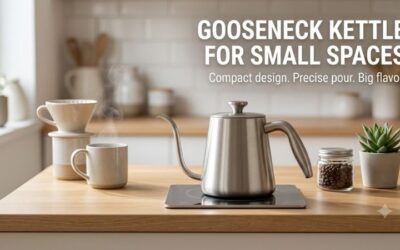
A gooseneck kettle can provide greater pouring control than a conventional wide-spout kettle.
For induction cooking, select a gooseneck kettle explicitly approved for induction use.
If precise temperature selection and consistent pouring are priorities, a dedicated electric gooseneck model may be more practical.
Best Setup for Small Apartments
A stovetop kettle can reduce countertop appliance clutter when an induction cooktop is already available.
An electric kettle may be preferable when burners are frequently occupied or when you want hot water without interrupting cooking.
Measure available storage and operating space before deciding.
Best Setup for Families
Families frequently heating water for several drinks may prefer a larger capacity.
However, greater capacity increases filled weight.
Choose a comfortable handle, secure lid, and stable base.
For households with children, prioritize safe placement and keep hot kettles and cords out of reach.
Cleaning and Maintenance
Removing Mineral Scale
Mineral deposits can accumulate inside kettles, particularly in areas with hard water.
Scale may affect appearance, water taste, and heating behavior.
Follow the manufacturer’s descaling instructions.
Use only approved cleaning products and concentrations.
Never mix descaling chemicals with bleach or other cleaners.
Cleaning the Exterior
Allow the kettle to cool before cleaning.
Follow the manufacturer’s instructions for the exterior material and finish.
Avoid abrasive tools that could damage coatings or polished surfaces.
For electric kettles, keep the electrical base and connectors dry.
Maintaining the Lid and Spout
Residue may accumulate around spout filters, lids, and seals.
Clean removable components according to the manual.
Inspect the lid for secure fit before heating water.
Never operate a kettle with damaged components or an obstructed steam outlet.
Important Safety Considerations
Preventing Boil-Dry Damage
A stovetop kettle must contain sufficient water during heating.
Do not leave it operating unattended.
Boiling dry can damage the kettle and create burn or other hazards.
Some electric kettles include boil-dry protection, but that does not justify intentionally operating them without water.
Handling Steam and Hot Surfaces
Steam can cause serious burns.
Keep hands and face away from the spout and lid while heating water.
Pour carefully and avoid overfilling.
A kettle’s body and lid can remain hot after the heat source is switched off.
Protecting Glass Induction Surfaces
Use a suitable flat-bottomed kettle.
Avoid dragging rough or heavy cookware across the glass surface.
Follow the induction cooktop manufacturer’s cleaning and handling instructions.
Frequently Asked Questions
Can an Electric Kettle Work on an Induction Stove?
Ordinary electric kettles are designed for their own powered bases and should not be placed on induction cooktops. Use a stovetop kettle specifically approved for induction instead.
Are All Stainless Steel Kettles Induction Compatible?
No. Stainless steel composition and base construction vary. Verify the exact product’s induction compatibility.
Does an Induction Kettle Need a Flat Bottom?
A suitable flat base is generally recommended for stable placement and proper compatibility. Check the kettle and cooktop requirements.
Is an Electric Kettle More Convenient Than an Induction Kettle?
An electric kettle may be more convenient for automatic shutoff and dedicated temperature settings. An induction-compatible stovetop kettle uses existing cooking equipment and may require less dedicated counter space.
Can I Use a Gooseneck Kettle on Induction?
Only when the specific gooseneck kettle is approved for induction cooking and its base meets the cooktop’s detection requirements.
Can I Leave a Kettle on Keep-Warm Mode?
Only if the electric kettle includes an approved keep-warm function. Follow the manufacturer’s time limits and operating instructions.
Conclusion
For buyers searching for an electric kettle for induction cooking, the essential decision is whether they want a kettle heated by an induction stove or a separate electric appliance. Choose an induction-compatible stovetop kettle for direct cooktop use, or a dedicated electric kettle for independent heating and optional temperature controls. Never interchange the two heating methods without explicit manufacturer approval.



Write Your Review
No reviews yet. Be the first to share your experience!