
An electric can opener for home baristas can be a useful addition to a coffee preparation area, especially when recipes involve canned coconut milk, sweetened condensed milk, or other packaged ingredients. Although it does not brew coffee, a compact opener can simplify ingredient preparation. This guide explains how to choose one based on convenience, cutting safety, cleaning, and available counter space.
- Quick Verdict: Is an Electric Can Opener Worth Buying for a Home Coffee Station?
- How an Electric Can Opener Fits Into a Home Barista Setup
- Understanding Electric Can Opener Types
- Which Cutting Style Makes More Sense?
- Can Size and Compatibility
- Choosing the Right Power Source
- One-Touch Operation and Accessibility
- Kitchen Footprint and Storage
- Cleaning and Food Hygiene
- Coffee Ingredients and Safe Storage
- Durability and Long-Term Value
- Electric vs. Manual Can Openers
- Common Buying Mistakes
- Frequently Asked Questions
- Conclusion
Quick Verdict: Is an Electric Can Opener Worth Buying for a Home Coffee Station?
For most home baristas, an electric can opener is an optional kitchen accessory rather than an essential piece of coffee equipment. A grinder, suitable brewer, scale, and water-heating equipment usually contribute more directly to beverage preparation.
However, an electric opener can be worthwhile if you frequently prepare drinks or desserts using canned ingredients, have difficulty operating manual can openers, or want one appliance that serves both your coffee station and general kitchen.
A compact hands-free or one-touch model is a sensible starting point. The best configuration depends on the cans you open, your preferred cutting style, and whether you have room to leave the appliance on the counter.
| Buying Factor | What to Look For | Why It Matters |
|---|---|---|
| Cutting mechanism | Conventional or side-cutting design | Affects lid removal and edge characteristics |
| Can compatibility | Suitable heights, diameters, and shapes | Avoids buying an opener that cannot handle your usual containers |
| Operation | One-touch or easy-start controls | Reduces manual effort |
| Cleaning | Accessible or removable cutting assembly | Helps prevent food residue buildup |
| Footprint | Compact housing and manageable storage dimensions | Preserves coffee-station space |
| Stability | Secure can engagement and reliable support | Reduces spills and operating problems |
| Power source | Corded, rechargeable, or replaceable batteries | Determines convenience and maintenance |
| Replacement parts | Compatible cutting components where available | Supports longer-term use |
If you open only a few cans each month and have no difficulty using a manual opener, the extra appliance may not justify its cost or storage requirements.
How an Electric Can Opener Fits Into a Home Barista Setup
Canned Ingredients in Coffee Recipes
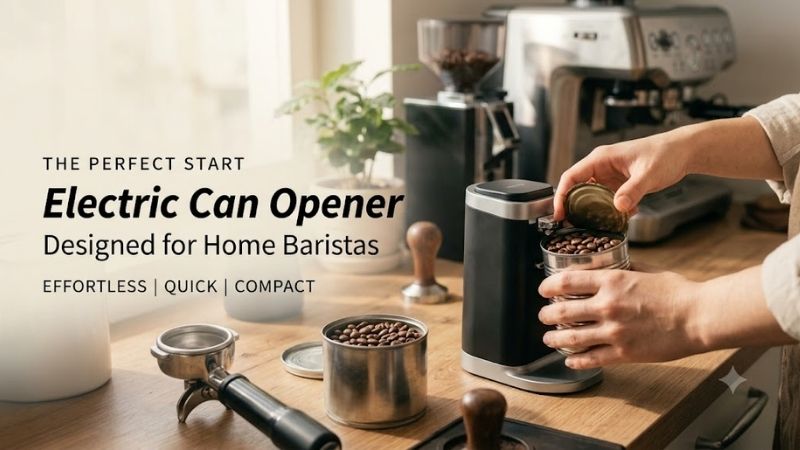
Home coffee recipes sometimes involve ingredients beyond roasted coffee, water, and milk. Sweetened condensed milk is used in some sweet coffee preparations, while coconut milk and coconut cream may appear in specialty beverages.
An electric can opener can make accessing these ingredients easier, particularly when you prepare several beverages or serve guests.
However, not every canned ingredient is interchangeable with another. Sweetened condensed milk, evaporated milk, coconut milk, and coconut cream differ in sweetness, fat content, consistency, and intended uses.
The opener makes preparation more convenient but does not determine the quality of the finished drink.
Preparing Coffee-Based Desserts
Home baristas may also prepare desserts using coffee as an ingredient. Canned dairy products, fruit fillings, and other shelf-stable ingredients can appear in certain recipes.
If you routinely bake or prepare desserts alongside coffee, a can opener may serve several kitchen functions.
This broader usefulness is an important purchase consideration. Buying an electric can opener solely for an occasional coffee recipe may offer limited value, but using it throughout the kitchen can make the investment more practical.
Why It Cannot Replace Coffee Equipment
An electric can opener performs a mechanical cutting operation. It does not grind coffee, extract espresso, heat brewing water, or froth milk.
Its value is therefore separate from brewing performance.
If your current setup lacks a suitable grinder or reliable brewing method, those purchases may deserve priority. A can opener becomes worth considering when opening cans is a frequent or physically difficult task.
Understanding Electric Can Opener Types
Countertop Electric Can Openers
Countertop electric can openers generally have a standing housing, motor, and cutting mechanism near the upper portion of the appliance.
The user positions the can according to the manufacturer’s instructions and activates the cutter.
Some models support cans automatically during operation. Others require more user involvement.
Their upright form can be convenient for routine use, but they occupy dedicated countertop or cabinet space.
For a crowded coffee station, check whether the opener fits beneath nearby shelving and whether there is sufficient clearance to position taller cans.
Handheld Automatic Can Openers
Handheld automatic openers are often compact and may use batteries or a rechargeable motor.
Some travel around the can rim after activation.
Their small storage footprint can be attractive when counter space is limited.
However, compact size does not guarantee effortless use. The appliance must engage the rim correctly, and different can shapes may affect performance.
Battery condition, grip requirements, and the ability to remove the opener after cutting are also important.
Conventional Cutting Mechanisms
Traditional can-opening designs commonly cut through the lid near its inner edge.
This produces an opening that allows the contents to be poured or removed.
However, the lid and opened metal edge can be sharp.
Always follow the manufacturer’s handling instructions and avoid contacting freshly cut edges with bare fingers.
Side-Cutting or Smooth-Edge Designs
Some electric can openers cut along the outer side of the can’s rim rather than through the top surface.
These are often marketed as smooth-edge openers.
The resulting edge characteristics depend on the particular mechanism and can construction.
Do not assume a smooth-edge label guarantees that every cut surface is harmless. Inspect opened cans carefully and follow the manufacturer’s instructions for removing the lid.
Which Cutting Style Makes More Sense?
For people who frequently handle cans and want to reduce exposure to conventional sharp lid edges, a suitable side-cutting opener may be appealing.
However, there are trade-offs.
Side-cutting designs may have different compatibility requirements from traditional openers. They can also leave residue around the cutting path, depending on the can and contents.
Traditional countertop models may offer familiar operation and straightforward lid removal.
The best choice is the mechanism that works consistently with your usual cans and can be cleaned safely.
Evaluate usability rather than relying on a single marketing phrase.
Can Size and Compatibility
Standard Food Cans
Many electric can openers are intended for common food cans.
However, manufacturer-supported height, diameter, and rim shapes vary.
Before buying, consider the ingredients you use regularly. A coffee enthusiast who frequently opens small cans of sweetened condensed milk may have different requirements from someone opening large food-service containers.
Check whether the appliance supports the size and construction of those cans.
Small Cans
Compact cans may be difficult for certain upright openers to engage, especially when the opener’s housing or support mechanism interferes with positioning.
This is worth checking when you regularly use small dessert or drink ingredients.
A model that handles ordinary soup cans is not necessarily equally convenient with every smaller container.
Tall Cans
Tall cans may require additional vertical clearance.
Some countertop appliances are designed to accommodate taller containers, while others have limited height.
Check maximum supported dimensions rather than assuming that an upright can opener handles any standard retail can.
Unusual Rim Designs
Certain cans have nonstandard rims, pull tabs, or other packaging features.
A powered opener may not engage these properly.
Do not force an incompatible container into the cutter.
An ordinary manual opener may still be useful as a backup for unusual packaging.
Choosing the Right Power Source
Corded Electric Can Openers
Corded openers are useful when you have an accessible outlet and a stable place to operate them.
They do not depend on battery charge.
However, the power cord adds clutter and must be routed safely around wet beverage preparation areas.
If your coffee station already contains an espresso machine, kettle, grinder, and other electrical equipment, outlet availability can become a meaningful limitation.
Avoid overloaded power strips and follow each appliance’s electrical requirements.
Battery-Powered Models
Battery-powered openers may be convenient for occasional use and compact storage.
However, performance can decline when batteries are weak.
Check the battery type and access compartment.
Consider whether replacing batteries frequently would create unnecessary operating cost.
Rechargeable Models
Rechargeable openers reduce the need for disposable batteries.
However, charging time, battery endurance, and charging-port construction vary by model.
A rechargeable device may be convenient for a small kitchen, but it should not be chosen solely because it uses a USB cable.
Evaluate overall reliability, controls, can compatibility, and charging safety.
One-Touch Operation and Accessibility
Why Simple Controls Matter
Some electric can openers require the user to hold a lever while the can rotates. Others offer automatic operation after a single activation.
A one-touch design may reduce the amount of continuous hand effort required.
However, the term automatic is used differently across products.
Check whether the machine starts, rotates, stops, and releases the can as expected.
Users With Reduced Hand Strength
Electric can openers can be useful for people who find manual twisting uncomfortable.
However, an automatic opener still requires some handling, such as aligning the cutter, placing the can, or removing the lid.
A device that minimizes twisting but requires substantial downward pressure may not solve the user’s actual difficulty.
Look for clear demonstrations of the complete opening process.
Automatic Shutoff
Some models stop automatically when the cutting cycle is complete.
This may reduce the need to monitor the motor continuously.
However, automatic shutoff does not eliminate the need to supervise operation.
Never leave the opener running unattended or attempt to bypass its controls.
Kitchen Footprint and Storage
Measuring Counter Space
A compact coffee station can fill quickly with equipment.
Measure the width, depth, and height of the location where you would place an opener.
Consider clearance for inserting and removing cans.
An opener that fits beneath a shelf may still be difficult to use when holding a tall container.
Storing the Opener in a Drawer
Handheld models may be easier to store in drawers than upright countertop machines.
However, ensure that the cutting area is protected from contact with utensils or other objects.
Follow the manufacturer’s storage instructions.
Choosing a Dedicated Location
If you open cans daily, keeping the opener accessible may improve convenience.
If you use it only once or twice a month, cabinet storage is more practical.
Do not sacrifice essential coffee preparation space merely to keep an infrequently used accessory on display.
Stability During Operation
An upright opener should stand securely on a level surface.
Check the base construction and how the appliance handles the weight of supported cans.
Do not use the opener where a falling or spilling can could damage coffee equipment or electrical connections.
Cleaning and Food Hygiene
Why Cutting Mechanisms Need Cleaning
Can rims and cutting surfaces can carry dirt, dust, packaging residue, or food particles.
The opener may contact these surfaces during use.
Over time, residue can collect around the cutting wheel, gears, and lid-holding mechanism.
This makes cleaning access an important buying factor.
Removable Cutting Assemblies
Some electric can openers feature removable cutting components.
These can simplify cleaning when the manufacturer permits removal.
However, detachable does not automatically mean dishwasher safe.
Follow the exact care instructions.
Cleaning Fixed Mechanisms
For fixed cutting assemblies, unplug or otherwise disable the appliance before cleaning.
Use the manufacturer’s approved method to remove food residue.
Do not immerse the electrical housing.
Avoid touching sharp cutting components.
Preventing Cross-Contamination
A home coffee station should be kept clean, particularly when opening ingredients used directly in beverages.
Wipe or wash can lids when appropriate before opening, and avoid transferring visible contamination into food.
Clean spills promptly.
Refrigerate opened perishable ingredients according to their labels and food-safety guidance.
Coffee Ingredients and Safe Storage
Sweetened Condensed Milk
Sweetened condensed milk is commonly sold in shelf-stable cans before opening.
However, once opened, the product requires storage according to the manufacturer’s directions.
Transfer leftovers to an appropriate food container when recommended.
Do not leave an opened can on the coffee counter for extended periods.
Evaporated Milk
Evaporated milk differs from sweetened condensed milk because it generally does not contain the same added sugar concentration.
After opening, it is perishable.
Refrigerate promptly and follow the product’s storage instructions.
An electric can opener offers no preservation benefit.
Coconut Milk and Coconut Cream
These ingredients may separate in their containers.
Their consistency and recipe behavior depend on composition.
Follow the product’s preparation and refrigeration guidance after opening.
Do not assume that all shelf-stable canned ingredients remain safe at room temperature after opening.
Canned Fruit Ingredients
Some coffee beverages and desserts use canned fruits or fruit preparations.
Inspect the can before opening.
Avoid using contents from leaking, severely damaged, bulging, or otherwise suspicious cans.
An electric opener should never be used to justify consuming food from unsafe packaging.
Durability and Long-Term Value
Cutting Mechanism Quality
The cutting wheel and drive system are essential components.
Poor engagement can lead to incomplete opening or repeated attempts.
Look for clear manufacturer specifications, suitable warranty coverage, and replacement-part availability where applicable.
Do not infer durability from motor wattage alone.
Motor Performance
Electric openers vary in motor design.
A larger stated power rating does not automatically mean smoother cutting or greater longevity.
The combination of gears, cutting wheel, can engagement, and housing stability determines practical performance.
Replacement Parts
Some manufacturers offer replacement cutting levers or assemblies.
Others treat the opener as a complete unit.
For frequent use, availability of compatible parts can improve long-term ownership value.
Warranty and Customer Support
Review the warranty’s duration, exclusions, and available support.
A low initial price may be less attractive if the appliance cannot be repaired or replaced after a minor component failure.
Electric vs. Manual Can Openers
| Decision Factor | Electric Can Opener | Manual Can Opener |
|---|---|---|
| Physical effort | Often reduced | Requires manual operation |
| Power source | Electricity or batteries | None |
| Storage | Varies from compact to bulky | Usually compact |
| Cleaning | Mechanism-specific | Usually simpler construction |
| Cost | Often higher | Often lower |
| Accessibility | May benefit users with limited grip strength | Depends on handle design |
| Backup reliability | Depends on motor and power | No electrical dependency |
A manual opener remains a sensible choice for infrequent use.
An electric model is more compelling when opening cans is common or physically uncomfortable.
Common Buying Mistakes
Buying an Electric Opener Just Because You Make Coffee
Most coffee preparation does not require opening cans.
Choose the appliance only when your actual recipes or kitchen tasks justify it.
Ignoring Small-Can Compatibility
A model that opens ordinary food cans may not be convenient for every compact ingredient can.
Choosing Only by Appearance
A stylish countertop housing does not guarantee reliable cutting or easy cleaning.
Assuming Smooth-Edge Means Risk-Free
Opened metal packaging should always be handled carefully.
Forgetting About Cleaning Access
A difficult-to-clean cutting mechanism can become inconvenient and unhygienic.
Overlooking Cord Placement
Coffee preparation areas often contain water and multiple powered appliances.
Keep electrical connections safe and accessible.
Frequently Asked Questions
Do Home Baristas Need an Electric Can Opener?
Not necessarily. It is mainly useful for opening canned coffee ingredients, preparing desserts, and general kitchen tasks.
Can an Electric Can Opener Open Sweetened Condensed Milk Cans?
Many can open common food cans, but compatibility depends on the exact can rim and appliance design.
Are Smooth-Edge Electric Can Openers Safer?
They may produce different edge characteristics from conventional cutters, but no opener should be assumed to eliminate all sharp-edge hazards.
Is a Battery-Powered Can Opener Better for Small Kitchens?
It can be easier to store without a permanent power cord, but battery maintenance and can engagement still matter.
How Often Should an Electric Can Opener Be Cleaned?
Clean food-contact and cutting components after use as directed, especially when residue or spills are present.
Is an Electric Can Opener Worth Buying for Occasional Use?
A manual opener may be more economical if you rarely open cans and can use it comfortably. Electric operation becomes more valuable with frequent use or accessibility needs.
Conclusion
An electric can opener for home baristas makes sense when canned drink ingredients and other kitchen foods are part of your regular routine. Choose a compact model that handles your usual can sizes, provides comfortable controls, and allows safe cleaning. For occasional use, a manual opener may be sufficient; for frequent can preparation or reduced hand effort, an electric model can offer meaningful convenience without needing to become a permanent part of your coffee station.






Write Your Review
No reviews yet. Be the first to share your experience!