
A French press coffee maker for baking at home can prepare flavorful coffee for drinking and for recipes such as chocolate cakes, coffee glazes, and tiramisu-style desserts. However, it is a brewing tool, not a baking appliance. Choosing the right press means considering coffee strength, filtration, batch capacity, materials, and cleaning. This guide explains how to select one that works well for both purposes.
- Quick Verdict: Which French Press Should Home Bakers Buy?
- Why a French Press Can Be Useful for Baking
- Understanding French Press Brewing
- Choosing the Right Capacity
- Glass vs. Stainless Steel French Presses
- Filtration Quality for Desserts
- Plunger Construction and Ease of Use
- Coffee Strength and Recipe Measurements
- Grind Size and Brewing Time
- Using French Press Coffee in Home Baking
- A Practical Coffee-for-Baking Workflow
- Cleaning and Maintenance
- Budget and Long-Term Value
- Common Buying Mistakes
- Frequently Asked Questions
- Conclusion
Quick Verdict: Which French Press Should Home Bakers Buy?
For most home bakers who also enjoy fresh coffee, a 34-ounce-class French press with a sturdy frame, reliable plunger, and easily removable filter assembly offers a useful balance of capacity and versatility.
That size can prepare coffee for a household while supplying brewed coffee for certain recipes. However, advertised capacity is not necessarily the amount of finished coffee you will collect. Grounds occupy space and retain some liquid.
If you make small desserts and drink coffee alone, a 12- to 17-ounce-class press may be more practical. For larger households or frequent entertaining, a bigger insulated model may be worthwhile.
| Buying Factor | What to Look For | Why It Matters |
|---|---|---|
| Capacity | Suitable for drinking and recipe quantities | Avoids repeated brewing |
| Filtration | Effective mesh with accessible components | Controls sediment in drinks and desserts |
| Materials | Heat-rated glass or suitable stainless steel | Affects durability and heat retention |
| Plunger quality | Smooth movement and secure fit | Supports predictable separation |
| Pouring design | Controlled spout and comfortable handle | Helps measure recipe liquids |
| Cleaning | Removable, washable filter assembly | Prevents stale coffee residue |
| Replacement parts | Compatible screens and vessels | Improves long-term ownership |
| Storage | Suitable height and footprint | Fits the kitchen comfortably |
| Price | Balanced against actual usage | Avoids paying for unnecessary features |
Best overall approach: Choose a durable, easy-to-clean French press that brews the quantity of coffee your recipes and household actually require. Prioritize filtration and practical pouring over decorative features.
Why a French Press Can Be Useful for Baking
Coffee as a Baking Ingredient
Coffee is used in many home desserts because its roasted, bitter, and aromatic characteristics can complement sweetness and other flavors.
In certain chocolate recipes, a small amount of brewed coffee contributes depth without necessarily making the finished dessert taste strongly of coffee.
Other recipes deliberately emphasize coffee flavor.
Examples include coffee-flavored cakes, frostings, dessert sauces, and espresso-inspired chilled preparations.
A French press can produce the brewed coffee component without requiring a drip machine or espresso setup.
However, the concentration of French press coffee depends on the recipe. It is not automatically interchangeable with espresso or instant coffee powder.
Brewing and Baking Are Separate Processes
A French press contains coffee and hot water during extraction. It does not bake batter, maintain oven temperatures, or cook food under pressure.
Never place an ordinary French press inside an oven or on a stovetop unless the exact manufacturer explicitly approves that use.
Even a heat-resistant glass press may not be rated for direct burner heat or oven exposure.
The correct workflow is to brew coffee in the press, transfer the required amount into a suitable measuring vessel, and use it in the baking recipe as directed.
When a French Press Makes More Sense Than an Espresso Machine
If your dessert recipe requires a substantial amount of brewed coffee, a French press can be convenient.
It produces coffee in a relatively large batch without requiring tightly controlled espresso extraction.
An espresso machine is more appropriate when the recipe specifically calls for a small quantity of concentrated espresso.
A French press is also useful for people who enjoy immersion-brewed coffee with a fuller body.
The choice depends on the liquid volume and strength needed for the recipe, not simply which brewing equipment is more expensive.
Understanding French Press Brewing
How Full-Immersion Brewing Works
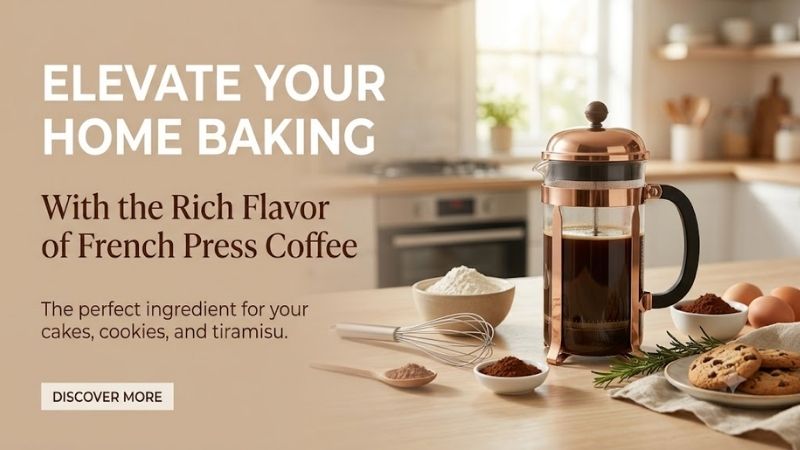
A French press uses an immersion method.
Ground coffee and hot water remain in contact inside a vessel for a selected brewing period.
A plunger with a filter screen is then lowered to separate much of the grounds from the liquid.
Unlike paper-filtered drip brewing, a typical French press permits some fine particles and coffee oils to pass into the beverage.
This can produce a heavier mouthfeel.
However, the amount of sediment depends on coffee grind, filtration, brewing technique, and how carefully the coffee is poured.
Does a French Press Produce Espresso?
No.
Traditional espresso involves pressurized extraction through finely ground coffee.
A French press uses immersion and mechanical filtration without espresso-style brewing pressure.
It can make relatively strong coffee when the dose is adjusted, but that does not make the beverage equivalent to espresso.
If a cake recipe calls for two tablespoons of espresso, substituting two tablespoons of ordinary French press coffee may produce a weaker coffee contribution.
Use substitutions only when the recipe allows them or when you understand the expected flavor and liquid-balance changes.
Why French Press Coffee Can Taste Different
The filter allows more suspended material and coffee oils into the cup than many paper filters.
This can affect body and texture.
However, a fuller body does not automatically mean better flavor.
Some drinkers prefer cleaner paper-filtered coffee.
For baking, sediment can be undesirable in smooth glazes or delicate desserts.
That makes filtration an especially important purchasing factor for this use case.
Choosing the Right Capacity
Small French Presses for Individual Baking
A small French press can be practical when you need a modest amount of brewed coffee and do not want to make a large batch.
It can also suit a single coffee drinker.
However, a small press may require repeated brewing when a dessert calls for more coffee.
Pay attention to the recipe’s required liquid volume.
A press whose advertised capacity equals the recipe volume may not yield enough finished coffee after grounds absorption and filtration.
Medium French Presses for Everyday Versatility
A medium press offers flexibility for making coffee alongside dessert preparation.
For example, you could prepare a batch and set aside an appropriate measured quantity for a glaze while serving the remaining beverage.
However, this is only practical when the coffee strength suits both uses.
A dessert requiring concentrated coffee may need a separately adjusted recipe.
A medium-capacity press is often the most reasonable compromise for general home use.
Large French Presses for Entertaining
A larger press can serve several guests or provide more brewed coffee for dessert preparation.
However, larger glass vessels become heavier when filled.
They may also require more storage space.
If you only bake with coffee occasionally, a large press may be unnecessary.
Consider whether the appliance will be used regularly for household beverages.
Coffee Maker Cups vs. Fluid Ounces
French press manufacturers sometimes describe capacity using a number of cups.
These are not necessarily standard eight-fluid-ounce US measuring cups.
An eight-cup French press may hold approximately 34 fluid ounces rather than eight large mugs.
Check the actual milliliter or fluid-ounce capacity.
For recipe measurements, use a measuring cup or kitchen scale instead of relying on the brewer’s marketing cup count.
Estimating Usable Yield
Ground coffee absorbs some brewing water.
Therefore, the quantity poured into the press exceeds the finished beverage volume.
For example, if a recipe requires 400 milliliters of brewed coffee, starting with exactly 400 milliliters of water may be insufficient.
The actual yield depends on coffee quantity, grind, and pouring method.
Prepare a reasonable margin when the recipe requires an exact amount.
Glass vs. Stainless Steel French Presses
Borosilicate Glass
Many French presses use borosilicate glass vessels.
This material can tolerate appropriate hot-beverage use when the product is designed for it.
Glass allows you to see the brewing process and remaining coffee volume.
However, glass can still break from impact, misuse, or inappropriate temperature changes.
A glass press should be used only within its manufacturer’s temperature and handling limits.
Do not assume that borosilicate glass is unbreakable or universally oven-safe.
Stainless Steel
Stainless steel presses can offer greater resistance to breakage during ordinary handling.
Some have insulated double-wall construction.
This may help retain beverage temperature.
However, steel construction does not guarantee superior brewing performance.
It may also make it harder to see the liquid level.
For home baking, measuring coffee after brewing is preferable to relying on visibility through the vessel.
Insulated French Presses
An insulated press can be useful when several people drink coffee over a longer period.
However, brewing continues to change the beverage while grounds remain in contact with the liquid.
Insulation does not stop extraction.
For more consistent flavor, transfer finished coffee away from the grounds after the recommended brew period.
A thermal carafe or suitable separate vessel may be useful for extended serving.
Plastic Frames and Components
Some French presses have plastic frames, lids, or handles.
These parts can reduce weight and cost.
However, material temperature limits and long-term durability vary.
Check the manufacturer’s instructions.
Do not assume that a plastic exterior makes the appliance unsuitable, or that a fully metal construction is necessary for good coffee.
Filtration Quality for Desserts
Why Sediment Matters
Fine coffee particles may be acceptable in a rustic mug of French press coffee.
However, they can create unwanted texture in a smooth frosting, glaze, or dessert sauce.
If you frequently bake with coffee, filtration deserves additional attention.
A press that leaves substantial sediment may require a secondary filtering step.
Single-Screen Filters
Traditional French presses use a metal mesh screen supported by additional plunger components.
The screen separates most grounds from the coffee.
However, very fine particles can pass through.
The actual result depends on mesh construction and grind distribution.
Multi-Screen Filtration
Some presses use additional screens or filter layers.
These may reduce sediment, but more screens also require cleaning.
A multi-filter design is worthwhile only when its filtration benefit justifies the maintenance.
Do not assume that the highest number of screens guarantees the cleanest coffee.
Secondary Paper Filtration
If a recipe needs especially smooth coffee, you can use an appropriate separate paper filter after French press brewing.
This may reduce suspended particles and oils.
However, secondary filtration requires additional time and may change beverage texture.
For home bakers who use French press coffee occasionally, this can be more economical than purchasing a specialized press solely for filtration.
Filter Replacement
Mesh screens and supporting components can become damaged.
A bent or poorly seated screen may allow more grounds to escape.
Choose a model with accessible replacement parts.
For regular use, serviceability can be more valuable than a decorative design.
Plunger Construction and Ease of Use
Smooth Plunger Travel
A French press plunger should move through the vessel in the manner specified by its manufacturer.
Excessive resistance may indicate an unsuitable grind, excessive grounds, or a mechanical problem.
Do not force the plunger.
Hot coffee can splash if a user applies too much pressure.
Filter Fit
The screen should fit the vessel appropriately.
A poorly fitting screen may allow more grounds to bypass the filter.
However, a completely rigid seal is not necessarily how a traditional French press is designed to function.
Assess the complete filtration mechanism.
Lid Security
A well-designed lid should allow controlled plunging and pouring.
However, a French press lid is not a pressure-sealed closure.
Never attempt to modify the vessel to trap pressure.
Handle Comfort
A full French press can be heavy and hot.
Choose a handle that allows stable lifting and pouring.
For larger sizes, this becomes especially important.
A comfortable handle can also help when measuring brewed coffee into a narrow baking vessel.
Coffee Strength and Recipe Measurements
Starting Coffee-to-Water Ratio
A useful French press starting point is approximately 60–65 grams of coffee per liter of brewing water.
For example, a recipe using 30 grams of coffee and 500 grams of water has a 1:16.7 coffee-to-water ratio.
This is a practical starting range rather than a universal requirement.
Different brewing recipes use different ratios.
The appropriate strength depends on the coffee and the intended use.
Strong Coffee for Chocolate Desserts
Some chocolate desserts benefit from a noticeable coffee contribution.
However, using more coffee grounds changes both concentration and extraction behavior.
An overly concentrated brew may also introduce excessive bitterness.
Follow a suitable recipe when possible.
If you adjust coffee strength, change one variable at a time.
Liquid Substitution in Cake Batter
Coffee is often used to replace part or all of the liquid in certain chocolate cake recipes.
However, the substitution must make sense for the batter formulation.
Adding extra coffee without reducing another liquid can alter hydration and texture.
Use an established baking recipe rather than assuming more coffee always improves chocolate flavor.
Coffee in Frosting and Glazes
Frostings often contain relatively little free liquid.
Adding substantial brewed coffee can make them too thin.
Some recipes therefore use concentrated coffee or dissolved instant coffee.
A French press can produce brewed coffee, but it may not be the best tool for every frosting.
Choose the coffee format specified by the recipe.
Measuring Finished Coffee
For repeatability, measure the coffee after brewing and filtration.
This is especially important when baking.
The brewer’s fill line indicates liquid capacity, not a guaranteed recipe yield.
Grind Size and Brewing Time
Why Grind Size Matters
French press brewing commonly uses a relatively coarse grind.
However, the ideal grind depends on the coffee, filter, and brewing method.
Very fine grounds can increase sediment and make pressing difficult.
An excessively coarse grind may produce a weak beverage under certain conditions.
Use a suitable starting setting and adjust based on results.
Burr Grinder vs. Blade Grinder
A burr grinder generally provides better control over particle size than a blade grinder.
This can help reduce excessive fines and improve repeatability.
However, actual performance varies by grinder.
For a home baker who uses coffee occasionally, appropriately ground coffee purchased from a roaster may be sufficient.
Brewing Time
A common starting method uses approximately four minutes of immersion.
However, other established French press recipes use different durations.
Coffee dose, grind, temperature, and agitation influence the result.
Follow a consistent recipe before making adjustments.
Water Temperature
For many hot coffee recipes, water in the broad range of approximately 195–205°F is a useful reference.
However, the temperature reaching the grounds depends on the kettle, vessel, and pouring process.
Use water that meets the brewing method’s instructions.
Do not assume every coffee requires the same temperature.
Decanting After Brewing
Once brewing is complete, transferring coffee into another vessel can reduce additional contact with the grounds.
This is particularly useful when you need a predictable flavor for baking.
If you leave finished coffee sitting in the press, extraction conditions continue to change.
Using French Press Coffee in Home Baking
Chocolate Cakes
Certain chocolate cake recipes use brewed coffee as part of the liquid component.
Coffee can complement cocoa flavor.
However, the amount should be determined by the recipe.
A French press is useful when a moderate quantity of coffee is needed and no espresso machine is available.
Filter the coffee well and measure the required amount.
Brownies
Some brownie recipes include coffee to complement chocolate.
However, brownies are sensitive to ingredient ratios.
Adding liquid coffee to a recipe that does not include it can change batter texture.
Use a tested recipe that specifies brewed coffee, or choose an appropriate concentrated coffee ingredient when the recipe calls for one.
Coffee-Flavored Frosting
French press coffee can work in frosting recipes that explicitly use brewed coffee.
However, recipes calling for instant espresso powder may not be suitable for direct substitution.
Instant powder adds flavor with relatively little liquid.
Brewed coffee contributes water as well.
Tiramisu-Style Desserts
Coffee is commonly used to flavor soaked biscuits or cake components.
French press coffee can be suitable when the recipe permits brewed coffee.
However, tiramisu-style desserts often contain perishable dairy ingredients and sometimes eggs.
Follow a food-safe recipe and refrigerate the finished dessert appropriately.
Do not leave cream-based desserts at room temperature for extended periods.
Coffee Syrups
Some recipes use brewed coffee in a syrup that is heated or combined with sugar.
Follow the recipe’s cooking instructions using suitable cookware.
Do not heat syrup inside an ordinary French press.
Coffee Ice Cream and Frozen Desserts
Brewed coffee may be incorporated into certain frozen dessert recipes.
However, dairy, eggs, and other ingredients require proper handling.
Choose a validated recipe.
The French press only provides the coffee component.
A Practical Coffee-for-Baking Workflow
Step 1: Determine the Recipe’s Coffee Requirement
Read the recipe completely.
Confirm whether it calls for brewed coffee, concentrated coffee, espresso, or instant coffee powder.
These are not identical ingredients.
Step 2: Select a Suitable Brew Ratio
Choose a recipe that produces the required strength.
Prepare enough water to account for coffee absorption.
Step 3: Grind the Coffee Appropriately
Use a grind suited to the French press.
Avoid excessive fine particles when sediment would be undesirable.
Step 4: Heat the Water
Use a suitable kettle.
Follow the brewing recipe’s temperature guidance.
Step 5: Brew Consistently
Add coffee and water.
Use the recommended immersion time and any prescribed stirring.
Step 6: Separate and Filter
Lower the plunger gently according to the brewer’s instructions.
If the dessert requires particularly smooth coffee, use an appropriate secondary filter.
Step 7: Measure the Finished Liquid
Transfer the coffee to a suitable measuring vessel.
Measure the exact amount required.
Do not estimate solely from the press markings.
Step 8: Adjust Temperature for the Baking Recipe
Some recipes require hot coffee, while others need cooled coffee.
Follow the recipe.
Adding unexpectedly hot liquid to egg-based mixtures can affect the preparation.
Step 9: Handle Leftover Coffee Appropriately
Use leftover coffee promptly or store it in a clean covered container under appropriate conditions.
Coffee-containing beverages mixed with milk or other perishables require refrigeration.
Step 10: Clean the French Press
Remove grounds safely.
Wash the vessel, plunger, and filter according to the manufacturer’s instructions.
Do not allow coffee oils to accumulate.
Cleaning and Maintenance
Removing Grounds
Coffee grounds are often difficult to pour directly into a sink without creating drainage problems.
Allow the press to cool.
Remove grounds using an appropriate method and dispose of them in household waste or compost where suitable.
Avoid flushing substantial quantities of grounds down the drain.
Cleaning the Mesh
Fine coffee particles and oils can accumulate between filter layers.
Disassemble only those components the manufacturer intends users to remove.
Clean them carefully and reassemble correctly.
Cleaning Glass Vessels
Use nonabrasive tools approved for the glass.
Inspect for cracks or chips.
A damaged glass vessel should not be used with hot water.
Cleaning Stainless Steel
Follow the manufacturer’s approved cleaning method.
Some stainless steel presses tolerate dishwasher cleaning, while others require handwashing.
Do not assume all models are dishwasher safe.
Drying Before Storage
Allow the components to dry thoroughly.
Reassemble according to the manual.
Check the screen and gasket condition periodically.
Budget and Long-Term Value
Budget Glass Presses
An inexpensive glass press may be adequate for occasional use.
However, pay attention to frame stability, glass replacement availability, and filter quality.
Midrange Presses
A better handle, reliable filter assembly, and replacement parts may justify additional cost.
However, a higher price does not guarantee better extraction.
Insulated Steel Presses
A durable insulated model may be worthwhile when you prepare several cups regularly.
However, it can be heavier and more expensive.
Accessories
A kettle, grinder, scale, and secondary filter may improve versatility.
However, you do not need every accessory immediately.
For home baking, accurate measurement and dependable filtration are often the highest priorities.
Cost of Ownership
French presses generally have relatively few consumable components.
Filter screens and glass vessels may eventually need replacement.
Choose a model with accessible parts rather than focusing solely on initial price.
Common Buying Mistakes
Assuming French Press Coffee Equals Espresso
It does not use espresso-style pressurized extraction.
Choosing Capacity by Cup Count Alone
Check fluid ounces or milliliters.
Ignoring Sediment in Desserts
Fine particles can affect smooth sauces and frosting.
Adding Brewed Coffee Without Adjusting the Recipe
Extra liquid can alter baking results.
Using the Press as Cookware
An ordinary French press is not a stovetop or oven vessel.
Overlooking Cleaning Access
Coffee oils and residue can collect inside the plunger.
Frequently Asked Questions
Is a French Press Coffee Maker Good for Baking at Home?
Yes, it can prepare brewed coffee used in suitable cakes, sauces, and desserts. However, it does not bake food and should only be used as a brewer.
Can I Use French Press Coffee Instead of Espresso in Baking?
Sometimes, but the concentration differs. Use a substitution only when the recipe supports it or when the liquid and flavor changes are acceptable.
What Size French Press Is Best for Home Baking?
A medium-capacity press around the 34-ounce category offers versatility, while smaller presses may be sufficient for occasional recipe use.
Does French Press Coffee Contain Sediment?
It can contain fine particles because typical metal filters are less restrictive than paper filters. Secondary filtration may help when a recipe needs smooth coffee.
Can I Put a French Press in the Oven?
Do not do so unless the exact manufacturer explicitly approves that use. Ordinary French presses are intended for beverage brewing.
Is a Glass or Stainless Steel French Press Better?
Glass offers visibility, while stainless steel can provide greater resistance to breakage and may offer insulation. Choose based on handling, cleaning, and storage needs.
Conclusion
The best French press coffee maker for baking at home combines suitable capacity, effective filtration, comfortable pouring, and accessible cleaning. A medium-sized press is a practical choice for households that enjoy coffee and occasionally use it in desserts. Choose the coffee strength required by each recipe, measure the finished beverage accurately, and remember that a French press is a brewing appliance—not a substitute for baking equipment.

Write Your Review
No reviews yet. Be the first to share your experience!