
A coffee scale for beginners on a budget can help make brewing more consistent without requiring expensive equipment. Measuring coffee and water by weight removes much of the uncertainty associated with scoops, cup markings, and visual estimates. However, not every inexpensive digital scale is suitable for espresso or pour-over brewing. This guide explains which features are worth paying for, what accuracy claims mean, and how to choose a practical scale for your coffee routine.
- Quick Verdict: What Coffee Scale Should Beginners Buy?
- Why Weighing Coffee Improves Brewing
- Understanding Readability, Accuracy, and Precision
- Choosing the Right Capacity
- Tare Function: The Essential Feature
- Built-In Timers: Useful but Not Essential
- Choosing a Scale for Espresso
- Choosing a Scale for Pour-Over
- Coffee Ratios for Beginners
- A Simple Beginner Brewing Routine
- Battery-Powered vs. Rechargeable Scales
- Cleaning and Durability
- Understanding Budget Value
- Common Buying Mistakes
- Frequently Asked Questions
- Conclusion
Quick Verdict: What Coffee Scale Should Beginners Buy?
For most beginners making pour-over, French press, or drip coffee, a compact digital scale with 0.1-gram readability, a stable platform, an easy-to-read display, and sufficient weighing capacity is a sensible starting choice.
A built-in timer is useful, but it is not mandatory.
For espresso, additional attention should be paid to physical size, measurement response, low-weight performance, and clearance beneath the machine’s group head.
| Feature | Budget Recommendation | Why It Matters |
|---|---|---|
| Readability | 0.1 g preferred | Helps measure coffee doses consistently |
| Accuracy | Credible repeatability and calibration | Affects confidence in measurements |
| Maximum capacity | Suitable for the complete brewing vessel | Prevents overload |
| Tare function | Essential | Removes container weight |
| Timer | Useful | Tracks extraction or brewing time |
| Response speed | Important for espresso | Helps stop shots near target yield |
| Platform size | Fits your cup or carafe | Supports stable weighing |
| Display location | Visible during brewing | Prevents blocked readings |
| Splash resistance | Useful | Helps manage minor spills |
| Power supply | Convenient batteries or charging | Influences ownership cost |
Best value: A dependable basic scale with 0.1-gram increments and a tare button usually provides more practical benefit than a feature-heavy model with Bluetooth connectivity.
Why Weighing Coffee Improves Brewing
Coffee Scoops Are Not Consistent Measurements
A scoop measures volume.
However, different coffee beans and grind sizes occupy volume differently.
A scoop of densely packed fine grounds may weigh more than a scoop of loose coarse grounds.
The amount also changes according to how the user fills or levels the scoop.
This creates variation in the coffee-to-water ratio.
A scale allows you to measure the coffee dose directly.
For example, 18 grams remains 18 grams regardless of whether the coffee is light-roasted, dark-roasted, whole, or ground.
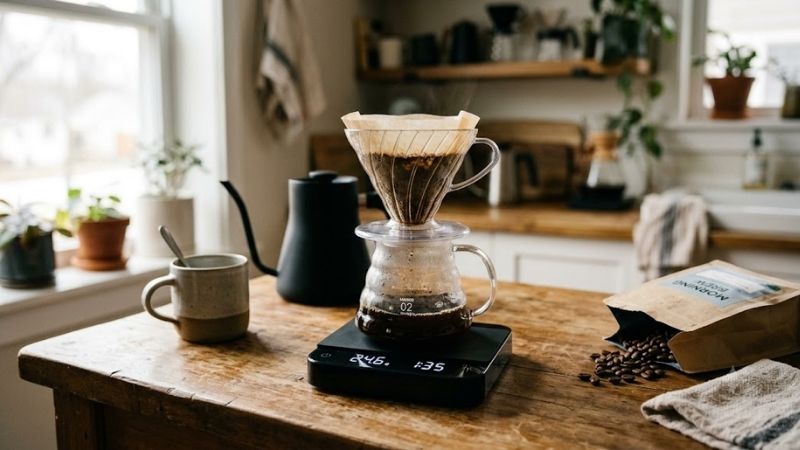
Water Weight Is Convenient
For ordinary brewing calculations, one gram of water is approximately one milliliter.
This relationship is sufficiently useful for many home coffee recipes, although exact density depends on temperature.
Using grams allows coffee and water to be measured on the same scale.
Instead of interpreting markings on different cups or kettles, you can track water added directly.
Repeatability Matters More Than Complicated Recipes
A beginner does not need an elaborate brewing formula to benefit from a scale.
The simple act of measuring the same dose and water quantity makes it easier to compare results.
If a brew tastes weak, you can adjust a known variable.
Without a scale, it is harder to determine whether the problem came from coffee quantity, water quantity, grind size, or brewing technique.
Does a Scale Make Coffee Taste Better?
A scale does not directly improve the flavor of coffee.
It provides measurement control.
The result can be more consistent brewing, but coffee quality still depends on beans, grind, water, equipment, and technique.
An expensive scale cannot correct stale coffee or an unsuitable grind.
Understanding Readability, Accuracy, and Precision
What Does 0.1-Gram Readability Mean?
Readability describes the increments shown on the display.
A scale with 0.1-gram readability may display 18.0 grams.
A scale with 1-gram readability may display only 18 grams.
However, readability is not the same as measurement accuracy.
A scale can display tenths of a gram while still producing inaccurate or unstable measurements.
Accuracy
Accuracy describes how closely a measurement corresponds to the actual weight.
Manufacturers may advertise accuracy specifications, but these should be interpreted carefully.
Performance can vary across the weighing range.
A scale that performs adequately with a large carafe may be less reliable with tiny coffee doses.
Repeatability
Repeatability describes whether the scale produces similar readings when the same object is weighed repeatedly under similar conditions.
For home coffee brewing, repeatability is especially valuable.
If a scale reads the same coffee dose differently every time, making controlled adjustments becomes difficult.
Resolution vs. Real Performance
A display with two decimal places does not automatically provide useful 0.01-gram accuracy.
For most home coffee brewing, 0.1-gram readability is sufficient.
There is usually little reason for a beginner to pay substantially more for an additional decimal place.
Calibration
Some scales offer user calibration with suitable reference weights.
Others are calibrated at the factory.
A calibration function is valuable only if it is supported by clear instructions and appropriate weights.
Do not attempt to calibrate a scale using random household objects whose weight is unknown.
Choosing the Right Capacity
Espresso Scales
Espresso brewing usually involves relatively small coffee and beverage quantities.
For example, a home barista might use 18 grams of ground coffee and target approximately 36 grams of espresso.
The scale must measure these values reliably.
However, it must also support the weight of the cup and any accessories placed on it.
A very low maximum capacity can become inconvenient.
Pour-Over Coffee Scales
Pour-over brewing may involve a dripper, filter, coffee grounds, carafe, and brewing water.
The total load can be much greater than the coffee dose alone.
Consider a setup in which a glass carafe weighs 450 grams, a dripper weighs 300 grams, and brewing water reaches 600 grams.
The complete assembly could exceed 1,350 grams before accounting for other items.
A scale with a 2,000-gram or greater capacity can be useful for many home pour-over setups, but your actual requirements depend on equipment weight.
French Press Scales
A French press can also be weighed during preparation.
However, a large metal or glass press may be relatively heavy.
Choose capacity based on the filled vessel.
For some users, weighing water separately in the kettle or another container is simpler.
General Kitchen Scales
A regular kitchen scale may have ample capacity but only 1-gram increments.
That may be acceptable for larger brewing batches.
However, it is less convenient for measuring small espresso doses or making subtle adjustments.
For someone who makes coffee daily, a dedicated 0.1-gram scale may be worthwhile.
Tare Function: The Essential Feature
What Does Tare Mean?
Tare allows the scale to subtract the weight of a container.
For example, place an empty dosing cup on the scale and press tare.
The display returns to zero.
You can then add coffee until the desired dose appears.
Taring During Pour-Over
Place the dripper and carafe on the scale.
Press tare.
Add coffee and record the quantity.
Depending on your workflow, tare again before pouring water.
This lets you measure added water directly.
Taring Espresso Cups
Place the empty espresso cup on the scale beneath the portafilter.
Press tare before extraction.
The display then measures the coffee beverage collected.
Common Tare Mistakes
If you accidentally press tare during brewing, you may lose the current accumulated measurement.
Some scales include advanced modes to simplify the process.
However, a simple tare button is sufficient once you develop a consistent routine.
Automatic Tare
Certain coffee scales offer automatic taring.
This can be convenient but may behave unexpectedly when cups are moved or the scale is touched.
For beginners, reliable manual tare operation is often easier to understand.
Built-In Timers: Useful but Not Essential
Why Timing Matters
Brewing time can help explain extraction behavior.
For espresso, the time required to reach a target beverage yield is one diagnostic variable.
For pour-over, total brewing duration can reflect grind size, pouring pattern, and filter resistance.
However, time alone does not determine coffee quality.
Manual Timer
A built-in timer that starts and stops with buttons is straightforward.
You control when measurement begins.
This is useful when comparing recipes.
Automatic Timer
Some scales detect changes in weight and start the timer automatically.
Others use different event triggers.
This can reduce button presses during brewing.
However, automatic detection may not respond exactly as expected to every pour or espresso drip.
Do Beginners Need Auto-Timing?
No.
A manual timer, smartphone stopwatch, or separate clock can provide adequate information.
Automatic timing becomes more valuable when you already have a stable brewing routine and want fewer manual actions.
When a Timer Is Worth Paying For
A small price difference may justify an integrated timer, particularly for pour-over.
However, a large premium solely for automatic modes is difficult to justify for most beginners.
Choosing a Scale for Espresso
Physical Clearance Under the Group Head
An espresso scale must fit between the drip tray and the bottom of the portafilter or spouts.
A scale that works on a kitchen counter may be too tall for a compact espresso machine.
Measure the available height with your preferred cup in position.
Remember that larger cups need more clearance.
Platform Width and Depth
The scale should fit securely on the drip tray.
A wide scale may extend beyond the tray or interfere with machine controls.
An extremely narrow scale may be unstable with certain cups.
Check actual dimensions before purchasing.
Measurement Response
During espresso extraction, beverage weight changes quickly.
If the display updates slowly, it can be difficult to stop the shot near your desired yield.
For example, if you target 36 grams but the scale responds with substantial delay, the actual beverage may exceed the target before you react.
However, response speed is not captured by resolution alone.
Look for credible performance information.
Drip-Tray Vibration
Pump-driven machines create vibration.
This can influence the stability of readings on some scales.
A suitable scale should perform reliably in its intended espresso environment.
However, not every inexpensive kitchen scale is designed for vibration.
Espresso Spills
Coffee can splash onto the weighing platform.
A splash-resistant design is helpful.
However, water resistance should not be assumed to mean full waterproofing.
Check the manufacturer’s rating and cleaning procedure.
Choosing a Scale for Pour-Over
Stable Platform
A pour-over scale supports a brewer and hot liquid.
It must remain stable.
Check that the platform is large enough for the carafe.
Avoid balancing a wide vessel on a tiny scale.
Visible Display
The carafe or dripper should not block the display.
A front-facing display can be useful.
However, actual visibility depends on the vessel.
Maximum Capacity
Calculate the weight of your complete setup.
Do not choose a scale that operates near its maximum load with every brew.
Timer Position
An integrated timer is especially convenient during pour-over because it allows you to watch both water weight and elapsed time.
However, the display should remain readable during pouring.
Heat Protection
Hot carafes can expose the scale to elevated temperatures.
Use the manufacturer-approved protective mat when required.
Do not assume that every coffee scale can safely support hot cookware directly.
Coffee Ratios for Beginners
Espresso Ratio
A common espresso starting ratio is approximately 1:2 by weight.
For example:
18 grams of ground coffee → 36 grams of espresso.
This does not mean every espresso should use this ratio.
Coffee characteristics, basket design, and taste preferences vary.
The scale makes the ratio measurable.
Pour-Over Ratio
A useful starting reference for filter coffee is approximately 55–65 grams of coffee per liter of water.
For example, 20 grams of coffee with 320 grams of water produces a 1:16 coffee-to-water ratio.
This is a practical starting point.
Adjust based on the coffee and brewing method.
French Press Ratio
French press recipes commonly use ratios in a similar broad range.
However, immersion brewing and filtration differ from pour-over.
Follow a suitable recipe.
Cold Brew Ratio
Cold brew concentrate recipes may use much more coffee relative to water.
For example, a 1:8 ratio means 75 grams of coffee with 600 grams of water.
However, the finished concentrate may require dilution.
A scale helps reproduce the recipe without guessing.
A Simple Beginner Brewing Routine
Step 1: Place the Scale on a Stable Surface
Make sure the surface is level and dry.
Do not place it on a soft or unstable support.
Step 2: Turn It On and Check Zero
Allow the scale to initialize according to its instructions.
Confirm that the display is stable.
Step 3: Add Your Coffee Container
Place the dosing cup, dripper, or filter holder on the platform.
Press tare.
Step 4: Weigh the Coffee
Add the intended dose.
For example, use 18 grams for an illustrative espresso recipe or 20 grams for a filter-coffee recipe.
Step 5: Prepare the Brewer
Follow the brewing method’s instructions.
Avoid changing the coffee dose accidentally during transfer.
Step 6: Tare Before Measuring Water or Beverage
For pour-over, tare the brewer assembly before adding water as appropriate.
For espresso, tare the empty cup before extraction.
Step 7: Start the Timer
Use the integrated timer or an external stopwatch.
Step 8: Monitor the Measurement
For pour-over, add the planned water quantity.
For espresso, stop near the target beverage yield.
Account for any liquid that continues to drip after stopping.
Step 9: Record the Result
If useful, note the dose, beverage yield, time, and flavor.
This makes adjustments more systematic.
Step 10: Clean and Store the Scale
Wipe away spills according to the manual.
Keep charging ports and battery compartments dry.
Battery-Powered vs. Rechargeable Scales
Replaceable Batteries
Some budget scales use AAA or other replaceable batteries.
They can be convenient because replacement batteries are widely available.
However, recurring battery purchases create expense and waste.
Rechargeable Scales
Rechargeable models commonly use USB charging.
These can reduce disposable battery use.
However, charging ports and battery serviceability vary.
Auto-Off Behavior
Automatic shutoff helps conserve power.
However, a scale that switches off too quickly may interrupt a long pour-over preparation.
Look for an appropriate timeout or selectable behavior.
Battery Indicators
A clear low-battery indicator helps prevent unexpected shutdown.
An unclear indicator can create frustration during brewing.
Charging Safety
Follow the manufacturer’s charging instructions.
Do not charge a wet scale or use a damaged cable.
Cleaning and Durability
Wiping the Platform
Coffee and water can accumulate on the surface.
Use the approved cleaning method.
Avoid abrasive tools that scratch the platform.
Cleaning Around Buttons
Buttons and seams may trap residue.
A simple control layout can reduce cleaning effort.
Display Protection
A display positioned near the front of the scale may be exposed to drips.
Check whether the scale includes suitable protection.
Overloading
Do not exceed the rated capacity.
An overloaded scale can provide inaccurate measurements or become damaged.
Storage
Keep the scale flat or in an approved orientation.
Avoid stacking heavy objects on its weighing platform.
A precision scale should not be treated like an ordinary cutting board.
Understanding Budget Value
Basic Kitchen Scale
A general kitchen scale can work for larger coffee batches.
However, 1-gram increments may limit its usefulness for espresso.
Budget Coffee Scale
A basic coffee-specific model with 0.1-gram readability and a timer can provide excellent everyday value.
However, verify actual performance and construction.
Midrange Coffee Scale
Midrange models may offer faster response, improved displays, and better splash resistance.
These can be worthwhile for frequent use.
Premium Smart Scale
Premium scales may include automatic modes, wireless connectivity, or advanced brewing analysis.
However, these features are rarely essential for beginners.
The Best Place to Spend Extra Money
If you have a limited coffee budget, a reliable scale is important, but a better grinder or appropriate brewing equipment may provide greater practical benefit than premium scale connectivity.
Do not allocate most of your budget to features that do not change how you brew.
Common Buying Mistakes
Assuming 0.1-Gram Display Means 0.1-Gram Accuracy
Readability and accuracy are different.
Buying a Scale Too Large for Espresso
Check drip-tray dimensions.
Choosing Too Little Maximum Capacity
A heavy carafe can overload a tiny scale.
Paying Extra for Bluetooth Before Learning Basic Brewing
Manual measurement is sufficient for most beginners.
Ignoring Display Response
Fast-changing espresso output requires reasonably responsive readings.
Forgetting Heat and Spill Protection
Coffee brewing involves hot water.
Choosing a Scale With an Aggressive Auto-Off
The display may turn off before a long brewing process finishes.
Frequently Asked Questions
Do Beginners Really Need a Coffee Scale?
A scale is not mandatory, but it can make coffee preparation more repeatable by measuring coffee and water quantities directly.
Is 0.1-Gram Readability Enough for Espresso?
Yes, 0.1-gram readability is generally useful for home espresso dosing and beverage measurement, provided the scale performs reliably.
Can I Use a Regular Kitchen Scale for Coffee?
Yes, especially for larger filter-coffee batches. However, a coffee scale may offer finer resolution, timing, and better espresso fit.
Do Coffee Scales Need Timers?
Not necessarily. A built-in timer is convenient, but a separate stopwatch also works.
How Much Capacity Does a Pour-Over Scale Need?
Enough to support the complete brewer, carafe, coffee, and water. A 2,000-gram class scale can suit many home setups, but heavier equipment may require more capacity.
Are Expensive Coffee Scales More Accurate?
Not automatically. Price may reflect construction, response speed, water resistance, or software features. Accuracy requires credible measurement evidence.
Conclusion
The best coffee scale for beginners on a budget provides reliable 0.1-gram measurement, an easy tare function, suitable capacity, and a readable display. A built-in timer is useful, but advanced automation is optional. Match the scale to your brewing method, measure your espresso clearance or carafe weight, and spend extra only when a feature improves your actual workflow.








Write Your Review
No reviews yet. Be the first to share your experience!