
An espresso knock box for everyday use provides a convenient place to dispose of spent coffee pucks after brewing. Although it is a simple accessory, the right design can make a home espresso station cleaner and more efficient. Capacity, knock-bar construction, stability, and washing access matter more than appearance alone. This guide explains how to choose a practical knock box for regular home coffee preparation.
- Quick Verdict: What Espresso Knock Box Should You Buy?
- What Is an Espresso Knock Box?
- Understanding Knock Box Designs
- Choosing the Right Capacity
- Knock Bar Design
- Stability and Nonslip Construction
- Material Choices
- Choosing the Right Shape
- Where to Place the Knock Box
- A Practical Everyday Espresso Workflow
- Why Some Espresso Pucks Do Not Release Easily
- Noise Considerations
- Cleaning and Hygiene
- Coffee Grounds Disposal
- Does a Knock Box Protect the Portafilter?
- Knock Box vs. Knock Drawer
- Choosing by Household Coffee Volume
- Budget and Long-Term Value
- Common Buying Mistakes
- Frequently Asked Questions
- Conclusion
Quick Verdict: What Espresso Knock Box Should You Buy?
For most home baristas making one to four espresso drinks daily, a compact countertop knock box with a stable nonslip base, cushioned knock bar, and removable interior components is a practical starting choice.
A larger bin may be useful for households that prepare several shots each morning.
However, greater capacity does not mean spent wet coffee should remain inside indefinitely.
| Buying Feature | Why It Matters | Priority |
|---|---|---|
| Suitable capacity | Reduces interruptions during brewing | High |
| Cushioned knock bar | Provides an appropriate striking surface | Essential |
| Stable base | Reduces sliding and spills | Essential |
| Removable knock bar | Makes cleaning easier | High |
| Accessible interior | Allows grounds and oils to be removed | High |
| Compact footprint | Preserves preparation space | High |
| Appropriate height | Helps contain pucks and loose grounds | High |
| Durable materials | Supports regular use | High |
| Replacement parts | Helps maintain long-term usefulness | Useful |
| Ease of emptying | Simplifies daily cleanup | Essential |
Best overall approach: Choose a knock box large enough for your normal brewing session but small enough that emptying and cleaning it remains convenient.
What Is an Espresso Knock Box?
Understanding the Basic Function
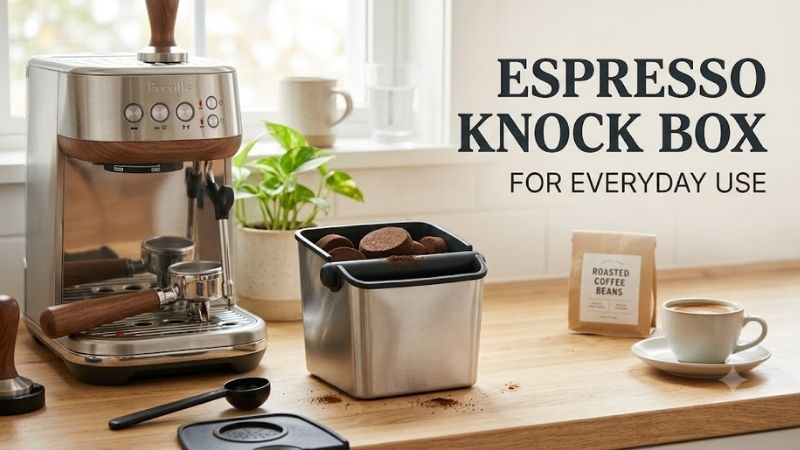
A knock box is a container designed to collect spent espresso coffee pucks.
It usually has a horizontal bar across the opening.
After brewing, the barista removes the portafilter from the espresso machine and taps it against the bar to release the spent coffee.
The grounds fall into the container.
This avoids repeatedly carrying the portafilter to a trash can during preparation.
Why Espresso Pucks Need a Dedicated Disposal Method
A spent espresso puck consists of wet compacted coffee grounds.
Depending on extraction conditions and basket design, it may remain relatively intact or break apart.
The puck can be awkward to remove by hand.
A suitable knock bar helps release it without requiring contact with the hot basket.
However, the amount of force required depends on the portafilter, puck condition, and knock-box design.
Is a Knock Box Essential?
No.
A home barista can sometimes remove spent coffee grounds using other appropriate methods.
However, a knock box can improve convenience and reduce mess.
It becomes more valuable when several espresso shots are prepared consecutively.
Knock Box vs. Ordinary Trash Can
A household trash can is designed for general waste.
Its rim may not provide an appropriate surface for striking a portafilter.
A knock box includes a bar intended for that purpose.
Do not repeatedly strike a metal portafilter against a hard trash-can edge, sink, or countertop where damage may occur.
Understanding Knock Box Designs
Compact Countertop Knock Boxes
These are common in home espresso setups.
They contain a small bin and a bar across the opening.
Their modest footprint makes them suitable for apartments and limited coffee stations.
However, small models require regular emptying.
Medium-Capacity Knock Boxes
A medium bin can accommodate more pucks before filling.
This may be useful for couples or families with several espresso drinkers.
However, it occupies more countertop space.
Large Knock Bins
Larger bins are designed for higher brewing volumes.
They may suit households that entertain frequently.
However, an oversized knock box can become unnecessary clutter in a small kitchen.
Drawer-Style Knock Boxes
A knock-box drawer is generally positioned beneath a grinder or another suitable piece of equipment.
The grounds container slides outward.
This can consolidate waste storage with the coffee station.
However, it raises the appliance placed above it.
The drawer must also be able to support the equipment’s weight when the manufacturer approves that arrangement.
Built-In Knock Chutes
Some commercial or specialized coffee stations use knock chutes installed into a counter.
These direct spent grounds toward a collection container below.
However, they require a suitable installation.
For most home kitchens, a countertop box is simpler and avoids permanent modifications.
Choosing the Right Capacity
Count Pucks per Day
Capacity should be based on the number of espresso extractions you prepare.
For example, if one person makes two double-shot extractions daily, the knock box receives approximately two pucks.
If a household makes six separate extractions, it receives approximately six.
The amount of coffee inside each puck depends on basket size and dose.
Small Daily Routines
A compact box may be sufficient for one or two coffee drinkers.
It can be emptied during ordinary cleanup.
This reduces the amount of wet coffee residue remaining in the kitchen.
Busy Family Mornings
If several people prepare espresso in succession, a larger bin may reduce interruptions.
However, cleaning remains important.
A container capable of holding many pucks should not be treated as permission to leave wet coffee waste for extended periods.
Frequent Entertaining
A medium or large box may be convenient when serving multiple guests.
However, consider whether this occurs frequently enough to justify the extra footprint.
Understanding Advertised Puck Counts
Some manufacturers describe capacity by the approximate number of coffee pucks.
However, puck size varies with basket diameter and dose.
A container marketed for ten pucks may hold a different quantity of unusually thick or broken pucks.
Treat advertised capacity as a useful estimate rather than an exact guarantee.
Knock Bar Design
Why the Knock Bar Matters
The bar is the surface against which the portafilter is tapped.
It should provide an appropriate combination of support and cushioning.
A poorly designed bar may make puck removal uncomfortable or cause excessive noise.
Rubber-Covered Bars
Some knock bars use rubber or another cushioning material over a rigid core.
This can reduce hard metal-to-metal contact.
However, the material must withstand repeated use and cleaning.
Inspect whether it can be replaced when worn.
Solid Metal Bars
Some designs use substantial metal structures.
However, a bare hard metal striking surface may create undesirable impact between components.
Choose a design specifically intended for espresso portafilters.
Removable Bars
A removable knock bar makes the interior easier to access.
Spent grounds often accumulate beneath and around the bar.
If the bar can be removed safely, cleaning may be simpler.
However, the removal mechanism should remain secure during normal use.
Bar Diameter and Shape
The bar should provide a comfortable striking surface.
An extremely narrow bar may concentrate impact.
An awkwardly positioned bar can make it difficult to release pucks cleanly.
The optimal design depends on portafilter shape and user technique.
Replacement Availability
A knock bar may wear over time.
If the product supports bar replacement, long-term ownership can become easier.
However, verify that the exact replacement component is available.
Stability and Nonslip Construction
Why Stability Is Essential
A knock box experiences repeated impact.
If it slides during use, coffee grounds can scatter.
It may also cause the container to fall.
A stable base helps manage this movement.
Rubber Feet
Nonslip rubber feet are common.
They can improve grip on suitable countertop materials.
However, effectiveness depends on the surface and whether the feet are clean.
Weighted Bases
Some knock boxes use heavier materials or weighted construction.
This can improve stability.
However, increased weight can make cleaning and emptying less convenient.
Wide vs. Narrow Bases
A broad base may provide more stability.
However, it occupies more space.
A narrow box may be practical when it has adequate weight and grip.
Placement Near the Counter Edge
Do not position the box where repeated impacts could push it off the counter.
Leave a safe margin from the edge.
Use a stable surface.
Material Choices
Plastic Knock Boxes
Plastic bins can be lightweight and relatively affordable.
They may also be easy to wash.
However, durability depends on the plastic and construction.
Thin walls may flex or produce more vibration.
Choose a product designed for repeated impact.
Stainless Steel Knock Boxes
Stainless steel can provide durable construction and an attractive appearance.
However, it may be heavier.
Some models use metal outer shells with removable plastic liners.
This can combine appearance with easier cleaning.
Rubber and Silicone Components
Cushioning materials may appear on the bar, base, or interior.
They can help reduce vibration.
However, they may collect coffee residue around seams.
Wooden Knock Boxes
Some boxes incorporate wood.
They may complement certain coffee-station designs.
However, wet coffee grounds and frequent washing create additional care requirements.
Choose a wood-containing product only when its cleaning method suits everyday use.
Which Material Is Best?
There is no universal winner.
For most home baristas, accessible cleaning, stable construction, and suitable impact resistance matter more than the exterior material.
Choosing the Right Shape
Round Knock Boxes
Round containers are common and can be compact.
However, their opening must be wide enough for comfortable portafilter handling.
Rectangular Knock Boxes
Rectangular designs may fit neatly beside a grinder or espresso machine.
They can also provide a broad opening.
However, corners may accumulate residue.
Tall vs. Shallow Boxes
A taller container may help reduce grounds escaping during use.
However, it occupies more vertical space and may be awkward to empty.
A shallow container may be easier to access but hold fewer pucks.
Drawer Designs
A drawer can make better use of the space beneath a grinder.
However, it must open completely in the intended location.
Measure the required forward clearance.
Choosing Based on the Station Layout
The right shape depends on available space and the direction from which you hold the portafilter.
A box that looks compact in isolation may interfere with tamping or grinder access.
Where to Place the Knock Box
Near the Espresso Machine
A position near the machine can reduce unnecessary movement after brewing.
However, keep the box away from electrical connections and water-tank access.
Near the Grinder
Some users place the knock box between the grinder and espresso machine.
This can create a compact workflow.
However, it should not interfere with dosing or tamping.
Beneath the Grinder
A compatible drawer-style bin may save some counter area.
However, it increases the height of the grinder.
Check both stability and access to the bean hopper.
Inside a Cabinet
A removable knock box can be stored when not in use.
However, never place a container full of wet coffee grounds into a closed cabinet for extended storage.
Empty and clean it first.
Shared Coffee Stations
In a household with multiple coffee drinkers, place the box where everyone can use it comfortably.
Clear access reduces accidental spills.
A Practical Everyday Espresso Workflow
Step 1: Prepare Fresh Coffee
Grind an appropriate dose and distribute the grounds.
Step 2: Tamp
Use a compatible tamper and level pressure.
Step 3: Brew Espresso
Follow the espresso machine’s instructions.
Step 4: Remove the Portafilter
The portafilter and basket may be hot.
Handle them carefully.
Step 5: Position Over the Knock Box
Hold the portafilter securely above the opening.
Step 6: Tap Against the Bar
Use a controlled motion to release the puck.
Do not strike with excessive force.
Step 7: Check the Basket
If grounds remain, follow an appropriate removal procedure.
Do not scrape the basket aggressively with damaging objects.
Step 8: Clean the Portafilter
Rinse or wipe according to the espresso machine’s instructions.
Step 9: Continue Brewing if Needed
A convenient knock box helps maintain the workflow between consecutive drinks.
Step 10: Empty and Clean
Dispose of grounds appropriately.
Wash and dry the knock box according to the manufacturer’s instructions.
Why Some Espresso Pucks Do Not Release Easily
Puck Moisture
Some spent pucks remain wet or soft.
Their texture depends on extraction, basket design, and machine behavior.
A wet puck is not automatically evidence of bad espresso.
Basket Geometry
Certain baskets release pucks differently.
Tapered or specialty baskets may influence how grounds remain after extraction.
Coffee Dose
Dose and available basket headspace can affect puck condition.
However, the relationship varies.
Machine Pressure Release
Some espresso machines release pressure differently after brewing.
The resulting puck moisture can vary.
Should You Hit Harder?
Not necessarily.
If the puck is difficult to release, aggressive striking can damage equipment or cause spills.
Check whether the basket is compatible and follow appropriate cleanup instructions.
A knock box should make disposal convenient, not require forceful impacts.
Noise Considerations
Knock-Bar Sound
Tapping a portafilter creates impact noise.
This can be noticeable in small apartments.
Cushioned Bars
A suitable rubber-covered bar may reduce harsh impact sound.
However, the overall noise depends on construction and technique.
Hollow Metal Resonance
Certain metal bins may resonate during use.
An interior liner or appropriate base construction can influence the sound.
Early-Morning Espresso
If you prepare coffee before others wake up, a well-cushioned bar and controlled tapping can be useful.
However, an electric grinder may produce more noise than the knock box.
Consider the complete coffee-making routine.
Does a Premium Knock Box Operate More Quietly?
Not automatically.
Material, cushioning, size, and countertop placement matter more than price alone.
Cleaning and Hygiene
Why Wet Grounds Need Attention
Spent coffee pucks contain moisture.
If left in a container, they can develop unpleasant odors and support unwanted microbial growth.
The exact rate depends on temperature, humidity, and conditions.
For everyday home use, prompt emptying is a practical hygiene habit.
Emptying Frequency
A sensible approach is to empty the knock box after the day’s brewing session.
However, households preparing several drinks may empty it more frequently.
Avoid waiting until the box is overflowing.
Removing the Knock Bar
A removable bar allows access to areas beneath it.
Food residue can accumulate around supports and attachment points.
Clean these areas according to the manual.
Washing the Interior
Use an appropriate detergent and water when permitted.
Some bins or liners may be dishwasher safe.
Others require handwashing.
Follow the manufacturer’s instructions.
Cleaning Rubber Components
Rubber bar sleeves and nonslip feet can collect coffee residue.
Inspect them regularly.
Replace damaged components when appropriate.
Drying
Allow the box and removable components to dry thoroughly before storage.
Do not close a damp container inside a cabinet.
Preventing Odors
Routine emptying and washing are more useful than simply choosing a container with a lid.
A lid may conceal the contents but does not stop wet grounds from changing during storage.
Coffee Grounds Disposal
Household Trash
Spent coffee pucks can generally be placed in household waste when appropriate for local disposal systems.
Allow hot grounds to cool before handling.
Composting
Coffee grounds can sometimes be added to compost in suitable quantities.
However, compost conditions and local guidance matter.
Coffee grounds should be combined appropriately with other compost materials rather than assuming unlimited quantities are beneficial.
Avoid Household Drains
Do not routinely dump coffee pucks into a sink.
Accumulated grounds can contribute to plumbing blockages, especially when combined with grease and other waste.
Garbage Disposals
Even kitchens equipped with garbage disposals should not assume large quantities of coffee grounds are harmless.
Follow plumbing and appliance guidance.
Reusing Coffee Grounds
Various household reuse ideas exist, but not every use is appropriate.
Do not treat spent espresso grounds as sterile.
For a simple daily routine, proper disposal is usually more convenient than accumulating wet grounds for speculative uses.
Does a Knock Box Protect the Portafilter?
Intended Contact Surface
A dedicated knock bar provides an appropriate area for tapping.
This can help avoid striking the portafilter against unsuitable hard objects.
Cushioning
A cushioned bar may reduce direct metal impact.
However, it does not eliminate the possibility of damage from excessive force.
Avoiding Basket Damage
Do not strike the exposed filter basket against sharp or unsuitable surfaces.
Use the portafilter in the manner recommended by its manufacturer.
Loose Baskets
Some portafilters use retaining springs to hold the basket.
An improperly secured basket may become displaced during forceful tapping.
Check that the basket is seated correctly.
Controlled Technique
A moderate controlled tap is preferable to aggressive repeated impacts.
If the puck does not release, use an appropriate alternative cleaning method.
Knock Box vs. Knock Drawer
Countertop Box Advantages
A countertop box is easy to move and empty.
It generally requires no special installation.
Drawer Advantages
A drawer may make efficient use of the area beneath an appliance.
However, it raises that appliance and requires clearance to open.
Cleaning Differences
A countertop box can often be lifted directly to the trash.
A drawer may require removing an internal tray.
Cleaning convenience depends on the design.
Stability
A drawer system must support the equipment above it when used that way.
Do not place a heavy espresso grinder on an unapproved drawer assembly.
Which Is Better for Small Kitchens?
A compact countertop box may be simpler.
A properly designed drawer can help consolidate a larger coffee station.
Choose according to available space and equipment compatibility.
Choosing by Household Coffee Volume
One Espresso Daily
A small box is sufficient.
A large bin would occupy unnecessary space.
Two or Three Drinks Daily
A compact or medium-capacity model may provide a comfortable workflow.
Four to Six Drinks Daily
Consider a medium bin with an accessible removable bar.
However, daily cleaning remains important.
Frequent Entertaining
A larger box may reduce interruptions when preparing several espresso drinks.
Shared Espresso Machine
Choose a stable, durable model that everyone can use easily.
Simple cleaning helps prevent disagreements about maintenance.
Budget and Long-Term Value
Basic Plastic Knock Boxes
These can offer adequate function at an accessible cost.
However, check the stability and bar construction.
Midrange Models
A removable bar, better nonslip base, and durable liner may justify additional expense.
Stainless Steel Designs
These may suit certain coffee-station aesthetics and provide durable construction.
However, appearance alone does not improve puck disposal.
Premium Drawer Systems
A drawer may be useful when integrating it into a larger espresso setup.
However, verify load capacity and cleaning access.
Replacement Parts
Some products allow replacement of the knock bar or liner.
This can improve long-term value.
What Matters Most
Spend money on stability, convenient cleaning, and appropriate capacity before decorative finishes.
Common Buying Mistakes
Choosing the Largest Box Available
Oversized bins waste space and may encourage delayed cleaning.
Ignoring the Knock Bar
The bar is the key functional component.
Buying a Lightweight Box Without a Stable Base
It may slide during use.
Assuming All Parts Are Dishwasher Safe
Verify the care instructions.
Leaving Wet Grounds for Days
Large capacity does not replace hygiene.
Placing the Box Too Close to the Counter Edge
Repeated impact can cause movement.
Buying a Drawer Without Checking Weight Capacity
A coffee grinder may be too heavy for an unsupported drawer.
Frequently Asked Questions
Is an Espresso Knock Box Worth Buying?
It can improve convenience and reduce mess, especially when preparing several espresso shots. However, it is not mandatory for every home setup.
What Size Knock Box Is Best for Everyday Home Use?
A compact model is usually sufficient for one to four daily extractions. Larger households may prefer more capacity, but the box should still be emptied regularly.
Are Stainless Steel Knock Boxes Better Than Plastic?
Not universally. Stability, impact cushioning, cleaning access, and durability matter more than exterior material alone.
How Often Should I Empty an Espresso Knock Box?
Empty it promptly as part of your regular brewing cleanup, commonly after the day’s coffee preparation. Do not allow wet grounds to accumulate for prolonged periods.
Can I Put Used Espresso Pucks Down the Sink?
It is better to dispose of them through an appropriate waste or compost system because accumulated grounds can contribute to drainage problems.
Are Knock Box Drawers Good for Small Kitchens?
They can consolidate space beneath equipment, but they must support the appliance’s weight and allow adequate drawer access.
Conclusion
The best espresso knock box for everyday use offers enough capacity for your regular brewing session, a well-cushioned bar, a stable base, and easy cleaning. Most home baristas do not need a commercial-sized bin. Choose a compact countertop model for simple disposal or a compatible drawer system when organizing a larger coffee station. Empty wet grounds promptly, protect the portafilter with controlled handling, and prioritize function over appearance.



Write Your Review
No reviews yet. Be the first to share your experience!