
An espresso puck screen for apartments can make home espresso preparation cleaner without adding another bulky appliance. This small metal or paper accessory sits between the tamped coffee and the espresso machine’s shower screen. However, correct basket fit, thickness, brewing clearance, and cleaning matter more than appearance. This guide explains when a puck screen is worth buying, how to choose one, and how to use it in a compact apartment coffee station.
- Quick Verdict: Is an Espresso Puck Screen Worth Buying?
- What Is an Espresso Puck Screen?
- Choosing the Correct Diameter
- Puck Screen Thickness and Espresso Headspace
- Stainless Steel vs. Paper Puck Screens
- Does a Puck Screen Improve Extraction?
- Puck Screens and Pressurized Baskets
- Cleaning a Puck Screen After Every Shot
- Deeper Cleaning and Maintenance
- Apartment-Specific Storage and Workflow
- Choosing Based on Your Espresso Routine
- Budget and Value
- Common Buying Mistakes
- Frequently Asked Questions
- Conclusion
Quick Verdict: Is an Espresso Puck Screen Worth Buying?
For most apartment-based home baristas using a traditional nonpressurized espresso basket, a correctly sized, thin stainless steel puck screen is a reasonable accessory to consider. Its clearest practical advantage is helping reduce the amount of coffee residue that directly reaches the shower screen and group-head area.
Whether it improves flavor, extraction uniformity, or channeling is less certain. Those outcomes depend on the entire espresso setup, and a puck screen should not be viewed as a substitute for appropriate grinding, distribution, and tamping.
If your basket already has limited space above the coffee, a thin screen or compatible paper screen may be preferable to a thick metal disc. If daily cleanup is your biggest concern, paper screens reduce screen-washing work but create a recurring consumable expense.
| Buying factor | What to prioritize | Why it matters |
|---|---|---|
| Screen diameter | Exact internal basket compatibility | Prevents binding or uneven placement |
| Thickness | Enough clearance above the coffee puck | Avoids crowding the shower screen |
| Construction | Suitable stainless steel or approved paper | Affects durability and handling |
| Filtration design | Accessible perforations or mesh | Determines how difficult residue is to remove |
| Cleaning | Practical after-shot rinsing and deeper washing | Important in apartment sinks |
| Storage | Small protective case or drying location | Prevents damage and loss |
| Cost | Reasonable purchase or replacement expense | Avoids unnecessary accessory spending |
| Machine compatibility | Approval for the relevant brewing setup | Avoids obstructing unusual brewing mechanisms |
Best overall approach: Buy only after confirming the basket’s interior dimensions and available headspace. Prioritize fit and convenient cleaning before considering specialty coatings or performance claims.
What Is an Espresso Puck Screen?
How the Screen Works
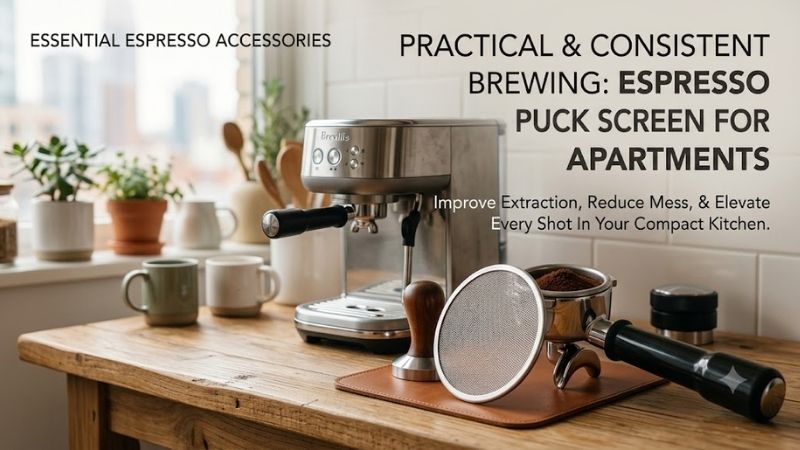
A puck screen is a thin disc positioned directly above the prepared coffee bed inside a portafilter basket.
During brewing, water passes through the machine’s shower screen, then the added puck screen, before contacting the coffee.
Many reusable designs are made from stainless steel with small holes or a layered mesh structure. Others use thin paper designed for espresso filtration.
The screen creates an additional physical barrier between the coffee and the group head.
This is different from changing the filter basket underneath the coffee. The basket controls beverage exit through its perforated bottom, while the puck screen is positioned above the coffee bed.
A puck screen does not generate pressure, grind coffee, or automatically correct uneven puck density.
Why Apartment Coffee Stations Can Benefit
A compact apartment coffee setup often includes an espresso machine, grinder, scale, tamper, and a limited amount of preparation space.
Cleaning coffee residue from the group head can require awkward positioning beneath cabinets or shelving.
A puck screen may reduce some direct contact between the coffee bed and the machine’s shower screen.
That can simplify certain parts of routine cleaning.
However, the screen becomes another item that must be removed, washed, dried, and stored.
The real benefit depends on whether the reduction in group-head residue outweighs the additional handling.
Is It Essential for Good Espresso?
No. Excellent espresso can be prepared without a puck screen.
Many traditional machines and workflows operate without one.
A suitable grinder, consistent coffee dose, appropriate distribution, correctly sized tamper, and reliable machine remain the foundations of espresso preparation.
A puck screen is an optional refinement.
For a beginner with a limited budget, improving an unsuitable grinder will generally be more important than purchasing a premium screen.
Choosing the Correct Diameter
Why Portafilter Labels Can Be Misleading
Espresso machines commonly use portafilter size classes such as 51 mm, 54 mm, and 58 mm.
However, the number used to describe the portafilter is not necessarily the exact size required for a puck screen.
The screen must fit inside the basket.
Its diameter must allow it to sit flat above the coffee without binding against the basket walls.
For some 54-mm home espresso systems, accessory manufacturers sell screens around 53.3–53.5 mm.
For many 58-mm systems, screens around 58.5 mm are sold for compatible baskets.
These are examples of accessory sizing, not universal specifications.
Basket Compatibility Table
| Basket class | Screen sizing consideration |
|---|---|
| 51-mm class | Check the exact basket and screen maker’s fit guidance |
| 54-mm class | Some compatible screens are approximately 53.3–53.5 mm |
| 57-mm class | Requires model-specific verification |
| 58-mm class | Certain compatible screens are approximately 58–58.5 mm |
| Specialty manual espresso baskets | Use manufacturer-specific dimensions |
A nominally 58-mm portafilter does not guarantee compatibility with every 58.5-mm screen.
Precision baskets, tapered walls, unusual rims, and aftermarket components can change the available fit.
How to Verify Your Basket
Begin by identifying the exact filter basket.
Check the basket manufacturer’s documentation or the screen maker’s compatibility chart.
If measurements are necessary, use suitable calipers and inspect the part of the basket where the screen will rest.
The screen should lower into place without excessive force.
It should sit flat and be removable without scraping or binding.
Never force an oversized metal disc into a basket.
A screen that jams may become difficult to remove after extraction.
Original vs. Aftermarket Baskets
If you have replaced the original basket with a precision basket, do not rely on the espresso machine’s published portafilter size alone.
The aftermarket basket may have a different internal profile.
An accessory that fits the original basket may not fit the replacement.
When buying several accessories together, verify the tamper, dosing funnel, puck screen, and basket separately.
Compatibility with one accessory does not prove compatibility with the others.
Puck Screen Thickness and Espresso Headspace
What Is Headspace?
Headspace is the available distance above the tamped coffee and below the machine’s shower screen or other limiting group-head component.
A puck screen occupies some of that space.
If the coffee puck is already close to the shower screen, adding a thick metal disc can create interference.
Coffee also changes physically when it becomes wet.
A setup that appears to fit when dry may behave differently during extraction.
This makes headspace one of the most important considerations.
Thin Puck Screens
Some screens are approximately 0.2–0.5 mm thick.
They occupy relatively little vertical space.
This can be useful with shallow baskets or comparatively large coffee doses.
However, very thin designs may be flexible or difficult to handle.
Durability depends on the material and construction.
A thinner screen should not be assumed to provide better extraction simply because it is less bulky.
Medium-Thickness Screens
Screens around 0.8 mm represent another design category.
They can offer a balance between flexibility and rigid handling, depending on construction.
However, suitability still depends on basket clearance.
A medium-thickness screen may be convenient for routine handling without being the best choice for every machine.
Thicker Metal Screens
Some traditional reusable puck screens are approximately 1–1.7 mm thick or more.
Their thickness can make them relatively easy to grasp.
However, they occupy more headspace.
If the basket is already full, the screen may contact the shower screen or central fastening components.
Do not assume that the thickest option is the most effective.
How to Check Clearance
Follow the espresso machine and basket manufacturer’s headspace recommendations.
If the screen causes interference, stop using that combination.
An appropriate reduction in coffee dose may be possible, but changing the dose also changes the espresso recipe.
Alternatively, a thinner compatible screen may be more suitable.
Do not alter the machine’s group head or force the portafilter into place to accommodate an accessory.
Stainless Steel vs. Paper Puck Screens
Reusable Stainless Steel
Stainless steel puck screens are popular because they can be reused.
A suitable screen can withstand repeated brewing when handled and cleaned properly.
Their main ownership trade-off is maintenance.
Coffee oils and fine particles may collect in holes or between mesh layers.
If you make several espresso shots daily, this cleaning workload becomes part of the routine.
Paper Puck Screens
Paper screens are generally intended for single use.
They can offer a simple handling process because the used screen is discarded after brewing.
This may appeal to people who dislike cleaning fine metal mesh.
However, they create a recurring expense and waste.
Their thickness, permeability, and fit vary.
Use paper products specifically suitable for the intended espresso application.
Mesh vs. Perforated Metal
Some metal screens use layered woven mesh.
Others use precisely perforated sheet metal.
Layered mesh can trap fine particles between layers, potentially complicating cleaning.
Perforated designs may offer easier visual access to individual openings.
However, actual cleaning difficulty depends on hole size, construction, and surface finish.
There is no universal evidence that one perforation pattern produces better espresso in every machine.
Which Is Better for Apartments?
A reusable metal screen can suit households with a convenient kitchen sink and a regular washing routine.
Paper screens may appeal to users who want fewer reusable parts to maintain.
If water access or drying space is limited, compare the practical cleanup procedures before choosing.
A reusable product is not automatically the most convenient one.
Does a Puck Screen Improve Extraction?
The Water-Distribution Claim
Some manufacturers claim that screens distribute water more evenly across the coffee surface.
This is mechanically plausible under certain conditions.
However, actual water distribution depends on shower-screen design, screen construction, pressure, flow, and basket geometry.
A visual demonstration of water flowing through a disc does not establish improved extraction in every espresso machine.
Channeling and Puck Preparation
Channeling occurs when water follows preferential paths through the coffee bed.
Poor coffee distribution, unsuitable grind, and other variables can contribute.
A puck screen sits above the prepared coffee.
It does not automatically eliminate density differences within the puck.
If your espresso shows inconsistent extraction, check dose, grind, distribution, and tamping before attributing the problem to the absence of a screen.
Flavor Differences
A puck screen may alter brewing conditions enough to produce a noticeable difference in some setups.
However, the direction and size of that difference cannot be assumed.
If you want to evaluate it, compare shots made using the same coffee, dose, grind, beverage yield, and preparation method, changing only the screen.
Repeat the comparison rather than relying on one extraction.
When the Cleaning Benefit Matters More
For many home baristas, reduced shower-screen contamination is the most straightforward reason to use a puck screen.
That benefit is practical even when no noticeable taste improvement occurs.
However, the group head still requires periodic cleaning.
A screen reduces certain residue contact; it does not eliminate coffee oils, scale, or all maintenance.
Puck Screens and Pressurized Baskets
Understanding Pressurized Baskets
Some beginner espresso machines include pressurized or dual-wall filter baskets.
These create additional resistance through the basket design.
Their behavior differs from ordinary nonpressurized baskets.
A puck screen may provide limited practical benefit in certain pressurized-basket workflows.
Is a Puck Screen Compatible?
Compatibility depends on the exact basket and machine.
Some configurations may not have sufficient headspace.
Others may allow the screen physically but provide no meaningful improvement.
Do not assume a reusable screen is necessary merely because a beginner espresso machine accepts a portafilter.
Where Beginners Should Spend First
If you use a pressurized basket and pre-ground coffee, a premium puck screen is unlikely to be the most important equipment upgrade.
A better grinder or a suitable nonpressurized basket may become more relevant as your technique develops.
However, any basket change must be compatible with the machine.
Cleaning a Puck Screen After Every Shot
Removing the Screen Safely
After extraction, the portafilter and screen may be hot.
Do not immediately touch the metal disc with bare fingers.
Allow appropriate cooling or use a manufacturer-approved removal method.
Some screens remain attached to the spent puck.
Others separate during disposal.
Avoid forceful tapping that sends the screen into the trash.
Rinsing Loose Residue
Rinse the screen according to its care instructions.
For certain metal screens, flowing water helps remove loose coffee grounds.
However, a quick rinse may not remove all trapped oils or particles.
Inspect the screen periodically.
Washing With Appropriate Detergent
Some manufacturers permit mild dishwashing detergent.
Others provide a different cleaning procedure.
Follow the exact instructions.
A screen used daily may need deeper cleaning in addition to ordinary rinsing.
Cleaning Layered Mesh
Fine grounds can become trapped inside layered mesh.
This can make cleaning more difficult than with a simple perforated disc.
Use approved cleaning tools.
Do not bend, scrape, or puncture the screen with sharp objects.
Drying Before Storage
A damp screen should not be placed in a closed container for prolonged storage.
Allow it to dry appropriately.
A small drying tray can help keep the accessory separate from other espresso tools.
Deeper Cleaning and Maintenance
When Deeper Cleaning Is Useful
If the screen shows persistent coffee residue, restricted openings, or unpleasant odors, follow the manufacturer’s deeper-cleaning procedure.
Coffee oils may require a suitable approved cleaner.
However, product compatibility varies.
Ultrasonic Cleaning
Some owners use ultrasonic cleaners for metal espresso accessories.
However, not every coating, finish, or layered component is appropriate for ultrasonic cleaning.
Follow the screen manufacturer’s guidance.
Do not assume every stainless steel accessory tolerates all cleaning methods.
Dishwasher Cleaning
Dishwasher compatibility varies by screen construction and manufacturer.
A bare stainless steel disc may look durable, but that does not automatically mean it is approved for dishwasher use.
Inspecting for Damage
Look for bent edges, broken mesh, delamination, corrosion, or rough surfaces.
A damaged screen may be difficult to clean or may interact improperly with the basket.
Replace it when necessary.
Apartment-Specific Storage and Workflow
Minimal Countertop Storage
A puck screen itself takes very little room.
However, storing a wet metal disc loose on a crowded counter is inconvenient.
A small tray, rack, or protective holder can provide a dedicated location.
You do not need an elaborate accessory stand.
Keeping Screens Away From Food Preparation
If the espresso station shares space with meal preparation, keep used coffee accessories separate from clean utensils and food-contact surfaces.
Wash after use.
Small Sinks and Limited Drying Space
A compact apartment sink may not have room for large equipment.
Fortunately, puck screens are small.
However, fine mesh can require additional attention.
Choose a design you can clean effectively with your available facilities.
Preparing Multiple Shots
If you make several espressos consecutively, consider whether you want one screen or several.
A second screen can reduce interruptions while one is being rinsed.
However, extra screens are unnecessary for someone preparing one shot daily.
Avoiding Accessory Clutter
A basic espresso routine may require a grinder, scale, tamper, and cleaning tools.
A puck screen should not trigger the purchase of several unrelated accessories.
Buy only what makes the routine cleaner or more consistent.
Choosing Based on Your Espresso Routine
One Shot Each Morning
A single reusable screen may be sufficient.
However, you must still remove and rinse it after use.
Two or Three Milk Drinks Daily
A screen may reduce coffee residue around the group head during repeated brewing.
However, milk-system cleaning remains a separate task.
Beginner Using a Compact Espresso Machine
Check basket size and headspace first.
Do not assume that a puck screen is necessary for beginner espresso.
Enthusiast With Precision Baskets
A thin, closely fitted screen may be appealing.
However, basket dimensions and headspace must be checked carefully.
Shared Apartment Coffee Station
Multiple users should understand how to remove and clean the screen.
Otherwise, it may be accidentally discarded with the spent puck.
Budget and Value
Basic Stainless Steel Screens
A simple well-fitting screen is often sufficient.
There is no need to assume that a higher price guarantees better extraction.
Premium Coatings
Some products advertise specialty coatings or polished finishes.
These may influence appearance or cleaning characteristics, but benefits need credible evidence.
Avoid paying substantially more for unsupported claims.
Multipacks
A two-screen set can be convenient for households making consecutive shots.
However, check that both screens have the correct specifications.
Consumable Paper Costs
Paper screens require replenishment.
Estimate how many shots you make each month before comparing cost.
Replacement Considerations
Reusable metal screens can become bent or damaged.
Choose a design with reasonable availability rather than relying on unusual proprietary sizes.
Common Buying Mistakes
Buying the Nominal Portafilter Diameter
The correct screen diameter depends on the basket interior.
Ignoring Screen Thickness
A thick screen can reduce necessary headspace.
Treating the Screen as a Channeling Cure
Uneven extraction has multiple causes.
Failing to Clean Fine Mesh
Trapped coffee residue can accumulate.
Removing a Hot Screen With Bare Fingers
Metal accessories may remain hot after brewing.
Knocking the Screen Into the Trash
Check the spent puck before disposal.
Overpaying for Unverified Extraction Claims
The strongest reason to buy may simply be easier group-head cleaning.
Frequently Asked Questions
Do Espresso Puck Screens Improve Espresso Flavor?
They may affect brewing conditions in some setups, but consistent flavor improvements are not established for every machine. Cleaner shower-screen operation is a clearer practical benefit.
What Size Puck Screen Fits a 54-mm Portafilter?
Some 54-mm systems use screens around 53.3–53.5 mm, but the correct choice depends on the actual basket. Verify the manufacturer’s compatibility guidance.
Is a Thin Puck Screen Better?
A thin screen occupies less headspace, which can be useful in shallow baskets. However, thickness alone does not establish better extraction.
How Often Should I Clean a Reusable Puck Screen?
Clean it after use according to its instructions and perform deeper cleaning when oils or residue accumulate.
Are Paper Espresso Puck Screens Worth It?
They may simplify cleanup but add recurring cost and waste. Choose according to your preferences and compatibility requirements.
Do I Need a Puck Screen for a Small Apartment Espresso Setup?
No. It is optional. Buy one when its cleaning or workflow benefits justify the extra handling and maintenance.
Conclusion
The best espresso puck screen for apartments is a correctly sized, easy-to-clean accessory that fits the available basket headspace without complicating preparation. A thin stainless steel screen is a practical starting point for many compatible nonpressurized espresso setups, while paper screens offer a disposable alternative. Verify exact basket dimensions, prioritize safe handling and cleaning, and treat claims about extraction improvement cautiously. A puck screen should make your espresso routine more convenient—not replace the fundamentals of good brewing.










Write Your Review
No reviews yet. Be the first to share your experience!