
A reusable coffee filter for busy mornings can eliminate the need to restock paper filters and make daily coffee preparation more convenient. However, reusable filters also require emptying, rinsing, and occasional deeper cleaning. Some fit ordinary drip machines, while others are designed for pour-over drippers or specific single-serve brewers. This guide explains how to choose the correct filter, compare brewing results, and decide whether reusable filtration genuinely saves time in your household.
- Quick Verdict: Which Reusable Coffee Filter Should You Buy?
- Why Reusable Filters Appeal to Busy Households
- Understanding Different Reusable Filter Designs
- Reusable Metal Filters vs. Paper Filters
- Compatibility: The Most Important Buying Check
- Mesh Design and Filtration Quality
- How Reusable Filters Affect Coffee Strength
- The Busy-Morning Workflow Test
- What About Reusable K-Cup-Style Capsules?
- Cleaning a Reusable Coffee Filter
- A Practical Five-Minute Morning Routine
- Storage and Kitchen Space
- Cost per Use and Break-Even Value
- Choosing for Different Households
- Common Buying Mistakes
- Frequently Asked Questions
- Conclusion
Quick Verdict: Which Reusable Coffee Filter Should You Buy?
For most households using an automatic drip coffee maker, a correctly sized reusable filter basket with a fine metal mesh and a rigid, easy-to-grasp frame is a practical choice.
It can reduce dependence on disposable paper filters while offering a repeatable daily brewing routine.
However, the filter must match the machine’s basket shape and capacity. An incorrectly sized filter may cause overflow, poor drainage, or messy grounds removal.
If cleanup speed is your highest priority, ordinary disposable paper filters may actually be more convenient.
| Filter type | Best use | Main advantage | Main drawback |
|---|---|---|---|
| Reusable flat-bottom basket filter | Compatible automatic drip brewers | No routine paper-filter purchase | Requires washing |
| Reusable cone filter | Compatible cone-basket brewers | Compact, reusable construction | Exact cone fit matters |
| Stainless steel pour-over filter | Manual brewing without paper | Can work as a standalone dripper | More sediment and cleanup |
| Reusable single-serve capsule | Compatible pod machines | Uses your preferred ground coffee | Filling and cleaning take time |
| Cloth coffee filter | Specialty manual brewing | Different filtration characteristics | More demanding care |
| Disposable paper filter | Busy households prioritizing cleanup | Grounds and filter can be removed together | Recurring cost and supplies |
Best overall approach: Choose the reusable filter designed for your exact brewer, then evaluate whether its cleaning requirements suit the time you actually have in the morning.
Why Reusable Filters Appeal to Busy Households
No More Running Out of Paper Filters
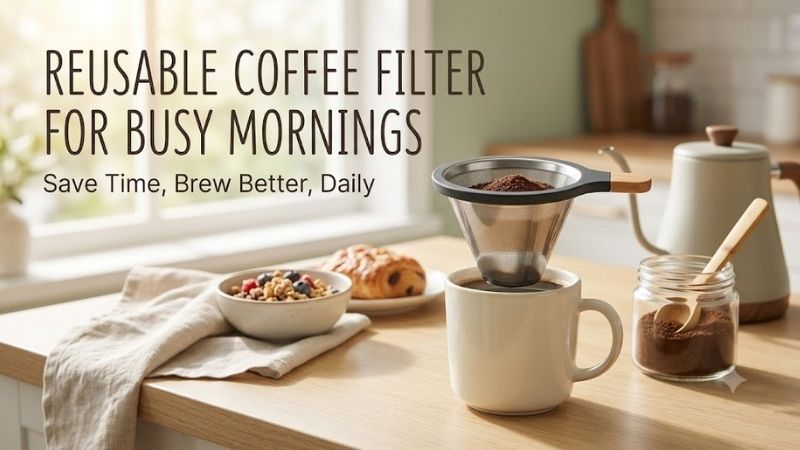
A reusable filter remains available after cleaning.
That can prevent the inconvenience of discovering an empty paper-filter box before breakfast.
For households that brew coffee every day, reducing dependence on consumables may simplify shopping.
However, a reusable filter only provides this advantage when it has been cleaned and is ready for use.
Leaving yesterday’s wet grounds inside the basket defeats much of the convenience.
A Predictable Brewing Routine
A reusable filter can remain associated with the same machine.
Once the correct dose and grind are established, preparing coffee becomes straightforward.
However, switching from paper to metal filtration can change brewing behavior.
You may need to adjust grind size or coffee quantity to achieve the flavor you prefer.
Less Disposable Filter Waste
Reusable filters can reduce the number of single-use paper filters discarded.
However, environmental impact depends on materials, manufacturing, lifespan, and cleaning practices.
A reusable filter that breaks quickly or requires excessive maintenance may provide less value than expected.
Choose durable construction intended for repeated use.
Potential Long-Term Savings
A reusable filter has an upfront cost but avoids recurring paper-filter purchases.
However, water, detergent, replacement parts, and your time also have value.
The practical savings depend on how frequently you brew and how long the filter lasts.
Understanding Different Reusable Filter Designs
Permanent Basket Filters
Permanent basket filters are designed to sit inside the filter compartment of a compatible drip coffee maker.
They commonly have a rigid frame and fine mesh walls.
Some replace paper filters entirely.
Others are intended to work only with specific machines.
Always verify which configuration the manufacturer approves.
Reusable Cone Filters
Cone-shaped filters fit certain cone-basket brewers.
They can be made from metal mesh, synthetic mesh, or other suitable materials.
The filter’s angle, upper rim, and lower shape affect compatibility.
A generic cone filter may not fit every machine that ordinarily uses a similarly numbered paper filter.
Stainless Steel Pour-Over Filters
Some reusable filters are shaped like standalone pour-over drippers.
They rest directly on a cup or compatible carafe.
These are not necessarily replacements for an automatic drip machine’s internal filter basket.
They may require a separate kettle and manual pouring.
Reusable Single-Serve Capsules
Reusable capsules allow compatible pod machines to use loose ground coffee.
However, these products have different construction and operating requirements from ordinary drip filters.
Some pod systems do not support reusable capsules, or third-party adapters may be incompatible.
Do not assume that a reusable capsule advertised for one brewer works with another.
Cloth Filters
Cloth can be used in certain manual brewing methods.
It offers different filtration characteristics from metal or paper.
However, cloth requires particular washing, drying, and storage practices.
For a household seeking minimal morning cleanup, cloth may not be the easiest option.
Reusable Metal Filters vs. Paper Filters
Coffee Body and Oils
Paper filtration generally retains more suspended particles and certain coffee oils than typical metal mesh.
Metal filters often allow more oils and small particles into the finished beverage.
This can create a fuller mouthfeel.
However, some drinkers prefer the cleaner cup produced by paper.
Neither flavor profile is universally superior.
Sediment
A reusable metal mesh filter may allow some fine grounds to pass.
The amount depends on the mesh construction and the grind.
A small amount of sediment is not necessarily a sign of filter failure.
However, excessive particles can be unpleasant.
If you prefer very clean coffee, paper filtration may be more suitable.
Flow Rate
Changing the filter material can affect water drainage.
A metal mesh basket may behave differently from paper even when the same coffee dose is used.
However, faster or slower flow depends on the complete filter and brewer.
Do not assume every reusable filter automatically brews faster.
Cleanup
Paper filters allow the used filter and grounds to be discarded together.
A reusable filter requires grounds removal and washing.
This is the central trade-off for busy households.
Everyday Comparison
| Factor | Reusable mesh | Disposable paper |
|---|---|---|
| Upfront cost | Higher | Usually lower per package |
| Recurring cost | Usually limited | Continual repurchasing |
| Daily cleaning | Required | Less filter cleaning |
| Coffee oils | More may pass | More may be retained |
| Fine sediment | Some may pass | Typically reduced |
| Stock management | Minimal | Filters must remain available |
| Durability | Depends on construction | Used once |
| Best fit | Owners prioritizing reusability | Owners prioritizing easy disposal |
Compatibility: The Most Important Buying Check
Identify the Exact Coffee Maker
Find the machine’s model number.
Check whether the manufacturer sells or approves a permanent filter.
If the machine includes a reusable filter, it may already meet your needs.
Avoid buying another without a clear reason.
Flat-Bottom vs. Cone Baskets
Flat-bottom baskets and cone-shaped baskets have different geometry.
A reusable cone filter generally will not fit properly into a flat-bottom compartment.
Some machines use unusual proprietary shapes.
Verify compatibility before ordering.
Understanding Filter Numbers
Paper filter sizes such as No. 2 and No. 4 are commonly associated with certain cone-basket designs.
However, those numbers do not establish universal reusable-filter dimensions.
Check the filter’s actual measurements and the machine’s compatibility guidance.
Check the Upper Rim
Some reusable filters have a rigid rim.
If that rim is too wide or thick, the machine’s basket door or lid may not close.
Never force the coffee maker shut over an incompatible accessory.
Consider Filter Height
An excessively tall filter may interfere with water distribution or the basket lid.
A short filter may have insufficient capacity for the intended coffee dose.
The filter should be designed for the brewer’s supported quantity.
Reusable Filter and Paper Liner Together?
Some manufacturers allow certain filter combinations.
Others instruct users not to use paper inside a permanent filter.
Do not assume that layering both improves coffee quality.
Follow the machine and filter instructions.
Mesh Design and Filtration Quality
Fine Stainless Steel Mesh
Many reusable filters use stainless steel mesh.
This can provide durable filtration when properly constructed.
However, fine openings can collect coffee particles and oils.
A filter that is difficult to rinse may become frustrating.
Synthetic Mesh
Some reusable filters use nylon or other food-contact mesh materials.
These can be lightweight.
However, temperature ratings and cleaning procedures vary.
Use only products intended for hot coffee brewing.
Rigid Support Frames
A rigid frame helps maintain the filter’s shape.
However, some frames include seams or grooves that collect residue.
Look for a design that can be inspected and washed easily.
Double-Layer Filters
Some products use multiple layers to control particle passage.
However, additional layers can increase cleaning difficulty.
A double-layer label does not guarantee a better cup.
Replaceable Filter Components
Certain products allow the mesh or another component to be replaced.
This can extend useful life.
However, replacements must be available.
For most budget-conscious households, a durable simple filter may offer better value.
How Reusable Filters Affect Coffee Strength
Coffee-to-Water Ratio Still Matters
A reusable filter does not automatically make coffee stronger.
The beverage depends on the coffee dose, water volume, grind, and brewing conditions.
For ordinary filter coffee, approximately 55–65 grams of coffee per liter of water is a useful starting range.
However, individual preferences vary.
Filter Change May Require Grind Adjustment
A new reusable filter can alter flow behavior.
If your coffee tastes unusually weak or harsh after switching from paper, adjust one variable at a time.
Begin with an appropriate grind.
Avoid immediately increasing the coffee dose without understanding the change.
Fine Grounds Can Clog Mesh
A very fine grind may cause slow drainage.
This can create overflow concerns in certain automatic machines.
Use a grind suitable for the brewer and filter.
Large Coffee Batches
A filter must support the full intended coffee dose.
Do not exceed its stated capacity.
Overfilled reusable baskets can create spills and uneven brewing.
Small-Batch Brewing
A reusable filter may work with a small coffee dose, but the machine’s water distribution and basket geometry still affect extraction.
Do not assume the filter alone corrects poor small-batch performance.
The Busy-Morning Workflow Test
Preparation Time
Does the filter require an additional holder, adapter, or assembly step?
A simple removable basket may be convenient.
A complicated adapter system may be less practical.
Filling
Can you add ground coffee without spilling?
A wide opening and stable frame can help.
However, the filter must still fit inside the brewer.
Brewing
Does the machine operate normally with the filter?
If the flow pattern changes dramatically, review compatibility and grind.
Grounds Disposal
Can the grounds be emptied into an appropriate waste container without repeatedly tapping or scraping?
A filter with awkward corners may trap residue.
Rinsing
Can it be cleaned quickly using the manufacturer’s approved method?
A large filter with multiple mesh layers may require more attention.
Drying
Does it need to dry before being reinstalled or stored?
Follow the material’s care instructions.
Resetting
A good morning routine ends with the equipment ready for the next use.
If cleaning consistently gets postponed, paper filtration may be the better choice.
What About Reusable K-Cup-Style Capsules?
Different From Ordinary Reusable Filters
A reusable single-serve capsule is a coffee container designed for a compatible pod brewing mechanism.
It is not simply a miniature drip-filter basket.
Compatibility Is System-Specific
Brewer mechanisms differ across brands and generations.
Some reusable capsules may interfere with needles, seals, or other components when used incorrectly.
Use only compatible products.
Coffee Dose
Reusable capsules have limited capacity.
Overfilling can create problems.
Follow the accessory instructions.
Grind Size
The appropriate grind depends on the capsule design and machine.
A grind that is too fine may restrict flow.
Daily Cleanup
Reusable capsules eliminate some single-use pod packaging but require filling and washing.
For someone in a hurry, the cleanup may be less convenient than disposable capsules.
When They Make Sense
They can suit people who want a particular ground coffee while keeping a compatible single-serve machine.
However, buying an ordinary ground-coffee drip brewer may offer a simpler alternative for some households.
Cleaning a Reusable Coffee Filter
After Every Brew
Allow the filter and grounds to cool enough for safe handling.
Remove the used coffee.
Dispose of grounds appropriately.
Rinse the filter according to its instructions.
Removing Fine Particles
Fine grounds can lodge in mesh openings.
Use an approved soft brush if needed.
Avoid scraping or puncturing the mesh.
Coffee-Oil Buildup
Coffee oils may gradually accumulate.
This can contribute to odors and potentially change filtration behavior.
Follow the manufacturer’s deeper-cleaning procedure.
Dishwasher Compatibility
Some permanent filters are dishwasher safe.
Others are not.
A stainless steel appearance does not guarantee dishwasher compatibility.
Drying
Allow the filter to dry appropriately before enclosed storage.
Do not leave wet grounds sitting inside it overnight.
When to Replace It
Replace a filter if the mesh tears, frame warps, plastic becomes damaged, or other essential components fail.
Do not continue using a damaged filter that may release material into the coffee.
A Practical Five-Minute Morning Routine
Step 1: Start With a Clean Filter
Prepare the filter after the previous day’s brewing whenever practical.
This prevents cleanup from becoming the first task of a busy morning.
Step 2: Measure the Coffee
Use your usual recipe.
Keep the amount consistent.
Step 3: Insert the Filter Correctly
Ensure that it sits securely in the basket.
Check that lids or doors close normally.
Step 4: Add Coffee
Avoid exceeding the manufacturer’s supported dose.
Step 5: Add Water
Use potable water appropriate for the coffee maker.
Step 6: Start Brewing
Allow the machine to complete its approved brewing cycle.
Step 7: Serve
Handle the carafe or mug carefully.
Step 8: Remove the Used Grounds
Wait until the components are safe to handle.
Step 9: Rinse the Filter
Use the approved cleaning method.
Step 10: Reset the Station
Leave the brewer and filter ready for the next session.
This process can be efficient, but the actual duration depends on the equipment. Do not assume every reusable filter makes cleanup faster.
Storage and Kitchen Space
Reusable Filters Reduce Paper-Filter Storage
A single permanent filter may replace a supply of disposable paper.
That can free cabinet space.
However, the reusable filter itself needs a hygienic storage location.
Keep the Filter in the Brewer?
Some machines allow the cleaned reusable filter to remain installed.
However, follow the manufacturer’s drying and storage guidance.
Small Apartments
A compact reusable filter can be practical when storage is limited.
However, easy access to a sink is important for cleaning.
Shared Kitchens
A reusable filter may become inconvenient if users leave grounds inside after brewing.
Agree on a cleaning routine.
Travel Coffee Setups
A standalone stainless steel pour-over filter can be portable.
However, it still needs safe washing and drying facilities.
Cost per Use and Break-Even Value
An Illustrative Comparison
Suppose a reusable filter costs $18.
Suppose disposable paper filters cost $0.06 each.
The purchase price equals the cost of 300 paper filters.
At one brew per day, that represents roughly 300 days of paper-filter purchases.
This example excludes washing costs, product replacement, and differences in brewing preferences.
Two Daily Brews
At two brews per day, those 300 filters would be used in approximately 150 days.
Higher brewing frequency can improve the financial case for a reusable product.
The Value of Time
A reusable filter may require a minute of cleanup that a paper filter does not.
For some households, that matters more than the monetary savings.
Durability
A reusable filter only provides long-term value when it lasts.
Choose a sturdy frame and reliable mesh.
When Paper Remains the Better Value
For occasional coffee drinkers, disposable filters may be inexpensive enough that a reusable alternative provides limited savings.
The right purchase is the one that matches your actual routine.
Choosing for Different Households
One Coffee Drinker
A small reusable filter can be sufficient.
Couples
A larger filter may support the normal batch size.
Families Brewing a Full Carafe
Capacity and reliable drainage become important.
Shared Apartment
Simple cleaning instructions help prevent residue from accumulating.
Home Office
A permanent filter can reduce repeated paper-filter purchases.
Espresso Drinkers
Traditional espresso machines use specialized filter baskets rather than ordinary reusable drip filters.
Do not confuse the two accessory categories.
Common Buying Mistakes
Buying a Generic Filter Without Checking Fit
Reusable filters must match the actual machine.
Assuming Reusable Means Faster Cleanup
Used grounds still need to be removed.
Ignoring Grind Size
Fine coffee can clog some mesh filters.
Choosing Based Only on Sustainability Claims
Durability and washing practices matter.
Overlooking Coffee Flavor Differences
Paper and metal filtration produce different results.
Buying a Reusable Capsule for an Incompatible Pod Machine
Compatibility is essential.
Failing to Clean the Mesh
Residue can build up over time.
Frequently Asked Questions
Is a Reusable Coffee Filter Worth It for Busy Mornings?
It can be if you value avoiding paper-filter purchases and are comfortable rinsing the filter after use. Paper may remain quicker to dispose of.
Do Reusable Coffee Filters Make Coffee Taste Different?
They can. Metal mesh often permits more coffee oils and fine particles than paper, affecting body and texture.
Can I Use a Reusable Filter in Any Coffee Maker?
No. Filter shape, dimensions, and machine approval must be verified.
Are Reusable Coffee Filters Dishwasher Safe?
Some are, but not all. Follow the exact care instructions.
How Often Should I Replace a Reusable Filter?
Replace it when damaged or when the manufacturer recommends it. There is no universal replacement interval.
Is a Reusable Filter Better Than a K-Cup Capsule?
They are different product categories. A drip filter works in compatible ground-coffee brewers, while a reusable capsule is designed for a specific pod system.
Can a Reusable Filter Save Money?
Yes, potentially, with regular use and sufficient durability. Compare upfront cost with your actual paper-filter spending and cleaning preferences.
Conclusion
The best reusable coffee filter for busy mornings is a correctly sized, durable filter that supports your normal coffee dose and can be cleaned without frustration. A permanent metal basket is practical for many automatic drip machines, while reusable single-serve capsules and standalone pour-over filters serve different needs. Check exact compatibility, consider the change in coffee texture, and evaluate whether daily rinsing fits your routine. Reusability is most valuable when the filter remains easy to use after months of regular brewing.


Write Your Review
No reviews yet. Be the first to share your experience!