
A thermal coffee carafe for small spaces can keep brewed coffee warm without relying on a continuously heated warming plate. It can be useful in apartments, compact home offices, and kitchens where several people drink coffee at different times. However, choosing the right carafe involves more than insulation. Capacity, base diameter, pouring control, lid design, and cleaning access determine whether it fits your space and daily routine. This guide explains how to select a compact thermal carafe that works with your coffee brewer and remains practical to own.
- Quick Verdict: What Thermal Coffee Carafe Should You Buy?
- What Is a Thermal Coffee Carafe?
- What Small Spaces Actually Require
- Choosing the Right Capacity
- Understanding Coffee Maker Cup Ratings
- How Vacuum Insulation Works
- Choosing a Carafe Lid
- Pouring Performance
- Direct-Brew Compatibility
- Thermal Carafes for Pour-Over Coffee
- Materials and Interior Construction
- Cleaning a Thermal Coffee Carafe
- Removing Coffee Stains and Odors
- Coffee Quality During Holding
- Can You Store Milk-Based Coffee in a Thermal Carafe?
- Choosing by Household Scenario
- A Practical Buying Checklist
- Common Buying Mistakes
- Frequently Asked Questions
- Conclusion
Quick Verdict: What Thermal Coffee Carafe Should You Buy?
For most one- or two-person households, a compact double-wall insulated stainless steel carafe with a comfortable handle, secure pouring lid, and easy-clean opening offers a strong balance of size and usability.
If you prepare coffee for several people, a larger one-liter-class carafe may be more practical.
However, a slim carafe is not automatically suitable for brewing directly beneath an automatic coffee maker.
The vessel must fit the brewer’s platform and, when replacing the original carafe, be explicitly compatible with the machine’s brewing system.
| Buying factor | What to prioritize | Why it matters |
|---|---|---|
| Actual capacity | Match daily beverage volume | Avoids unnecessary size |
| Base diameter | Fits available countertop and storage | Preserves usable space |
| Height | Fits beneath cabinets when required | Supports easy placement |
| Vacuum insulation | Suitable thermal performance | Retains heat without a warming plate |
| Lid design | Secure closure and controlled pouring | Reduces splashes |
| Opening width | Allows appropriate cleaning | Prevents residue buildup |
| Weight | Comfortable when full | Important for safe handling |
| Brewer compatibility | Approved for direct brewing when necessary | Prevents spills and machine problems |
| Replacement parts | Lids and seals available | Improves long-term value |
| Care instructions | Practical for the household | Avoids difficult maintenance |
Best overall approach: Choose the smallest thermal carafe that comfortably holds your normal coffee batch and provides easy pouring and cleaning.
What Is a Thermal Coffee Carafe?
Understanding Insulated Coffee Storage
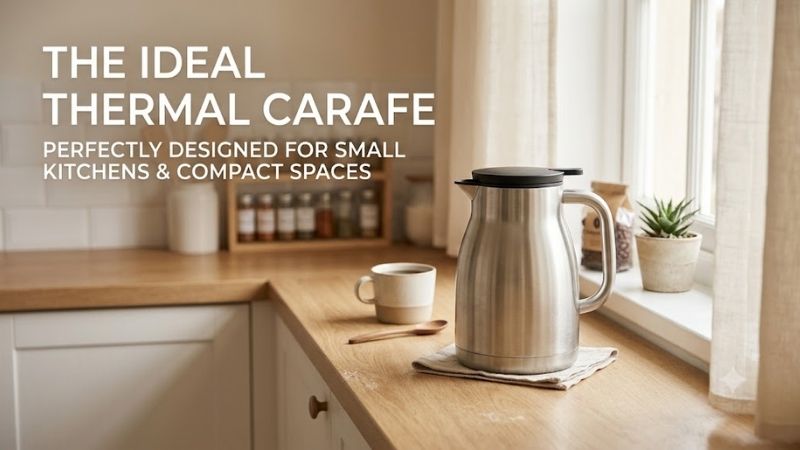
A thermal carafe is a serving vessel designed to slow heat transfer between its contents and the surrounding environment.
Many use double-wall vacuum insulation.
Some use other insulating constructions.
Unlike a conventional glass carafe sitting on a warming plate, an insulated carafe retains heat primarily through its own construction.
This can provide flexibility when coffee is consumed over time.
However, insulation does not stop temperature changes entirely.
Coffee gradually cools, and the rate depends on the vessel, fill level, starting temperature, ambient conditions, and opening frequency.
Thermal Carafe vs. Ordinary Glass Carafe
A glass carafe is often used with an automatic drip brewer.
It can be easy to see the coffee volume.
However, some coffee makers keep glass carafes warm using a heated plate.
This can alter coffee flavor during prolonged holding.
A thermal carafe can retain heat without continuous external heating.
However, thermal models may be heavier or harder to clean.
Thermal Carafe vs. Travel Mug
A travel mug is usually intended for an individual serving.
A thermal carafe is designed to hold and pour multiple servings.
Some carafes have larger openings and dedicated handles.
However, not every thermal carafe is leakproof for transport.
Do not assume that a serving vessel can safely be carried inside a bag like a sealed travel bottle.
Thermal Carafe vs. Airpot
An airpot commonly holds a larger quantity and dispenses coffee through a pump or lever mechanism.
These can be useful for offices and group service.
However, they are often larger than ordinary home carafes.
For small kitchens, a simple handheld carafe may be more practical unless several people need frequent self-service.
What Small Spaces Actually Require
Measure the Countertop Footprint
A thermal carafe may have a narrow base but a wide handle or spout.
Measure the complete width, including protruding components.
Consider whether it will sit next to the coffee maker, on a breakfast table, or inside a cabinet.
A compact carafe should not interfere with access to other appliances.
Height Beneath Cabinets
Tall thermal vessels may be difficult to fill or clean beneath wall cabinets.
Check height with the lid installed.
Also consider whether you need overhead clearance to remove the lid.
Cabinet Storage
If the carafe is stored after each use, measure the shelf.
A tall narrow design may fit where a short wide one will not.
However, a very tall carafe can be unstable on a shallow shelf.
Handle Clearance
The handle should be accessible without knocking into neighboring objects.
A compact housing with an oversized handle may not save as much space as expected.
Space for Cleaning
A narrow carafe may fit the counter but have a small opening that is difficult to wash.
For daily use, cleaning access can matter more than saving one or two inches of exterior width.
Choosing the Right Capacity
One Coffee Drinker
If you prepare one large mug daily, a relatively small carafe may be sufficient.
However, check whether the carafe’s shape is convenient for pouring a small quantity.
A large insulated vessel with very little coffee inside may cool differently from a nearly full one.
Choose capacity close to normal usage.
Two Coffee Drinkers
Suppose two people each want a 12-fluid-ounce serving.
The household needs approximately 24 fluid ounces of finished coffee.
A carafe with modest additional headroom may be useful.
However, the brewing method must produce the required finished volume.
Ground coffee retains some water, so brewing-water input and beverage yield are not always identical.
Small Families
A 32- to 40-fluid-ounce-class carafe may be worth comparing for several modest servings.
However, actual needs depend on the number of coffee drinkers and mug sizes.
Entertaining Guests
A larger carafe can support group service.
However, a compact kitchen may not need a large serving vessel for occasional gatherings.
Two smaller carafes can offer flexibility for regular and decaf coffee.
They also require more storage and cleaning.
Capacity Comparison
| Beverage need | Illustrative finished coffee volume | Practical consideration |
|---|---|---|
| One modest mug | 8–10 fl oz | A small vessel may suffice |
| One large mug | 12–16 fl oz | Avoid oversized storage |
| Two 12-oz mugs | 24 fl oz | Add useful pouring headroom |
| Four 8-oz servings | 32 fl oz | Check handling when full |
| Six 6-oz servings | 36 fl oz | Larger carafe or multiple batches |
These figures illustrate beverage demand, not universal product capacities.
Understanding Coffee Maker Cup Ratings
A Coffee Maker Cup Is Not Always Eight Ounces
Many drip coffee makers define one cup as approximately five or six fluid ounces.
That is smaller than a standard US eight-fluid-ounce measuring cup.
A brewer described as eight cups may therefore produce a substantially different amount from eight full mugs.
Match Finished Yield to the Carafe
When choosing a replacement carafe, compare actual fluid-ounce capacity.
Do not assume that a carafe advertised as eight cups fits every eight-cup machine.
Allow Safe Headroom
A carafe should not be filled beyond its intended maximum.
Overfilling can interfere with the lid or create spills.
Understand Brewing Losses
A pour-over recipe using 800 grams of water does not necessarily produce 800 milliliters of finished coffee.
Some water remains in the coffee grounds.
Plan accordingly.
Use Real Household Measurements
Measure your favorite mug using a suitable kitchen measure.
This can make capacity selection much more accurate than relying on vague terms such as family size.
How Vacuum Insulation Works
Double-Wall Construction
Many thermal carafes contain inner and outer metal walls separated by a low-pressure space.
This reduces certain forms of heat transfer.
However, heat can still escape through the lid, neck, and other structural connections.
Why Lid Design Matters
The lid is a major part of the thermal system.
A narrow opening and secure lid may reduce heat loss.
However, different lid designs trade insulation against ease of pouring and cleaning.
Is a Heavier Carafe Better Insulated?
Not necessarily.
Weight can reflect metal thickness, handle construction, or other components.
Insulation performance depends on the entire vessel.
A lightweight model may perform well.
Why Insulation Claims Vary
Manufacturers may report temperature retention after a selected number of hours.
However, the starting water temperature, room conditions, fill level, and testing procedure affect the result.
Do not compare numbers from different brands unless the test conditions are similar.
Does Preheating Help?
Preheating an appropriate insulated carafe with hot water may reduce the initial cooling caused by a cold interior.
However, use only the manufacturer’s approved method.
Do not subject the vessel to temperatures or handling conditions outside its instructions.
Choosing a Carafe Lid
Screw-Top Lids
A threaded lid can provide a secure closure.
However, it may require several turns.
This can be inconvenient when pouring repeatedly.
Push-Button Pouring
Some carafes use a button or lever to open the pouring pathway.
This can simplify one-handed service.
However, moving components may collect coffee residue.
Twist-to-Pour Lids
Certain vessels require partial lid rotation to pour.
This can provide controlled flow, but the user must understand the correct position.
Fully Removable Lids
A simple removable lid may be easy to wash.
However, removing it frequently can release heat.
Leakproof vs. Spill-Resistant
These terms should not be treated as interchangeable.
A carafe intended for table service may resist splashing without being safe to carry horizontally in a bag.
Check the product’s actual usage instructions.
Pouring Performance
Why a Good Spout Matters
A poorly designed spout can drip coffee onto the counter or table.
For small kitchens, repeated drips create unnecessary cleanup.
Choose a carafe with a controlled pouring pathway.
Handle Ergonomics
A full carafe can be relatively heavy.
The handle should support a secure grip.
If the handle is uncomfortable, pouring can become awkward.
Balance When Full
The center of gravity changes as the vessel fills.
A tall carafe may feel different when nearly full.
Consider how easily you can lift and tilt it.
Serving Small Portions
If you frequently pour only a few ounces, precise pouring control is useful.
A wide spout designed for large quantities may be less convenient.
One-Handed vs. Two-Handed Use
Some carafes can be operated comfortably with one hand.
Others may be safer with additional support.
Choose based on your normal serving routine and physical comfort.
Direct-Brew Compatibility
A Critical Distinction
Some thermal carafes are designed as replacement vessels for specific automatic drip coffee makers.
Others are general serving containers.
A general insulated pitcher should not automatically be used in place of the original brewing carafe.
Automatic Brewer Sensors
Certain machines use mechanisms that depend on the supplied carafe being positioned correctly.
A substitute vessel may interfere with brewing or cause overflow.
Brew-Through Lids
Some compatible thermal carafes include lids designed to receive coffee directly from the brewer.
However, these are not universal.
Platform Fit
The carafe must fit beneath the coffee outlet and on the approved support area.
When a Separate Serving Carafe Is Better
If you already own a working coffee maker, transferring freshly brewed coffee into a separate insulated carafe may be more practical than replacing its original vessel.
However, use suitable heat-resistant equipment and follow safe handling practices.
Thermal Carafes for Pour-Over Coffee
Brewing Into a Compatible Carafe
Certain pour-over drippers can rest securely on thermal servers designed for that purpose.
However, stability and compatibility must be checked.
Temperature Management
A suitable insulated server may retain heat during and after brewing.
However, preheating and brewing method can affect the result.
Dripper Clearance
The combined height of dripper and carafe must fit beneath shelves or cabinets.
Scale Capacity
If you brew on a coffee scale, ensure the scale supports the carafe, dripper, coffee, and water.
When Glass Is More Convenient
Some pour-over enthusiasts prefer glass servers because they can see the beverage level.
However, a thermal carafe offers insulation and potentially greater break resistance.
Choose according to the workflow.
Materials and Interior Construction
Stainless Steel Interiors
Stainless steel is common in insulated carafes.
It can provide durable food-contact construction when properly manufactured.
However, coffee oils can accumulate on the interior.
Regular cleaning remains necessary.
Glass-Lined Thermal Carafes
Some insulated vessels use glass liners.
These may have different handling and cleaning requirements.
Glass liners can be fragile.
Check the manufacturer’s instructions.
Plastic Lids and Handles
Plastic components are common even in stainless steel carafes.
Use only products suitable for hot beverage contact.
Coatings
Some vessels have specialty interior or exterior finishes.
However, coating claims should be evaluated separately from insulation performance.
Avoid Material-Based Assumptions
A stainless steel exterior does not guarantee dishwasher compatibility, leakproof operation, or superior heat retention.
The complete design matters.
Cleaning a Thermal Coffee Carafe
Why Coffee Oils Accumulate
Coffee contains compounds that can adhere to interior surfaces.
Over time, residue may affect odor and flavor.
A narrow vessel can make these deposits difficult to inspect.
Wide-Mouth Designs
A wider opening can simplify washing with a suitable brush.
However, it may also influence heat retention depending on lid design.
Narrow-Mouth Designs
A narrow neck may be useful for insulation or compact construction.
However, cleaning may require a dedicated bottle brush.
Removable Lid Components
Some lids can be disassembled for washing.
Others contain mechanisms not intended for user disassembly.
Follow the exact instructions.
Dishwasher Safety
Some carafes or components are dishwasher safe.
Others require handwashing.
Do not assume that a stainless steel vessel can be placed in a dishwasher.
Drying
Allow the carafe and lid to dry before enclosed storage.
Leaving the lid closed over a damp interior can contribute to unpleasant odors.
Removing Coffee Stains and Odors
Routine Washing
Use the manufacturer’s approved detergent and water-temperature guidance.
Persistent Deposits
Certain manufacturers recommend specific cleaning products for insulated vessels.
Use only approved options.
Avoid Abrasive Scraping
Hard abrasive tools may damage finishes or the inner surface.
Do Not Mix Household Chemicals
Never combine bleach, acids, or unrelated cleaning products.
Inspect Seals
Lid gaskets can trap residue.
Clean or replace them according to manufacturer guidance.
Coffee Quality During Holding
Freshly Brewed Coffee Changes Over Time
Thermal insulation slows cooling.
However, it does not preserve every aroma and flavor component indefinitely.
Coffee can taste different after hours of storage even when it remains warm.
Thermal Carafe vs. Hot Plate
A thermal carafe can avoid continuous direct heating.
This may be useful when coffee is consumed gradually.
However, the outcome depends on the brewer and coffee.
Don’t Brew Excessive Quantities
A large carafe is convenient, but brewing more coffee than you drink can increase waste.
Choose capacity according to normal demand.
Regular vs. Decaf
Two smaller carafes may be useful when serving different coffees.
Label them clearly.
Serving Temperature
Coffee held in a high-performance insulated vessel can remain hot enough to cause burns.
Do not assume that coffee becomes safe to drink immediately simply because it was brewed earlier.
Can You Store Milk-Based Coffee in a Thermal Carafe?
Coffee With Milk Is Perishable
Milk-based beverages require appropriate food-safety handling.
A thermal coffee carafe is not automatically a safe hot-holding or cold-storage system.
General Food-Safety Principles
Perishable foods should not remain in the temperature danger zone for extended periods.
For hot holding, suitable equipment must maintain an appropriate safe temperature.
An ordinary insulated carafe without verified temperature control should not be assumed capable of doing so.
Better Approach
Store milk appropriately and add it to individual servings.
This can simplify cleaning and help each person customize the beverage.
Flavored Creamers
Some products have different storage requirements before and after opening.
Follow their labels.
Cleaning After Milk
If the manufacturer permits milk-containing drinks, clean the vessel thoroughly after use.
However, not every carafe is intended for dairy storage.
Choosing by Household Scenario
Small Apartment
A narrow carafe with an easy-pour lid can be practical.
One-Person Household
Choose modest capacity.
Couple With Different Schedules
A thermal carafe can keep coffee available without brewing a second pot immediately.
Home Office
An insulated server may reduce repeated trips to the kitchen.
Occasional Entertaining
A larger carafe can support guests, but storage space should be considered.
Shared Kitchen
Clear cleaning responsibilities help prevent residue and odors.
A Practical Buying Checklist
Step 1: Measure the Space
Record available width, depth, height, and cabinet clearance.
Step 2: Determine Coffee Demand
Calculate the number and volume of normal servings.
Step 3: Identify Brewing Compatibility
Decide whether the carafe will collect coffee directly or only serve it afterward.
Step 4: Compare Insulation Claims Carefully
Look for credible tests under comparable conditions.
Step 5: Evaluate the Lid
Check pouring mechanism, seal construction, and cleaning access.
Step 6: Consider Full Weight
A filled carafe must be comfortable to lift.
Step 7: Inspect the Opening
Make sure the interior can be cleaned effectively.
Step 8: Check Replacement Parts
Lids, seals, and other components may eventually need replacement.
Step 9: Confirm Care Instructions
Verify dishwasher and cleaning compatibility.
Step 10: Choose the Smallest Practical Capacity
Avoid paying for volume you rarely use.
Common Buying Mistakes
Buying by Cup Count Alone
Check actual fluid-ounce capacity.
Assuming Narrow Means Easy to Clean
A slim vessel may have a difficult-to-reach interior.
Replacing an Automatic Brewer’s Carafe Without Checking Fit
Direct-brew compatibility is model-specific.
Assuming Leak-Resistant Means Leakproof
Serving lids may not be safe for horizontal transport.
Trusting Heat-Retention Claims Without Test Conditions
Results depend on fill level and environment.
Leaving Milk Coffee Unrefrigerated
Insulation is not automatically verified food-safe holding.
Buying an Oversized Carafe
More capacity can mean unnecessary storage and weight.
Frequently Asked Questions
What Size Thermal Coffee Carafe Is Best for Small Spaces?
Choose based on actual beverage volume and available storage. Smaller models suit one person; approximately one-liter-class carafes may suit several modest servings.
Does a Thermal Carafe Keep Coffee Hot All Day?
Heat retention varies significantly by model and conditions. Do not assume a specific number of hours without relevant testing.
Can I Use Any Thermal Carafe With My Drip Coffee Maker?
No. Direct-brew replacement compatibility must be verified. A separate serving carafe may be safer and more flexible.
Are Stainless Steel Coffee Carafes Dishwasher Safe?
Some are, but many require specific washing procedures. Follow the manufacturer’s care instructions.
Is a Thermal Carafe Better Than a Glass Carafe?
It can retain heat without a warming plate, but it may be heavier or harder to clean. The best choice depends on the household.
Should I Preheat My Thermal Carafe?
Preheating may improve thermal performance when approved. Use the manufacturer’s recommended method.
Can I Keep a Latte in a Thermal Coffee Carafe?
Milk-containing beverages are perishable. Use appropriate temperature control and follow product instructions rather than assuming insulation makes storage safe.
Conclusion
The best thermal coffee carafe for small spaces combines appropriate beverage capacity, manageable dimensions, dependable insulation, comfortable pouring, and practical cleaning. A slim stainless steel carafe may fit a compact kitchen, but lid design and interior access are just as important as its footprint. Confirm direct-brewing compatibility before replacing a coffee maker’s original vessel, and choose a size that matches the coffee your household actually drinks.








Write Your Review
No reviews yet. Be the first to share your experience!