
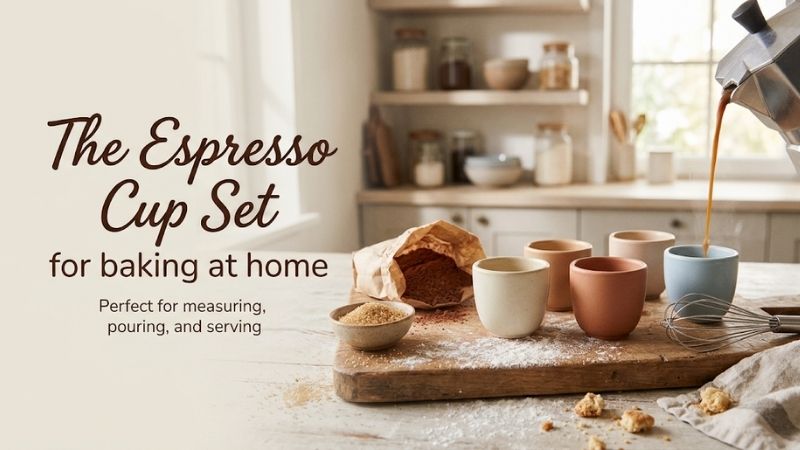
An espresso cup set for baking at home can transform ordinary miniature desserts into attractive individual servings. Small ceramic cups work well for selected custards, chocolate desserts, and baked treats, but not every espresso vessel can withstand oven temperatures. Safe purchasing starts with verified oven compatibility, suitable capacity, and correct temperature handling.
Can Espresso Cups Be Used for Baking?
Some espresso cups can safely serve as miniature baking vessels, but appearance alone does not establish oven suitability. The ceramic body, glaze, decoration, and complete product construction must tolerate the intended heating conditions. A cup that safely holds boiling coffee may still crack or fail during conventional oven use.
The first requirement is explicit manufacturer approval for baking. A product described only as microwave-safe or dishwasher-safe should not automatically be placed inside a conventional oven.
Several porcelain and stoneware collections include oven-compatible espresso cups. Their suitability nevertheless depends on the exact product specifications, approved temperature, and intended recipe.
Understand Oven-Safe and Heat-Resistant Materials
An espresso cup may tolerate freshly brewed coffee without being suitable for baking. Conventional ovens expose the entire vessel to sustained heat, while beverage use primarily heats the interior surface. Oven-safe construction must accommodate these different conditions without causing unacceptable stress or damage.
What matters most
Look for explicit statements that the cup is oven-safe, ideally accompanied by a maximum approved temperature.
Terms such as heat-resistant, durable, high-fired, or microwave-safe are not sufficient by themselves.
If a listing does not clearly establish oven compatibility, choose a different product.
Why Microwave-Safe Does Not Mean Oven-Safe
Microwave and conventional oven heating involve different energy-transfer mechanisms. Microwave-safe drinkware may tolerate ordinary reheating because the beverage absorbs much of the microwave energy, while an oven heats the entire vessel through hot air and radiant energy over an extended period.
Practical consequences
A cup labeled microwave-safe may still have decorative features or construction details unsuitable for conventional oven temperatures.
Only use the vessel in cooking equipment explicitly permitted by the manufacturer.
Avoid extrapolating from one type of temperature exposure to another.
Recognize Thermal Shock Risks Before Baking
Thermal shock occurs when different areas of a ceramic vessel change temperature at unequal rates, creating internal mechanical stress. A cup may be approved for oven use yet remain vulnerable to damage if moved directly from a cold refrigerator into a very hot oven or placed on a cold wet surface immediately after baking.
How to reduce risk
Follow the manufacturer’s temperature-transition instructions.
Do not add frozen ingredients to very hot ceramic.
Use appropriate heat-safe resting surfaces when removing finished desserts.
Oven-safe does not mean immune to cracking or rough handling.
Oven-Safe Espresso Cups Worth Considering
The most useful espresso cups for baking have specific, documented oven-use guidance rather than vague claims of durability. Small cups can be appropriate for carefully portioned desserts, but their limited volume means recipes often require adjustment. These options provide starting points for buyers who also want attractive coffee drinkware.
Fable Espresso Cups – Best for Miniature Baked Desserts
Fable Espresso Cups combine stoneware construction with a compact serving size suitable for individual dessert portions. Their four-piece set and manufacturer-stated oven compatibility make them appealing for home bakers who want coordinated vessels that can also serve espresso, small custards, or carefully adapted miniature cakes.
Key specifications
-
Set of four stoneware cups
-
Capacity: 2.5 oz
-
Manufacturer-stated oven-safe limit: 450°F
-
Stackable design
-
Dishwasher- and microwave-safe according to the product guidance
Best applications
These cups are useful for small baked custards and desserts designed for miniature vessels.
Their 2.5 oz capacity is substantially less than that of many conventional ramekins, so recipe quantities must be adjusted accordingly.
For baked goods that rise, leave sufficient headspace to prevent overflow.
What to avoid
Do not treat the 450°F rating as an instruction to bake every dessert at that temperature.
Follow the recipe’s appropriate cooking temperature and do not exceed the cup’s approved limit.
Avoid sudden temperature changes.
Advantages: Clear oven rating, coordinated set, stackable storage, versatile serving use.
Limitations: Small portions, limited headspace, ceramic breakage risk.
Tuxton Artisan Espresso Cup – Best High-Temperature Option
Tuxton Artisan Espresso Cups are restaurant-oriented ceramic vessels made from vitrified china, providing a different construction approach from ordinary decorative demitasse cups. Their published oven-safe rating makes them interesting for home bakers who need small serving vessels with more explicit temperature guidance and practical food-service durability.
Key characteristics
-
Vitrified china construction
-
Approximately 3.5 oz capacity
-
Manufacturer-listed oven rating of 500°F
-
Traditional handled espresso design
Why capacity matters
A 3.5 oz cup provides more working space than a conventional 2 oz demitasse.
This can be useful for small baked custards or carefully adapted chocolate desserts.
However, it remains smaller than many standard ramekins.
The shape and filling level can influence baking time.
Durability considerations
Vitrified china is manufactured to reduce porosity and provide a durable ceramic body.
It can be suitable for demanding food-service use, but it is not unbreakable.
The manufacturer’s oven limit and handling instructions still apply.
Advantages: Documented temperature rating, useful small-dessert capacity, durable construction.
Limitations: Handle requires tray clearance, limited serving volume, possible variation in pack quantities.
Lineage Ceramics Espresso Cup – Best Artisan Stoneware Option
Lineage Ceramics Espresso Cups appeal to buyers who prefer handmade-looking drinkware that can also serve miniature baked desserts. Their stoneware construction creates a substantial, distinctive presentation, while the manufacturer’s temperature guidance provides a practical basis for deciding which recipes are appropriate for the chosen vessel.
Key characteristics
-
Stoneware construction
-
Approximately 3 oz capacity
-
Manufacturer guidance for oven use below 400°F
-
Small-format serving design
Baking applications
The cup may accommodate miniature custards or small baked chocolate desserts prepared below its stated temperature limit.
Recipes written for larger ramekins should not be transferred without adjusting portion sizes.
Smaller volumes may heat differently.
Important restrictions
Do not use the cup for a recipe requiring a higher temperature than the manufacturer permits.
Avoid abrupt temperature transitions.
Handmade decorative finishes may vary slightly between cups, so examine every piece for damage before baking.
Advantages: Artisan appearance, documented oven guidance, compact portions.
Limitations: Lower temperature ceiling, limited capacity, recipe adaptation necessary.
Loveramics Egg Espresso Cup – Best Dual-Purpose Porcelain Cup
Loveramics Egg Espresso Cups are primarily designed for serving coffee, but the manufacturer’s collection information also identifies oven-compatible porcelain configurations. Their traditional form, thick walls, and matching saucers appeal to buyers who want small baking vessels that remain attractive as part of an everyday espresso service.
Why porcelain is useful
The Egg collection uses high-fired porcelain with a durable glazed finish.
Its 80 ml capacity is suitable for very small portions.
The rounded interior can provide an attractive shape for custards or other desserts served directly in the vessel.
Temperature verification
Check the oven-use rating for the exact collection and finish being purchased.
The manufacturer’s general collection information indicates oven compatibility, but buyers should not assume every decorative variation and accessory has identical instructions.
Saucers may need separate verification.
Limitations
These cups are very small and are not substitutes for larger baking ramekins.
Recipes requiring generous headspace or substantial fillings will be easier to prepare in dedicated bakeware.
Advantages: Dual-purpose construction, attractive porcelain, coordinated serving appearance.
Limitations: Small volume, exact variant must be verified, additional saucer storage.
How to Choose an Espresso Cup Set for Baking at Home
Baking in espresso cups requires closer attention to product specifications than ordinary coffee service. The key purchasing considerations are temperature approval, usable volume, shape, material, and how safely the cup can be moved between kitchen surfaces. Decorative style should be considered only after these requirements are satisfied.
Check the Maximum Approved Oven Temperature
An oven-safe label is useful, but a published maximum temperature provides better purchasing guidance. A cup rated for use below 400°F should not be selected for a recipe requiring 425°F. The approved temperature must apply to the exact cup, including its glaze, handle, and decorative finish.
How to compare products
Start with the recipe’s required temperature.
Then compare it with the product’s documented limit.
Choose a vessel with appropriate manufacturer approval rather than assuming extra durability from a thick ceramic wall.
Compare Porcelain and Stoneware Construction
Porcelain and stoneware are both ceramic materials, but their appearance, wall thickness, and manufacturing methods can differ. Stoneware often offers a substantial artisan feel, while porcelain provides a refined glazed finish. Neither material is automatically safe for oven use without explicit product-specific approval.
Practical differences
Both materials can work well for small baked servings when approved.
Porcelain cups may be visually suited to formal coffee service, while stoneware may feel more casual.
Consider the cup’s shape and care instructions rather than selecting solely by material name.
Calculate the Correct Capacity for Each Dessert
Espresso cups typically provide much less usable space than conventional ramekins, so recipes must be adapted carefully. A 2.5 oz cup cannot hold the same amount of batter as a 6 oz ramekin, and a dessert that rises may require even more clearance. The cup’s interior shape also affects how ingredients heat and set.
Portion planning
Measure the capacity before filling the cup.
For rising batters, follow a recipe designed for miniature portions or adjust the fill level conservatively.
Do not automatically reuse baking times written for much larger vessels.
Consider Handles, Saucers, and Baking-Tray Clearance
A handled espresso cup occupies more space in a baking dish than a similarly sized handleless ramekin. Saucers add visual appeal during serving but are not necessarily approved for oven use. These dimensions and accessory restrictions can affect how conveniently several small desserts fit in one batch.
Practical setup
Arrange the cups in the baking dish before adding ingredients.
Check that handles do not touch neighboring vessels.
Use the saucers for serving unless the manufacturer explicitly confirms their baking suitability.
How to Bake Small Desserts in Espresso Cups Safely
Small ceramic cups can create attractive individual servings when the cooking process respects their physical limits. Safe preparation involves choosing an appropriate recipe, avoiding excessive filling, controlling temperature changes, and using suitable equipment for handling hot vessels rather than treating the cups as ordinary room-temperature drinkware.
Prepare the Cups Before Adding Batter or Custard
Begin by examining every espresso cup for cracks, chips, or damage that could affect its suitability for oven use. Confirm the temperature rating and choose a recipe designed for small ceramic portions. Prepare the baking dish and any required water bath before filling the cups to reduce unnecessary handling.
Preparation sequence
Wash and dry the cups.
Arrange them in an appropriately sized baking tray.
Measure ingredients rather than filling by eye.
Leave sufficient headspace and confirm that any required cooking temperature is within the manufacturer’s instructions.
Adjust Recipes for Smaller Serving Volumes
Most baking recipes assume a particular vessel size, shape, and depth. When the same mixture is placed into a much smaller espresso cup, its heating behavior can change because there is less food mass and a different ratio of exposed surface area to volume. Baking time must therefore be assessed carefully.
What to monitor
Do not rely exclusively on the time specified for larger ramekins.
Follow appropriate food-safety and doneness indicators for the actual recipe.
Avoid using a cup that is too small to accommodate the preparation safely.
Use Water Baths Only When Appropriate
A water bath can moderate the heating of delicate desserts by surrounding the cooking vessels with warm water. However, not every espresso cup or recipe requires this method. The cup must be approved for the cooking conditions, and the baking dish must allow safe movement without spilling hot water.
Handling advice
Use a stable, heat-safe baking dish.
Follow the dessert recipe’s recommended water depth and temperature.
Avoid pouring cold water onto hot ceramic.
Remove the finished dish with suitable oven protection.
Cool and Serve Without Thermal Shock
Freshly baked espresso cups can retain considerable heat, including around their handles and bases. Rapid temperature changes may stress the ceramic, while placing hot cups directly onto unsuitable countertops can damage nearby surfaces. A controlled cooling process protects the vessel and makes serving safer.
Serving approach
Use appropriate oven mitts.
Place the cups on a heat-safe surface.
Allow them to cool according to the recipe.
Do not assume the handles remain cool simply because they are small.
Frequently Asked Questions
Can Any Espresso Cup Be Used for Baking?
No. Espresso cups are manufactured for different purposes, and ordinary beverage heat resistance does not establish oven compatibility. Only use vessels whose manufacturers explicitly approve the intended oven conditions, including the relevant temperature and any restrictions associated with decorative finishes or handles.
Choose dedicated ramekins when oven guidance is missing.
Are Double-Wall Espresso Glasses Safe in the Oven?
Double-wall espresso glasses are typically designed for beverage service rather than baking. Their enclosed construction should not be assumed compatible with sustained oven temperatures or rapid heating. Unless the manufacturer specifically approves conventional oven use, select documented oven-safe porcelain or stoneware.
A glass’s ability to hold hot coffee is not sufficient evidence of baking safety.
Conclusion
An espresso cup set for baking at home can make miniature desserts more appealing when the cups have verified oven-safe ratings and suitable capacity. Fable and Tuxton offer clear temperature guidance, while selected stoneware and porcelain collections provide decorative alternatives. For larger portions, conventional ramekins remain the more practical choice.










Write Your Review
No reviews yet. Be the first to share your experience!