
A cast iron Dutch oven holds heat steadily for braises, stews, bread, and outdoor cooking, but uncoated iron requires different care from enamel. Pot shape, lid construction, legs, and handle design determine whether a model is suited to a stovetop, oven, or campfire. These six options offer distinct strengths and limitations.
Best cast iron Dutch oven choices for everyday cooking
Traditional bare cast iron Dutch ovens provide substantial heat retention and durable cooking surfaces without relying on synthetic nonstick coatings. Their seasoned interiors can improve with use, but the pots require proper drying and maintenance. These first three designs are especially useful for home cooking, bread baking, and versatile stovetop preparation.
Lodge 5-Quart Cast Iron Dutch Oven – Best overall
The Lodge 5-Quart Cast Iron Dutch Oven is a practical choice for home cooks who want traditional cast iron performance without enamel. Its pre-seasoned cooking surface, fitted iron lid, and compact round shape make it suitable for soups, braises, roasts, and bread baking in an ordinary home kitchen.
This model uses bare cast iron seasoned with vegetable oil rather than a porcelain enamel finish.
The seasoning creates a protective layer that helps reduce sticking and limits rust when maintained properly.
Unlike enameled cookware, the cooking surface can be restored through cleaning and additional seasoning if the existing layer becomes damaged.
Its 5-quart capacity is useful for modest family meals, small roasts, and bread recipes that fit comfortably inside the pot.
The cast iron body retains heat effectively, making it suitable for recipes that require steady cooking temperatures.
For example, a pot roast can begin with stovetop browning before being transferred to the oven with vegetables and cooking liquid.
The fitted lid helps retain moisture during the braising stage.
Lodge specifies compatibility with conventional stovetops, induction, ovens, grills, and campfires for its standard seasoned Dutch oven.
The main drawback is weight. The 5-quart model weighs approximately 13.3 pounds empty, which makes it considerably heavier than a stainless steel pot of similar capacity.
Bare cast iron also requires drying and occasional oiling to prevent rust.
Advantages: Durable seasoned surface, excellent heat retention, versatile heating compatibility, and approachable pricing.
Limitations: Heavy construction, routine seasoning maintenance, and less convenience for prolonged acidic cooking.
Best for: Home cooks wanting one traditional cast iron pot for braising, bread, and everyday meals.
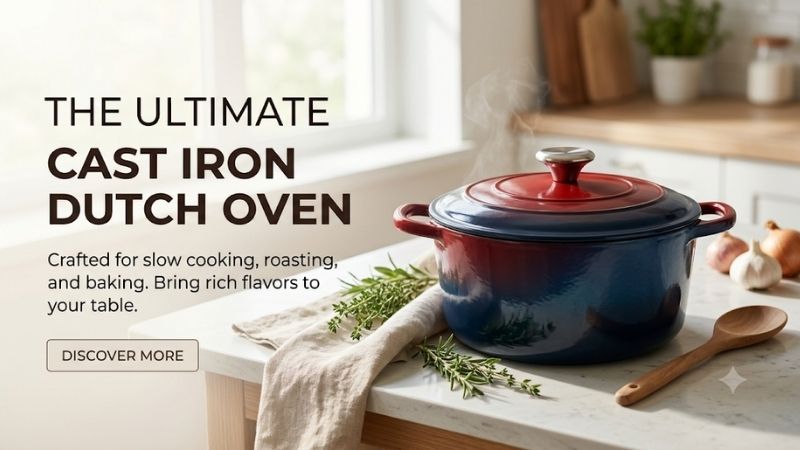
Lodge 5-Quart Double Dutch Oven – Best multifunctional design
The Lodge 5-Quart Double Dutch Oven provides additional versatility by combining a traditional Dutch oven body with a lid that can also function as a shallow dual-handle skillet. This arrangement offers useful flexibility for bread baking, searing, roasting, and preparing meals with fewer separate cookware pieces.
The defining feature is its convertible lid.
When inverted, the lid becomes a cooking surface suitable for foods that benefit from shallow pan cooking.
This allows the same cookware set to perform multiple tasks.
For example, a cook could use the shallow lid to sear vegetables or prepare a small breakfast while the deeper body serves as a pot.
Its design is also particularly interesting for bread baking.
Some bakers prefer placing shaped dough on the shallow lid before covering it with the deeper vessel.
This arrangement can make dough placement easier than lowering it into the bottom of a tall, preheated Dutch oven.
However, extreme care is still necessary when handling hot cast iron.
The pot and lid are both seasoned rather than enameled, so they require appropriate cleaning and drying.
The 5-quart capacity makes the Double Dutch suitable for a broad range of smaller household recipes.
Its main limitation is that the shallow lid does not provide the same deep, enclosed shape as a conventional Dutch oven lid.
It also adds weight and requires adequate storage space for the complete unit.
Advantages: Multifunctional lid, excellent bread-baking versatility, pre-seasoned surface, and durable construction.
Limitations: Heavy components and additional care when handling the inverted lid.
Best for: Bread enthusiasts and home cooks wanting one piece of cookware to perform several functions.
Lodge 7-Quart Cast Iron Dutch Oven With Bail Handle – Best for larger meals
The Lodge 7-Quart Cast Iron Dutch Oven With Bail Handle is designed for cooks who need more capacity than a compact household model. Its seasoned cast iron body, fitted lid, and steel bail handle make it suitable for family stews, larger roasts, and cooking situations where the vessel may need to be lifted using a secure overhead grip.
The 7-quart capacity offers more room for substantial meals.
This is useful when preparing chili, soups, braised meat, or large quantities of beans.
The seasoned interior can tolerate vigorous stirring and scraping more readily than delicate coated cookware.
Its bail handle also distinguishes it from models that rely exclusively on side handles.
The overhead handle can be useful for certain outdoor cooking arrangements, although safe lifting still requires suitable equipment and attention to the total weight.
The pot has a flat bottom suitable for conventional stovetop use, unlike camp-specific Dutch ovens designed with legs.
Lodge lists compatibility with induction, ovens, grills, and campfires.
However, capacity comes with additional weight.
The 7-quart model weighs approximately 16.6 pounds before food is added.
That makes it less convenient for cooks who frequently move hot cookware between the stovetop and sink.
It also requires more storage space and may be unnecessarily large for one- or two-person households.
Advantages: Generous capacity, durable bare cast iron construction, versatile heat-source compatibility, and bail handle.
Limitations: Heavy weight, larger footprint, and ongoing seasoning maintenance.
Best for: Families preparing substantial stews, roasts, and shared meals.
Other cast iron Dutch oven designs for outdoor cooking
Outdoor Dutch ovens differ from ordinary indoor cookware because their lids, handles, and bases may be designed for direct heat from charcoal or campfires. Some feature raised legs that keep the vessel above coals, while flanged lids hold fuel for top-down heating. These specialized features are valuable outdoors but can limit indoor versatility.
Camp Chef Classic 12-Inch Dutch Oven – Best for charcoal cooking
The Camp Chef Classic 12-Inch Dutch Oven is built for traditional outdoor cooking, where heat may come from charcoal briquettes or wood rather than a conventional stovetop. Its seasoned cast iron body, flanged lid, and thermometer notch support cooking methods such as campfire braising, baking, and roasting.
The 12-inch Classic configuration has a 6-quart capacity, providing useful room for family camping meals.
Its flanged lid is particularly important.
Rather than allowing charcoal to slide off the edge, the raised rim helps contain coals placed on top of the pot.
This creates an additional heat source above the food.
For outdoor baking, heat from both above and below can help cook bread, biscuits, or cobblers more evenly.
The thermometer notch provides a convenient route for monitoring internal conditions without completely removing the lid.
Camp Chef also applies a factory seasoning finish so the cookware arrives ready for appropriate initial use.
However, charcoal cooking requires more experience than operating an electric oven.
Heat output depends on fuel quantity, weather, wind, and the arrangement of hot coals.
The cook must monitor the food and adjust the heat source as necessary.
This model weighs approximately 20 pounds in its 12-inch configuration, making transport and handling important considerations.
Advantages: Charcoal-friendly lid, thermometer notch, seasoned construction, and practical outdoor capacity.
Limitations: Heavy weight, outdoor heat-management learning curve, and specialized design.
Best for: Campers who frequently prepare Dutch oven meals over charcoal or wood.
Lodge 6-Quart Cast Iron Camp Dutch Oven – Best traditional campfire option
The Lodge 6-Quart Cast Iron Camp Dutch Oven is designed specifically for outdoor cooking with charcoal and open flames. Its integrated legs, steel bail handle, and seasoned cast iron construction distinguish it from flat-bottomed household Dutch ovens and make it suitable for campsite stews, baking, and slow cooking.
The raised legs allow the pot to stand above coals rather than resting directly on a flat surface.
This arrangement helps create space for a controlled heat source beneath the vessel.
The lid can also support coals placed above the food, providing heat from two directions during outdoor baking.
That feature is useful for preparing bread, cornbread, biscuits, and certain casserole-style dishes.
Its 6-quart capacity offers enough room for several servings while remaining smaller than many oversized camp ovens.
The seasoned cast iron surface can be maintained with ordinary cleaning, thorough drying, and a thin protective layer of oil.
However, this camp model is not designed for indoor stovetop use.
The manufacturer explicitly identifies it as outdoor cookware, so buyers should not assume that it can replace a flat-bottomed Dutch oven inside the kitchen.
Its legs can interfere with stable contact on conventional burners.
The pot also weighs approximately 18 pounds empty, making proper lifting equipment valuable during outdoor use.
Advantages: Campfire-specific construction, raised legs, coal-compatible lid, and practical 6-quart capacity.
Limitations: Outdoor-only design, substantial weight, and required seasoning care.
Best for: Campers seeking a traditional Dutch oven designed for direct outdoor heat.
Bayou Classic 8-Quart Camp Dutch Oven – Best large outdoor capacity
The Bayou Classic 8-Quart Camp Dutch Oven is designed for preparing generous meals over outdoor cooking equipment. Its seasoned cast iron body, raised feet, and flanged lid make it suitable for stews, beans, roasts, and baked dishes where heat is supplied by charcoal or other appropriate outdoor sources.
The main advantage of this model is its 8-quart capacity.
Large camping groups often need enough space to prepare substantial portions without requiring several separate cooking vessels.
An 8-quart pot can accommodate generous quantities of stew, chili, or beans, depending on the ingredients and required headroom.
The raised feet allow hot coals to be positioned beneath the vessel.
Its flanged lid provides a practical surface for holding coals above the food.
This arrangement helps create the enclosed heating environment needed for certain baked dishes.
The pot’s seasoned interior can be restored when necessary, and its bare cast iron construction is suitable for demanding outdoor conditions when properly maintained.
However, the increased capacity also makes the vessel difficult to handle once filled.
A large portion of hot stew can add considerable weight to an already substantial cast iron pot.
Camp cooks should use appropriate lifting tools, protective gloves, and stable cooking surfaces.
This design should not be confused with a conventional indoor Dutch oven.
The raised feet and outdoor-focused construction make it more appropriate for campsite use than ordinary kitchen burners.
Advantages: Large capacity, charcoal-compatible construction, seasoned cooking surface, and sturdy outdoor design.
Limitations: Heavy filled weight, substantial transport requirements, and limited indoor practicality.
Best for: Camping groups preparing large one-pot meals outdoors.
How to choose a cast iron Dutch oven for your cooking style
The most important purchasing decision is whether the Dutch oven will be used primarily indoors or outdoors. Capacity, lid shape, base design, and handle configuration should support that environment. Bare cast iron also requires specific care, particularly when preparing acidic dishes or storing cookware between uses.
How does bare cast iron differ from enameled cast iron?
Bare and enameled cast iron share similar underlying heat-retention characteristics, but their cooking surfaces behave differently. Traditional cast iron relies on a polymerized oil seasoning layer, while enameled cookware uses a protective glass-like finish. That difference affects cleaning, ingredient compatibility, and maintenance.
Bare cast iron develops a seasoned cooking surface through repeated use and appropriate care.
This surface can improve food release over time, although it is not equivalent to a modern synthetic nonstick coating.
The seasoning also helps protect the iron against rust.
Enameled cast iron does not require seasoning because its protective finish separates the iron from food and moisture.
It is therefore particularly convenient for recipes involving tomatoes, vinegar, wine, and other acidic ingredients.
Bare cast iron can be used for brief acidic cooking, but prolonged simmering in acidic liquids may affect the seasoning and potentially produce metallic flavors.
For cooks who frequently prepare tomato-heavy stews, an enameled Dutch oven may be more practical.
For outdoor cooking, bread baking, and situations where a restorable surface is valuable, bare cast iron has important advantages.
The choice should reflect cooking habits rather than assuming one material is universally superior.
What Dutch oven capacity works best for home and camping?
Dutch oven size influences serving capacity, heat management, lifting weight, and transport convenience. A compact pot may be adequate for daily meals but restrictive for camping groups, while an oversized vessel can be inefficient when preparing only a few servings. Choosing the correct capacity reduces unnecessary complications.
A 2- to 3-quart Dutch oven is suitable for small side dishes, individual meals, and limited portions.
A 5-quart model offers greater flexibility for everyday family cooking and moderate bread recipes.
A 6- to 7-quart pot is useful for larger stews, roasts, and group meals.
An 8-quart or larger camp Dutch oven can accommodate substantial outdoor cooking, although the weight becomes increasingly significant.
Capacity should not be treated as a guaranteed serving count.
Ingredients vary in density, and recipes involving large pieces of meat may require more space than soups or beans.
For bread baking, the pot’s interior diameter and height can matter more than maximum volume.
A large Dutch oven also needs an appropriate cooking environment.
Check oven dimensions for indoor use and ensure that outdoor equipment can support the full weight of a filled cast iron vessel.
For most households, a 5-quart flat-bottomed Dutch oven offers practical versatility.
For group camping, a 6- to 8-quart outdoor model may be more suitable.
How should a cast iron Dutch oven be cleaned and seasoned?
Bare cast iron can remain functional for generations when cleaned, dried, and maintained properly. Unlike enameled cookware, it relies on a protective seasoning layer that can be renewed. Understanding the difference between ordinary cleaning, rust prevention, and full seasoning restoration helps owners avoid unnecessary work.
Allow the Dutch oven to cool before washing.
Use warm water, a sponge or suitable brush, and a small amount of mild dish soap when necessary.
Modern dish soap does not normally remove a properly polymerized seasoning layer, so avoiding soap entirely is unnecessary.
Do not leave bare cast iron soaking in water for extended periods.
After washing, dry the pot thoroughly.
Gentle stovetop heating can help remove remaining moisture when the cookware is compatible with the heat source.
Apply a very thin layer of cooking oil to the dry surface if recommended for maintenance.
Wipe away excess oil so the surface does not become sticky during storage.
If rust develops, remove it using an appropriate cleaning method, dry the cookware, and restore the seasoning.
For more extensive seasoning restoration, apply an extremely thin oil layer and heat the cookware according to the manufacturer’s instructions.
Avoid using excessive oil because it can produce sticky, uneven deposits.
When storing the Dutch oven, leave a small gap between the lid and body if necessary to encourage airflow.
These habits are particularly important after outdoor cooking, when moisture, ash, and food residue may remain on the cookware.
Conclusion
The right cast iron Dutch oven depends on whether you need a versatile household pot or a specialized outdoor cooking vessel. The Lodge 5-Quart Dutch Oven is a practical all-around choice, while the Double Dutch offers additional functionality for bread baking. Lodge’s 7-quart bail-handle model suits larger meals, and Camp Chef, Lodge Camp, and Bayou Classic provide options designed around charcoal and campfire cooking. Choose the correct capacity and base design, maintain the seasoning carefully, and prioritize safe handling whenever heavy cast iron is used.


Write Your Review
No reviews yet. Be the first to share your experience!