
A cast iron Dutch oven for easy storage can bring slow braises, soups, and oven baking into a small kitchen without overwhelming its cabinets. The best choice balances capacity with total footprint, lid height, handle clearance, and weight. This guide explains how to measure storage space, compare designs, and protect enameled or seasoned cookware.
How to choose a cast iron Dutch oven for easy storage
Small kitchens make cookware dimensions especially important because a Dutch oven occupies space even when it is not being used. The best model should handle ordinary meals, fit the available burner, and remain easy to retrieve from storage. Capacity, exterior dimensions, weight, and lid design all deserve attention before purchasing.
Measure total dimensions instead of relying on capacity alone
Dutch ovens with identical advertised capacities can have very different shapes. One model may be tall and narrow, while another has a broad base and relatively shallow walls. These differences affect cooking performance, cabinet clearance, and how conveniently the pot fits beside other cookware.
Begin by measuring the cabinet or shelf where the Dutch oven will be stored. Record its usable width, depth, and height, accounting for hinges, shelf supports, and neighboring items.
Next, examine the manufacturer’s exterior measurements. Include both handles because their combined width can exceed the diameter of the cooking vessel by several inches.
Lid height is another easily overlooked measurement. A domed lid with a prominent knob may prevent the Dutch oven from fitting beneath a low shelf, even when the pot itself appears compact.
For example, a four-quart Dutch oven with a broad body may require more horizontal clearance than a taller five-quart model. The smaller capacity does not automatically mean a smaller storage footprint.
Think about the direction in which the pot will be placed inside the cabinet. Rotating the handles may help it fit, but the lid and surrounding cookware must remain accessible.
A Dutch oven should not require excessive force to remove from its storage location. Cast iron is heavy, and lifting it around tightly packed objects increases the possibility of dropping it.
If the pot will be stored on an open shelf, check the shelf’s load rating and mounting strength. A filled cabinet can become surprisingly heavy when several cast iron items are stored together.
The most useful measurement is the complete external footprint, not simply the number of quarts printed in the product description.
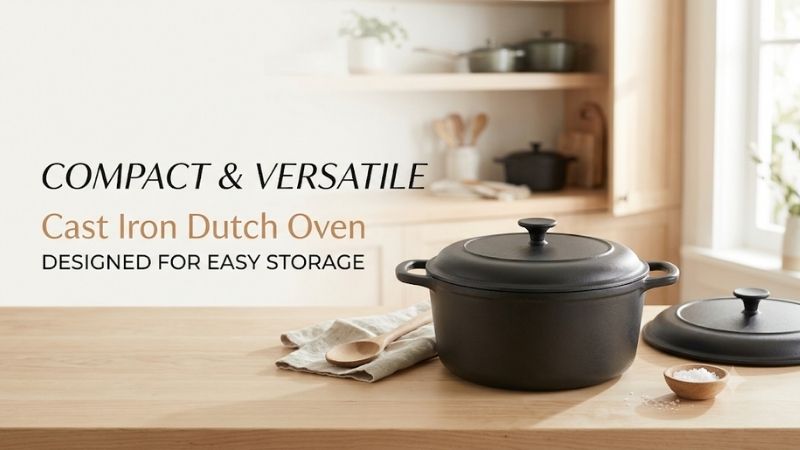
Choose between three-, four-, and five-quart capacities
Capacity directly influences the number of servings a Dutch oven can prepare, but it also affects weight and storage requirements. A compact three-quart model is convenient for smaller households, while four- and five-quart designs offer more flexibility for complete meals and occasional entertaining.
A three-quart Dutch oven can be suitable for one or two people preparing modest soups, braised vegetables, or smaller portions of meat.
It is relatively easy to fit into compact cabinets and may be more comfortable to move than larger models.
However, the cooking surface may become crowded when browning several pieces of meat.
A four-quart Dutch oven offers a useful compromise. It provides additional capacity for soups, stews, and family-style dishes without becoming as bulky as larger six- or seven-quart cookware.
A five-quart model is attractive for households preparing several servings or cooking ahead for the week.
It can accommodate more ingredients, but the added weight becomes noticeable when transferring the pot between the stove and oven.
Consider the size of the meals prepared most frequently rather than purchasing for rare gatherings.
A person who usually cooks for two may find a compact three- or four-quart Dutch oven more convenient than a large model that remains half-empty.
However, recipes involving substantial cuts of meat may require more cooking area than the volume alone suggests.
Check the flat interior diameter as well as the stated capacity.
For limited storage, a four-quart model is often a sensible starting point when the household wants one versatile cooking vessel.
Compare round and oval Dutch oven shapes
Round and oval Dutch ovens provide different cooking and storage advantages. Round designs generally fit conventional burners more naturally, while oval models can accommodate elongated cuts of meat. For small kitchens, the shape also determines how the cookware fits into cabinets and whether it interferes with neighboring appliances.
A round Dutch oven provides a compact, symmetrical footprint.
This is especially useful on standard circular burners because the base can sit centrally over the heating area.
Round shapes also tend to be easier to rotate inside cabinets when organizing cookware.
An oval Dutch oven may accommodate a whole chicken, long roast, or several pieces of meat arranged lengthwise.
However, its extended dimensions can complicate storage in narrow cupboards.
On a small circular burner, an oval base may also heat less evenly because its outer ends extend beyond the primary heat source.
This does not make oval cookware unsuitable, but it requires more attention to burner placement and heating technique.
For households that primarily cook soups, stews, bread, and ordinary braised dishes, a round model is generally the more practical first purchase.
A compact oval Dutch oven may be worthwhile when elongated ingredients are prepared frequently.
Consider whether the cookware will also be used inside a countertop oven.
The available oven dimensions may favor a round vessel with shorter overall length.
Always compare measurements with both handles included.
Choosing the right shape can eliminate storage problems before they begin.
Best storage features for compact cast iron cookware
A Dutch oven that fits inside a cabinet is not necessarily easy to store. Handles, lids, weight distribution, and exterior finishes determine whether the cookware can be retrieved safely and stacked with other equipment. Buyers should examine these practical features as carefully as they compare capacity and appearance.
Look for wide loop handles and a manageable total weight
Handles are essential when moving a Dutch oven because cast iron becomes heavy even before food is added. A secure grip is particularly important when lifting cookware from low cabinets or placing it inside an oven. The best design allows both hands to support the vessel comfortably.
Wide loop handles are common on enameled cast iron Dutch ovens.
They provide openings that can accommodate appropriately sized oven mitts and support two-handed lifting.
However, some decorative handles are narrow or positioned close to the cooking body.
These designs may feel less comfortable when the pot is full.
Weight should also influence the purchase decision.
A compact cast iron Dutch oven can still weigh several pounds, and a large model may be difficult to lift from an elevated shelf.
Consider the weight of the empty vessel and lid together.
Water, meat, and vegetables can substantially increase the load during cooking.
For example, four quarts of water weigh approximately 8.3 pounds before accounting for the pot itself.
A Dutch oven used for soup may therefore become much heavier than expected.
In a small kitchen, frequent lifting can be more inconvenient than countertop storage.
Avoid placing heavy cast iron above shoulder height if retrieval requires stretching or unstable movement.
Choose a lower cabinet or sturdy shelf that allows the pot to be lifted with both hands.
A manageable weight and secure handles are more useful than a compact appearance alone.
Evaluate lid height and safe stacking options
The lid often creates the greatest storage challenge because its knob projects above the pot and prevents other items from sitting flat. Some cookware collections feature nesting or stackable designs, while ordinary Dutch ovens require more careful organization. Buyers should understand how the lid can be stored without damaging the finish.
A flat or moderately domed lid may fit more easily beneath a cabinet shelf than one with a tall decorative knob.
However, lid shape also affects cooking.
Domed lids provide additional internal clearance and may help accommodate larger ingredients.
Do not choose a lid solely for its storage dimensions if it compromises the recipes prepared most often.
Some manufacturers offer cookware designed to nest together with compatible pieces.
Tramontina, for example, has offered stackable enameled cast iron sets intended to reduce storage requirements.
However, a stackable collection is useful only when the cookware is designed and protected for that arrangement.
Do not place a heavy pot directly against the enamel of another vessel without suitable protection.
Lid clips or pot protectors can help maintain separation and allow limited ventilation.
When storing a lid upside down, check whether the knob and rim can safely support that orientation.
A lid should not wobble or create pressure points that could damage the enamel.
For a single Dutch oven, storing the lid separately on a vertical organizer may provide easier access.
The best arrangement protects the cookware while keeping it convenient for regular use.
Decide between enameled and seasoned cast iron
Enameled and traditional seasoned cast iron share the same basic metal foundation, but their maintenance requirements differ. For limited-storage kitchens, the choice affects how the cookware can be cleaned, dried, stacked, and used with acidic ingredients. Buyers should consider convenience alongside cooking performance.
Enameled cast iron has a protective coating over the metal.
This eliminates the need to maintain a traditional seasoning layer and makes ordinary acidic recipes easier to prepare.
Tomato-based stews, lemon sauces, and wine reductions are generally more convenient in enameled cookware.
The coating also simplifies routine cleaning when used appropriately.
However, enamel can chip or crack if the pot is dropped or struck against hard objects.
This makes careful cabinet organization especially important.
Traditional bare cast iron requires seasoning to protect the surface and improve food release.
It can be highly durable and may be restored when the seasoning becomes worn or damaged.
However, the pot must be dried thoroughly after washing.
Moisture trapped inside a closed vessel can encourage rust, particularly when exposed metal remains damp.
For a small kitchen where the Dutch oven may be stored tightly among other items, enamel offers convenient maintenance but requires protection from impacts.
Seasoned cast iron is attractive for people comfortable with drying and oiling routines.
Neither option is automatically superior.
The best choice depends on cooking habits, storage conditions, and willingness to maintain the surface.
Cooking efficiently with a cast iron Dutch oven for easy storage
A compact Dutch oven should earn its storage space by performing several cooking tasks. It can serve as a soup pot, braising vessel, bread oven, or general-purpose casserole when used appropriately. Understanding its strengths helps buyers reduce the need for additional cookware without compromising everyday meal preparation.
Prepare soups and stews without overcrowding the pot
Soups and stews are natural uses for Dutch ovens because the heavy cooking vessel retains heat and supports extended simmering. However, a compact model has limited working capacity, so ingredients should be measured carefully. Leaving adequate headroom helps prevent boilovers and makes stirring more comfortable.
Begin by selecting a recipe suited to the pot’s capacity.
A four-quart Dutch oven may accommodate several servings of vegetable soup, but it should not be filled to the rim.
Ingredients expand, release moisture, and move as the liquid heats.
A bubbling stew can overflow if there is insufficient space.
For recipes involving meat, brown the pieces in batches before adding liquid.
Crowding the bottom prevents moisture from evaporating efficiently.
Once the meat is browned, remove it temporarily if necessary.
Cook onions, carrots, or other aromatics in the same pot to develop additional flavor.
Then return the meat and add the recipe’s specified liquid.
A tight-fitting lid helps retain moisture during slow simmering.
However, some recipes benefit from a partially open lid to encourage reduction.
The heavy cast iron body changes temperature gradually, so avoid excessive burner settings.
A gentle simmer is usually preferable to vigorous boiling for tender braised meats.
For compact cookware, careful ingredient sequencing improves results more effectively than forcing additional food into the vessel.
Use one Dutch oven for braising and oven baking
A Dutch oven can replace several specialized pieces of cookware because it moves between stovetop and oven when permitted by the manufacturer. This versatility is especially valuable when counter and cabinet space are limited. Recipes that involve searing, simmering, and baking can often be completed in the same vessel.
Consider preparing braised chicken thighs with vegetables.
Begin by searing the chicken in the Dutch oven over moderate heat.
Remove the pieces once an appropriate browned surface develops.
Add vegetables and aromatics, then deglaze the pot with stock or another suitable liquid.
Return the chicken, cover the pot, and finish the recipe in the oven at the specified temperature.
The same cookware handles every major cooking stage.
This reduces the number of pans requiring cleaning.
Dutch ovens are also popular for bread baking because their lids help retain moisture during the early stages.
However, oven compatibility must be verified.
Enameled Dutch ovens can have different temperature limits depending on the body, lid knob, and manufacturer.
A high-temperature bread recipe should never exceed the rating of the cookware or its components.
Some recipes also involve preheating an empty Dutch oven, which may not be appropriate for every enameled model.
Follow the manufacturer’s instructions rather than assuming all cast iron can be treated identically.
A versatile Dutch oven is most valuable when its operating limits match the recipes prepared regularly.
Manage heat on compact gas, electric, and induction burners
Cast iron retains heat effectively but distributes it relatively slowly compared with highly conductive metals. This can create temperature differences when a broad Dutch oven is placed over a small burner. Gradual preheating and appropriate burner selection help improve cooking consistency and protect the cookware.
Begin with a low or medium burner setting.
Allow the pot to warm gradually before adding ingredients that require browning.
Avoid placing a cold enameled Dutch oven over maximum heat without considering the manufacturer’s guidance.
Rapid temperature changes can create unnecessary stress in the cookware.
For induction cooking, verify that the model is compatible.
Most cast iron Dutch ovens work on induction because the iron responds to magnetic heating.
However, a small induction zone may heat only part of the base efficiently.
This is particularly relevant for oval cookware.
Gas burners offer flexibility, but flames should remain beneath the cooking vessel.
Flames extending around the sides may damage finishes or overheat handles.
On ceramic glass cooktops, lift the heavy Dutch oven rather than sliding it across the surface.
Sliding can scratch or damage the cooktop.
Once the pot is heated, cast iron may retain substantial energy even after the burner setting is reduced.
Adjustments should therefore be made gradually.
Understanding this behavior helps prevent scorching and improves control during long cooking sessions.
Storage, cleaning, and long-term maintenance
A cast iron Dutch oven can remain useful for many years when cleaned and stored appropriately. However, heavy cookware can damage neighboring items if packed carelessly, and moisture can cause problems for uncoated surfaces. A practical care routine protects the pot while keeping the kitchen organized.
Use cabinet organizers and shelf placement safely
Storing heavy cookware requires more planning than arranging lightweight pans. A Dutch oven should remain stable inside the cabinet and be easy to retrieve without moving several other items. Appropriate shelving and protective accessories can reduce inconvenience and help prevent accidents.
A lower cabinet is often the safest location for a heavy Dutch oven.
It allows the cook to lift the vessel without reaching overhead.
However, low shelves can be uncomfortable if access requires excessive bending.
A sturdy pull-out shelf may improve convenience when professionally installed and appropriately rated for the load.
Check the combined weight of all cookware stored on the shelf.
Do not assume that ordinary cabinet organizers are rated for substantial cast iron collections.
Vertical lid racks can free space by storing lids separately from cooking vessels.
However, the rack should support the lid securely without placing excessive pressure on its rim.
If stacking multiple pots, use compatible protectors to avoid enamel-to-enamel contact.
Never balance a heavy Dutch oven on top of unstable lightweight cookware.
For open shelving, confirm that mounting hardware and structural supports can withstand the load.
The goal is to create a storage location where the pot can be removed easily and returned safely after cleaning.
A well-organized cabinet makes bulky cookware much more practical.
Clean enameled Dutch ovens without scratching the finish
Enameled cast iron is relatively easy to maintain because its protective surface does not require traditional seasoning. However, abrasive cleaning and sudden temperature changes can damage the finish. Gentle care helps preserve the interior and makes the cookware more comfortable to use regularly.
Allow the Dutch oven to cool enough for safe handling.
Avoid placing an extremely hot vessel directly into cold water.
This sudden temperature change can stress the enamel and underlying iron.
For ordinary residue, use warm water, mild dish soap, and a soft sponge.
Food that has adhered during slow cooking may need additional soaking.
Follow the manufacturer’s instructions for stubborn deposits.
Avoid aggressive metal scraping or abrasive cleaning products that could damage the finish.
Some enameled Dutch ovens are described as dishwasher-safe, but handwashing is commonly recommended to preserve appearance.
Inspect the lid rim and handle areas for trapped residue.
After washing, dry the cookware thoroughly.
Store the lid with appropriate separation if needed to prevent trapped moisture or contact damage.
Light-colored enamel may develop staining after repeated use.
Cosmetic discoloration does not always mean the coating has failed.
However, visible chips or exposed sharp areas require careful evaluation.
A consistent cleaning routine reduces the need for aggressive restoration methods.
Protect seasoned cast iron from rust during storage
Traditional bare cast iron needs a protective seasoning layer and careful drying to reduce oxidation. Storage becomes particularly important when the Dutch oven is not used every day. Moisture trapped beneath a lid or between stacked pieces can create rust even when the pot appeared clean after washing.
Clean the Dutch oven according to the manufacturer’s care instructions.
Use warm water and an appropriate brush or sponge.
Established seasoning generally tolerates a small amount of mild dish soap.
However, prolonged soaking should be avoided.
After washing, dry the entire vessel thoroughly.
Pay attention to the lid, handle openings, and underside.
Residual moisture may remain in small recesses.
Briefly warming the pot over low heat can help remove remaining water when performed safely.
If recommended, apply a very thin film of cooking oil before storage.
Wipe away excess oil to avoid sticky buildup.
Store the Dutch oven in a dry, well-ventilated location.
Leaving the lid slightly separated from the pot can help prevent trapped moisture.
A clean cloth or appropriate spacer may be useful, provided it is completely dry.
Inspect the cookware periodically if it remains unused for several months.
Minor surface rust can often be addressed through appropriate cleaning and reseasoning.
Consistent prevention is easier than restoring a heavily corroded surface.
Know when compact cookware is too small for your needs
A Dutch oven should save space without making normal recipes unnecessarily difficult. Buying an extremely small model can lead to overcrowding, repeated cooking batches, and the eventual purchase of another pot. Evaluating ordinary serving requirements helps buyers choose a size that remains useful.
Consider how many people usually eat together.
A two- or three-quart Dutch oven may be sufficient for small portions and side dishes.
However, preparing a whole chicken or several substantial servings of stew may require additional capacity.
A four- or five-quart model can provide greater flexibility while remaining manageable in many kitchens.
The cooking surface is particularly important for braising.
Meat needs contact with the base during the initial browning stage.
A tall, narrow pot may hold enough liquid but provide limited space for searing several portions.
A slightly wider model can therefore be more useful than a taller vessel with the same capacity.
However, wider cookware requires more cabinet and burner space.
The choice involves balancing cooking area against storage dimensions.
Before purchasing, identify the largest meal prepared regularly.
Choose a vessel that can accommodate that meal without excessive crowding.
For rare gatherings, cooking in batches may be more economical than storing an oversized pot all year.
A compact Dutch oven is worthwhile when it meets ordinary needs rather than merely occupying the smallest possible space.
Conclusion
The best cast iron Dutch oven for easy storage combines practical capacity, manageable weight, secure handles, and a footprint that fits the kitchen. A three- or four-quart round model is often suitable for smaller households, while five-quart cookware provides greater flexibility for batch cooking. Measure exterior dimensions, including handles and lid, before purchasing. Protect enamel from impacts, keep seasoned iron dry, and choose a storage arrangement that allows safe two-handed lifting.



Write Your Review
No reviews yet. Be the first to share your experience!