
A carbon steel wok for beginners should sit securely on the stove, feel controllable when loaded with food, and be straightforward to season. The right first wok depends more on burner design and cooking habits than an elaborate accessory kit. This guide explains how to shop, prepare the pan, and make reliable stir-fries without frustration.
What makes a carbon steel wok for beginners easy to use?
Learning to cook with carbon steel involves understanding heat response, ingredient movement, and seasoning maintenance. A beginner-friendly wok should simplify these tasks rather than make them unnecessarily difficult. Stable construction, sensible dimensions, and a comfortable handle are more useful than premium finishes or elaborate accessories.
Why a flat-bottom wok is usually the best starting point
A flat-bottom wok provides a stable cooking surface on most conventional household ranges. This allows beginners to concentrate on controlling heat and moving ingredients rather than balancing the cookware. Round-bottom woks have advantages on specialized burners, but those benefits are less relevant without suitable equipment.
On a gas stovetop, a flat-bottom wok rests directly on the burner grate.
The flame heats the base and, depending on burner design, may also contact the lower curved sides.
On a conventional electric or glass-ceramic cooktop, the flat base makes more reliable contact with the heated surface.
Induction cooking requires an additional consideration: the wok must have a compatible magnetic base with sufficient contact area for the cooktop.
Some traditional round-bottom woks require a specialized burner or wok ring to remain stable.
A ring does not automatically solve heating problems on every residential stove. In some arrangements, it can increase the distance between the pan and the heat source.
For beginners, stability is more valuable than recreating a restaurant setup.
A flat-bottom model offers greater versatility and reduces the likelihood of accidentally tipping the wok while stirring.
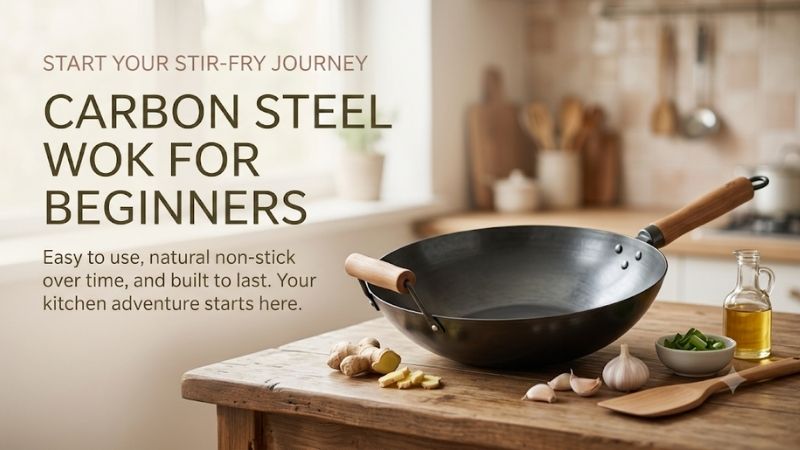
Choosing the right diameter and steel thickness
Wok diameter and steel thickness determine how easy the pan is to control during cooking. Beginners need enough room for ingredient movement without choosing a vessel that is too heavy or difficult to store. A practical combination of size and thickness makes repeated cooking sessions more comfortable.
A 12-inch wok is manageable for smaller households and compact kitchens.
However, its limited upper-bowl space can become restrictive when preparing larger quantities of noodles or vegetables.
A 13- to 14-inch wok provides more room for stirring and tossing.
The larger diameter does not mean the entire cooking surface receives equally intense heat.
Most residential burners concentrate their strongest heat beneath the flat base.
Ingredients should therefore be cooked in manageable portions rather than spread throughout the entire bowl at once.
Steel thickness also affects handling.
Carbon steel around 1.5–1.8 mm thick provides a practical balance between responsiveness and structural rigidity.
Very thin steel can heat quickly but may be more vulnerable to distortion.
Thicker steel is generally heavier and may take longer to respond when the heat setting changes.
Choose a pan that can be lifted and tilted comfortably with one hand while supported by the other when necessary.
Why handle design matters more than appearance
A wok’s handle affects how comfortably ingredients can be tossed, stirred, and transferred. Beginners often underestimate handle shape because they focus on cooking-surface material. However, a poorly balanced wok can become tiring to control, particularly when preparing several batches of food.
A long wooden handle provides insulation during ordinary stovetop cooking.
It also gives the user leverage when moving ingredients around the bowl.
However, the metal connector near the wok can become very hot.
A stainless steel handle offers broader oven-use possibilities on certain models, but its temperature depends on the cooking conditions.
Some stainless handles are designed to limit heat transfer during normal stovetop operation. They should not be assumed to remain cool in every situation.
A helper handle on the opposite side improves control when lifting a wok filled with food.
This is particularly useful for larger models.
Beginners should also consider grip thickness and balance.
A handle that is too narrow may feel uncomfortable, while an excessively heavy pan can make one-handed tossing impractical.
When shopping, prioritize a secure grip and predictable movement rather than decorative materials.
How to season and prepare your first carbon steel wok
Carbon steel is commonly sold with either a protective factory coating or an initial seasoning layer. These finishes have different preparation requirements, so beginners should read the manufacturer’s instructions before cooking. Proper initial preparation helps protect the metal from rust and creates the foundation for better food release.
Understanding pre-seasoned and unseasoned cookware
A pre-seasoned wok has already received some form of factory surface treatment intended to begin the seasoning process. An unseasoned wok generally requires more preparation before use. Neither option remains permanently nonstick without appropriate heating, cleaning, and ongoing maintenance.
Factory pre-seasoning can reduce the amount of initial preparation.
However, the surface may still change appearance during early cooking sessions.
Some pre-seasoned woks have unevenly colored areas, particularly around the center where the highest heat is concentrated.
This is not necessarily a defect.
The seasoning develops gradually as thin layers of oil polymerize onto the metal.
An unseasoned wok may arrive with a protective coating that prevents rust during shipping.
That coating must be removed according to the manufacturer’s instructions before food is prepared.
Do not assume all protective treatments can be removed using the same method.
Beginners who want to cook immediately may prefer a reputable pre-seasoned model.
Those interested in learning the full seasoning process may appreciate an unseasoned wok.
Both can become effective cooking tools with proper care.
Seasoning a carbon steel wok step by step
Seasoning develops a thin, protective layer on the metal through controlled heating and the application of cooking oil. The goal is to form a durable polymerized surface rather than leave a visible layer of liquid fat. Applying too much oil is one of the most common beginner mistakes.
First, wash the wok according to the manufacturer’s initial cleaning instructions.
Remove any shipping coating that is not intended to remain on the cooking surface.
Dry the wok completely.
Next, heat the empty wok according to the manufacturer’s recommended seasoning procedure. Use appropriate ventilation, particularly when the process produces smoke.
Apply a very thin layer of suitable oil using a cloth or paper towel held with appropriate utensils.
Wipe away excess oil so the surface appears only lightly coated.
Heat the wok until the oil polymerizes according to the recommended method.
Allow the cookware to cool safely.
Repeat the process if the manufacturer recommends additional seasoning layers.
Do not attempt to rush the process by using excessively thick layers of oil.
Thick oil deposits can become sticky, uneven, and difficult to remove.
An initially imperfect seasoning layer is normal. Regular cooking and careful maintenance usually improve the finish over time.
Preventing rust and maintaining the seasoning layer
Carbon steel can rust when moisture remains on an exposed surface. The seasoning layer provides protection, but it may become uneven or damaged through prolonged soaking, acidic foods, and inappropriate cleaning. A simple maintenance routine is more effective than repeatedly performing complicated full-seasoning procedures.
After cooking, allow the wok to cool enough for safe handling.
Wash the interior with warm water and a suitable sponge or brush.
A small amount of mild dish soap is generally acceptable for established seasoning.
Avoid prolonged soaking or leaving the wok in a sink filled with water.
Dry it thoroughly.
When appropriate, briefly warm the pan to remove residual moisture.
Apply a very thin layer of oil if needed to protect the surface during storage.
Avoid leaving food inside the wok overnight, especially if it contains acidic ingredients.
Tomato sauces, vinegar-heavy mixtures, and extended acidic simmering can weaken seasoning.
If small rust spots appear, clean the affected area and restore its protective seasoning.
A properly maintained wok does not need to look perfectly uniform.
Dark patches, brown areas, and gradual changes in surface color are common as the seasoning develops.
Learning everyday stir-frying techniques with a wok
Owning the correct cookware does not automatically produce restaurant-quality stir-fries. Ingredient preparation, batch size, oil management, and heat control have a greater influence on results. Beginners can build confidence by practicing a few repeatable techniques rather than attempting complicated dishes immediately.
How to preheat the wok without damaging it
Preheating prepares the cooking surface for food contact, but the correct method depends on the wok material and burner type. Carbon steel responds relatively quickly to temperature changes, so extended uncontrolled heating is unnecessary. Beginners should learn to recognize adequate heat rather than relying exclusively on maximum burner settings.
Start with a clean, dry wok.
Heat it gradually according to the manufacturer’s recommendations.
On a gas burner, the pan will generally respond more quickly than on many conventional electric ranges.
Avoid leaving the wok unattended while it heats.
When the surface reaches an appropriate cooking temperature, add a suitable oil.
The oil should become fluid and spread easily across the cooking surface.
If it immediately produces excessive smoke, the pan may be hotter than necessary for the recipe.
Add ingredients promptly once the desired temperature is reached.
Do not assume every food requires maximum heat.
Eggs, delicate fish, and certain sauces benefit from gentler cooking.
For stir-frying vegetables or small pieces of meat, moderate-to-high heat may be appropriate when the burner and pan can maintain it.
The goal is sufficient heat for rapid cooking, not the highest possible surface temperature.
How to prevent food from sticking during stir-frying
Sticking is common when carbon steel seasoning is still developing or when ingredients are added at the wrong temperature. Excess moisture, insufficient oil, overcrowding, and moving food too early can also contribute. Correcting these factors is usually more effective than repeatedly adding large amounts of cooking fat.
Begin by drying ingredients where appropriate.
Excess water on meat or vegetables can reduce the surface temperature and encourage steaming.
Preheat the wok adequately and add oil before introducing ingredients.
For protein, allow brief contact with the heated surface before attempting to move it.
This helps develop browning and may make the food easier to release.
Avoid adding a large amount of cold meat at once.
The temperature drop can cause moisture to accumulate, interfering with browning.
Eggs are often a challenging early test of seasoning quality.
If they stick, the problem may involve insufficient seasoning, inadequate fat, or incorrect heat.
Try easier dishes such as stir-fried vegetables before attempting delicate eggs in a newly seasoned wok.
As the surface develops and cooking technique improves, food release generally becomes more predictable.
Three simple recipes beginners should practice first
A good first recipe should require few ingredients and provide clear feedback about heat control. Simple stir-fried vegetables, fried rice, and chicken with vegetables introduce different skills without demanding specialized equipment. Practicing these dishes helps beginners understand the wok’s temperature zones and cooking capacity.
Start with garlic green beans.
Dry the beans, heat the wok, add oil, and stir-fry until the vegetables begin to soften and develop light browning.
Add garlic near the end to reduce the risk of burning.
For fried rice, use cooked rice that has been cooled promptly and stored safely.
Cold rice often contains less surface moisture than freshly cooked rice, helping the grains separate during stir-frying.
Cook eggs or other proteins separately if necessary, then combine the ingredients near the end.
For chicken and broccoli, cut the chicken into small, uniform pieces.
Brown the chicken in manageable batches and remove it.
Cook the broccoli, then return the chicken and add a prepared sauce.
Ensure the chicken reaches a safe internal temperature of 165°F.
These three recipes teach different aspects of wok cooking: vegetable movement, moisture management, protein browning, and sauce timing.
Once these techniques become familiar, more complicated dishes are easier to manage.
Common beginner mistakes when buying and using a wok
Many disappointing wok experiences result from choosing cookware that does not match the stove or expecting seasoning to work like a commercial nonstick coating. Correcting a few common assumptions can prevent unnecessary purchases, sticky food, and premature surface damage.
Buying a round-bottom wok for an incompatible stove
Traditional appearance is not sufficient reason to choose a round-bottom wok. Without appropriate equipment, the pan may wobble or fail to receive adequate heat. Beginners should prioritize cookware stability and heating efficiency before attempting techniques associated with dedicated restaurant burners.
For conventional electric and induction cooktops, a flat-bottom wok is generally the safer choice.
A round-bottom pan may not contact the cooking surface correctly.
On a gas range, a suitable wok ring can sometimes provide support, but the arrangement must be stable and compatible with the burner.
Some rings position the wok too far from the strongest heat.
This can make cooking slower and less predictable.
Before purchasing, check the manufacturer’s stated cooktop compatibility.
For induction, confirm magnetic compatibility and adequate flat-base contact.
Overcrowding the pan and expecting restaurant-style heat
Professional kitchens often use powerful wok burners that deliver considerably more heat than residential equipment. A home wok cannot compensate for limited burner output when too much food is added simultaneously. Beginners achieve better results by reducing batch sizes and controlling ingredient moisture.
Cook protein in portions that maintain direct contact with the hottest cooking zone.
Transfer browned ingredients to a plate while preparing the remaining components.
Vegetables should also be added in manageable quantities.
If water accumulates in the wok, reduce the amount of food being cooked at once.
Avoid repeatedly adding cold sauce during the initial browning stage.
Combine the ingredients and sauce only when the individual components are nearly finished.
This sequence produces better texture than trying to cook an entire family meal in a single overcrowded batch.
Expecting a new wok to be completely nonstick
A newly seasoned wok may still release food less easily than a mature cooking surface. Seasoning develops through repeated heating, cooking, and maintenance. Expecting perfect performance immediately can lead to excessive oil use, unnecessary scrubbing, or abandoning an otherwise suitable piece of cookware.
Begin with recipes that tolerate some food contact.
Stir-fried vegetables and simple meat dishes are often more forgiving than delicate eggs.
Avoid using harsh abrasives to remove every dark mark after cooking.
A changing surface color is not necessarily evidence of damage.
If the wok becomes sticky, review whether too much oil was used during seasoning.
If rust appears, address the exposed area promptly rather than ignoring it.
With appropriate use, a carbon steel wok can develop an increasingly effective cooking surface.
Conclusion
Choosing a carbon steel wok for beginners starts with matching the pan to the stove. A 12- to 14-inch flat-bottom model with a comfortable handle and manageable weight is the most practical option for many home kitchens. Pre-seasoned cookware simplifies initial preparation, but cleaning, drying, and continued seasoning remain essential. Begin with uncomplicated vegetable and rice dishes, cook in small batches, and develop temperature control gradually. Good technique will improve results more than buying the most expensive wok.








Write Your Review
No reviews yet. Be the first to share your experience!