
A stock pot for home baristas can support large batches of coffee concentrates, flavored syrups, chai bases, and hot water preparation when ordinary saucepans are too small. The best option should offer a nonreactive interior, manageable capacity, and safe handling. This guide explains how to choose a pot for café-style preparation at home without unnecessary equipment.
Why a stock pot can be useful for home baristas
Home coffee preparation sometimes involves more than making one espresso or pour-over serving. People who host guests, prepare drinks ahead, or experiment with café-style recipes may need larger vessels for concentrates, syrups, and tea bases. A suitable stockpot can simplify batch preparation, although it does not replace specialized coffee-brewing equipment.
Understand the role of stockpots in batch beverage preparation
A stockpot is designed to hold substantial quantities of liquid and support controlled heating on a stovetop. For home baristas, its usefulness lies mainly in preparing beverage ingredients in larger batches. It is not a substitute for an espresso machine, coffee grinder, or dedicated precision coffee brewer.
One practical application is preparing flavored syrup for several days of drinks.
Vanilla, cinnamon, and other flavored syrups may be produced by heating water, sugar, and appropriate ingredients together.
A stockpot becomes useful when the recipe volume exceeds the capacity of a small saucepan.
Another application involves preparing chai concentrate.
A large vessel can hold water, tea, and spices while allowing enough room for gentle simmering and stirring.
Home baristas who host gatherings may also use a stockpot to prepare substantial quantities of hot water.
However, the pot does not provide the precise temperature control associated with specialty electric kettles.
Coffee brewing itself often requires different tools.
Espresso depends on pressurized extraction, while pour-over coffee requires controlled water delivery through a coffee bed.
A conventional stockpot cannot reproduce either process simply by heating water.
The right approach is to use the stockpot for supporting beverage ingredients and large-batch preparation.
This distinction helps buyers avoid purchasing oversized cookware for tasks that require more specialized equipment.
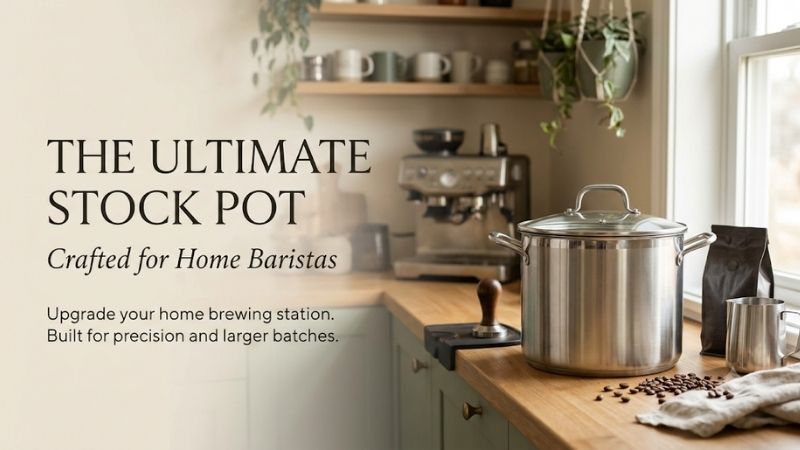
Prepare coffee concentrates for multiple servings
Coffee concentrates can be useful when preparing iced coffee drinks for several people or making beverages ahead of time. A stockpot can serve as a large mixing vessel when the recipe and material are appropriate, although extraction method, filtration, and food-safe storage remain more important than the size of the pot.
Cold brew is commonly prepared by combining ground coffee with cool water and allowing time for extraction.
A clean stainless steel stockpot can hold a substantial batch during preparation.
However, a wide pot with a loose lid may not be the most convenient storage vessel inside a crowded refrigerator.
A dedicated food-safe container with a secure lid may be preferable for prolonged steeping.
If a stockpot is used for cold brew, it should be thoroughly cleaned and placed in suitable refrigerated conditions.
Do not assume that leaving coffee and water at room temperature indefinitely is appropriate.
After extraction, the grounds must be removed using a suitable filtering method.
A fine-mesh strainer may remove larger particles, while a paper filter can reduce finer sediment.
The resulting concentrate may be diluted with water or milk according to personal preference.
Concentration depends on the coffee-to-water ratio, grind size, and extraction conditions.
A larger vessel does not automatically produce stronger or better coffee.
Repeatable measurements are essential.
For most home baristas, a stockpot is valuable only when batch volume justifies the extra space and cleaning effort.
Use stockpots for chai and flavored beverage bases
Chai concentrate and flavored drink bases often require simmering spices, tea, sugar, or other ingredients in water. A stockpot provides enough capacity to prepare several servings while leaving room for stirring and reducing. This makes it useful for households that regularly prepare café-style beverages for guests.
A common chai preparation begins with water and selected spices such as cinnamon, cardamom, cloves, and ginger.
The ingredients are heated according to the chosen recipe to extract flavor.
Tea may be added at a later stage, depending on the desired preparation method.
The stockpot’s capacity allows several servings to be prepared without repeated batches.
However, larger quantities require careful attention to extraction and concentration.
Doubling a recipe does not always mean that every heating period should also be doubled.
Evaporation depends on surface area, burner output, and whether the pot is covered.
The cook should monitor the liquid level and taste the finished concentrate after it has cooled to a safe temperature.
For flavored coffee syrups, a nonreactive stainless steel interior is especially convenient.
It accommodates ordinary acidic ingredients, such as citrus juice, without relying on a maintained seasoning coating.
However, sugar-based mixtures can become extremely hot.
Use moderate heating, adequate headroom, and careful stirring.
A stockpot with stable handles makes transferring larger batches easier, but heavy liquid should be moved in controlled portions when necessary.
Recognize when smaller equipment is more appropriate
Although a large stockpot can support batch preparation, it is not always the most efficient tool for home baristas. Small recipes often benefit from compact saucepans, precision kettles, or dedicated brewing vessels. Choosing equipment based on typical serving volume prevents unnecessary storage demands and inefficient heating.
For a single cup of pour-over coffee, a gooseneck kettle provides better pouring control than a stockpot.
Its narrow spout helps direct water accurately onto the coffee bed.
For preparing two servings of flavored syrup, a small saucepan is usually easier to manage.
A stockpot may spread the ingredients across an unnecessarily broad base, changing evaporation behavior.
For espresso preparation, specialized equipment is required to generate appropriate extraction pressure.
A stockpot cannot reproduce the function of an espresso machine.
For ordinary cold brew, a compact sealed brewing container may be easier to refrigerate and filter.
However, larger batches change the calculation.
A household preparing several liters of chai concentrate may benefit from a six-quart stockpot.
The additional capacity provides room for spices and stirring.
The key is to match equipment to actual preparation volume.
Home baristas should avoid treating a large stockpot as essential equipment when their normal routine consists of one or two drinks per day.
How to choose a stock pot for home baristas
The most useful stockpot for beverage preparation should combine a suitable capacity with predictable heating and straightforward cleaning. Stainless steel is often a practical material because it handles water, sugar, spices, and ordinary acidic ingredients without requiring seasoning. Buyers should also consider whether the pot fits their stove and storage area.
Choose between four-, six-, and eight-quart capacities
Stockpot capacity should reflect how many beverage servings the household prepares at once. A smaller model is easier to store and handle, while a larger vessel provides flexibility for gatherings and batch preparation. Buying more capacity than necessary can make ordinary recipes inconvenient.
A four-quart pot can accommodate moderate batches of syrup, tea concentrate, or hot water.
It may be sufficient for couples or small households preparing several servings ahead.
A six-quart model provides additional flexibility.
It can hold larger batches of chai base while leaving reasonable space for stirring.
An eight-quart stockpot is more suitable for gatherings or frequent high-volume preparation.
However, its size introduces practical limitations.
A large stockpot can be difficult to fit inside a refrigerator when preparing cold brew.
It also requires significant cabinet space.
When filled, the combined weight of liquid and cookware can make handling challenging.
Consider whether the household has enough sink space to clean the pot properly.
The ideal capacity should accommodate the usual batch with some additional headroom.
Do not fill the vessel to its absolute maximum when boiling ingredients that foam or expand.
For many serious home baristas who prepare concentrates regularly, a four- or six-quart stainless steel pot may provide a more practical balance than an oversized twelve-quart model.
Prioritize nonreactive stainless steel construction
A stockpot used for coffee-related ingredients may come into contact with acidic liquids, sugar, spices, and dairy products. Stainless steel is a practical choice because it is durable and generally nonreactive under ordinary food preparation conditions. Its maintenance requirements are also relatively straightforward.
Coffee naturally contains organic acids, and many flavored syrups include citrus or other acidic ingredients.
These components can interact with certain untreated metals.
A stainless steel cooking surface is therefore preferable to bare cast iron for many beverage preparations.
Stainless steel also avoids the seasoning requirements associated with carbon steel and traditional iron cookware.
However, the construction beneath the stainless steel surface matters.
A thin single-layer pot may develop localized hot spots when heating thick syrups.
An encapsulated aluminum base can improve heat distribution.
Fully clad cookware extends conductive layers through the body and may provide additional consistency when ingredients coat the sidewalls.
For a pot used mainly to heat water, a good disc-bottom design may be entirely sufficient.
For frequent syrup or concentrate preparation, fully clad construction may offer useful control.
Buyers should also check the quality of handle attachments and interior finishing.
The most practical stockpot is one that supports reliable heating while remaining easy to clean after sticky beverage preparations.
Check induction compatibility and burner dimensions
Home beverage stations may include gas, electric, ceramic, or induction cooking equipment. The stockpot should be compatible with the available heat source and appropriately sized for the burner. A large vessel with a poorly matched base can heat unevenly and complicate temperature-sensitive preparations.
Induction cooking requires cookware with a suitable magnetic base.
Many stainless steel stockpots are induction-compatible, but the exact model should be verified.
A pot made from nonmagnetic materials may not interact properly with an induction burner.
The base diameter also matters.
Some compact induction burners require cookware within a particular size range.
An oversized stockpot may extend beyond the effective heating area.
This can create temperature differences, especially when preparing thick syrups.
Gas burners are more flexible regarding vessel materials, but the flame should remain beneath the base.
Flames reaching the sidewalls or handles can cause unnecessary heating and safety problems.
For electric ranges, a flat cooking base helps maintain stable contact.
Avoid using a warped stockpot that rocks on the burner.
A properly matched pot improves temperature control and reduces frustration.
For home baristas, predictable heating is more important than maximum advertised capacity.
Evaluate handles, lids, and pouring control
A stockpot used for beverage preparation may need to hold several liters of hot liquid. Secure handles, a well-fitting lid, and a practical pouring rim can improve usability. However, large quantities should be transferred carefully rather than relying on the ability to lift a full pot.
Look for sturdy side handles that accommodate a secure two-handed grip.
Riveted stainless steel handles are common, although some cookware uses welded or alternative attachment designs.
The connection should remain stable under normal operating loads.
A fitted lid is useful when heating water or simmering certain beverage ingredients.
However, the lid may need to remain partially or completely open when a recipe requires evaporation.
A flared pouring rim can help direct liquid into another vessel.
Nevertheless, pouring several liters of hot syrup directly from a heavy stockpot may be unsafe.
A ladle or suitable heat-resistant transfer tool can provide better control.
For cold preparations, a pouring vessel or funnel may simplify transferring concentrate into storage containers.
The lid material also matters.
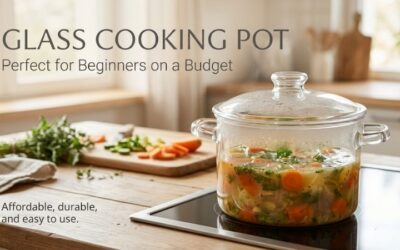
Glass provides visibility but is more vulnerable to breakage.
Stainless steel lids are generally less fragile and can be easier to store.
Choose accessories that support the actual workflow rather than adding unnecessary complexity.
Using a stock pot for café-style recipes at home
A stockpot can simplify large-batch beverage preparation when recipes are adapted carefully. Coffee concentrates, chai bases, flavored syrups, and hot water all involve different temperature and handling requirements. Understanding these differences helps home baristas produce repeatable results while protecting ingredient quality and food safety.
Prepare cold brew concentrate with controlled measurements
Cold brew concentrate is produced by extracting coffee in cool water over an extended period. A stockpot can hold the mixture when its material and size are suitable, but successful preparation depends on measured ingredients, appropriate refrigeration, and thorough filtration rather than the vessel alone.
Begin with a clean food-safe container.
If using a stainless steel stockpot, ensure the interior is free from residue and strong odors left by previous recipes.
Measure coffee and water by weight or volume using a consistent method.
The coffee-to-water ratio determines the initial concentration.
For example, a ratio near 1:5 by weight can provide a starting point for concentrate, although recipes vary.
Combine the ingredients and stir sufficiently to wet the grounds.
Cover the mixture appropriately and refrigerate according to the chosen recipe.
Cold brew is often steeped for roughly 12–18 hours, but the suitable duration depends on grind size, temperature, and desired flavor.
After extraction, filter the grounds using a suitable strainer and finer filtration when needed.
Transfer the coffee to clean food-safe storage containers.
Keep the finished beverage refrigerated and follow appropriate storage guidance.
A stockpot is useful when producing large volumes, but a dedicated sealed container may be easier to manage for smaller batches.
Make flavored coffee syrups without scorching sugar
Flavored syrups are commonly used in lattes, iced coffee, and other café-style drinks. A stockpot can support larger batches, especially when preparing syrup for gatherings. However, sugar solutions become extremely hot and require careful temperature management to avoid scorching or unsafe handling.
A basic syrup commonly combines sugar and water in a measured ratio.
The mixture is heated until the sugar dissolves.
Flavoring ingredients such as vanilla, cinnamon, or citrus may be added according to the recipe.
The cooking temperature should reflect the intended syrup rather than automatically reaching caramelization temperatures.
For ordinary drink syrup, excessive heating is often unnecessary.
Use moderate heat and stir appropriately.
A heavy base can reduce localized overheating.
However, even a premium stockpot will not prevent sugar from burning if the heat is excessive.
Leave enough space for bubbling.
Avoid leaning over the pot while adding ingredients to hot syrup.
Once prepared, allow the mixture to cool under suitable food-safe conditions before transferring it to storage bottles.
Homemade syrups do not automatically have the same shelf life as commercial products.
Refrigeration and storage duration depend on the ingredients, concentration, sanitation, and recipe.
Follow reliable food-safety guidance rather than assuming that high sugar content makes every syrup shelf-stable.
Simmer chai concentrate and spiced beverage bases
Chai concentrate is a useful preparation for home baristas who want to serve spiced tea lattes without repeating the entire brewing process for every drink. A stockpot can accommodate larger quantities of water, spices, and tea while providing space for stirring and controlled simmering.
Begin by preparing the spices according to the chosen recipe.
Whole spices may require crushing or other preparation to improve flavor extraction.
Water and spices can be heated together at a gentle simmer.
The timing depends on the ingredients and desired intensity.
Tea is often added during a later stage to avoid excessive extraction, although recipes vary.
A stockpot provides enough room to stir and strain the mixture safely.
However, making a larger batch does not necessarily require multiplying every cooking time.
Evaporation depends on the pot’s width, lid position, and burner output.
Monitor the liquid level rather than relying entirely on a timer.
Once the concentrate is finished, strain it through an appropriate filter.
If the recipe includes milk or another perishable ingredient, follow safe cooling and refrigeration practices.
For flexibility, some home baristas prefer preparing a water-based concentrate and adding milk separately when serving.
This can simplify portioning and allow different milk preferences.
Heat water for beverage preparation without wasting energy
A stockpot can heat substantial quantities of water when serving several guests, but it lacks the pouring precision and temperature programming of a specialty kettle. Home baristas should decide whether large-volume heating provides a practical advantage or simply creates extra work.
For a gathering, heating several liters of water in one suitable stockpot may be convenient.
The water can then be transferred carefully into approved serving equipment.
However, the pot should not be lifted casually while completely full.
Hot water is heavy, and uncontrolled pouring can cause serious burns.
Use a stable burner and avoid exceeding the safe fill level.
A lid can reduce heat loss while water approaches boiling.
For delicate tea or pour-over coffee, temperature must still be controlled.
A food-safe thermometer can help determine when the water reaches the desired range.
However, a conventional stockpot does not provide precise slow pouring.
A separate gooseneck kettle or suitable pouring vessel may still be necessary.
Heating more water than needed also wastes energy.
For one or two drinks, a smaller kettle is generally more convenient.
The stockpot becomes worthwhile when batch size clearly exceeds the capacity of ordinary brewing equipment.
Cleaning, food safety, and long-term maintenance
Batch beverage preparation places particular demands on cleaning because sugar, coffee oils, spices, and dairy ingredients can leave persistent residue. A suitable stockpot should be easy to inspect and clean thoroughly. Food-safe cooling and storage are equally important, especially when preparing drinks intended for later consumption.
Remove coffee oils and syrup residue effectively
Coffee oils, sugar residue, and aromatic spices can accumulate on cookware surfaces after repeated preparation. Stainless steel is relatively straightforward to clean, but a large stockpot still requires access to the bottom, corners, and handle attachment areas. A regular cleaning routine helps prevent lingering flavors between batches.
After use, allow the pot to cool sufficiently for safe handling.
Remove remaining ingredients and rinse with warm water.
Use mild dish soap and a suitable sponge to clean ordinary residue.
Sugar deposits may dissolve through soaking or gentle reheating with water when performed safely.
Avoid applying cold water directly to an extremely hot empty pot.
Coffee oils may require more thorough washing because they can leave a thin film.
Inspect the lower sidewalls and areas near rivets for trapped residue.
Do not assume a visually clean surface is necessarily free from all food contamination.
Rinse thoroughly and allow the pot to dry completely.
If the stockpot is dishwasher-safe, verify that it fits securely without interfering with the machine’s operation.
Handwashing may still be more practical for large vessels.
A clean pot helps prevent unwanted flavor transfer between coffee, tea, and syrup preparations.
Follow safe cooling and refrigeration practices
Large batches of beverages can take longer to cool than small servings. This matters particularly when a recipe includes milk, cream, or other perishable ingredients. Proper cooling and storage reduce food-safety risks and help maintain the quality of prepared concentrates.
Do not assume that a full stockpot of hot liquid can be placed directly into a crowded refrigerator without affecting surrounding food.
Large volumes may cool slowly.
For perishable preparations, divide the mixture into smaller, shallow food-safe containers to support faster cooling.
Follow established food-safety guidance for time and temperature.
Refrigerators should generally be maintained at 40°F or below.
Perishable foods should not remain at room temperature for extended periods.
A common food-safety rule is to refrigerate perishable ingredients within two hours, with a shorter limit under very hot conditions.
For coffee concentrates without dairy, refrigeration is still a prudent approach when storing the beverage for later use.
Use clean containers with secure lids.
Label prepared batches with their production date when helpful.
Do not assume a homemade syrup or concentrate has an indefinite shelf life.
Ingredients, acidity, sugar concentration, sanitation, and storage conditions all affect stability.
When uncertain about a stored preparation’s safety, discard it rather than relying solely on smell or appearance.
Avoid using stockpots for unsuitable coffee techniques
A stockpot is versatile, but it cannot replace equipment designed for controlled coffee extraction. Attempting to use it for espresso or other specialized brewing methods can produce disappointing results and unnecessary safety risks. Understanding its limitations helps home baristas build a more effective preparation setup.
Espresso requires equipment capable of delivering water through finely ground coffee under controlled pressure.
A stockpot cannot provide that extraction method.
Pour-over brewing requires a suitable filter, coffee bed, and controlled water delivery.
A stockpot’s broad rim generally makes accurate pouring difficult.
French press coffee requires a compatible vessel and filtering plunger.
A stockpot can hold brewed coffee, but it does not provide the same filtration mechanism.
For cold brew, it can serve as a mixing container when the preparation is properly refrigerated and filtered.
For flavored syrups and chai bases, it is more directly useful as a heating vessel.
Avoid using the pot to boil removable components from coffee equipment unless the manufacturer specifically permits that cleaning method.
Plastic, rubber, electronic, and pressure-containing parts may be damaged by boiling water.
A stockpot should support the preparation workflow rather than replace specialized appliances in ways they were not designed to handle.
Decide whether a premium stockpot is worth buying
Premium stockpots offer fully clad construction, refined handles, and durable finishing. These features may be worthwhile for frequent batch cooking, but home baristas who mainly heat water or prepare simple syrups may not need expensive cookware. The best purchase should reflect recipe frequency and normal batch volume.
A basic stainless steel stockpot with an encapsulated aluminum base can be sufficient for heating water and preparing ordinary liquid-based concentrates.
For frequent thick syrup preparation, fully clad construction may provide more useful temperature control.
However, even a premium pot requires attentive stirring.
Consider how often the cookware will be used.
Someone preparing one batch of flavored syrup each month may not benefit substantially from a high-end eight-quart model.
A home barista regularly serving drinks to groups may appreciate a larger, well-constructed vessel.
Storage space is another consideration.
Large cookware occupies considerable cabinet room and can be inconvenient to wash.
The pot should also fit the available burner.
A high-quality stockpot used over an undersized heating surface may not deliver the expected performance.
Choose a model that supports actual recipes without unnecessary capacity or expense.
The best long-term value comes from cookware that remains useful across beverage preparation and ordinary household cooking.
Conclusion
The best stock pot for home baristas is a nonreactive, easy-to-clean vessel sized for real batch-preparation needs. A four- or six-quart stainless steel pot suits many households preparing coffee concentrates, chai bases, and flavored syrups, while larger sizes are useful for frequent gatherings. Prioritize stable handles, suitable burner compatibility, and controlled heating. Use dedicated coffee equipment for espresso and precision brewing, and follow appropriate sanitation, cooling, and refrigeration practices for every prepared batch.



Write Your Review
No reviews yet. Be the first to share your experience!