
A wok pan for small kitchens should deliver enough room for stir-frying while fitting a compact burner, narrow cabinet, or crowded sink. Flat-bottom designs, moderate diameter, and practical handles often matter more than maximum capacity. This guide explains what to buy, how to manage heat, and how to store and maintain a wok efficiently.
What makes a wok suitable for small kitchens?
A wok occupies more space than its flat cooking surface suggests because the sides flare outward and handles can extend beyond the rim. In a compact kitchen, the best design must balance usable cooking capacity with safe burner clearance, comfortable movement, and straightforward storage. Measuring the complete cookware footprint is essential.
Choose a manageable diameter for everyday meals
Wok diameter affects both capacity and storage requirements, but a larger model is not always more practical. Small households often benefit from a moderately sized wok that heats efficiently on the available burner and fits comfortably inside cabinets. The ideal diameter depends on portion size and normal cooking habits.
An 11- or 12-inch wok can be a sensible starting point for one or two people.
It offers enough room for modest stir-fries, vegetables, fried rice, and simple noodle dishes without occupying the same space as a large restaurant-style wok.
A 13- or 14-inch model provides greater capacity for family meals.
However, its broad rim can interfere with neighboring burners and appliances.
The flat cooking area is usually much smaller than the overall diameter.
For example, a 13.5-inch wok may have a flat base measuring only a few inches across.
This is normal because the sloped walls are intended to accommodate ingredients during stirring and tossing.
A larger rim does not mean every ingredient should be placed in the hottest area simultaneously.
For small kitchens, a 12-inch wok often provides a useful compromise between cooking capacity and handling comfort.
However, buyers should examine the total length including handles.
A nominally small wok may still require considerable storage space if it has an extended handle.
Consider the largest meal prepared regularly rather than selecting a size for occasional gatherings.
Cooking in batches can make a smaller wok effective for larger meals when necessary.
Prioritize flat-bottom stability on household burners
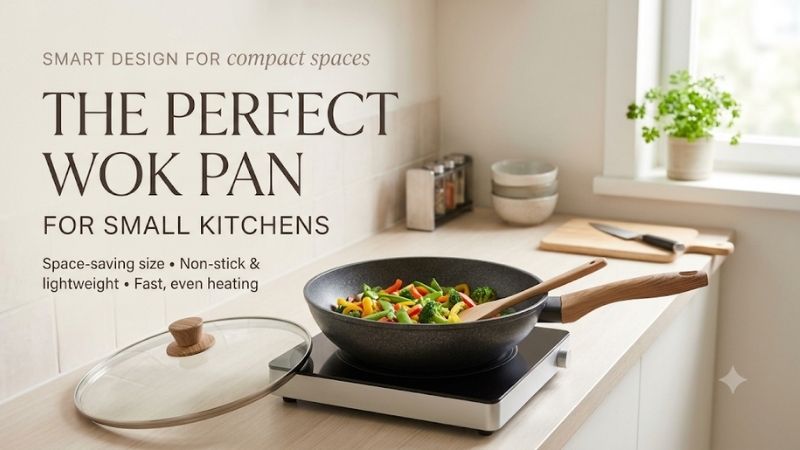
Flat-bottom woks are generally more convenient in small kitchens because they can rest directly on compatible household stoves. Traditional round-bottom models require suitable support and may not work efficiently on conventional electric or induction cooktops. Stability and heat-source compatibility should therefore be considered before cooking performance claims.
A flat-bottom carbon steel wok is suitable for many gas and electric burners.
When the base includes appropriate magnetic material, it can also work with induction cooking systems.
However, the exact model should be checked for compatibility.
A round-bottom wok can perform well on a dedicated gas wok burner or approved support system.
Its curved geometry allows ingredients to move smoothly toward the hottest central area.
Nevertheless, a conventional household stove may not support it safely.
Using an improvised wok ring or unstable support can create serious hazards.
Induction cooktops generally require sufficient contact with an appropriate magnetic base unless designed for rounded cookware.
For a small apartment kitchen, a flat-bottom wok is usually the more flexible purchase.
It can remain stable during stirring without requiring additional equipment.
The base should also match the burner diameter reasonably well.
An extremely small burner beneath a large wok may create uneven heating.
A compact flat-bottom model often provides better practical performance than a much larger round-bottom wok on an unsuitable stove.
Evaluate handle length and overall storage footprint
The handle can make a wok difficult to store even when the cooking vessel itself fits inside a cabinet. Long handles support traditional tossing but increase overall length, while loop-handle designs reduce protrusion at the expense of lifting convenience. Buyers should match the handle arrangement to their kitchen layout and cooking style.
Traditional woks often have one long handle and a smaller helper handle.
This arrangement allows the cook to lift, tilt, and toss the vessel while supporting the opposite side when necessary.
However, the long handle may extend well beyond a compact stovetop.
In a narrow kitchen, this can create a collision risk when people walk past.
A double-loop-handle wok occupies less length but requires different handling.
It is generally better suited to stationary cooking with a spatula.
The Lodge 14-inch cast iron wok is an example of a double-handle design, although its weight makes it less convenient for frequent lifting.
Compact carbon steel woks with shorter handles can offer a useful compromise.
However, buyers should inspect whether the handles become hot during operation.
Wooden handles may remain comfortable in certain stovetop conditions but introduce oven and flame restrictions.
Metal handles provide durability but require appropriate protection when hot.
Before purchasing, measure the complete distance from the handle tip to the opposite rim.
This dimension often determines whether the wok can be stored safely in a narrow cabinet.
Select materials that balance weight and maintenance
Wok materials influence how quickly the pan heats, how easily it moves, and how much cleaning it requires. Carbon steel is a traditional choice, while cast iron and coated aluminum offer different advantages. Small kitchens benefit from cookware that is easy to lift and maintain without requiring excessive storage accessories.
Carbon steel is relatively lightweight compared with substantial cast iron.
It can respond quickly to burner adjustments and gradually develop a seasoned surface.
This makes it suitable for frequent stir-frying.
However, the surface requires prompt drying and occasional oiling.
Cast iron provides substantial heat retention but can be difficult to lift.
A heavy wok also requires more careful storage because cabinet shelves must support the load.
Nonstick aluminum woks are often lightweight and convenient to clean.
However, conventional coatings have temperature limitations that make them less suitable for some traditional high-heat techniques.
Stainless steel offers durability and avoids seasoning maintenance.
Nevertheless, ingredients may adhere more readily during certain stir-fries.
No material is universally superior.
For someone cooking vegetables and fried rice several times per week, carbon steel often provides an attractive combination of responsiveness and durability.
For occasional low-temperature cooking, a coated wok may be more convenient.
Choose according to the meals prepared most frequently and the maintenance routine the cook is willing to follow.
How to choose a wok pan for small kitchens by design
Compact cooking requires attention to geometry, not just the advertised diameter. A wok with steep walls can hold substantial ingredients while occupying a moderate burner area. However, its shape influences tossing, heat distribution, and storage. Buyers should examine the relationship between base width, sidewall height, and handle design.
Compare steep-sided and shallow wok designs
Woks vary in how sharply their walls rise from the base. Traditional bowl-shaped designs provide room for moving ingredients, while shallower stir-fry pans resemble deep frying pans. Each shape can be useful, but the best choice depends on how the cook prepares food and how much storage space is available.
A steep-sided wok concentrates direct heat near its base.
The surrounding walls provide room for moving ingredients away from the hottest area.
This is useful for traditional stir-frying, where meat, vegetables, and aromatics may be cooked in stages.
However, steep walls increase overall height.
A deep wok can be difficult to store in a shallow cabinet or compact drawer.
A shallower stir-fry pan may fit more easily beside ordinary frying pans.
Its broader flat base can also provide additional contact with a conventional household burner.
This can be useful for searing several portions of meat.
However, shallow walls provide less room for vigorous tossing.
Ingredients may spill more easily when the pan is crowded.
For small kitchens, a moderately deep flat-bottom wok often provides a useful compromise.
It should accommodate ordinary stir-fries without requiring the storage space of a large traditional wok.
Consider whether the wok will also be used for steaming or shallow simmering.
A deeper vessel may provide greater versatility for these tasks.
Choose a shape that supports the actual cooking technique rather than an idealized professional kitchen setup.
Understand cooking-surface diameter and burner coverage
The flat base determines how much of the wok contacts the cooking surface directly. A large rim can create the appearance of substantial capacity, but a relatively small base may limit how many ingredients can sear at once. Understanding this geometry helps buyers select cookware appropriate to their stove.
A traditional wok concentrates heat near the bottom.
This allows ingredients to cook rapidly in the central area before being moved toward the sides.
However, ordinary household burners may not generate the same intense heat as specialized commercial wok equipment.
A flat-bottom wok with a sufficiently broad base can provide better contact with a conventional burner.
This may improve browning when preparing proteins in smaller batches.
However, an excessively broad base can change the cooking experience.
It may make the pan behave more like a deep skillet than a traditional wok.
For induction cooking, a stable magnetic base is essential.
The induction zone must also recognize the cookware.
Check the minimum and recommended pan dimensions specified by the cooktop manufacturer.
For compact electric burners, avoid selecting a wok whose base extends far beyond the effective heating area.
Uneven heating can make cooking frustrating.
The ideal wok should provide enough base contact for searing while retaining sloped walls for moving food.
Consider whether a wok lid is necessary
A wok lid expands cooking options by supporting steaming, covered simmering, and certain braised dishes. However, it also occupies storage space and may be unnecessary for people who mainly prepare quick stir-fries. Small-kitchen buyers should determine whether a matching lid will be used often enough to justify its footprint.
Traditional stir-frying usually takes place uncovered.
High heat and rapid ingredient movement encourage evaporation and browning.
A lid becomes useful when steaming vegetables, cooking dumplings, or preparing recipes that require retained moisture.
A domed lid can accommodate more food than a flat cover.
However, it also requires greater cabinet height.
Glass lids allow visual monitoring but can break if dropped.
Stainless steel lids are often more resistant to accidental impacts.
Wooden lids may suit traditional preparation but require appropriate cleaning and storage.
Before purchasing, check whether the selected wok has a compatible lid.
Not every lid advertised for a particular nominal diameter fits every brand.
The outer rim profile can vary.
If the kitchen already has a suitable lid, additional equipment may be unnecessary.
A compact wok without a lid can still prepare a wide range of stir-fried meals.
The best choice is the simplest arrangement that supports the intended recipes.
Choose storage-friendly handles and accessories
Wok accessories can improve cooking but also create clutter. Long spatulas, ladles, strainers, and large lids may occupy more space than the wok itself. Buyers with limited kitchens should prioritize a small collection of versatile tools rather than purchasing every accessory advertised in a complete set.
A heat-resistant spatula is one of the most useful accessories.
Its shape should allow ingredients to be moved along the curved cooking surface.
Traditional metal wok spatulas can work with uncoated carbon steel when used appropriately.
However, coated nonstick surfaces usually require gentler utensils.
A long-handled ladle is useful for sauces and liquid-based recipes, but it is not essential for ordinary stir-frying.
A lid may be worthwhile when steaming is common.
A dedicated wok ring is usually unnecessary for flat-bottom cookware and should only be used with a compatible stove.
Storage becomes easier when accessories can be hung on hooks or placed in a compact utensil container.
Avoid purchasing large sets that duplicate tools already available in the kitchen.
A simple wok, suitable spatula, and optional lid can support many recipes.
The goal is to create an efficient cooking setup rather than accumulate specialized equipment.
Cooking efficiently with a compact wok
A smaller wok can produce excellent stir-fries when the cook manages heat, moisture, and ingredient quantity. Limited cooking area makes preparation especially important. Cutting ingredients consistently and cooking in stages often produces better results than attempting to cook a large meal in one crowded batch.
Prepare ingredients before heating the wok
Stir-frying moves quickly, particularly when the wok is appropriately preheated. Searching for ingredients while the pan is hot can cause food to overcook or oil to smoke unnecessarily. Preparing everything before cooking creates a safer and more predictable routine in a compact kitchen.
Begin by washing and cutting vegetables.
Try to keep pieces reasonably similar in size so they cook at comparable rates.
Prepare proteins according to the recipe.
Thinly sliced beef, chicken, tofu, and shrimp often cook more quickly than large pieces.
Place sauces and seasonings within easy reach.
If using garlic, ginger, or other aromatics, measure them before heating the wok.
This prevents the need to leave the cooking area during a high-temperature stage.
In a small kitchen, arrange ingredients on a single tray or cutting board when practical.
Avoid filling the entire counter with multiple large bowls.
Keep raw meat separate from ready-to-eat ingredients to prevent cross-contamination.
Use clean utensils and follow appropriate food-safety practices.
Once everything is ready, preheat the wok according to its material and manufacturer instructions.
Add ingredients in the planned sequence.
This preparation reduces unnecessary movement and helps the cook maintain control over the burner.
A well-organized workstation can make a compact kitchen feel considerably more functional.
Cook proteins and vegetables in separate batches
One of the most common wok mistakes is adding too much food at once. Cold ingredients reduce the temperature of the cooking surface, while vegetables release moisture. In a small wok, these effects are amplified because the hot central area is limited. Batch cooking can improve texture and browning.
Begin with the protein when the recipe requires searing.
Pat meat dry before adding it to the wok.
Use an appropriate quantity of oil and avoid overcrowding.
Allow the surface to brown before turning or stirring excessively.
Remove the cooked protein temporarily if necessary.
Next, cook vegetables according to their density.
Carrots and broccoli may require more time than leafy greens.
Adding every ingredient simultaneously can produce uneven results.
The vegetables may release moisture and begin steaming.
Cooking in stages allows the wok to recover heat between additions.
Once the ingredients are appropriately cooked, return them to the vessel.
Add the sauce and toss briefly to combine.
Avoid continuing to cook everything for an extended period after the sauce thickens.
This can make vegetables excessively soft.
A 12-inch wok can prepare several servings effectively when the process is organized.
The key is using the limited hot surface strategically rather than filling the entire vessel from the beginning.
Use a compact wok for meals beyond stir-frying
A wok can support several cooking techniques when its material and shape are appropriate. Besides stir-frying, it may be useful for shallow frying, steaming, simmering, and preparing certain noodle dishes. This versatility can reduce the number of separate pans required in a small kitchen.
For fried rice, the wok’s sloped walls allow rice and vegetables to be moved rapidly.
However, the rice should not be excessively wet.
High moisture can encourage clumping and reduce browning.
For shallow frying, the wok’s curved shape may accommodate a modest quantity of oil.
However, the cooking method requires careful temperature control and should never exceed safe oil levels.
Deep frying introduces additional safety concerns and may not be suitable for a small or unstable cooking setup.
For steaming, a compatible rack and lid may allow dumplings or vegetables to cook above simmering water.
The arrangement must remain stable and provide adequate clearance.
A wok can also prepare certain noodle dishes containing sauce and vegetables.
However, long acidic simmering may damage carbon steel seasoning.
A stainless steel saucepan is usually more convenient for extended tomato-based cooking.
The goal is to use the wok for tasks that benefit from its shape rather than forcing it to replace every cooking vessel.
A versatile compact wok can reduce kitchen clutter when selected thoughtfully.
Manage smoke, ventilation, and heat safely
High-temperature stir-frying can produce smoke and cooking fumes, particularly when oil or ingredients become overheated. Small kitchens may have limited ventilation, making careful temperature management especially important. The goal is controlled browning rather than generating maximum heat regardless of conditions.
Use an appropriately functioning range hood or other suitable ventilation system.
Keep combustible materials away from the burner.
Avoid placing paper towels, packaging, or plastic utensils close to the hot wok.
Select a cooking oil appropriate for the recipe and temperature.
Do not allow oil to smoke heavily for extended periods.
A carbon steel wok may tolerate high cooking temperatures, but the surrounding kitchen equipment may have different limits.
Wooden handles, coated surfaces, and nearby appliances require particular attention.
Never leave the wok unattended while heating oil.
If the pan becomes excessively hot, reduce or stop the heat according to safe operating practices.
Avoid pouring water onto burning oil.
Keep an appropriate kitchen fire extinguisher available and understand how to use it.
For many home stir-fries, moderate-to-high heat used with small batches provides excellent results without creating excessive smoke.
Good temperature control is more important than attempting to reproduce commercial burner conditions.
Storage, cleaning, and long-term ownership
A wok is only practical in a small kitchen when it can be cleaned and stored without unnecessary difficulty. Carbon steel requires attention to moisture, while coated cookware needs protection from scratches. Simple storage and maintenance habits preserve cooking performance and reduce the possibility of premature replacement.
Store the wok vertically or hang it securely
A wok’s broad rim can make cabinet storage awkward, especially when several other pans occupy the same shelf. Vertical organizers and wall-mounted hooks may provide alternatives, but the storage arrangement must be secure and appropriate for the cookware’s weight.
A carbon steel wok is often light enough to hang from a properly installed hook.
However, the hook and mounting surface must support the full weight.
Do not assume ordinary adhesive hooks are suitable.
Check the load rating and installation requirements.
A vertical cabinet organizer can also separate the wok from other cookware.
This may reduce scratching and make the pan easier to retrieve.
However, the organizer must accommodate the wok’s curved shape.
A broad rim may not fit narrow pan slots.
If the wok has a long handle, measure the total length before selecting a storage location.
Hanging the wok by its handle can save shelf space, but the pan should not obstruct walkways or cabinet doors.
For heavy cast iron woks, lower shelves are generally safer than elevated hanging arrangements.
Avoid placing heavy cookware where it could fall onto a person or appliance.
The best storage method balances accessibility, stability, and protection of the cooking surface.
Clean carbon steel without stripping useful seasoning
Carbon steel develops a protective seasoning layer through repeated cooking. Cleaning should remove food residue while preserving that layer whenever possible. The process is straightforward, but moisture must not remain on exposed metal for prolonged periods.
Allow the wok to cool enough for safe handling.
Rinse with warm water and use a suitable brush or sponge to remove ordinary residue.
A small amount of mild dish soap is generally compatible with established seasoning.
However, follow the manufacturer’s guidance for the particular wok.
Avoid leaving the pan soaking.
Prolonged moisture exposure can encourage rust, especially in areas where seasoning is thin.
After washing, dry the wok thoroughly.
Brief warming over low heat may help evaporate remaining water when performed carefully.
If recommended, apply a very thin layer of oil.
Wipe away excess oil to prevent sticky buildup.
The surface may develop patchy colors during seasoning.
This is normal and does not automatically indicate damage.
If rust appears, follow an appropriate cleaning and reseasoning procedure.
Do not place traditional carbon steel cookware in the dishwasher unless the manufacturer explicitly permits it.
Consistent maintenance helps the wok remain useful for many years.
Protect nonstick coatings and avoid unnecessary replacement
Coated woks are convenient, but their surfaces can deteriorate through excessive heat, abrasive cleaning, and contact with sharp utensils. A gentle routine can extend their useful life. Buyers should also recognize when a coated pan no longer provides the performance or safety expected from the product.
Use low or medium heat when recommended by the manufacturer.
Do not assume that every nonstick wok is suitable for traditional high-temperature stir-frying.
Avoid heating a coated pan empty over high heat for extended periods.
Use silicone, wooden, or other approved utensils.
Metal spatulas may scratch conventional nonstick surfaces.
Allow the wok to cool before washing.
Use mild dish soap and a nonabrasive sponge.
Even when dishwasher cleaning is permitted, handwashing may help preserve the coating.
Avoid stacking heavy cookware directly against the interior.
A suitable pan protector can reduce contact damage.
Inspect the coating periodically.
Extensive peeling, flaking, or significant deterioration may indicate that replacement is appropriate.
Conventional nonstick cookware generally has a shorter service life than well-maintained uncoated carbon steel.
For frequent high-temperature cooking, traditional carbon steel may provide better long-term value.
For occasional gentle cooking, a coated wok can remain a practical choice.
Avoid buying a wok that is too large for your kitchen
A large wok may appear more versatile, but excessive diameter can create problems on compact burners and inside narrow cabinets. A smaller model used correctly may produce better results while occupying less space. Buyers should evaluate practical cooking requirements rather than assuming maximum capacity is always desirable.
Consider the normal number of servings.
A person preparing one or two portions may find an 11- or 12-inch wok sufficient.
A family of four may benefit from a 13- or 14-inch model.
However, the larger pan must fit the stove.
A broad wok placed over an undersized burner may heat unevenly.
This makes browning difficult when too many ingredients are added.
A large wok also occupies more space in the sink.
Cleaning can become inconvenient if it does not fit beneath the faucet.
Storage may require rearranging other cookware.
A smaller wok reduces these problems but may require batch cooking for larger meals.
That compromise can be reasonable when large meals are infrequent.
Before purchasing, compare overall diameter, handle length, weight, and base size.
Choose a model that fits the kitchen comfortably while supporting normal recipes.
The most useful wok is the one that remains convenient enough to use several times per week.
Conclusion
The best wok pan for small kitchens balances a manageable diameter, stable flat base, comfortable handles, and easy storage. An 11- or 12-inch flat-bottom carbon steel wok is a practical starting point for individuals and couples, while larger models suit households with adequate burner and cabinet space. Prioritize stove compatibility, safe handling, and proper heat control over maximum size. With simple batch-cooking techniques and consistent maintenance, a compact wok can become one of the most versatile tools in a small kitchen.



Write Your Review
No reviews yet. Be the first to share your experience!