
A grill pan can produce browned ridges on chicken, steaks, vegetables, and sandwiches when an outdoor grill is unavailable. It cannot reproduce live-fire smoke, however, and raised ridges change how food contacts heat. This comparison weighs six real options against food release, heat retention, cleaning effort, and everyday practicality.
Best grill pan choices for indoor cooking
An indoor grill pan should provide reliable heating, sufficient cooking space, and ridges that support attractive browning without making cleaning unnecessarily difficult. Cast iron is particularly effective at retaining heat, but enameled and coated alternatives offer different advantages. These first three models suit cooks who prioritize durable construction and conventional stovetop searing.
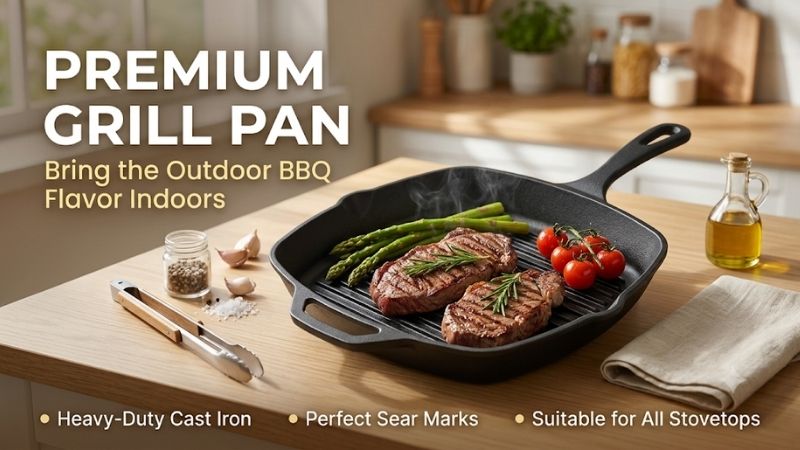
Lodge Chef Collection Square Grill Pan – Best overall value
The Lodge Chef Collection Square Grill Pan is a practical choice for home cooks who want durable cast iron construction without premium pricing. Its raised cooking ridges, compact dual-handle design, and pre-seasoned surface make it suitable for chicken breasts, burgers, vegetables, and other foods that benefit from concentrated contact browning.
The pan uses seasoned cast iron, a material valued for its durability and ability to retain heat.
Once sufficiently preheated, cast iron provides a stable cooking surface that can produce pronounced browned marks where food contacts the raised ridges.
The Chef Collection model features an approximately 11-inch square design, with a cooking surface sized for modest portions.
Its low-profile dual handles distinguish it from traditional long-handled grill pans.
This arrangement reduces overall length and can simplify storage, although both handles become hot during cooking.
The pan weighs approximately 7 pounds, making it substantial but more manageable than some larger cast iron alternatives.
Lodge specifies compatibility with conventional stovetops, induction, ovens, grills, and campfires.
The factory-seasoned surface also eliminates the need for a full initial seasoning process, although ongoing maintenance remains necessary.
One limitation is cleaning.
Food residue and cooking fat can accumulate between the raised ridges, requiring more attention than a smooth skillet.
The pan is most attractive when durability, useful searing marks, and accessible pricing matter more than effortless cleanup.
Advantages: Durable cast iron construction, strong heat retention, induction compatibility, and compact handles.
Limitations: Heavy relative to aluminum cookware, requires seasoning care, and takes more effort to clean.
Best for: Home cooks seeking an affordable cast iron pan for indoor grilling.
Le Creuset Signature Square Skillet Grill – Best premium enameled option
The Le Creuset Signature Square Skillet Grill combines premium enameled cast iron with a ridged cooking surface designed for indoor searing. Its black satin enamel interior eliminates traditional cast iron seasoning requirements, while its cast iron body retains heat effectively for foods such as steaks, chicken, shrimp, and vegetables.
The pan has an approximately 10.25-inch square cooking surface.
Its elevated ridges create distinct contact points that can develop pronounced grill marks when food is cooked at an appropriate temperature.
Between those ridges, some cooking fat and released juices collect below the food.
However, this should not be confused with an outdoor grill, where excess fat can drip away from the cooking area entirely.
Le Creuset’s black satin enamel is designed for searing and does not require the same oil-seasoning routine as bare cast iron.
The surface may develop a patina with repeated cooking.
The pan is compatible with gas, electric, ceramic, and induction cooktops.
Its manufacturer-listed oven limit reaches 500°F, supporting stovetop-to-oven recipes when handled properly.
The cast iron construction helps retain heat, although the pan still requires appropriate preheating.
The principal disadvantage is its premium price.
A less expensive seasoned cast iron pan can create similar contact browning, so the additional investment is best justified by enamel convenience, design, and brand-specific construction.
Advantages: Enameled cast iron surface, induction compatibility, durable construction, and oven versatility.
Limitations: Premium pricing, substantial weight, and cleaning required between ridges.
Best for: Home cooks who want premium cast iron performance without traditional seasoning maintenance.
Staub Enameled Cast Iron Square Grill Pan – Best for substantial searing
The Staub Enameled Cast Iron Square Grill Pan is designed for cooks who value steady heat retention and a durable enameled cooking surface. Its raised ridges, substantial cast iron body, and dark interior make it suitable for preparing meat, poultry, and vegetables when a conventional outdoor grill is unavailable.
Staub’s dark matte enamel differs from ordinary bare cast iron seasoning.
It provides a protective finish that does not require repeated oil-seasoning procedures.
The pan’s substantial weight helps maintain heat during cooking, although performance still depends on the burner and ingredient quantity.
For example, when preparing pork chops, the pan can be preheated appropriately before the meat is placed across the ridges.
The raised areas develop concentrated browning where they touch the surface.
However, the food between the ridges receives less direct conductive heating.
This means the pan should not be judged only by the darkness of its grill marks.
The internal temperature of the meat remains the more important indicator of complete cooking.
Staub offers square grill pan configurations in several sizes, including approximately 11-inch versions.
Buyers should confirm the handle arrangement and exact dimensions of the specific model.
The primary disadvantages are weight, price, and cleaning effort.
Residue can accumulate in the valleys between ridges, particularly after cooking fatty proteins or marinades containing sugar.
Advantages: Durable enamel finish, strong heat retention, induction compatibility, and substantial construction.
Limitations: Heavy weight, premium pricing, and more demanding cleaning than a smooth skillet.
Best for: Cooks who frequently prepare steaks, chops, and other substantial proteins indoors.
Other grill pan options for convenient daily meals
Cast iron is not the only material suitable for ridged indoor cooking. Hard-anodized aluminum and conventional nonstick surfaces can reduce weight and simplify food release, while alternative bare cast iron designs may offer different handle shapes or cooking areas. These models illustrate how cooking convenience and searing performance can require different compromises.
Calphalon Premier 11-Inch Square Grill Pan – Best nonstick convenience
The Calphalon Premier Hard-Anodized Nonstick 11-Inch Square Grill Pan is designed for cooks who want an easier-release surface and more manageable weight than traditional cast iron. Its hard-anodized aluminum construction and ridged nonstick interior make it convenient for chicken, vegetables, and moderate-temperature indoor cooking.
The pan uses Calphalon’s MineralShield nonstick system, which incorporates a multilayer coating.
This provides easier food release than an uncoated metal surface under appropriate cooking conditions.
Its approximately 11-inch square body offers practical space for several smaller portions.
At roughly 3.1 pounds, the pan is considerably lighter than many cast iron alternatives.
That makes it easier to lift, wash, and store.
The long handle also provides a conventional gripping position for moving the pan between cooking and serving areas.
Calphalon specifies an oven-safe limit of 450°F for this model.
However, this does not mean the coating is suitable for uncontrolled high-temperature preheating.
Nonstick cookware should be heated according to manufacturer guidance, and prolonged empty heating should be avoided.
The pan is compatible with gas, electric, and glass cooking surfaces, but this specific configuration is not presented as an induction-ready model.
A limitation is that coated surfaces eventually wear.
Even when a manufacturer permits certain metal utensils, silicone or wooden tools can reduce unnecessary abrasion.
Advantages: Lightweight construction, easy food release, convenient cleanup, and practical everyday dimensions.
Limitations: Coating-related temperature restrictions, finite nonstick lifespan, and no stated induction compatibility.
Best for: Home cooks prioritizing easy cleanup and manageable handling over intense searing.
All-Clad HA1 Hard Anodized Square Grill Pan – Best sturdy nonstick alternative
The All-Clad HA1 Hard Anodized Square Grill Pan offers a balance between substantial aluminum construction and everyday nonstick convenience. Its ridged cooking surface is designed for indoor grilling tasks, while the hard-anodized body provides a durable exterior and a different handling experience from heavy cast iron.
The HA1 collection uses hard-anodized aluminum to support even heating and structural stability.
In a grill pan, consistent heating is important because the raised ridges must reach sufficient temperature to brown ingredients.
Its nonstick interior helps reduce adhesion, making it useful for chicken breasts, vegetables, and foods that can be difficult to release from uncoated metal.
The square format provides more usable space for multiple rectangular or elongated ingredients than some smaller round pans.
For example, several asparagus spears can be arranged parallel to the ridges without excessive overlapping.
The pan’s long stainless steel handle provides control during ordinary stovetop cooking.
However, its shape and material may feel different from the thicker handles found on some cast iron cookware.
A key limitation is that nonstick surfaces should not be used in the same way as bare cast iron.
Aggressive high-temperature cooking can damage coatings or shorten their useful life.
The HA1 is therefore better suited to moderate-temperature grilling tasks than extreme searing.
Buyers should confirm the particular model’s cooktop compatibility and oven limitations because HA1 configurations can differ.
Advantages: Hard-anodized construction, nonstick convenience, practical square format, and stable handling.
Limitations: Coating maintenance, temperature restrictions, and less suitability for aggressive searing.
Best for: Home cooks seeking a sturdy nonstick alternative to heavy cast iron cookware.
Victoria Square Cast Iron Grill Pan – Best traditional cast iron alternative
The Victoria Square Cast Iron Grill Pan provides another option for cooks who want a durable seasoned surface without paying for premium enameled cookware. Its cast iron body, raised ridges, and conventional cooking design make it suitable for preparing vegetables, sandwiches, chicken, and smaller portions of meat.
Victoria specializes in cast iron cookware, including skillets and grill pans designed for conventional kitchen use.
Its seasoned cast iron surface provides a durable cooking area that can be maintained with routine cleaning, drying, and occasional oiling.
Like other ridged cast iron pans, it retains heat effectively after preheating.
This can be useful when preparing vegetables that benefit from concentrated contact browning.
For example, zucchini slices can be placed across the ridges after their surfaces have been lightly coated with oil.
The pan develops browned contact marks while moisture evaporates during cooking.
However, the ridged surface does not eliminate the risk of steaming.
Overcrowded vegetables may still release enough water to reduce browning.
The square format also requires attention to burner coverage.
An undersized burner may heat the central area more intensely than the outer corners.
Victoria offers different cast iron cookware configurations, so dimensions, handles, and product weight should be checked for the specific square grill pan being considered.
The primary advantage is the durability of bare cast iron.
Unlike conventional nonstick coatings, a damaged seasoning layer can often be restored.
Advantages: Durable seasoned cast iron, strong heat retention, restorable cooking surface, and traditional design.
Limitations: Heavy construction, routine maintenance, and difficult cleaning between raised ridges.
Best for: Cooks seeking a traditional cast iron grilling surface with long-term maintenance flexibility.
How to choose a grill pan for your kitchen
The most important buying factors are cooking material, ridge geometry, burner compatibility, and cleaning convenience. Grill marks can be visually appealing, but they are not proof of superior cooking performance. Buyers should understand what a ridged pan does differently from a conventional skillet before deciding whether it deserves cabinet space.
Cast iron versus nonstick: Which is better for indoor grilling?
Cast iron and nonstick grill pans support different cooking priorities. Cast iron retains heat and tolerates demanding searing conditions, while nonstick cookware reduces food adhesion and is generally lighter. The better option depends on whether browning performance, convenient cleaning, or everyday handling matters most.
Cast iron is particularly useful for thicker proteins and recipes that benefit from a substantial heated cooking surface.
Once properly preheated, it maintains heat relatively well.
However, cast iron is heavy and requires more effort to clean.
Bare cast iron must also be dried thoroughly and protected from rust.
Enameled cast iron removes the traditional seasoning requirement but remains heavy.
Nonstick grill pans provide easier food release.
They can be useful for vegetables, fish, and moderate-temperature chicken recipes.
However, many nonstick coatings have lower practical temperature limits than bare cast iron.
They are not ideal for intense searing methods that involve prolonged high-temperature preheating.
Buyers should also consider long-term maintenance.
Bare cast iron can often be re-seasoned, while severely damaged nonstick coatings generally require replacement.
For frequent high-temperature meat cooking, cast iron is the more versatile choice.
For gentle cooking and easy cleanup, nonstick may be more convenient.
Do raised grill ridges actually improve food quality?
Raised ridges create concentrated contact areas that develop dark grill marks while leaving spaces beneath the food. This changes how heat reaches the ingredients. The result can be visually attractive, but a ridged pan generally provides less direct contact browning than a smooth skillet.
When a steak rests on raised ridges, only part of its surface contacts the heated metal directly.
Those contact points may become deeply browned.
However, the areas between the ridges receive heat differently and may remain less browned.
A smooth skillet creates greater surface contact, which can encourage more uniform Maillard browning.
This is why a traditional cast iron or stainless steel skillet can produce a more evenly developed crust on steak.
A grill pan may still be useful when appearance and controlled fat collection are priorities.
The ridges can also create space beneath certain foods, but they do not recreate the airflow or smoke exposure of an outdoor grill.
For chicken breasts, vegetables, and sandwiches, the visual pattern can be appealing.
For maximum continuous crust development, a smooth pan is often the better tool.
Buyers should therefore choose ridged cookware for its specific cooking characteristics rather than assuming it produces universally better flavor.
How to clean ridged cookware without damaging the surface
Cleaning a ridged cooking surface requires more attention than cleaning a smooth frying pan because oil, marinades, and food particles can accumulate between raised sections. The correct approach depends on the material. Cast iron, enameled cookware, and nonstick coatings should not all be cleaned using the same methods.
For bare cast iron, allow the pan to cool before washing.
Use warm water and a suitable brush to remove food residue from the grooves.
A small amount of mild dish soap is generally safe for established seasoning.
Dry the pan completely and apply a thin layer of protective oil when necessary.
For enameled cast iron, use warm water, mild detergent, and nonabrasive cleaning tools.
Avoid scraping enamel aggressively with sharp metal utensils.
For nonstick cookware, choose soft sponges and utensils compatible with the coating.
Avoid using abrasive pads that can damage the surface.
When residue becomes difficult to remove, soaking the cooled pan briefly may be more effective than forceful scrubbing.
For cast iron, avoid prolonged soaking because exposed iron can rust.
Do not pour cold water into a very hot pan.
Sudden temperature changes can create thermal stress and may damage cookware.
Consistent cleaning after each use prevents residue from becoming increasingly difficult to remove.
How to cook better food with a grill pan
A successful indoor grilling technique depends on controlled heating, ingredient preparation, and realistic expectations about the cooking surface. High heat is not always necessary, and visible grill marks do not guarantee that food is cooked safely. These practical techniques help improve consistency while reducing smoke and sticking.
Preheat correctly and avoid excessive kitchen smoke
Preheating helps establish the cooking temperature needed for browning, but excessive heat can burn oil, produce unpleasant smoke, and damage certain cookware surfaces. The correct approach depends on whether the pan is bare cast iron, enameled cast iron, or nonstick-coated aluminum.
Begin with a clean, dry pan.
For cast iron, preheat gradually according to the manufacturer’s recommendations.
A substantial cast iron pan may require more time to reach a reasonably consistent cooking temperature.
Avoid immediately selecting the highest burner setting.
Once the pan is sufficiently heated, apply a suitable amount of oil to the food or pan as appropriate for the recipe.
Using excessive oil can create smoke and cause unwanted splattering.
For coated cookware, follow the manufacturer’s lower temperature limits.
Do not leave an empty nonstick pan heating unattended.
Turn on the range hood or provide appropriate kitchen ventilation.
If oil begins smoking excessively, reduce the heat rather than continuing to cook at the same setting.
A grill pan should develop controlled browning, not require the kitchen to fill with smoke.
Cook chicken, steak, and vegetables with consistent results
Different ingredients require different heating strategies. Thick meat must reach a safe internal temperature without burning the exterior, while vegetables need enough heat to evaporate moisture. A grill pan’s raised ridges make these distinctions important because not every part of the food receives direct contact heat.
For chicken breasts, choose pieces of similar thickness.
Pat the surface dry and apply a suitable amount of oil.
Cook over controlled heat and use a thermometer to confirm the center reaches 165°F.
For steaks, consider the desired doneness and the thickness of the cut.
A grill pan can produce visible marks, but those marks do not confirm the internal temperature.
Use a thermometer rather than relying only on appearance.
For whole cuts of beef, the USDA recommends a minimum internal temperature of 145°F followed by a three-minute rest.
For vegetables, cut pieces thick enough to remain stable across the ridges.
Zucchini, bell peppers, asparagus, and eggplant are common choices.
Avoid overcrowding because released moisture can interfere with browning.
Cook in batches when necessary.
The best results come from matching the temperature and cooking time to each ingredient rather than using one setting for everything.
When a smooth skillet is a better choice
A grill pan is not always the best cookware for a particular dish. Its ridges reduce direct contact area and complicate cleaning, which can be disadvantages for foods needing uniform browning or delicate handling. Understanding when to use a conventional skillet can improve results and prevent unnecessary equipment purchases.
For steaks where a continuous browned crust is the priority, a smooth cast iron or stainless steel skillet may perform better.
More of the meat contacts the heated cooking surface, allowing browning to develop across a larger area.
For delicate fish, a smooth nonstick or stainless steel pan may provide easier control.
For foods containing small ingredients, raised ridges can be inconvenient because pieces may settle into the valleys.
A smooth frying pan is also easier to use for pan sauces.
The cooking residues are more accessible for deglazing, and the flat surface is easier to scrape and stir.
A grill pan becomes more attractive when visible grill marks, elevated contact cooking, or indoor presentation are important.
For households with limited storage, a versatile smooth skillet may deserve priority over specialized ridged cookware.
The decision should reflect the meals prepared most frequently.
Conclusion
The best grill pan is one that matches your cooking habits rather than simply producing the darkest grill marks. Lodge Chef Collection provides strong everyday value, while Le Creuset and Staub offer premium enameled cast iron alternatives. Calphalon Premier and All-Clad HA1 prioritize easier food release, and Victoria offers another durable bare cast iron option. For frequent indoor searing, cast iron is generally the most versatile material, but buyers should also consider whether a smooth skillet would deliver better browning and simpler cleaning for their favorite dishes.




Write Your Review
No reviews yet. Be the first to share your experience!